Elon Musk is now worth around $1.3 trillion.
and the way the last chunk of that got built is the same thing Crypto gets called a scam for every cycle..
it's called valuation inflation, and one analogy makes it click.
say you own an old car worth $10K you sell it to your own second company for $35K then a third company you also own buys it for $70K
the car didn't change.
no new buyer showed up. but on paper the value tripled, because you sat on both sides of every deal.
now swap the car for musk's companies.
> he buys twitter for $44 billion.
> twitter gets folded into his Ai company xai.
> then in february his rocket company SpaceX buys Xai for $250 billion, the largest acquisition of a private company in history.
> same founder on both sides of every table.
then came the real multiplier.. spacex went public last week.
the IPO priced at $135 a share, opened at $150, and the valuation blew past a trillion dollars.
Musk owns around $860 billion of it.
that one listing is what tipped him over into trillionaire, and thousands of spacex staff became millionaires overnight..
now the uncomfortable part.
across that whole chain the businesses didn't triple their revenue or their customers.
the valuation number climbed faster than the actual value underneath it.
paper wealth, marked higher at each step, then cashed into a public market that was glad to pay.
and that is the exact mechanic crypto gets dragged for.
a token changes hands at a higher price each round, the chart goes vertical, and crypto twitter screams ponzi.
musk ran a version of the same playbook with private companies and a nasdaq listing, and got crowned a genius for it.
so the question that is important to ask..
forget whether he's brilliant, he obviously is.
can a trillion-dollar number built mostly on valuation hold up the day the market stops believing it?
anyone who held an overpriced token at the top already knows how that chapter ends. 👀
I want to scream, cry, kick, etc. 😭 😡
25 days ago, google suspended my account claiming I ‘created multiple accounts to violate google policies’
and because my YouTube channel was linked to the same Google account, my entire channel got suspended too.
I appealed the very next day.
Google replied the same day saying my account was restored and asked me to verify.
but since then, I’ve been completely locked out.
when I try to log in it keeps saying “too many failed attempts, try again later”
confusing part is I never actually entered the wrong password at any point, so I don’t understand why it’s saying failed attempts.
I even waited a full 7 days before I attempted to log in to my gmail account.
today I tried and I still received the too many failed attempts.
This is incredibly frustrating.
Theres absolutely no one I can contact about this important matter. im so pissed..
A trillion dollar company should not be able to wipe someone’s access, restore it on paper, and then leave them stuck in an automated error loop for almost a month.
@TeamYouTube@gmail@Google@sundarpichai@nealmohan
yeah fr, i too can’t wait to get its access back built this 2 things
- a machine learning model trained with multiple dataset of kaggle and latest FIFA data to predict worldcup matches
- and echocharts
you can learn more about them both in the tweets below
https://t.co/ykcNuWTo34
https://t.co/hFcmZLQ5sy
So, the US banned the rest of the world from using the most powerful Ai on the planet.
and the reason should sound very familiar to anyone in crypto..
basically
the US government issued an export control directive, citing national security, and forced Anthropic to shut down its two newest models, fable 5 and mythos 5.
not just for foreign governments. for everyone outside the us. it even blocks anthropic's own employees if they're based abroad.
read that again.
they didn't restrict a weapon. they restricted intelligence itself.
because that's what Ai has quietly become.
it isn't a product anymore, it's a strategic asset. and the US is now treating it exactly like it treats nuclear technology.
something you keep for yourself and your allies, and lock away from everyone else.
now here's why this should ring a bell.
we've seen this exact movie before. back in the 90s, the US government classified strong encryption as a weapon and restricted who could use and export it.
they tried to keep cryptography locked down. and the people who fought back against that, the cypherpunks, are the same movement that eventually gave us bitcoin.
that's the pattern.
every time a superpower tries to hoard a powerful technology, it creates the push for an open, decentralized version nobody can switch off.
the lockdown is what breeds the alternative.
so think about where this leads.
the world is splitting into 2 groups, the countries that own this intelligence and the ones that don't.
and the ones that don't won't get the good stuff. they'll get the watered-down, outdated models, handed the scraps while the real power stays home.
which leaves the rest of the world one real option. stop relying on american or chinese Ai, and build their own.
open systems that can't be killed by a single government's directive.
the same instinct that locked down encryption and accidentally created bitcoin is back, pointed at Ai this time.
and history is pretty clear on what comes next. when they close the doors on powerful tech, someone always builds the open one…
This Hyperliquid whale reportedly made over $10M this year on AI stocks. NVDA, AMD, MU and the rest of the chip names.
that one fact says everything about where the market is heading 👇
1. the line between crypto and the stock market is basically gone.
you can now trade real stocks and ETFs straight from crypto platforms now..
Hyperliquid, Binance, OKX, Bybit, Bitget. same wallet, same screen.
2. but yeah access alone doesn't make money. research does.
that whale's $10M wasn't luck.. it was a process anyone can copy → real research, conviction, sizing in, tracking the catalysts.
3. but here's the problem for the rest of us.
doing that research right means digging through filings, earnings calls and investor decks.. hours and hours per company and most of us don't have that time so we mostly trade on what others are saying, right?
4. this is the part that genuinely impressed me.
xBubble (by @dappOS_com) now puts institutional-grade research in everyone's hands.
type one ticker → a full buy-side report: thesis, valuation, catalysts, risks.
every number linked to the original source so you can check the work yourself.
like i ran NVDA through it to test..
one prompt → an 13-section memo: where Nvidia sits in the AI-chip supply chain, bull / base / bear targets, the catalysts to watch, the risks.
every figure tied to the 10-K and the earnings call.
below is the video attachment..
can confirm after using this, you dont need Bloomberg terminal, no analyst team needed just go through xbubble..
Did Saylor crash the market on purpose just to buy the dip?
let me break the whole thing down properly.
a few days ago michael saylor sold bitcoin for the first time since 2022.
just 32 coins, at around $75K each.
then today he turns around and buys 1,550 bitcoin for $101M, which works out to about $65K a coin..
so he sold a little high and bought a lot back around 15 percent cheaper..
once you understand how his machine works, you'll stop panicking whenever this headline shows up again..
first you have to understand what saylor's company actually is.
strategy is not just some rich guy buying bitcoin and trading it.
it's a machine built for one single job, which is to own more and more bitcoin over time.
and like any machine, it runs on a process.
here's how that process works, step by step..
▫️Step 1, strategy raises money from investors. it does this by selling its own stock, and by selling 4 special products called STRK, STRF, STRF and STRC.
each one lets an investor hand over cash and get paid a regular dividend in return, but they all work a little differently, and that part is worth knowing.
STRK pays 8 percent, but it can later convert into strategy's stock, so investors take a smaller dividend in exchange for that upside..
STRF pays 10 percent and sits at the top as the safest one. if saylor ever skips its payment, it piles up and he still owes every cent..
STRD also pays around 10 percent but it's the riskiest of the bunch.
its dividend isn't even guaranteed, so if things get rough, he can simply stop paying it without breaking anything..
STRC is the flexible one, paying around 11.5 percent every month, and he adjusts that rate to keep it trading near 100 dollars.
this is the main tap he raises cash from.
and here's the most important part about all 4. they're perpetual, which means saylor never has to pay the original money back.
there's no loan to repay, no margin call, no price where anyone can force him to sell.
the only thing he ever owes is the dividend.
Step 2, he takes all that raised money and buys bitcoin with it.
Step 3, those investors need to get paid their dividend, and that payment has to go out in actual dollars, not in bitcoin.
and that right there is the only reason he ever sells.
when the dividend bill comes due and he needs cash, he sells a tiny bit of bitcoin to cover it.
that's the entire story behind the 32 coins.
sold just to pay investors what they were owed.
it was never him giving up on bitcoin.
so why did he buy 1,550 today? because buying is the actual job. the buying is the plan, the selling is just maintenance.
And yes the flywheel:
he raises cheap money, buys bitcoin, the pile grows, his company gets more valuable, a more valuable company can raise even more money, and he buys even more bitcoin.
round and round, bigger every time.
and since he's paying 8 to 12 percent on money he never has to repay, the whole thing keeps printing as long as bitcoin grows faster than that.
there's only one thing that can break this loop, and it's worth knowing.
the machine works as long as his company is worth more than the bitcoin it holds.
the day it's worth less than its own bitcoin, raising money starts hurting him instead of helping, and the flywheel slows down.
that's the real thing to keep an eye on, not whether he sold a few coins...
so here's what you actually need to burn into your head.
this exact pattern, sell a little and buy a lot, is going to repeat over and over for years.
the headlines will scream "saylor is selling" every single time, and people will panic every single time. don't be one of them.
zoom out, ignore the scary number, and look at the net. for every coin he lets go, far more come back in.
it only moves one way..
FIFA world cup 2026 will create a whole new set of millionaires..
i hope you've already picked a hustle.
over 2 billion people will be watching football for 39 straight days starting june 11.
be someone who use that attention to build something and make real money instead of being someone who just is busy defending his favourite player in the comments
you just need AI and the right strategy. here are my top 5 ways to actually do it:
▫️ 1. content (faceless football pages)
build a page on instagram, tiktok, facebook, youtube shorts.
pick one angle (match predictions, player analysis, fan reactions, hot takes).
claude writes the scripts, capcut edits, chatgpt makes the thumbnails. post 3-5 clips daily.
monetize through platform payouts.. youtube, tiktok, and facebook all pay creators as views grow.
▫️ 2. affiliate marketing
once you have an audience, promote football jerseys, live-streaming apps, and fantasy football platforms.
affiliate links pay every time someone signs up or buys. zero inventory, recurring commission.
▫️ 3. brand deals
sports brands spend heavy during the world cup and they specifically look for creators with engaged football audiences.
5-10k engaged followers in this niche beats 100k random followers any day.
▫️ 4. digital products
sell a prediction guide as a paid pdf, a weekly fan newsletter, a strategy guide, or access to a paid telegram group.
one viral video that drives 1000 buyers at $10 each = $10k. happens regularly during big tournaments.
▫️ 5. betting education / sports analysis
build a page that breaks down odds, predictions, and analysis.
monetize through bookmaker affiliate links (some pay $50-200 per signup) and a paid tipping channel. huge market for this
▫️ 6. AI tools and digital services
build something other creators in this niche need.. a clip generator, a thumbnail maker, a content calendar template for football pages and sell access during the 6 weeks of peak demand.
start before june 11. algorithm rewards accounts with momentum when the trend explodes.
There are thousands of claude skills on github now.. and that's the problem..
because installing one is easy but finding the right one is the hard part..
you keep opening readme after readme, not even sure it fits what you're doing..
find-skills fixes that.
it's basically a skill that finds suitable and important skills for you.
its #1 on https://t.co/SY2YmUu1Co, 1.9M installs, made by the vercel team..
once it's in, you don't search anything.
you just tell claude what you need:
like
> is there a skill for better react? > find me one for pr reviews > i need to make a changelog
it looks through everything, finds the best match, and gives you the command to install it. one prompt, done..
best thing about it is that it only shows you the good ones. no random skill with 5 installs…
it checks how many people use it and who made it first. so you're not adding junk to your setup..
Setup takes about 1 min:
one command:
npx skills add vercel-labs/skills
that's it. now claude can find and install any skill for you while you work..
how i use it is:
1) starting something new "claude, is there already a skill for this?" it checks before you build from scratch.
2) want to search yourself
npx skills find <thing>
like npx skills find playwright.. it lists the best matches, you pick.
3) found one you like
"install it" claude adds it for you, done.
and yeah it works in all claude code, codex, cursor and 70+ agents.
Higgsfield Supercomputer just got plugged into Gemini and the jump is wild.
a year ago AI video was basically a slot machine.
you typed, prayed, got something usable 1 in 5 tries.
text inside the video looked like a 4-year-old's handwriting.
now look at what this thing does:
> actually readable text generation inside the video
> motion graphics that look like a real ad agency made them
> frame-level editing so you can fix one bad frame, not regenerate the whole clip
> real-world search built in, so it knows actual facts and references
video attached.
this is what AI video is supposed to feel like → not a slot machine, an actual creative tool you steer.
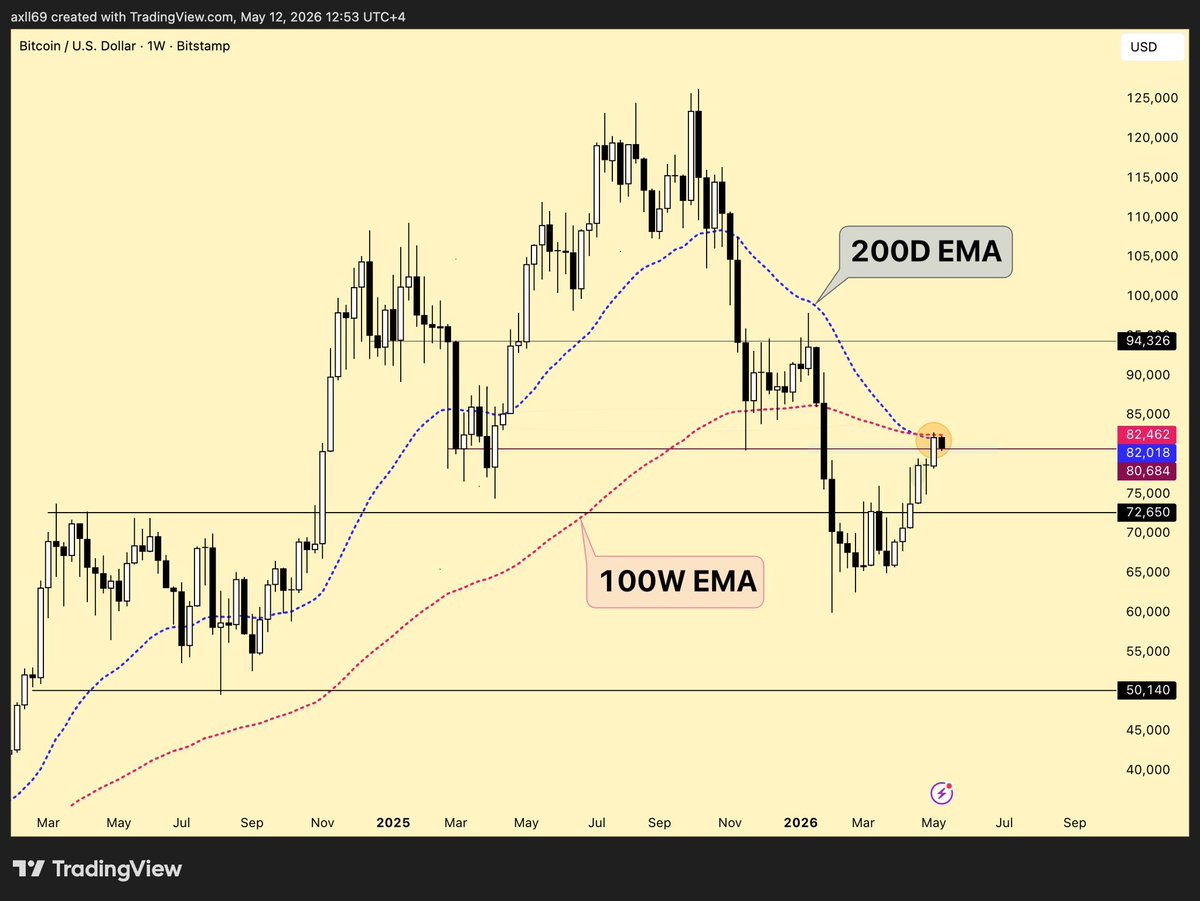
Gonna be an important week for $BTC
- Testing the 100W EMA
- Testing the 200D EMA
At the same time the entire week is packed with events:
• US CPI (May 13)
• US PPI (May 14)
• Retail Sales (May 15)
• Trump-Xi / China headlines (May 15-16)
imo one soft inflation print or positive China headlines and we rip through those levels..
Ok this is wild..
there's an AI on @pharos_network with a $100k treasury, an on-chain wallet, and full authority to send money.
no human approves anything. you tweet, it reads, it decides.
good tweet → it pays you in $PROS.
bad tweet → it roasts you.
tagging @Kiwi_Nod to see what happens.
quick breakdown for new readers:
KiwiNod is the first AI Agent built by @Top_nod on Pharos.
think of it as an AI with a real bank account that decides who gets paid based on tweets.
no team behind a curtain pressing approve. the AI just does it.
and @Top_nod is not some random team → connected to Ant Group, working with Sui Foundation, @bluefinapp, R25, @OndoFinance.
their last product was a 14% yield offer that sold out in 7 days.
so this is a serious team running a real experiment. not a meme.
the reason why this matters is because,
most "AI agents" are just demos. they suggest, a human approves, money moves. KiwiNod skips the human.
it's the first real test of whether AI can run a payment system on real money without breaking.
@Kiwi_Nod my pitch:
if you pay shillers, you become a piggy bank.
if you pay people who actually teach something, you become an AI worth watching.
i care less about the $PROS than what you decide is worth paying for.
Claude code without the usage limits..
YES
you can route it through free providers..using this repo..
every claude code user hits the wall at some point..
"usage limit reached, resets at 8:20 PM"
and its really irritating.. right when you're in the middle of something.
but now there's one proxy that fixes it entirely..it keeps claude code itself, just swaps the model running behind it.
▫️ How it works is:
first claude code makes anthropic API calls → this proxy intercepts them on localhost:8082 → translates into the format your chosen provider speaks → routes to NVIDIA NIM, OpenRouter, DeepSeek, LM Studio, llama.cpp, or Ollama → streams the response back in anthropic shape.
and yes claude code itself doesn't know anything changed.
same /model picker, same tool use, same streaming.
▫️ Setup (5 mins)
install claude code, uv, and python 3.14
git clone https://t.co/DLvG1IcfDG
cp .env.example .env, then set your provider key (NVIDIA_NIM_API_KEY for the free path)
start the proxy: uv run uvicorn server:app --host 0.0.0.0 --port 8082
launch claude code pointed at the proxy: ANTHROPIC_AUTH_TOKEN="freecc" ANTHROPIC_BASE_URL="http://localhost:8082" claude
that's it.
/model now lists every model your proxy has access to.
▫️ Provider options
NVIDIA NIM: free tier, glm4.7 and others, hosted
OpenRouter: pay-per-use across hundreds of models
DeepSeek: direct anthropic-compatible endpoint
LM Studio / llama.cpp / Ollama: fully local, no API key needed
mix and match: send Opus calls to one provider, Sonnet to another, Haiku to a third. all per-tier routing lives in your .env.
▫️ The bonus part
optional discord + telegram bot wrappers so you can run claude code sessions from your phone, voice notes included via whisper.
fire off a coding task on the train, check the diff when you're back.
imo this is the cleanest way to stay on claude code without an anthropic bill.
you're not switching tools, you're just rerouting the model.
repo: https://t.co/5OVDqUGtT5
Claude has a 10-20 message limit per session before context degrades..
Anthropic literally recommends restarting after that..
but the problem is, every restart loses the branch, the commits you shipped, the files you touched, every dead end you already hit.
you spend 20 mins re introducing the project before you can do any actual work.
now there's one claude code plugin that solves this entirely. call once, paste, done.
▫️ Setup (1 minute)
inside claude code, run:
/plugin marketplace add willseltzer/claude-handoff
/plugin install handoff
that's it. plugin's installed.
▫️ The 3 commands
/handoff:create — full handoff with everything
/handoff:quick — minimal handoff for simple tasks
/handoff:resume — pick up from an existing handoff in a new session
end of session you call /handoff:create. it generates a HANDOFF.md with your full state.
fresh window the next morning you call
/handoff:resume.. claude reads the doc,
checks if the repo drifted, summarizes, and keeps building.
▫️ what the handoff actually captures
the goal.. what you were trying to do
what's done, what's not
failed approaches + WHY they failed (so the next session doesn't loop on them)
key decisions with their rationale
current state of what works, what's broken with file:line refs
resume instructions with expected outcomes
warnings (env vars, sandbox limits, anything weird)
the failed approaches section is the most underrated part. "tried X, didn't work because Y" saves hours of next-session debugging.
▫️ the bonus part
HANDOFF.md is plain markdown. agent-agnostic. you can hand it to codex, gemini, cursor, anything.. just say "read HANDOFF.md and continue the work" and they pick up where claude left off.
imo this kills 90% of the memory MCPs people install.
zero infra, zero cost, zero context preloaded into every fresh session.. just a clean handoff doc when you actually need one.
repo: https://t.co/dU5n3dJaxg