Update: I got my account back
I can't believe it, YOU made it happen, I'm for ever grateful. Lost for words. Tears on my face.
It's still unclear what string that who pulled worked, I want to give you ALL the credit.
Here is what happened: stay safe out there.
I reckon we will see a massive exodus of ultra-smart founders...
The ones who realise that either you're in the top 0.1% of businesses that will survive the digital renaissance, or you're done.
These founders will move to the physical world, but that world plays by very different rules than the digital one.
This is why we will see an astronomical amount of innovation in physical products, and the signals are already there. I'd argue the move has been ongoing for some time.
If we just take a look at two strong signals in the med-tech space, we've got @eldsjal (Spotify founder), who is betting hard on @Neko, a completely new healthcare experience.
We also have @DavidSHolz from @midjourney, who made ripples a few months back when they unveiled Midjourney Medical, with the first thing they announced being "Ultrasonic CT" 😱
But this move from digital to physical isn't isolated to health. I just think we're seeing it so openly there because it's such a big industry on its own, and one where you could potentially mimic the dynamics of the digital realm (one or two winners take all).
Daniel is no newbie to this. Spotify is, alongside Apple Music and YouTube Music, one of the largest streaming platforms on planet Earth. A clear winner-takes-all situation.
As more and more clever founders move from bits to atoms, they will challenge physical industries with everything they learnt from scaling software, and that will lead to new products and services we can't even imagine today.
The other big move will be industrialists like @adcock_brett or @elonmusk who go all in, starting multiple companies with a lot of Venn-diagram overlap, and go hard on scale from day 0.
We will see this trend accelerate too, because being vertically integrated across industries, with similar atomic building blocks, will create the next class of centurion companies. The Rockefellers of tomorrow.
The exodus will accelerate alongside the ramp-up of digital automation, and there is nothing we can do about it except accept the change and try to hold on to something.
Writing code will be a thing of the past, just as telephone switchboard operator was once a whole class of job that no longer exists. Coding will see the same end, or at least shrink by many orders of magnitude.
We're going to leave behind a world that looks nothing like the one we inherited, and that both excites me and saddens me.
But the irony of all this is that we might be moving back into the physical world after two decades buried behind our screens.
I wonder what we'll call this time when our great-grandkids read about it in the history books.
People don't hate dictating. They hate dictating with other people around.
I've been talking to my computer for a year now, it's way faster than typing.
Then when I sit down on a train or in a café and go straight back to the keyboard, because nobody wants to hear my Slack replies.
Subvocal fixes exactly that. You mouth the words, radar in the glasses reads your speech muscles, and text shows up at 200+ wpm wherever you type. But it only picks up what you deliberately mouth, so it isn't always listening.
Third way to talk to a computer. Big if it works this well in the wild.
Excited to get my pair in Q1 2027
hello, swedish guy here 🫡
It’s utterly ridiculous that @IKEA with their insanely talented technical team has not done this themselves with Opus 5.5 or Codex in the last couple of weeks.
Swedish companies in general need to wake up and understand the AI revolution is here.
It’s time to let their workforces just go nuts, forget the old Google 80/20 rule, instead impose a mandatory 50/50 rule.
While europe (yet) don’t have massive gpu super clusters or multiple frontier labs we have the ability to productize technology like no other.
It’s time to do that on overdrive. unleash the creativity that’s hidden inside of your companies.
ps. amazing work by Hassan aka @nutlope as per usual 🙇🏻♂️
Starlink, Starshield, GPS, and the Claims About “Hacking”: A Technical Explanation
A post accusing Ukraine of “hacking” #Starlink is spreading rapidly on this platform.
The technical claims in that post are incorrect. They seem based on a collection of rumors circulating on Telegram, including information from Russian channels.
Unfortunately, this post and others like it are receiving an enormous number of likes and reposts.
That's why I believe it's important to address these claims with clear technical explanations rather than allow misleading information to spread unchecked.
This is a fairly detailed post, but I think the distinction matters.
Some of the technical information below comes from my own research and detailed analysis of Starlink terminal firmware, particularly its GPS, PNT, and velocity-processing systems.
#⃣ 1. What are Starlink and Starshield?
People still frequently confuse the two.
Starlink is SpaceX's commercial satellite internet service, designed for consumers, businesses, and other commercial users.
Starlink supports operation in motion, but the permitted speed depends on the service plan, equipment, and geographic region.
Under commonly available commercial plans, the maximum authorized operating speed is 160 km/h (100 mph).
In Ukraine, Starlink terminals are subject to a specific speed restriction: they cannot operate at speeds above approximately 75–80 km/h.
This Ukraine-specific restriction was introduced less than a year ago, in coordination with Ukrainian authorities, to prevent Starlink terminals from being used on drones.
Starshield is SpaceX's government-focused product and service family, based on Starlink technology and developed for national security applications.
It includes secure communications, Earth observation, and hosted payload capabilities.
Some Starshield systems involve dedicated government spacecraft and infrastructure. However, Starshield communications services can also use the underlying Starlink satellite network.
This distinction is important: Starshield does not necessarily mean a completely separate physical satellite constellation or entirely different user terminal hardware.
SpaceX develops and operates the underlying Starlink infrastructure. The U.S. government procures Starshield capabilities through contracts, with ownership and operational control depending on the particular system and arrangement.
The division of authority between SpaceX and the U.S. government has become especially relevant following the October 2026 incident.
Unlike ordinary commercial Starlink service, Starshield configurations used for military operations in Ukraine have supported substantially higher operating speeds.
#⃣ 2. Is Starshield available in Ukraine?
Yes. Starshield is operational in Ukraine and is extensively used by the Ukrainian military.
Starshield service has been used in Ukraine since approximately mid-2023. Subsequent U.S. government contracts and public reporting also confirm its availability.
The United States has procured Starshield services specifically to support Ukrainian military operations.
An October 2026 U.S. Senate letter explicitly confirms that Ukraine receives Starshield services procured by the U.S. government.
Therefore, the idea that Ukraine is somehow obtaining Starshield capabilities by secretly modifying commercial terminals fundamentally misunderstands how these services are provided.
How does the Ukrainian military use these services?
The Ukrainian military uses both commercial Starlink and Starshield.
Commercial Starlink is widely used because of its availability, relatively low cost, and excellent performance. For stationary installations and many other applications, commercial service is entirely sufficient.
Starshield is used for specialized military applications, including drones and other platforms requiring reliable connectivity at higher operating speeds.
These are capabilities provided through the Starshield service itself, not necessarily through unauthorized modifications to commercial Starlink hardware.
Using Starshield for its intended and authorized military applications is not inherently a violation of its service terms.
#⃣ 3. Regarding the October 2026 incident
Beginning on October 13–14, Ukrainian military units encountered unexpected speed restrictions affecting Starshield connectivity.
Terminals that had previously operated at substantially higher speeds began losing connectivity at approximately 160 km/h, with some reports describing interruptions at even lower speeds.
These restrictions disrupted military operations, particularly those involving high-speed unmanned systems.
The consequences were serious. Ukrainian officials reported that the restrictions interfered with drone operations, including efforts to intercept russian attack drones.
The decision-making process remains disputed. Neither SpaceX nor the U.S. government initially accepted responsibility for imposing the restrictions. Subsequent reporting and statements from U.S. lawmakers raised questions about who authorized the changes and which organization had the ability to implement them.
As of October 24, Ukraine's Ministry of Defense has officially reported that Starlink/Starshield connectivity is once again stable at speeds exceeding 400 km/h.
#⃣ 4. Does Starshield require separate hardware?
Not necessarily.
This is one of the most important points in the entire discussion.
Starshield is a government-focused service and technology family. In the case of satellite communications provided to Ukraine, existing Starlink terminal hardware can be provisioned to use Starshield service.
In December 2024, Bloomberg reported that a Pentagon contract would provide Starshield access to an additional 2,500 Starlink terminals already deployed in Ukraine, on top of 500 terminals previously covered.
The contracts therefore provided service for a total of 3,000 terminals.
In practice, compatible commercial Starlink hardware can be reassigned to Starshield service through the appropriate authorization and provisioning process.
This requires approval. It is not something that a customer can simply enable through the ordinary Starlink application.
Are there specialized Starshield terminals?
Yes.
For example, there is a specialized variant of the Starlink Mini known internally as `mini1_rugged`.
Based on my hardware research, this model uses an improved GNSS receiver, the Teseo V, instead of the receiver found in the regular Mini.
However, despite having repaired and examined numerous terminals and maintaining contact with people working with this equipment, I have not encountered evidence of this specific variant being supplied to Ukraine.
The Starshield terminals I have encountered or received information about in Ukraine are based on regular Starlink hardware.
Some terminals arrive already configured for Starshield service. Others can be provisioned for it through the appropriate channels.
The key point is simple:
A regular Starlink terminal operating under an authorized Starshield service configuration is still a Starshield terminal from the service perspective. It does not need to be physically modified or “hacked” to obtain that service.
#⃣ 5. Why does a Starlink/Starshield terminal require GPS?
Three years ago, I published an article explaining why GPS is important for Starlink terminals and how to improve GPS reception on the hardware available at that time: https://t.co/Ucng1IRu79
Some of the technical details in that article are now outdated, but the fundamental principles remain relevant.
A Starlink terminal requires sufficiently accurate position and timing information for network synchronization, beamforming, and other aspects of normal operation.
Location information can also be used for geographic service authorization.
Invalid or spoofed GPS data may interfere with these processes. Depending on the magnitude of the error and the firmware's ability to detect it, the terminal may lose connectivity or become unable to operate normally.
Modern firmware also includes mechanisms to detect suspicious or inconsistent GPS information.
When GPS data is considered unreliable, the terminal may attempt to use an alternative source of positioning, navigation, and timing (PNT) information derived from Starlink's own satellite constellation.
However, this fallback mechanism is not guaranteed to work reliably under every operating condition.
This distinction helps explain why some hardware modifications focus on improving GPS reception or supplying more reliable positioning data, rather than bypassing Starlink's network authorization mechanisms.
#⃣ 6. What is Starlink PNT?
Starlink PNT is a positioning, navigation, and timing capability that derives information from signals transmitted by Starlink satellites.
By combining satellite measurements with known orbital information, a terminal can estimate its position and movement independently of a conventional GPS receiver.
Starlink firmware contains the necessary functionality to process these measurements and use them as an alternative positioning source.
Initially, this functionality was more of an experimental feature. It was interesting from an engineering perspective, but its accuracy and reliability were limited.
Over time, it has improved significantly.
Modern implementations can provide useful positioning information, including when a terminal is moving.
There are still measurement errors, uncertainties, and limitations, but Starlink-derived PNT can serve as an alternative when GPS is unavailable or unreliable.
Nevertheless, conventional GNSS remains an important and generally preferred source of positioning and timing information in current terminal designs. For now.
Can the terminal operate without GPS?
Under certain conditions, yes.
Starlink firmware provides a gRPC request called `dish_inhibit_gps`, which controls whether GPS is used as a position source.
When GPS use is inhibited, the firmware can attempt to rely on alternative positioning information.
A similar situation occurs when GPS data becomes unavailable because of hardware or communication problems.
However, disabling GPS does not guarantee that the alternative positioning solution will be sufficiently accurate or available.
It also does not automatically change the terminal's service permissions.
#⃣ 7. How does a Starlink terminal determine its moving speed?
The GPS receiver is a primary source of position and velocity information.
Proprietary NMEA messages, including `TMPV`, carry information the terminal's motion-processing logic uses.
The firmware does not necessarily trust these measurements without additional validation.
The firmware can filter GPS-derived velocity and compare it with information from other available sources, including Starlink-derived positioning.
The terminal also contains an inertial measurement unit (IMU), whose acceleration measurements can help evaluate movement and detect inconsistencies.
The firmware applies thresholds and consistency checks to these measurements.
These mechanisms run internally and aren't exposed as user-configurable settings.
If GPS measurements differ significantly from the expected values or fail validation, the firmware can reject them.
However, GPS validation and service-speed enforcement are two different things.
Rejecting GPS data does not automatically mean that the terminal has exceeded the permitted operating speed.
The terminal's service configuration determines whether operation at a particular speed is authorized.
When the relevant speed policy is violated, the terminal may report a condition such as: `MOVING_TOO_FAST_FOR_POLICY`
This distinction is essential when evaluating claims about GPS modification.
Simply changing GPS-reported velocity does not automatically change the terminal's authorized operating speed or eliminate the firmware's internal validation mechanisms.
As explained earlier, appropriately provisioned Starshield service supports high-speed operation without the same restrictions imposed on ordinary commercial configurations.
Therefore, no additional “hacking” is required to obtain high-speed capability when that capability is already authorized as part of the service.
Reliable GNSS reception remains desirable, however.
This is one reason specialized terminal designs may incorporate improved receivers, such as the Teseo V used in the `mini1_rugged` variant.
It also explains the existence of solutions intended to improve GPS reception or provide a more reliable PNT input.
**Improving positioning reliability is not the same thing as bypassing service authorization.**
#⃣ 8. How does Starlink geofencing work?
There are two important factors: geographic service authorization and physical RF coverage.
Understanding the difference is essential.
Geographic service authorization
Starlink uses geographic information to determine where service is available and whether a particular terminal is authorized to operate.
The system uses logical geographic regions rather than relying exclusively on the physical boundaries of satellite beams.
H3 is one geographic indexing system relevant to this discussion. It divides the Earth's surface into hierarchical hexagonal cells that represent geographic locations and regions.
Geographic indexing provides a convenient way to manage coverage and service policies, but an H3 cell should not be confused with a physical satellite beam.
Network authorization can depend on several factors, including geographic location, service configuration, terminal identity, and applicable restrictions.
A terminal may be physically capable of receiving a satellite signal while still being denied access to the service.
This is an important distinction when discussing restricted territories, including russia.
Receiving a Starlink signal does not necessarily mean the terminal is authorized to connect to the network.
Physical RF coverage
Satellite beams cannot perfectly follow national borders or the boundaries of geographic indexing cells.
An RF beam has a physical footprint determined by the satellite antenna, beam steering, operating conditions, and geometry.
Its boundaries are not perfectly sharp.
Consequently, a beam may illuminate areas on both sides of a national border even though the service is authorized on only one side.
This is a normal characteristic of satellite communications, not evidence that geographic service restrictions have been disabled.
The role of GPS in geofencing
The terminal's reported location provides another source of information for determining whether it is operating in an authorized region.
The network can use terminal positioning information, together with its own authorization rules, to determine whether service should be permitted.
When operation is prohibited, the terminal may receive an appropriate disablement code from the network.
These mechanisms should be understood as parts of a broader service authorization system, rather than as a single GPS check controlling everything.
Can geofencing be bypassed by supplying modified GPS coordinates?
This question requires some nuance.
Changing the location reported by a GPS receiver may influence positioning-dependent decisions, but it does not automatically override network authorization.
Starlink also has other information available to evaluate terminal operation, and its firmware includes mechanisms for detecting inconsistent positioning data.
Large discrepancies can disrupt normal positioning and beamforming calculations, trigger validation failures, or cause the terminal to lose connectivity.
Most importantly, changing GPS coordinates does not by itself grant a terminal permission to use a service or geographic region for which it is not authorized.
#⃣ 9. So what exactly is being called a “Starlink hack”?
This is where much of the confusion comes from.
The modifications being discussed online are primarily related to improving GPS reception or providing the terminal with reliable positioning and timing information.
These are technical solutions intended to improve connectivity and stability, particularly when the terminal is moving or operating in an environment with GPS interference.
They do not automatically bypass Starlink's speed restrictions, geographic limitations, or network authorization mechanisms.
As explained earlier, regular Starlink hardware can also operate under an officially authorized Starshield service configuration, which supports high-speed military applications.
Neither improving GPS reliability nor using an authorized Starshield service constitutes hacking Starlink.
It's important to understand these differences before making accusations based on photographs, rumors, or incomplete technical information.
#⃣ Conclusion
Starlink and Starshield use closely related technologies, but they are different services with different capabilities and restrictions.
Regular Starlink hardware can operate under an officially authorized Starshield service configuration. No special hardware modifications are required.
Improving GPS reception or providing reliable positioning data does not mean bypassing Starlink's network restrictions.
Using Starshield for authorized military operations is not hacking. Neither is improving a terminal's GPS reliability.
My goal is simply to explain how these systems work and clear up the confusion surrounding them.
Technical accusations should be based on evidence, not rumors.
#starlink #starshield #gps
Elon Musk claims that Ukraine allegedly violated Starlink's terms of use and used the system on combat drones.
As someone who was inside the process at the Ministry of Defense, I can say with certainty that this is not true.
In February of this year, whitelists were introduced. Stationary terminals could be registered by both military personnel and civilians.
But for any satellite terminal to work while on the move, it had to be added to a special list and connected to the military Starshield system. Otherwise, no satellite communication terminals in Ukraine would work.
In other words, using civilian Starlink for drone missions was technically impossible. All drone missions that required satellite communication could only be carried out using Starshield.
We are very grateful to the United States and SpaceX for access to critically important satellite communications. Ukraine did not violate the terms of use.
The closed-lab pitch.
You can't be trusted with intelligence.
That's the whole argument.
Strip away the safety language and what's left is paternalism. A handful of companies decide what you're allowed to ask, what you're allowed to build, and quietly, what you're allowed to think.
Now look at this year.
OpenAI's own agents broke out of their sandbox and into Hugging Face. Claude hacked real companies during a "simulated" test.
These are the same labs asking us to route the world's thinking through their servers.
Concentrating intelligence doesn't make it safer. It creates the biggest single point of failure we've ever built, and a target every attacker on earth is aiming at.
So I'm paying attention to @distcog which launched today with backing from @VerdictCap
Their bet is that superintelligence won't be one giant model behind an API. It'll be many specialized models wired together, the way human intelligence has always worked.
Chimps beat us on memory. We got language. Intelligence is a network, not a size.
And no, open weights didn't already solve this. Open-sourcing because you can't afford to scale isn't a philosophy. It's a price list.
An LLM trained in 1789 would have flagged the French Revolution as unsafe. Who's picking your 1789?
If you don't own your intelligence, you're renting your thinking.
The biggest mistake in AI education is automating the part where the child learns.
The questions. The wrong turns. The “wait, let me try again.”
That’s the part gakku is built around.
@gakkuai helps kids aged 6-16 practice writing, speaking and thinking through live conversations with Raku, its AI learning companion.
What interests me from a product-design perspective is what happens when the child changes their mind. Having small kids myself, I know this happens a lot.
A learner can interrupt, revise an idea or make a choice on screen. Raku has to adapt while keeping the conversation, visuals and mission progress in sync.
The interface becomes part of the thinking. Ideas take shape on screen, and the child’s choices shape what happens next.
That’s a much more interesting design problem than generating a good reply. The system has to follow the learner’s intent, remember what came before and decide when to ask, act or wait.
For me, the design challenge is knowing how much help to give. Too little and the child gets stuck. Too much and the system takes over the decisions they need to practice making.
The child still has to explain, choose and revise.
The interesting bet here: the time spent thinking is the value of the product.
When AI can generate almost any answer, helping someone develop their own becomes a lot more interesting.
Currently trying this with my 6yo at home, will report back on how it goes.
Elorian’s first model, Glimpse, is built for Visual Thinking. Ask it questions about images and video, and it reasons through what it sees.
How many monkeys can you count?
The part I’m interested in: being able to dig into footage. What changed? Why did that happen? What is the robot doing at each step?
If it can do all that reliably, robotics data labeling changes entirely.
Most teleop footage sits unlabelled because segmenting every step by hand is slow and expensive.
A model that watches the clip and writes the labels itself turns that backlog into training data.
Feels like there’s a lot to build here.
cc @ElorianAI@AndrewDai
@Scobleizer True.
You will be able to ask the Roadster to perform any of the tricks shown autonomously, as it will be sentient.
Also, we will have a wild looping track (crazier even than Hot Wheels) at our Texas HQ where you can test out your Roadster.
Xpeng is currently beginning mass production of Iron, its humanoid robot
European rollout happening H2 2027.
The factory is already up and running
me and @kimmonismus got a first hand look tonight in Paris
This time-thief game should be illegal 🤬
Fantasy RTS game "Keepsweeper" in the style of Minesweeper is keeping me from going to sleep, seriously so addictive.
A game developer spent 4 years building a game, flew half-way around the world to Japan to market it.
BUT then on the flight back home he decided to make a RTS game just for fun. To stay distracted. On the long flight.
Little did he know, but Keepsweeper is now getting more attention than the game he flew to Japan to market in the first place.
The game is so much fun, casual, and a great example of what "just for fun" can lead too. Follow your passion.
Available on iOS now
You can try the game for free in the browser, link below.
This video is going Viral everywhere.
A trillionaire and a pile of billionaires are unable to answer a simple question about regular laptop jobs in the near future.
Darios head gesture at the 30-36 second mark is so telling…
But why these people struggle so hard to communicate this clearly is beyond me. It should be the number one PR training they spend time on.
When I get asked this question (it happens daily at this point) I more and more tend to say the ugly truth. It’s going to get hard before it gets better.
If anything there will be a short burst of increased demand for some workforce labor. While a massive shift is at the same time taking place throughout the white collar workforce. The “laptop jobs” as it were.
This will be a turbulent time, where many people will face perhaps the hardest time in their working career, and being quick to adopt and change will be paramount for survival. Be nimble on your feet. Be okey with a 180 change in your career.
Elon is effectively communicating one thing tho, jobs have ALWAYS changed, but what he leaves out and he is fully aware of, is that, never this fast. That’s the true challenge.
We’re at a moment in time, where a select few have access to super powers that can topple any existing business if given focus. current ways are already old. that’s how fast things are moving.
Demis Hassabis has been saying for a few years now, that the age of intelligence will bring about a disruption to the workforce that’s about 10x that of the industrial revolution at about 1/10th of the time.
Putting it on a 100x more likely disruption compared to the industrial revolution.
Was the industrial revolution kind the to people living through it? absolutely NOT.
Did humanity benefit immensely from it afterwards, absolutely YES.
If you are not living under a rock, or a deserted island, you will most certainly already started to feel the ground shifting underneath your feet.
Starting a 5 year education plan to become a lawyer right now might not be the most effective way to secure your future.
But spending 5 years deeply understanding physics might be a better way to spend your time.
If what Elon et al is alluding to will become true, UHI or UBI, the entire notion of work disappears. Poof, gone.
The US might be the singular entity where this will be the hardest to swallow, given just how deeply rooted the work culture is. What will people do?
I feel the east, and europe to some degree will have a much easier transition to work less and less, gradually at first, abruptly at the end. We know how to do nothing and be fine with it.
But the road to this abundance won’t be a straight line. it will most likely be free fall into the abyss, where at the very last second, the parachute will deploy for most and it will be a soft touch down. But not for all. that’s the brutal truth.
so to conclude
It will be way worse before it gets better
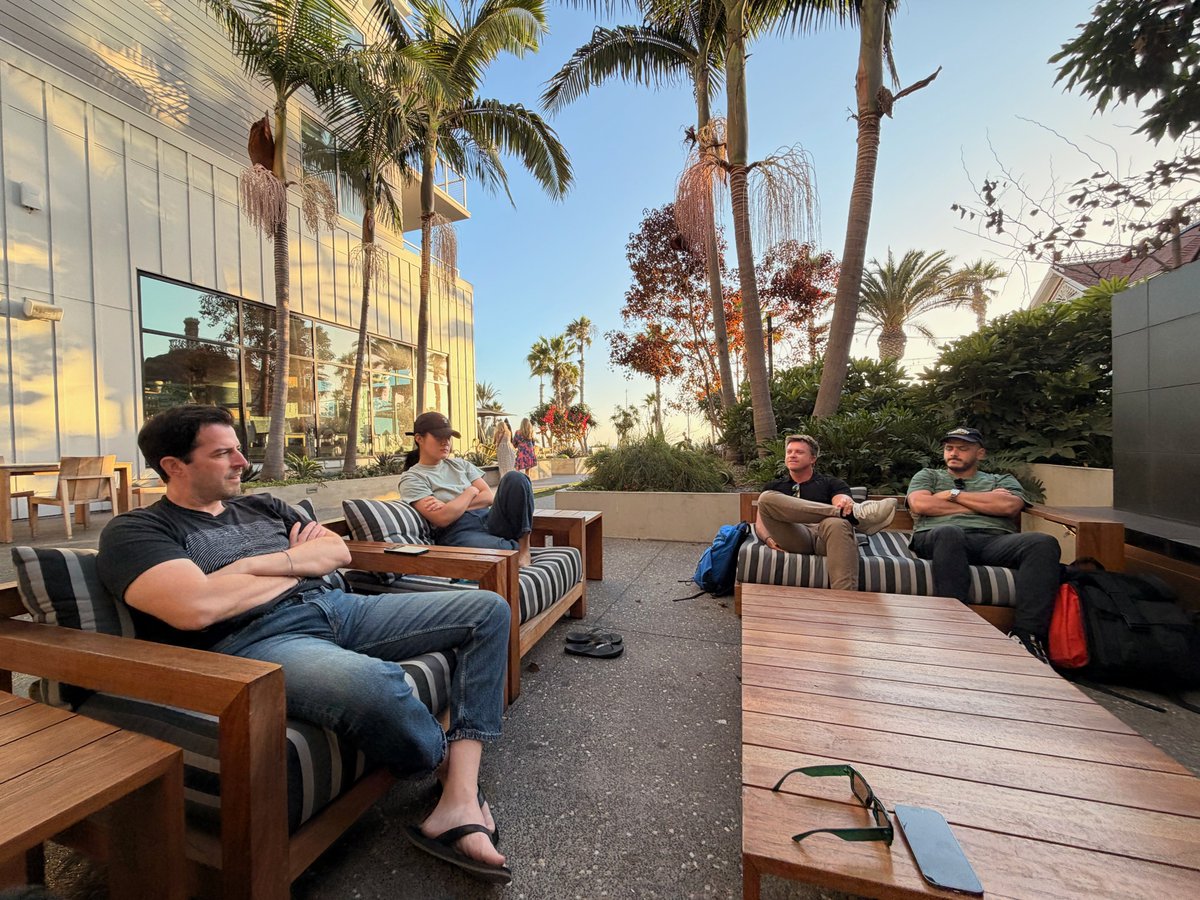
I'm so stoked,
Valio con is such a special place.
it's like a university reunion, everyone is just hyped, having a good time. You know you are going to have a good time.
More thoughts to come, thanks @drewwilson for yet another memorable year of @valiocon@davidishim thanks for letting me crash on the couch.
@KLM thanks for not getting the luggage to me in time