#OnThisDay in 1872, Royal Navy Lieutenant and Chief Engineer and photographer for Scott's British National 'Discovery' Expedition, Reginald Skelton was born.
Skelton was born in Lincolnshire, and educated at Bromsgrove School, Worcestershire before joining the Royal Navy in 1887. During his time on the 'HMS Majestic' from 1899 to 1900, Skelton had risen to the position of senior engineer and served with Robert Falcon Scott. This meeting led to Skeleton's appointment to supervise the building of Scott's expedition ship 'Discovery' as ship's engineer. Once in Antarctica and particularly in the winter, Skelton assumed other duties for the good of the expedition. He became "photographer-in-chief" to the expedition and produced some of the best pictures of Antarctica obtained up to that date!
Following his time in the Antarctic, Skelton returned and served in World War 1 and rose through the service becoming Engineer Rear-Admiral in 1923, Engineer Vice-Admiral in 1928 and Engineer-in-Chief of the Fleet, Admiralty. In 1931 he was knighted and retired the following year. He died in 1956, aged 84, at his home in Aldingbourne.
#inspire #explore #discover #conserve #Antarctica #OTD
📸 Officers of the 'Discovery' on the 1901-1904 British Antarctic Expedition. Reginald Skelton sixth from left. Alexander Turnbull Library.
#OnThisDay in 1921, the decision to go South as part of the Shackleton-Rowett 'Quest' Expedition 1921-22 was confirmed!
Shackleton met with several men who joined him on the Imperial Trans-Antarctic Expedition 1914-17, both 'Endurance' and 'Aurora' party members; Frank Worsley, Frank Wild, Leonard Hussey, Lewis Rickinson and Joseph Stenhouse, as well as his partner John Quiller Rowett, Lee Keedick, Northrup McMillan, Percy Wallace and Laurence Legge. The men dined at the Savoy Restaurant in London, and all signed the menu, complete with drawings of penguins.
📸 Signed menu at Savoy Resturant. Copyright unknown. Sourced from @ QuestChronicle
#OnThisDay in 1956 British Antarctic explorer, naval surgeon and founder of the Public Schools Exploring Society (now British Exploring Society), George Murray Levick, died.
Levick was born in Newcastle in 1876. He studied medicine at St Bartholomew's Hospital and in 1902 was commissioned in the Royal Navy. Several years later Levick was granted leave of absence to accompany Robert Falcon Scott on the British Antarctic 'Terra Nova' Expedition 1910-13 as surgeon and zoologist.
During this expedition, Levick was one of the six members of the Northern Party who built a hut and wintered at Cape Adare in 1911. The 'Terra Nova' then took the Northern Party south to complete geological work and surveys and they were dropped at Evans Cove 8 January 1912. They were supposed to be picked up a month later however because of the ice conditions the ship couldn't get to them and they spent the winter in a snow cave at Inexpressible Island, Terra Nova Bay. In the spring of 1912, the men travelled some 200 miles on meagre rations, finally reaching the safety of the hut at Cape Evans on 7 November 1912.
📸 George Murray Levick, self portrait. SPRI.
#inspire #explore #discover #conserve #Antarctica
#OnThisDay in 1879, polar explorer Eric Stewart Marshall was born in Hampstead, London. He read medicine at Emmanuel College, Cambridge and continued his studies at St Bartholomew's Hospital in London, qualifying as a surgeon in 1906.
Marshall was the surgeon on Shackleton's British Antarctic 'Nimrod' Expedition 1907-1909 and also the cartographer with the shore party. He was a member of the Southern Party, which led by Shackleton, achieved the Farthest South record of latitude 88° 23' South, longitude 162° East in January 1909, in their attempt to reach the South Pole. During this journey, Marshall was instrumental in saving the lives of the party by struggling to a food depot when the rest of the party was exhausted.
After his expedition to Antarctica, Marshall went on to research nutritional deficiency diseases and had a successful military career.
He was awarded the Polar Medal and a Military Cross and is commemorated in Antarctica by the naming of the Marshall Mountains 84°37' S 164°30' E.
📸 Wild, Shackleton, Marshall and Adams upon their return from the Southern Journey (Canterbury Museum).
Last week during Tech Week at Tūranga Central Library (Christchurch, NZ), 168 students got to explore our Scott’s ‘Discovery’ Hut Minecraft World!
These students had the opportunity to step into our interactive Minecraft world where they arrive on the RSS 'Discovery,' then go ashore to:
- Search for artefacts inside Scott's 'Discovery' hut
- Build kennels for the expedition huskies
- Design their own Antarctic huts fit for polar exploration
Their creativity, collaboration, and problem-solving skills were incredible to see in action, truly reflecting an ‘Explorer Mindset.’
The Trust is grateful to the following generous supporters including, project sponsor the Greater Christchurch Schools Network, project developer WDekkers Digital, and Antarctic Heritage Trust Inspiring Explorers™ Fund donors.
📸Image 1&2: Christ the King school students meeting heroic explorers and finding artefacts in Scott's 'Discovery' Hut Minecraft World.
Image 3: Ohoka school students exploring Scott's 'Discovery' Hut Minecraft world
Image 4: Ohoka school students listening to a presentation about Scott's 'Discovery' expedition and hut.
It was a fantastic weekend of ideas, discussion, and connection for New Zealand Huts programme participant, Lara Teodorescu, who presented at the Architectural Centre symposium on Adaptive Re-use, held at Victoria University of Wellington (NZ).
The presentation provided a valuable opportunity for Lara to connect her studies with the preservation of the huts built by Antarctica's early explorers, alongside the hands-on conservation work completed in Nelson's Hopeless Hut (NZ) as part of the programme.
Around 30 people attended the symposium, including students and architects, creating a highly engaged audience for the presentation and discussion.
One particularly special moment came afterwards, when an audience member introduced herself to Lara and shared that she had previously worked on conserving artefacts from the Antarctic huts, a wonderful reminder of the strong connections and shared passion within the heritage conservation community.
Thanks to the Inspiring Explorers™ Fund donors, partner Backcountry Trust, and support from @docgovtnz for helping young people to step into New Zealand’s backcountry, learn new skills, and give back.
📸Inspiring Explorer, Lara, presenting at Victoria University of Wellington.
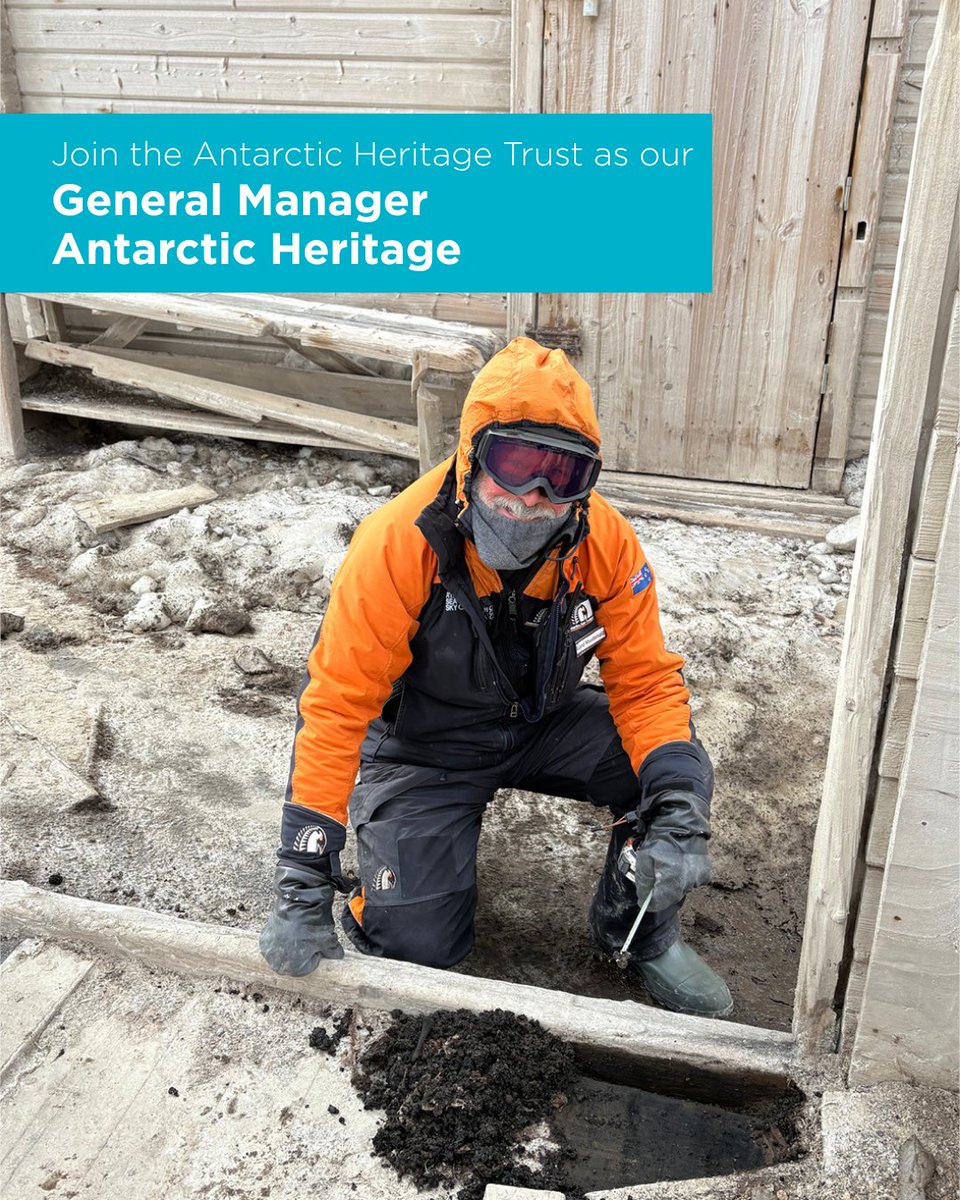
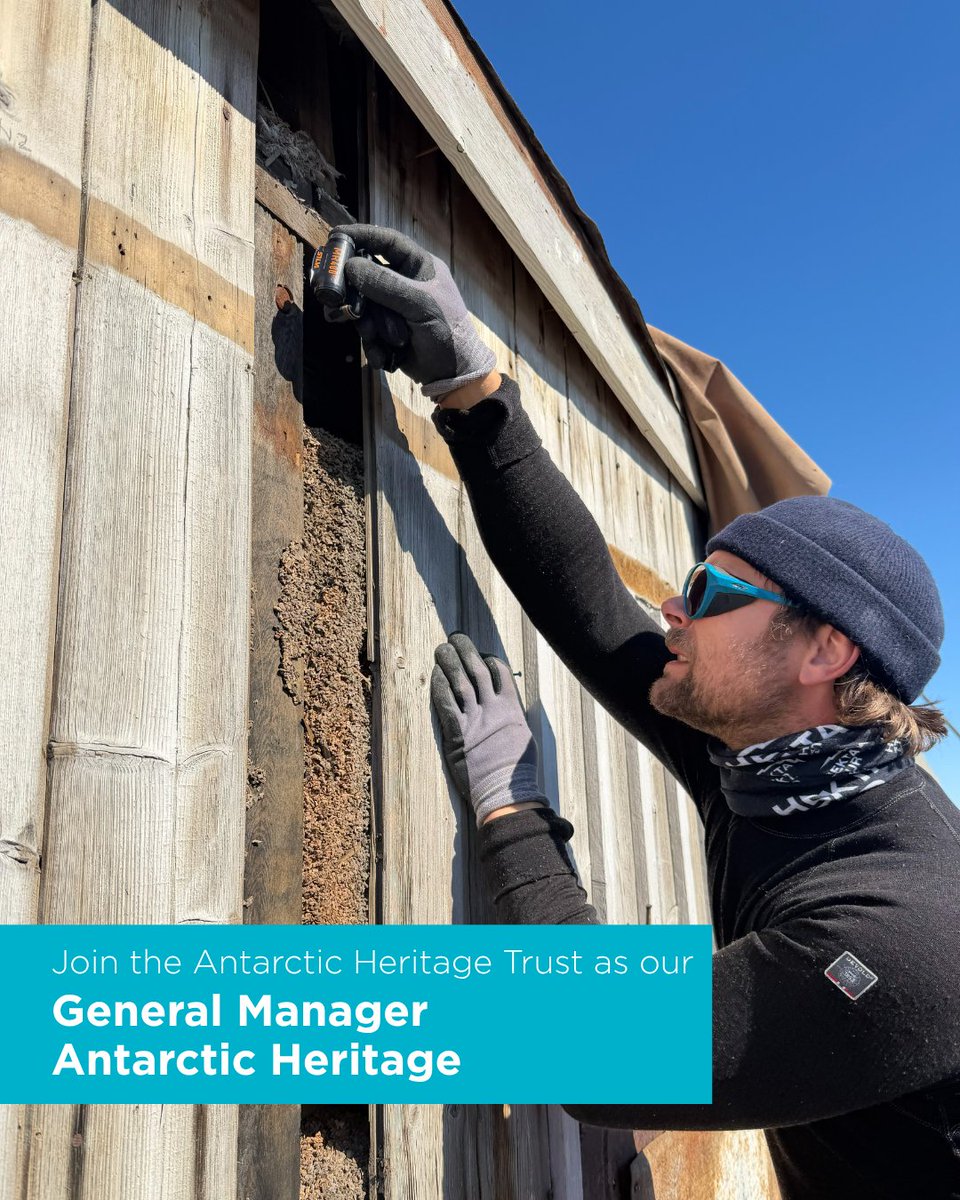
Work with us! Join Antarctic Heritage Trust as our General Manager Antarctic Heritage.
This senior leadership opportunity is a chance to lead world-class work preserving iconic cultural heritage in one of the most extraordinary environments on earth.
Join our team in this exciting construction and programme delivery role where you will oversee the full project cycle across a portfolio of historic sites on Ross Island.
This role also contributes to shaping the future of the Trust's work at Cape Adare, the site of the first building ever constructed on the Antarctic continent.
To find out more or apply, please click this link to our website: https://t.co/TYqzQD8KyP
Applications are open now and close Sunday 7 June.
Getting out of your comfort zone is a core part of the Inspiring Explorers™ programme, along with developing an 'Explorer Mindset' - innovation, curiosity, leadership, teamwork, and resilience.
For Inspiring Explorer Corbin, it is also about drawing the link between past explorers and how stepping out of their comfort zone led them to explore further and achieve more.
Where has stepping outside your comfort zone taken you?
Thanks to the Inspiring Explorers™ Fund donors, partner Backcountry Trust, and support from @docgovtnz for helping young people to step into New Zealand’s backcountry, learn new skills, and give back.
📹AHT/Brittany Fox
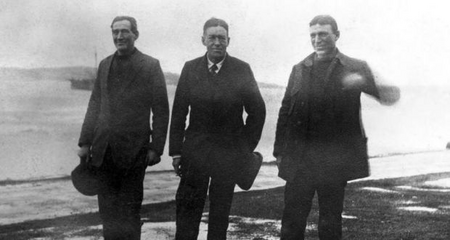
#OnThisDay in 1916, Ernest Shackleton, Frank Worsley and Tom Crean set off at approximately 3am on their journey into the unknown to cross the island of South Georgia. The men were attempting to reach the Stromness whaling station in order to rescue their remaining crew - the three men left with the beached 'James Caird' at King Haakan Bay, and the remaining crew of the 'Endurance' stranded at Elephant Island.
The men had no map and had to improvise a route across mountain ranges and glaciers with only three days of provisions for each man. At one point, they coiled their pieces of rope into three 'pads' to sit on and straddling each other launched themselves into the unknown. Worsley estimated that they travelled approximately 3,000 feet down the slope in three minutes and in his own words said:
“We seemed to shoot into space. For a moment my hair stood on end. Then quite suddenly I felt a glow and knew that I was grinning. I was actually enjoying it. It was most exhilarating...."
Incredibly the men were successful in reaching their destination, and the crew of the 'Endurance' were saved.
#inspire #explore #discover #conserve #antarctica #OTD #shackleton #endurance
📸Crean, Shackleton, and Worsley, after their arrival in Port Stanley. (Robert Burton Collection).
Innovation in the 'Explorer Mindset' is about finding better ways to achieve an outcome. For Inspiring Explorers Lucy and Alesha, that meant seeing how multiple organisations can come together to achieve a shared goal in the backcountry.
It also opened their eyes to the behind the scenes work that goes into maintaining Aotearoa New Zealand’s backcountry, leaving them with a new appreciation for what it takes to care for these places.
We loved seeing how innovation sparked when our Inspiring Explorers™ came together for a common goal.
Thanks to the Inspiring Explorers™ Fund donors, partner Backcountry Trust, and support from @docgovtnz for helping young people to step into New Zealand’s backcountry, learn new skills, and give back.
📹AHT/Brittany Fox
#OnThisDay in 1959, Apsley Cherry-Garrard, Assistant Zoologist on Scott's British Antarctic 'Terra Nova' expedition, died at age 73. Born Apsley George Benet Cherry in Bedford, England into a wealthy family, he was educated at Winchester College and at Christ Church, Oxford. His name was changed to Cherry-Garrard when his father inherited a large country estate, which he was later to inherit himself.
During the 'Terra Nova' expedition, Cherry-Garrard was joined by Edward Wilson and "Birdie" Bowers on a grueling trek from Cape Evans to Cape Crozier and back, in the depths of the Antarctic winter to collect Emperor Penguin eggs in the hope that studying the embryology of this primitive bird may prove the missing link between birds and reptiles. Although successful in this mission, the three men came close to dying during the five-week journey, and upon their return Scott remarked that he felt it to be the worst journey in the world.
Cherry-Garrard took these words to name his memoir of the 'Terra Nova' expedition, "The Worst Journey in the World" published in 1922 and considered to be a classic of travel writing, and by many as the best of this category ever written.
Cherry-Garrard was also involved in depot laying in preparation for Scott's polar attempt. For a variety of reasons, it fell upon him and dog handler Dmitriy Girev to deposit food at One Ton Depot. The men arrived on 3 March 1912 and waited there hoping to meet Scott's polar team, however on 10 March they had to return to base due to poor weather and a lack of dog food. Sadly, they weren't to know what was to become of Scott and his remaining party who died 11 miles south of One Ton Depot on 29 March.
Cherry continued with his scientific work during the winter and was part of the team that discovered the bodies of Scott, Bowers and Wilson in their tent on 12 November 1912. Sadly Cherry-Garrard suffered with physical and mental health issues for his lifetime, partially due his experiences in Antarctica. He felt that he could have ventured south from One Ton Depot and possibly saved Scott's ill-fated team.
Antarctic Heritage Trust is proud to be the New Zealand distributer of the graphic novel adaptation of 'The Worst Journey in the World' by animator Sarah Airriess. You can purchase Volume 1 of this exciting series from our website, https://t.co/Z4NuUjiaIn
#inspire #discover #explore #conserve #antarctica #TerraNovaExpedition #GraphicNovel #TheWorstJourneyInTheWorld
📸 Bowers, Wilson and Cherry-Garrard. Public Domain
It was #OnThisDay in 1898, that the crew of the 'Belgica' began their Antarctic night, a two-month long period of darkness which lasted until 23rd July.
Often considered the first expedition of the Heroic Age of Antarctic Exploration, the Belgian Antarctic Expedition 1897-1899, under the command of Adrien de Gerlache, had set sail from Antwerp in August 1897. Failing to get into the Weddell Sea, the 'Belgica' had become trapped in the ice of the Bellingshausen Sea, and despite the best efforts of the crew, could not be freed.
The crew suffered miserably as the expedition was ill equipped without enough warm winter clothing for the men and a shortage of food. Several men showed signs of scurvy and mental illness until they began to eat penguin and seal meat which is now known to contain small amounts of Vitamin C.
Even as Spring and Summer arrived the ship was still trapped and by January 1899 the possibility of another winter in the ice loomed ahead - despite open water being visible about 800 metres away. The weakened men used explosives and various tools to create a channel and on 15 February 1899, managed to move slowly down the channel, finally clearing the ice on 14 March.
Despite the hardships experienced, the crew had managed to collect significant scientific data which included a year of meteorological observations.
Fun fact: the 'Belgica antarctica' is the name of a flightless midge, endemic to the continent and the largest purely terrestrial animal native to Antarctica - the only insect that can survive year-round in Antarctica! The first specimens were collected by the 'Belgica' expedition's biologist Emil Racoviță.
#OTD #inspire #explore #discover #conserve #antarctica
📸 Belgica, the ship of the Belgian Antarctic Expedition, ice locked in the Bellinghausen Sea, 1898. Ohio State University Library
Work with us! Join Antarctic Heritage Trust as our General Manager Antarctic Heritage.
This senior leadership opportunity is a chance to lead world-class work preserving iconic cultural heritage in one of the most extraordinary environments on earth.
Join our team in this exciting construction and programme delivery role where you will oversee the full project cycle across a portfolio of historic sites on Ross Island.
This role also contributes to shaping the future of the Trust's work at Cape Adare, the site of the first building ever constructed on the Antarctic continent.
To find out more or apply, please click this link to our website: https://t.co/TYqzQD8KyP
Applications are open now and close Sunday 7 June.
Out in Aotearoa New Zealand’s backcountry, the 'Explorer Mindset' of teamwork is everything. For Inspiring Explorer Melino, it means looking after each other, supporting each other, and sharing the load.
It also shows up in how a group comes together to get a big job done, each person bringing different strengths to the task.
When have you relied on teamwork to get something done?
Thanks to the Inspiring Explorers™ Fund donors, partner Backcountry Trust, and support from @docgovtnz for helping young people to step into New Zealand’s backcountry, learn new skills, and give back.
📹AHT/Brittany Fox