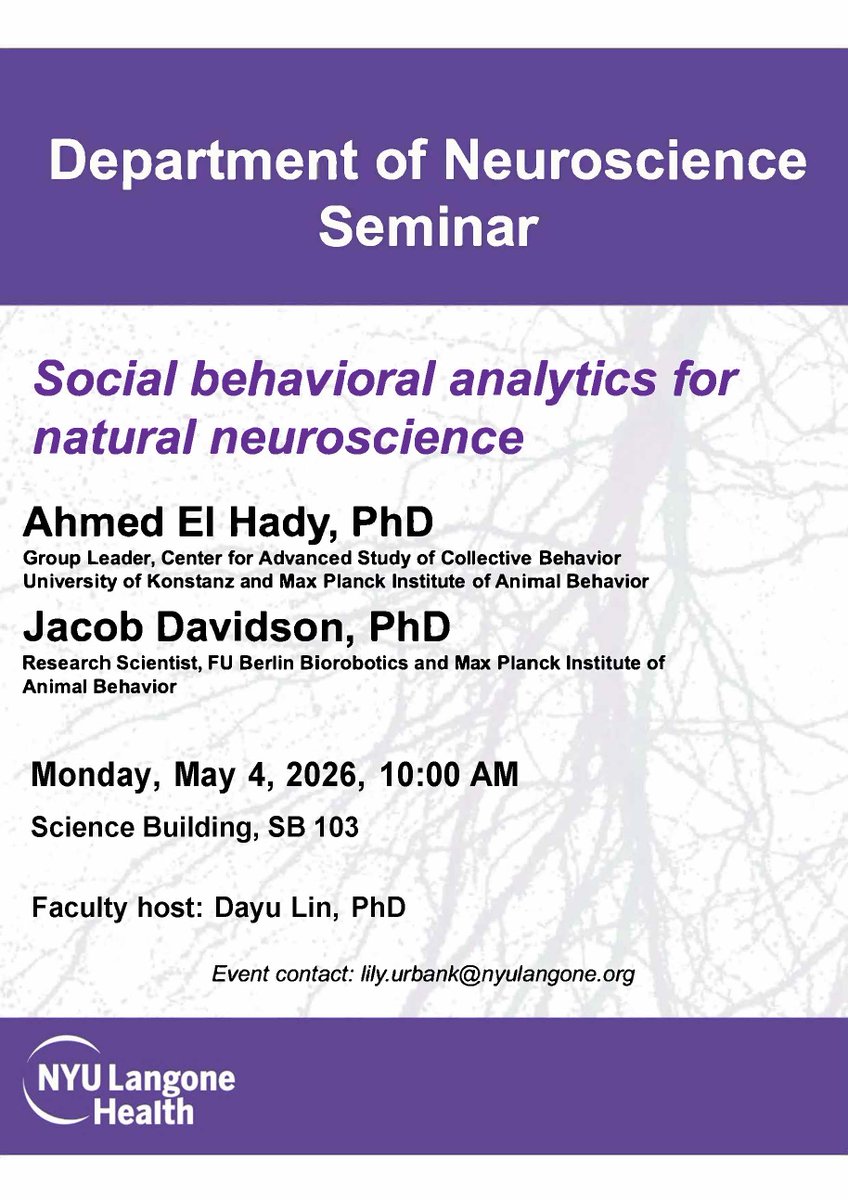
If you happen to be around NYU on May 4th , come see Jacob Davidson and myself speaking about our latest work developing algorithms for social behavior analytics. All details are on the poster below, reach out if you are around.
After three years of working on this review with my collaborator Emily Jane Dennis from Janelia Farm Research Campus , it is finally in press. The review provides an overview and our personal reflections on what constitutes an integrative approach to neurobiology of foraging. Pretty pertinent discussion today as foraging is becoming a topic of interest for many neuroscientists. Enjoy the review
https://t.co/1uDNX2oXYd
A new preprint from our group formalizing mate choice, a central problem in evolutionary biology, as an optimal foraging problem.
Check it out here: https://t.co/ggCHkNCi6P
NEW PREPRINT ALERT:
Mate choice is a central problem in evolutionary biology. Daniel Bernstein from @Princeton and myself asked whether Mate choice can be formalized as foraging problem.
We developed an analytically tractable optimal foraging-inspired mechanistic theory of decision-making underlying mate choice .
We got interesting mate choice strategies :D across our parameter spaces from eager to patient to reserved. Check out the preprint for all details https://t.co/ZdqSRv67Iu
A new paper from our group that investigates how different forms of social hierarchy and inequality shapes patch foraging strategies.
Check out the paper here: https://t.co/iMYUxY5ccg
So happy that my paper with Lisa Blum Moyse on how social hierarchy shapes foraging strategies is out in Physics Review Research.
We develop an analytically tractable model of how leader - follower dynamics and spread of misinformation shape patch foraging.
Check the paper here: https://t.co/JtPFZ8VEEE
So excited we are organizing again with @AllysonSgro the Junior Scientist workshop for theoretical biophysics to take place at @HHMIJanelia from September 13 - 18, 2026 . Janelia will cover the cost of accommodation, meals and reasonable travel expenses for accepted participants.
Deadline: April 16, 2026
Website: https://t.co/tgfWGA9dWA
This workshop is intended as a "by the students, for the students" meeting. Other than the organizers and invited speakers, participants will include only students and postdocs working on a variety of problems in theoretical biophysics, broadly defined. Topics include but not limited to:
·Physical principles underlying biological function in molecular, cellular, multicellular systems
·Theory of organismal development
·Theory of animal behavior, ecological systems, and evolutionary dynamics
· Data driven identification of principles in biophysical systems
· Physics of active matter
· Non–equilibrium thermodynamics of living systems
The Konstanz school of collective behavior is happening again in 2026 with an amazing line up of speakers.
Check out the website: https://t.co/kWxC7fmP30
So excited that the Konstanz school of Collective Behavior will take place again from 20th July to 7th August , 2026.
We have an amazing line up of speakers covering state of the art research on collective behavior from cells to tissues to whole organisms and across animal species from worms, flies, fish to non-human primates and human. One of a kind school that takes you on a journey exploring the complexities and the mathematical beauty of collective behavior.
Application deadline : March 15th
All details can be found here: https://t.co/1FWBiToaxK
Pls RT this ad:
I have an opening for a PhD student in my @IntBioPhysics group to begin ASAP , part of a collaboration with the group of Ilya Nemenman @INemenman at Emory university.
Deadline: 1st November
Details here: https://t.co/QK4oWpntJN and application portal here: https://t.co/0jf4clo2OH
We are seeking a doctoral student with a quantitative background. Ideally, the candidate should have a master degree in physics but other quantitative backgrounds will be considered. The researcher will be based in the Integrative Biophysics group at the University of Konstanz and Max Planck Institute of Animal Behaviour, located in Konstanz, Germany.
The project summary is as follows:
Project Title: Inferring dynamical interactions in social groups
Project Abstract:
Social interactions are one of the most foundational building blocks of group behaviors, shaping decision making strategies across ecologies. Social groups consist of small number of individuals in contrast with collectives that consist of large number of agents. Despite the importance of social groups as a building block of living systems, there is little understanding of mechanistic details of the nature of those social interactions and how they shape emergent social functional properties. This stands in contrast with physics of collectives, which usually focus on the dynamics of very large group of individuals and have been thoroughly studied. In an experimental system or in field observations tackling social behaviors, we do not know a priori the social forces, nature of those interactions and their dynamics. Recent advances in software and hardware allow us to track the behavior of multiple individuals over extended spatio-temporal scales. Thus it is crucial to develop methodologies to infer dynamical social interactions and social forces from experimental observations. This relates closely to work done inferring "social forces" from dusty plasmas.
Recent theoretical work has developed an information theoretic approach to estimate intrinsic motivation, based on maximizing an agent's empowerment (defined as the mutual information between its past actions and future states). This approach can be used to study social behaviours, where individuals choose actions without an explicit reward signal. In this project, we are planning to apply this framework to infer and understand social behaviour of small animal groups specifically locusts, mice and marmosets monkeys offering not only a mechanistic insights into mechanisms of social organization but also make quantitative evolutionary comparison of social behaviours.
1. Yu, Wentao, Eslam Abdelaleem, Ilya Nemenman, and Justin C. Burton. "Physics-tailored machine learning re-veals unexpected physics in dusty plasmas.Proceedings of the National Academy of Sciences 122, no. 31 (2025): e2505725122.
2. Tiomkin, Stas, Ilya Nemenman, Daniel Polani, and Naftali Tishby. "Intrinsic motivation in dynamical control sys-tems.” PRX Life 2, no. 3 (2024): 033009.
Very glad that Albin Salazar @latinchemist is joining our group as a postdoctoral fellow where his goal is to wed multi-level paradigms with multi-scale data integration to elucidate mechanistic behaviors pertinent in diverse foraging scenarios.😄
Can one bring together Reinforcement learning and Drift Diffusion models to unravel cognitive mechanisms underlying collective foraging ?
Congrads to Jonathan Marienhagen , Lisa Blum Moyse and Dominik Deffner on this new study. Very happy that @IntBioPhysics postdoc Lisa and myself were part of this collaboration.
Preprint here: https://t.co/VOuYf4h4yr
Konstanz school of collective behavior 2025 was a great success. Amazing students and faculty , who spent so many hours discussing state of the art collective behavior research. We are already preparing for the 2026 version so stay tuned. Details to be updated here : https://t.co/XN9vgbL0qv
During the last day of the school, every student gave a short presentation about their school project, thread: / n
So happy this paper is finally out in PRX Life (https://t.co/qt8j7lLPYH ) . Let me tell you more about the story of this paper in this thread :
Foraging is my big passion and step by step I hope to develop a general theory of foraging , predicting decision strategies from the individual to the social. This time we are extending our foraging models to the social domain. Along with a very talented postdoc in my
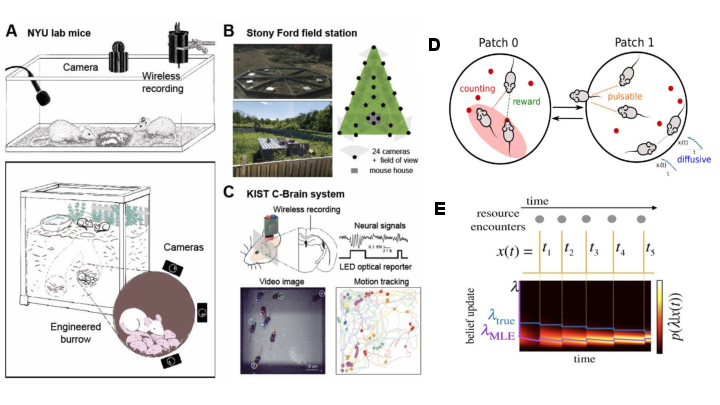
@IntBioPhysics group Lisa Blum Moyse , we developed an analytically tractable model to predict social foraging strategies in an egalitarian group . We assumed that agents would couple through different social information sharing mechanisms as shown in this figure and derived the strategies analytically , we got some exciting results:
Check out this new paper from our group by our very own talented postdoc Lisa Blum Moyse and our PI @zamakany
We present an analytically tractable model to give us mechanistic insights of how animals socially forage under different forms of social couplings.
Cohesion, residence time, and habitat-choice accuracy emerge as key metrics shaped by social interaction, revealing exploration-exploitation trade-offs in the collective foraging patterns of large egalitarian groups.
https://t.co/8YCCHmkumB
Please share around this Job ad :
Are you excited about foraging ? do you want to analyse multidimensional large scale behavioural, metabolic and neural data ? I have a job opening for you :D
I have an opening for a postdoc in my @IntBioPhysics group. The Postdoc will be working as part of a recently funded Human Sciences Frontiers Program (HSFP) research grant ‘”Neurometabolic mechanisms underlying social foraging” in collaboration with the experimental groups of Robert Froemke (New York University) and Jee Hyun Choi (Korean Institute of Science and Technology). The project aims to understand neuro-metabolic mechanisms underlying social foraging. The PostDoc will have the opportunity to travel to the collaborators in New York and Seoul.
All details here and below in the thread : https://t.co/6P5W3ngjAn
Check out this exciting junior scientist workshop focusing on theoretical biophysics . Deadline June 10, 2025
Link: https://t.co/GtNcvyBvzy
We are inviting postdocs and graduate students working on a variety of problems in theoretical biophysics, broadly defined.
Topics include but not limited to :
Physical principles underlying biological function in molecular, cellular, multicellular systems
Theory of organismal development
Theory of animal behavior, ecological systems, and evolutionary dynamics
Data driven identification of principles in biophysical systems
Physics of active matter
Non–equilibrium thermodynamics of living systems
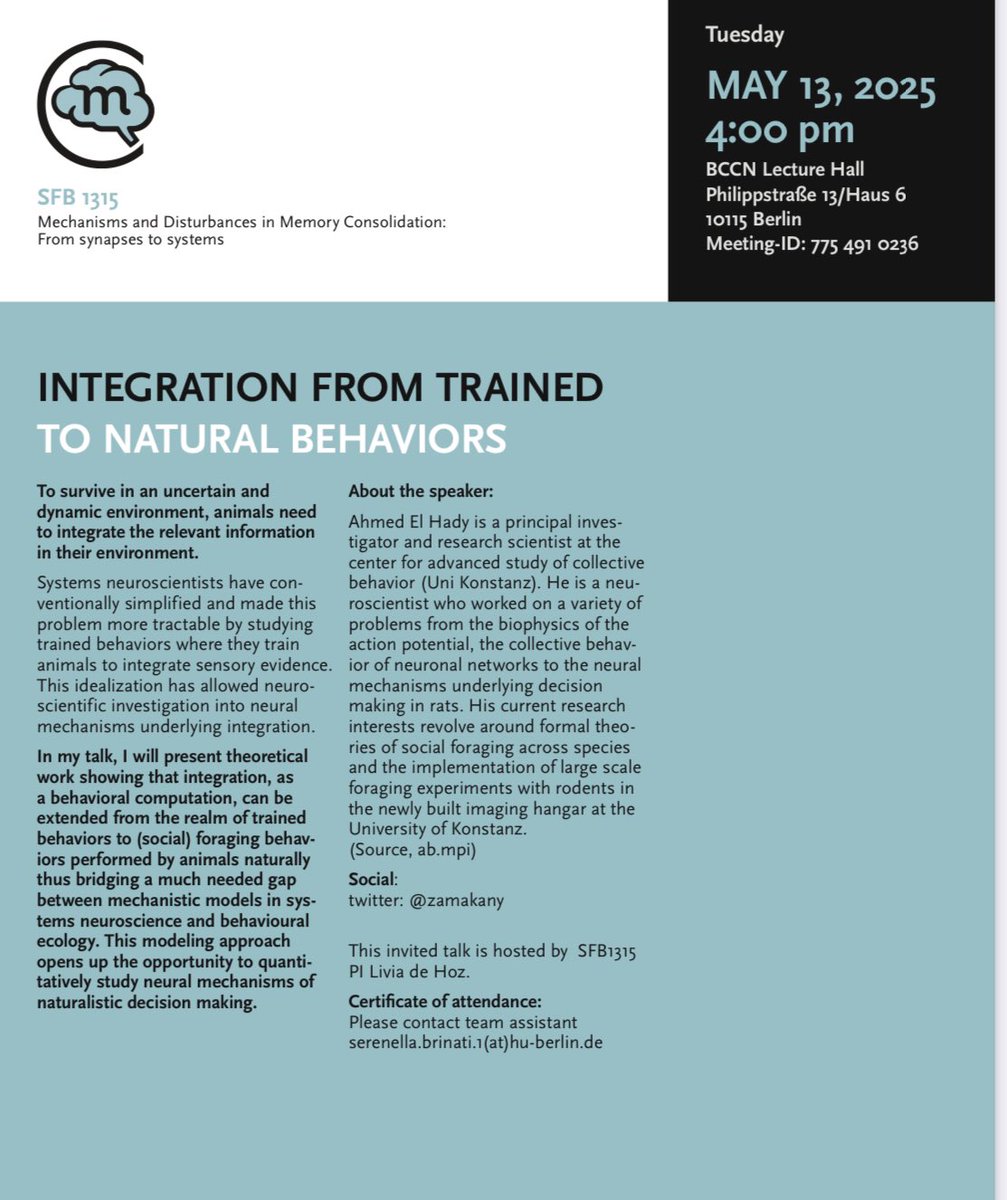
If you are around in Berlin , make sure to mark your calendar on May 13th when I will be giving my seminar hosted by @liviadehoz . All details
In this link : https://t.co/ppPWC4vKqP
Lisa Blum-Moyse from our group @IntBioPhysics will be giving a talk at NWG 2025 this Friday at 16:00. She will talk about her work on theoretical models of social foraging with Ahmed El Hady @zamakany
If you are heading to the Neuroscience Conference in Goettingen this week, make sure to go on Friday 28th March to the talk by the very talented postdoc Lisa Blum-Moyse on theoretical models of social foraging. For reference, check our preprints too:
https://t.co/kUlf1nHKBN and https://t.co/yyCt95lIBx
A new paper from our group @IntBioPhysics led by our PI @zamakany using foraging theory to reformulate saccadic eye movements as a patch foraging problem
Very excited that this cute study is finally out as a preprint. It began in @neurobridges 2023 when Tal Nahari approached me after my lecture on foraging theory wondering : " I have some saccadic eye movement data that looks like your patch foraging model" . Here we are, two years after, it turns out that one can recast saccadic eye movements during an information exploration task as a patch foraging problem. We claim that this might be a generic property of saccadic eye movement ( Share your data with us if you want :D ) . Follow along the thread to know more /n