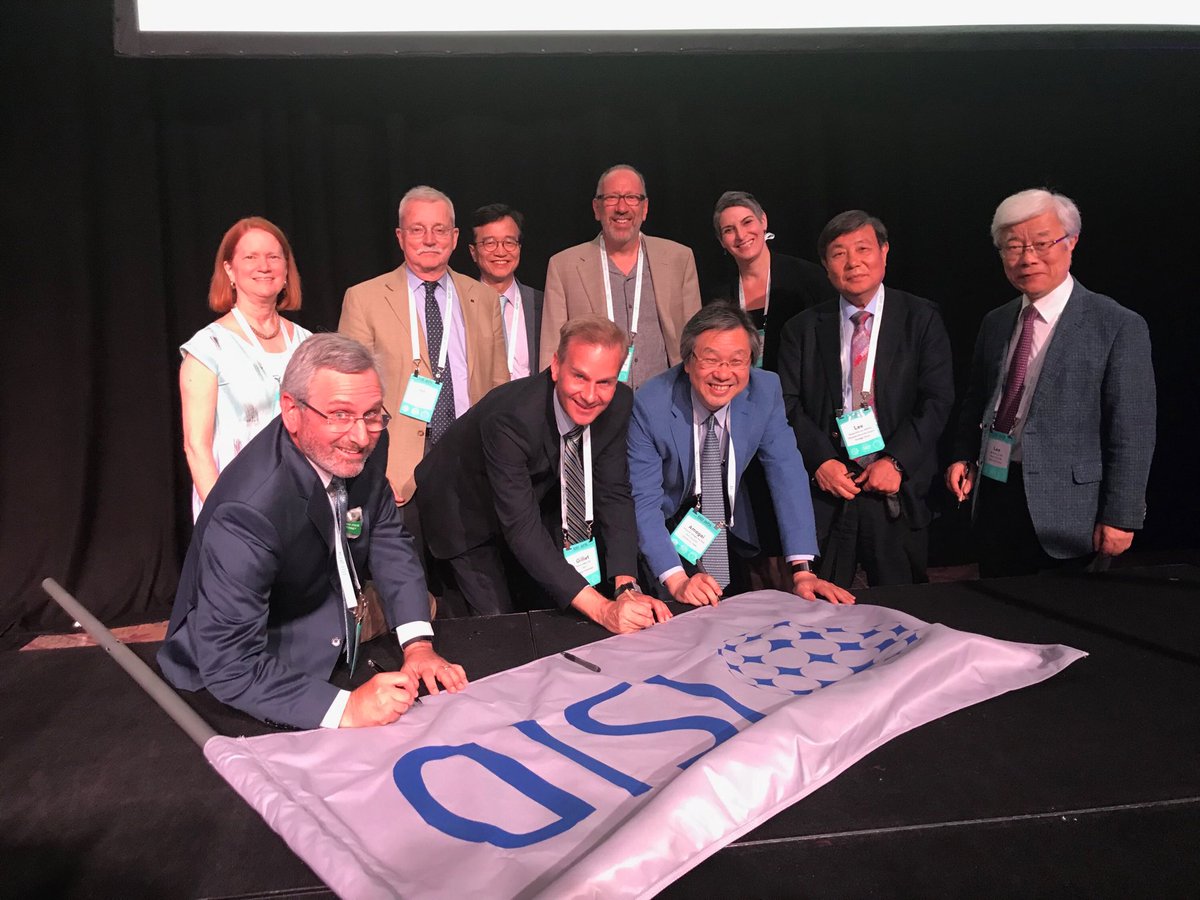
Our scientists were invited to present their groundbreaking research, including findings on circadian rhythm, at the prestigious International Investigative Dermatology meeting on May 16-19th! @IntInvDerm18. #IID2018
Dr Khavari describes considerable efforts to decode the regulatory genome, focusing on characterizing a genome-wide collection of SNP-containing enhancers that confer skin disease risk #IID2018
Dr Paul Khavari from Stanford University presents the prestigious SID Albert M Kligman/Phillip Frost Leadership Lecture, which recognizes significant contributions to our understanding of the structure and function of the skin. #IID2018
Dr Hayday shared exciting new data showing that tissue-resident gamma delta T cells maximize the T cell receptor potential by using both germline-encoded sequence for a polyclonal innate response and adaptive sequences to make clonally restricted responses to antigens. #IID2018
The 2018 ESDR Celgene Lecture honors Dr Adrian Hayday from King’s College London who presents his current efforts to understand body-surface surveillance by local T cells. #IID2018
Dr Jeremy Di Domizio (University Hospital CHUV, Lausanne, Switzerland) described compelling evidence that the host exploits skin commensal bacteria to promote wound healing processes that involve pDCs and type I IFN production. #IID2018
A Finnish nationwide registry study presented by Dr Kaisa Tasanen from the University of Oulu showed that DDP-4 inhibitors, specifically vildagliptin, for treatment of diabetes can trigger breakage of immune tolerance and development of bullous pemphigoid. #IID2018
Dr Tomic-Canic revealed that FGF7 and its receptor are targeted and downregulated in diabetic foot ulcers by microRNAs, positing that the complexities in this system will present challenges for clinical therapeutic translation. #IID2018
In her plenary presentation, Dr Marjana Tomic-Canic(University of Miami) described her work on keratinocyte-fibroblast crosstalk, which functions improperly in chronic wounds. #IID2018
A plenary presentation by a medical student Yuji Ota from Tohoku University in Japan described an intricate deep convolutional neural network for discrimination of malignant melanoma from other lesions with great sensitivity and specificity. #IID2018
A large prospective study of pustular psoriasis patients, presented by Dr Sophie Twelves from King’s College London, demonstrated that palmoplsntar pustulosis is genetically distinct from other forms and that IL36RN mutations associate with earlier disease onset. #IID2018
Dr Francois Kuonon from Stanford University described their investigations into pathway switching during tumor evolution from BCC to SCC, highlighting extensive work identifying a switch from hedgehog to Ras activation via a loss of cilia in resistant BCC. #IID2018
In her plenary session talk, Dr Marie-Charlotte Brueggen from University Hospital in Zurich showed nice data detailing the differences between the leukocyte compartments in subcutaneous adipose tissues and in the skin. #IID2018
Dr Ethan Lerner described compelling evidence that Mas-related G protein-coupled receptors (MRGRPs) on sensory neurons as well as mast cells are important in itch and inflammation and suggested targeting of these molecules as a treatment for inflammatory conditions. #IID2018
Dr Ethan Lerner from Massachusetts General Hospital talked about how sensory nerves and mast cells communicate with each other and with other cells in the skin. #IID2018