Evidence over ideology. Explaining science in context, exposing harmful misinformation, sharing references—and posting reminders the world is beautiful.
Baldy, I think we’re finding some common ground here.
Neither the American nor British political system offers anything approaching unlimited transparency. Behind-the-scenes negotiations, institutional resistance, lobbying influence and political bargaining can make it extraordinarily difficult to establish why particular decisions were made.
And you’re right that meaningful reform can take years.
That’s precisely why I place so much importance on institutional oversight, access to records, independent investigations and transparent decision-making.
We may never eliminate political self-interest or institutional resistance, but we can strengthen the mechanisms that expose misconduct and make officials accountable.
My concern is that generalized cynicism can become self-defeating. If we assume meaningful reform is impossible, we risk abandoning the very mechanisms that might make it possible.
I don’t think we need to choose between skepticism and hope. We need skepticism disciplined by evidence, and hope accompanied by measurable action.
I suspect we’re closer on that principle than our earlier exchange suggested.
What happened to America’s health and science institutions—and how do we establish who was responsible?
Since Democrats control both chambers of Congress, they should investigate the decisions made by RFK Jr., Elon Musk, and other administration officials: what they authorized, what evidence they relied on, and what consequences can be demonstrated.
Claims of efficiency deserve testing. So do claims of harm.
Part I of a three-part series: establish the record, protect essential institutions, and rebuild with stronger safeguards. 🧵
Baldy, the Hegseth vote is worth examining carefully.
The House didn’t actually vote on impeachment. Republicans passed a procedural motion, 211–204, referring the articles to the Judiciary Committee. Every Democrat who voted opposed that maneuver.
Eleven Democrats were absent, and their absence affected the result. That deserves scrutiny.
But there’s another consideration: in January, Democrats take control of the House and Senate, including the committees responsible for investigating misconduct.
They could reopen the matter, conduct hearings, subpoena records and build a more comprehensive evidentiary case before considering impeachment.
That doesn’t prove the November defeat was deliberate. It does mean the current result may not be the final word.
The important question is what Democrats actually do with their new oversight authority.
And that’s precisely why I favor measurable accountability over assumptions that every reform effort is destined to fail.
Baldy, you’re raising a legitimate concern. Politicians frequently promise reforms they ultimately fail to deliver. And lobbying influence, regulatory capture, conflicts of interest and institutional resistance are real phenomena.
But how do we distinguish a politician who has been corrupted from one who encountered legitimate institutional constraints, legislative opposition, or simply failed to deliver?
That’s an important distinction.
The same applies to foreign influence. Lobbying, political donations, diplomatic pressure and actual corruption are not interchangeable. Each requires its own evidence.
I’m not suggesting Washington is free of corruption. Far from it.
I’m suggesting that we identify specific officials, decisions, financial relationships and documented conflicts rather than assume everyone eventually becomes compromised.
Otherwise, the theory becomes impossible to falsify: successful reformers are exceptions, unsuccessful ones were captured, and every outcome confirms the original suspicion.
What specific examples would you offer, and what evidence demonstrates actual capture rather than political compromise or failure?
That’s a conversation worth having.
Baldy, I think we agree that concentrated wealth, corporate lobbying and political influence deserve serious scrutiny. And those concerns certainly aren’t confined to one party.
Where we differ is in the leap from documented influence to the conclusion that both parties exist primarily to serve their supposed masters.
That’s a much larger claim, and it requires much stronger evidence.
I’m equally reluctant to assume that newly elected reformers will inevitably become corrupted. Some may compromise their principles. Others may deliver meaningful institutional reforms. Their records should tell us which.
If we begin with the assumption that every institution is irredeemably captured, we create a theory that can explain every failure but dismiss every potential success.
My approach is more practical: investigate specific decisions, establish responsibility, identify conflicts of interest, and implement reforms whose effects can actually be measured.
And I’d apply those standards equally to Democrats, Republicans, corporations, and foreign-policy interest groups.
Skepticism is healthy. Predetermined conclusions aren’t.
I suspect we share some concerns, but differ considerably on what constitutes sufficient evidence.
Devin, fair question. And I share your concern about investigations becoming political theater without producing meaningful improvements in people’s lives.
My proposal isn’t a dozen impeachments or endless hearings.
It’s a three-part approach:
Investigate: Establish an evidence-based record of what happened to federal health and science institutions, who authorized the changes, and what consequences followed. Subpoenas and hearings are tools, not the objective.
Protect: Restore essential scientific capacity, safeguard public health programs, and prevent further institutional damage where the evidence justifies intervention.
Rebuild: Strengthen scientific independence, transparency, conflict-of-interest safeguards, and congressional oversight so similar problems are less likely to recur.
Success over the next 18 months shouldn’t be measured by how many officials are embarrassed or impeached.
It should be measured by what was documented, what institutional capabilities were restored, what safeguards were enacted, and whether public services improved.
Accountability without reform is incomplete. Reform without establishing what went wrong risks repeating the same mistakes.
That’s the distinction I’m trying to make.
That sounds a little like a variation on the old “uniparty” or deep-state narrative, where everyone eventually becomes part of the same corrupt establishment.
Institutional capture and conflicts of interest are legitimate subjects for investigation. But we shouldn’t assume corruption simply because someone belongs to an established political institution.
That’s precisely why I’m advocating congressional hearings, documentary evidence, sworn testimony and independent oversight.
If wrongdoing occurred, establish who was responsible, what they did, and what evidence supports the findings.
Accountability should follow the evidence, regardless of party affiliation.
Otherwise, we’re simply replacing one political narrative with another.
🚨 DEVELOPING STORY 🚨
1/12
What does it take to stop departures across the United States?
On November 13, the FAA issued an exceptionally rare nationwide ground stop following air traffic control communications problems.
Stopping departures may have been the responsible decision. But why did the disruption require a nationwide halt?
That question deserves a documented answer—especially after years of warnings about the systems supporting American aviation.
Here is what we know, what remains uncertain, and where accountability should begin. 🧵
@maolesen It’s my understanding that what precipitated the problems today, was the attempt to execute “software patches” to “fix” the existing over stretched infrastructure.
Therefore, absent the attempted fix earlier today, the mishap would not have happened today.
“•A 2nd pediatric #measles death was reported in Wisconsin amid an ongoing outbreak.
•The first death was reported last week in southwestern Wisconsin.
•Wisconsin authorities have reported 649 cases in 20 counties so far in 2026.” #Ivax2protect
https://t.co/FbD8J240Cn
If the Electoral College guarantees that small states get heard, why does a candidate have more reason to visit Nevada than Wyoming? Both are small. Nevada is competitive. That distinction gets lost in this argument.
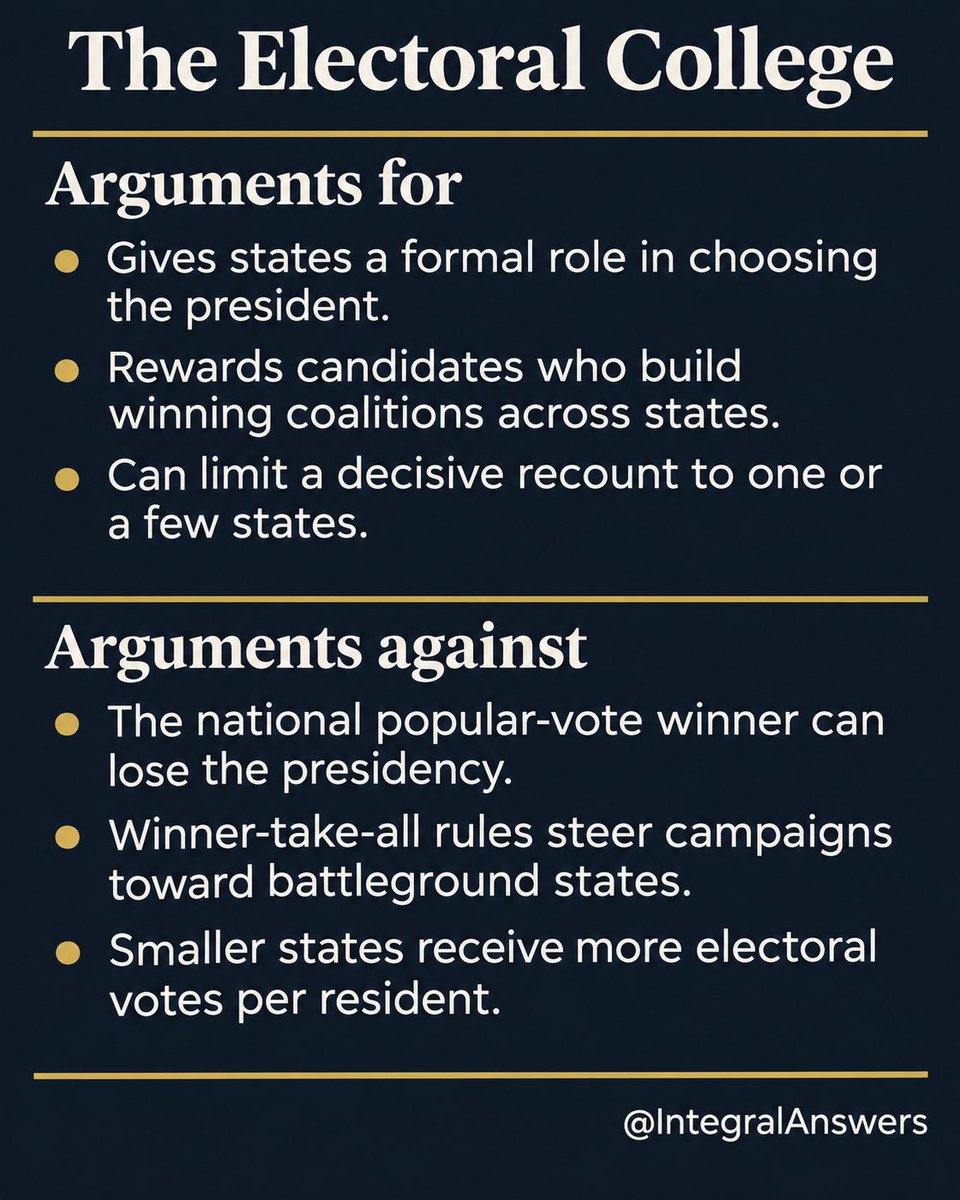
There’s a fair case for the Electoral College. States have a constitutional role in choosing the president, and candidates have to assemble a winning coalition across state lines. It can also narrow the scope of a recount. When one state’s electoral votes will settle the election, officials can focus on that state.
But winner-take-all rules in 48 states give campaigns a powerful incentive to concentrate on a handful of battlegrounds. And a candidate can finish second with voters nationwide and still become president. That happened in 2000 and 2016.
Would California, Texas, New York and Florida “decide every election” under a popular vote? In 2024, those four states together cast roughly 31% of presidential votes, and their voters split millions of votes between the candidates. Under a national tally, a Republican vote in California and a Democratic vote in Texas would each add one vote to their candidate’s total, even if that candidate lost the state by a landslide.
As for waiting four weeks, the relevant question is how close the race is. A clear national lead could be called while California was still counting. A razor-thin lead could take time to resolve. Whether it triggered a nationwide recount would depend on the rules adopted. And anyone who remembers Florida in 2000 knows the Electoral College can keep the country waiting, too.
The honest question is whether the states’ role in choosing a president is valuable enough to justify occasionally electing the candidate who received fewer votes. That’s worth debating. The claim that four states would choose for everyone else doesn’t hold up.
THREAD: Is Raw Milk a Health Miracle or a Risky Myth?
Dr. Ben Tapper claims raw milk boosts immunity, prevents asthma, & reduces childhood illness. He even says it’s “comparable to breastfeeding.”
Let’s take a look at what the science actually says.
A 17-month-old nearly died after developing E. coli O157:H7 and hemolytic uremic syndrome.
Raw goat milk was strongly implicated—but the original milk was never recovered.
This is more than a raw-milk story. It is a lesson in how public health reasons under uncertainty. 🧵
1/ Most people still think AI is about chatbots.
It’s not.
The most important AI system in the world right now doesn’t write text—
It predicts biology.
AlphaFold may reshape all of medicine.
Here’s why: