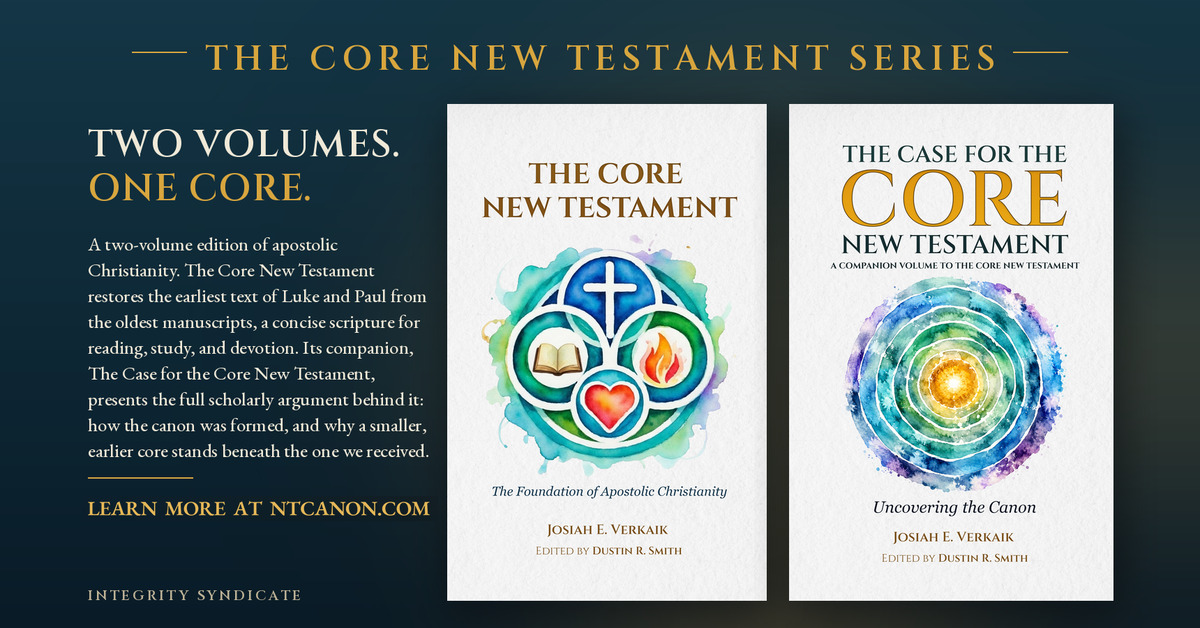
An exciting project from Integrity Syndicate. The NT Archive is an enhanced library of classic Christian works: biblical scholarship, church history, theology, devotional writing, and literature. https://t.co/HnbQgRj3ai
At the root of the leftist AI panics is a nieve sense that government is the solution. The paradox is that while the claim to be realists about the threats about Ai the are totally naive in their misplaced confidence in government as the solution. Humans have a horrible track record of ruling over each other.
@paleochristcon The worst part was not that you didn't know, but that you projected that you did, and presumed she didn't. People can see that you were not acting in good faith on account of the tactics used to deflect and attack when confronted. It was gas lighting at it's finest.
Not what the earliest manuscripts read and nowhere attested by the apostolic preaching in the book of Acts. In a loose sense, Jesus is a manifestation of God. That doesn't mean he literally is the one true God. https://t.co/7cqTReCK9k
1 Tim 2:5-6
<5> For there is one God, and one mediator between God and men, the man Christ Jesus, <6> who gave himself as a ransom for all, the testimony at the proper time.
@LHIM_LivingHope We are flawed, but God indented us to have dominion like him (as if we weren't flawed). So does that mean we are not flawed, or that we shouldn't see ourself as being so? Either way thankful for the restoration that is through Christ Jesus.
Not exactly, I am not a docetic and don't have the same views that Maricon had on the God of Israel. Also Marcion cut out parts of Luke (including the birth narrative) and didn't include Acts. So although my canon is more primitive like his, I am not a Marcionite. But you can't really go wrong if you take Luke-Acts + Paul to heart. Is sufficient for conveying the core essentials of the apostolic proclamation (kerygma).
Please elaborate without presuming what my motives are.
Can't really go wrong by emphasizing the core kerygma, seeking to restore primitive apostolic Christianity, pursuing a Christian faith built on the most defensible foundational witnesses, taking Luke-Acts and Paul to heart.
Its a great question. Emphasizing the kerygma of Luke-Acts + Paul does have doctrinal implications. It is my top Hermeneutical stumbling block. In addition to increased misrepresentation of the historical Jesus, some of the harms caused by a departure from emphasis of the core Kerygma of Luke-Acts+Paul to emphasizing later and less reliable gospels, are as follows:
John: the identification of Jesus with God through the Logos framework, and the philosophical categories that later shaped Trinitarian, Modalist and Arian formulation; a diminished emphasis on Jesus' humanity; sacramental readings of the Eucharist drawn from the discourse of John 6; and a portrait of Jesus whose extended self-declaring discourses have no Synoptic parallel. The Fourth Gospel's earliest sustained use was among gnostic interpreters, whose commentaries precede any surviving orthodox commentary by decades.
Matthew: the triadic baptismal formula of Matthew 28:19, which is attested nowhere in the baptismal practice recorded in Acts; the primacy text of Matthew 16:18, unique to Matthew and absent from the Synoptic parallels, later invoked to support an institutional papacy; teaching material expanded and shaped for liturgical and catechetical use; conflated and over-applied prophetic citations; ascetic sayings taken with a literalism their Lukan parallels do not invite; Judaizing and exclusivist emphases; and eschatological expansions beyond the primitive narrative.
Mark: the long ending of Mark 16:9-20, absent from the earliest manuscripts, from which serpent handling and poison drinking derive; dramatized and sensationalized expansions of the Lukan narrative; prosperity readings drawn from its unqualified promises about prayer; redacted ethical teaching; and a pervasive ambiguity that later gnostic and docetic readers found congenial.
https://t.co/NLE12ayHi8
@Quintus74689745 Much of what is in the traditional canon is unreliable and unnessary. Adding the "Apostolic Fathers" would be an even bigger mistake. The core kerygma is all that is essential.
@Gdaddy58X The canon is the product of men, not God. Some parts are a more reliable testimony the Gospel than others. The Case for the Core New Testament provides the detailed analysis.
That is the thesis. Luke-Acts and Paul are sufficient for the core gospel message, and the rest are not necessary for establishing it. That is sufficiency, not worthlessness. The apostolic proclamation was complete and being preached before any Gospel or letter was written, which is why the Kerygma ranks above every written Gospel. The other books elaborate that proclamation. They do not constitute it.
Peter is the one name I would push back on directly. Acts appears in two of the three CNT volumes, and the third is the Kerygma itself, distilled from the earliest apostolic preaching that the speeches in Acts preserve, most of them Peter's. Peter's proclamation is not merely present, it holds the highest rank in the entire study, above every written Gospel including Luke. What is questioned is not Peter but whether Mark is an independent witness to him, which is a claim about literary dependence. Peter's authorship of 1-2 Peter is disputed.
@henrycobb Not exactly. Although there is the similarity of a more primitive canon tied to Luke and Paul, that doesn't equate to advocating Docetism or sharing the same claims about the God of Israel that Maricon did.