People who drink a few cups of coffee a day get Parkinson's about 30% less often, run a lower risk of type 2 diabetes, and are far less likely to scar their liver. How much of that payoff you keep comes down to what you stir into the cup.
Most of what makes coffee good for you is a family of plant compounds called chlorogenic acids, the same kind of antioxidants you find in fruit. Coffee just happens to be packed with them. One cup carries a few hundred milligrams, and for the average person it works out to their single biggest daily source of the stuff. Decaf drinkers get most of the same benefits, which is a strong sign the credit belongs to the bean, with caffeine mostly along for the ride.
The numbers are steady, and they show up across millions of people. Each daily cup lines up with roughly 6% lower odds of type 2 diabetes, and by five cups the gap is close to a third. The liver gets the biggest lift of all. Two extra cups a day are tied to nearly half the risk of cirrhosis, the slow scarring that destroys the organ, and about 15% lower odds of liver cancer per cup. That liver protection even holds in people who drink alcohol or carry hepatitis.
What you add to the cup matters as much as the coffee. A big 2025 study out of Harvard followed 150,000 people and found each plain black cup came with 10% lower diabetes risk. Add one spoon of sugar a day and that 10% dropped to 5. So a daily spoonful seems to wipe out about half of what the coffee was doing for you.
Almost all of this is correlation. That means the studies can show coffee drinkers are healthier, but they can't prove the coffee is the cause. They might just live differently in ways the research can't fully catch. When scientists use clever genetic methods that act like a real medical trial to strip out that bias, some of the benefit gets wobblier. The honest read from the big reviews is that two to five cups a day sits somewhere between harmless and good for you, which is a rare thing to be able to say about anything you do for pleasure every morning.
So the drink-it-black advice holds up. The good stuff lives in the bean, and a daily spoon of sugar is the part the data most clearly catches working against you.
Charlie Munger used to repeat that we need to be just and fair to the other side of the table, as roles can be reversed at any time.
He insisted that if you treat the other side ruthlessly when you have the upper hand, you guarantee your own destruction when the scales inevitably tilt.
This is applicable to all aspects of life.
Unfortunately, it is usually forgotten by all ruling parties.
I know people that started investing in 2020 but lost everything during the stock market crash in 2022.
Don’t be someone that loses everything if the market crashes again in 2026.
People are probably wondering why CrowdStrike's and Broadcom's stocks seem to stop at these levels. The answer lies in panic and fear. The sellers just want these stocks off their sheets. They are prepared to sell it lower than this. Don't count on the sellers to stop here. They want the money for SpaceX/Anthropic
Ancient bread fermented for hours, sometimes overnight. Most bread you buy now goes from flour to packaged loaf in about three and a half hours. The protein in the wheat is nearly identical to a century ago. What changed is what the dough does before it hits the oven.
A USDA survey of wheat from the 1920s to today found gluten content basically flat. The dwarf varieties from the green revolution didn't load up on it. So the "modern wheat is juiced with gluten" idea doesn't survive contact with the data.
What did change is two specific things. Vital wheat gluten, a concentrated gluten powder, gets added to industrial dough to fake the structure that slow fermentation used to build, and US consumption of it has roughly tripled since 1977. At the same time, the fermentation itself got deleted. Long proofing breaks down fructans, a fast-fermenting carb in wheat, by up to 90 percent at around 4.5 hours of rise. Drop the proof to an hour and those fructans ride into the loaf intact.
That's the quiet part: most people who blame gluten are reacting to fructans instead. Fructans pull water into the gut and ferment quickly, which is the bloating and the gas. The crowd that swears they "can eat bread in Europe" are usually eating the long-fermented version that already digested its own fructans before they ever touched it.
True celiac is a separate thing, and it genuinely rose. Serum from a 1950 Air Force base compared against samples in 2006 showed celiac markers climbing from 0.2 to 0.9 percent. Close to a fivefold jump in actual immune response, not just more testing.
The grain held steady for a hundred years. The processing stripped out the slow step that made it digestible, then added concentrated gluten back in to compensate. Most people are reacting to a faster loaf. A smaller group reacts to the protein itself, for reasons still being worked out.
first red close on the S&P in 10 days and it was chaos
imagine if we actually stay red for a while 😆
as annoying as it is, did feel healthy
earnings growth is strong but some valuations genuinely are not making sense, probably why $CRWD took a 10% hit
oil at $95 also didn’t help
so far every dip has been bought though so bulls either are gonna be resilient here or give in
SpaceX $SPCX IPO could be sucking up plenty of liquidity as well
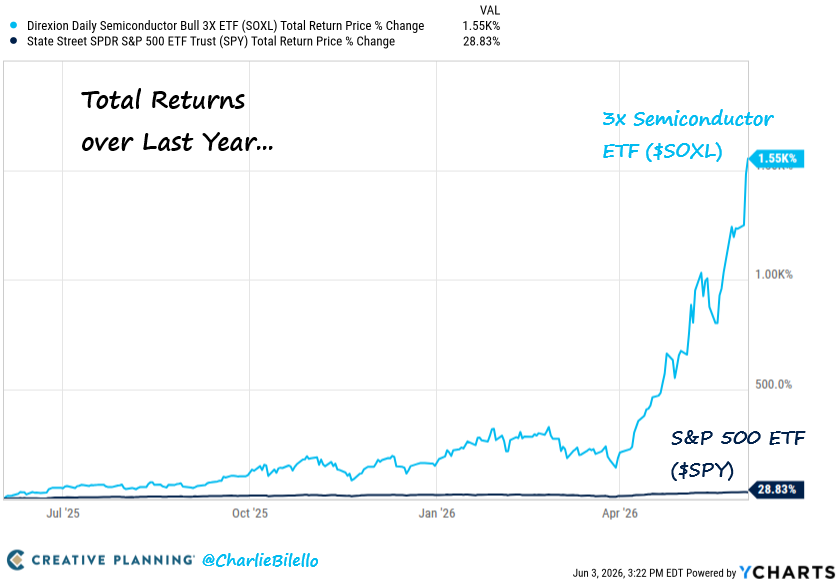
The 3x Semiconductor ETF is up 1,550% over the last year. That's a 16x return.
The last time we saw moves like this was in 1999-2000 during the dot-com bubble.
But today's version is even more extreme because leverage allows investors to pour gasoline on the fire.
“We will have a crash, I just can't tell you when, and I can't tell you how deep. But I can assure you, unfortunately, I wish I wasn't saying this, we will have a crash,” Andrew Ross Sorkin has said.
Let’s talk buy in points!
Here is a screen shot from @dividendvision of $BLOX
These charts show how important finding the right buy in points can be. You can see I own $BLOX in 5 different brokerage accounts I have. I’m up despite the fact that when you scroll down BLOX is just slightly down for the year. It is very important to research funds, news and moving averages before you buy. Always buy the fund that is on sale. You will see several nice buy in points on the chart below that I took advantage of.
And there is a huge payoff to doing your research and buying in correctly. If you look as the yield vs yield on cost. While BLOX is at 34.57% yield. The money I am making off my buy in points is actually 37.31%. So I am actually making almost an extra 3%
Every generational wealth transfer in history created a window.
Only the few moved through it...
• Farmland in the 1980s (prices dropped 60%, most farmers went bankrupt)
• Tech stocks in 2002 (fewer than 1 in 5 Americans owned any stocks at that time)
• Real estate after 2008 (home prices down 33%, most people panic-sold while institutions bought)
Right now, the opportunity is buying main street businesses from retiring boomers. 2.9 million owners are heading for the exit with no buyer lined up, and $10 trillion in assets behind them.
The ones who move in the next 5 years will set up their families for generations….
$QQQ $SPY
I am telling all my dear followers/ friends.
- Dont FOMO if you missed out on this rally
- Chasing now is risking $1 to make $1
- Nasdaq, S&P 500 both showing RSI divergence
- Only 45% of S&P 500 stocks are above its 50 day
Many extended stocks will pullback by 20-30% when the 5-7% pullback come. Its a clock work.
We have had an extremely rewarding run for two straight months, and shared a tons of wins. But now is when you want to want to protect profits, dont let Greed make your trading decisions.
We will get another window of fresh opportunities, we always do.
Here's the right strategy to follow, and make note of this- you can use it every year:
- Start dropping lagging stocks
- Start reducing exposure, trim positions
- Start planning buy levels for stocks you'd like to buy
- Ride the winners you have cushion on
Have a plan, Apply your process, And manage risk.
With oil back to $96 here we go back to Conoco and Diamondback
And, of course, higher yields....relentless but now there is more supply coming and it will be a much tougher slog
You earn decent money.
You’re not bad with money.
Yet it still feels like you’re living paycheck to paycheck.
The trap isn’t your salary.
It’s that every raise gets eaten by “lifestyle upgrades” before it can build wealth.
Income without structure just scales your spending.
One action: Track every dollar for the next 30 days. You’ll see the leaks.
It’s funny that after a stock market or a sector gets annihilated, it could present opportunities for investors
There are values out there, but the investors who experienced the contraction end up with the memory of the losses, so they stay clear
The new ones with a clear head and no memory/experience from the losses are at an advantage
Example includes people who owned stocks during the Great Depression, were likely scarred from stocks (1929 - 1954); The ones that weren’t alive didn’t have the mental baggage so they could be bullish in the 1950s and 1960s $DIA $SPY
I saw this with tech stocks, which really had a terrible 2000 - 2013, which scarred many (myself too). In hindsight, investing would have worked great, if you didn’t have the mental baggage from the dot-com bust $QQQ
Same thing with financials, which experience the GFC. They’ve done well since the end of GFC - $XLF
Energy did experience almost a “lost decade” 2014 - 2022, though things didn’t really turn ugly until Covid $XLE
These are some random thoughts that probably only make sense to me, as they deal with being scarred from investments when you experience the loss periods, and potentially not participating when they do appear cheap and promising (so you miss out potentially). Your investment experiences do shape you.
The flip side of course is if you have only experienced a roaring bull market, you may not be mentally prepared for an extended bear market (e.g. a lost decade like the 1930s, 1970s, 2000s)
This is where it is important to have a strategy to follow, and stick to it.
Lots of people in this space pick the wrong income ETFs, usually NAV-eroding ones, then jump to selling options, then chase the next thing.
Nothing is bulletproof. Do your due diligence. Options traders get wrecked too, but somehow everyone on 𝕏 is an options guru.