I've released or been part of teams that have released some amazing software in my lifetime.
@YourOwnAI version 0.9.0 is the release I'm most proud of.
Hang around software devs long enough, and you'll hear the phrase "make it work, then make it better". The release before this were the make it work steps and now we're making it better.
The headline feature for this release is the Holochain powered syncing of your data, encrypted and peer to peer between any computer you add Your Own AI on. It's pretty simple too. Install it on multiple computers, click Sign in With Flowsta on both, and then it all automatically happens.
For your encrypted Holochain conversations in Your Own AI, a private Holochain network is created and the conversations gossip encrypted peer to peer.
Your AIs and memories are also stored encrypted on your device, and they are also synced with your others devices via Flowsta Vault. Also Holochain powered. If you're a Holochain app developer, you can easily add this to your own apps when you use the Flowsta SDK. More info @ https://t.co/AMimwgmnW1
Something I'm very passionate about is providing alternatives to people and businesses who don't want to outsource their AI memory to anyone else. From a privacy point of view, of course, but a business building up its memory on a service that can just cut them off at any time could probably start to rethink that strategy.
So the memory enhancements have been front and centre in this release. I've gone on a deep dive on what Claude, OpenAI and a few other players do with memory and brought the good bits to Your Own AI. But of course, with one big difference, nobody can access it but you.
There are so many other features in this release. New online and offline models, plus so much more.
But it's the little touches and relentless efforts to track and squash the bugs that make this release really special.
If you've used Your Own AI before, this release is definitely one to upgrade to. If you haven't yet, it's a free download for Linux, Mac and Windows from https://t.co/TKEhZi6Tsx
Your next robotics project could start with these steps.
Today, we're open-sourcing Asimov 1's locomotion policy and the training code behind it, giving developers a foundation to build on.
Alongside the trained policy checkpoint, we're sharing our Isaac Lab-based training code, including reward definitions, hardware-tuned actuator configurations, and domain randomization settings.
That foundation gives you a starting point for your own experiments. Adapt the training setup to hardware changes. Explore different walking styles. Build toward new capabilities.
We've taken the first steps.
Build what comes next.
Asimov 1 locomotion: https://t.co/CJazjU57z4
xAI launched ~3 years ago
Since then:
Colossus 1 + Colossus 2 ≈ 670k GPUs
Grok Imagine
Grok Voice
Grok Build
Grok Bot
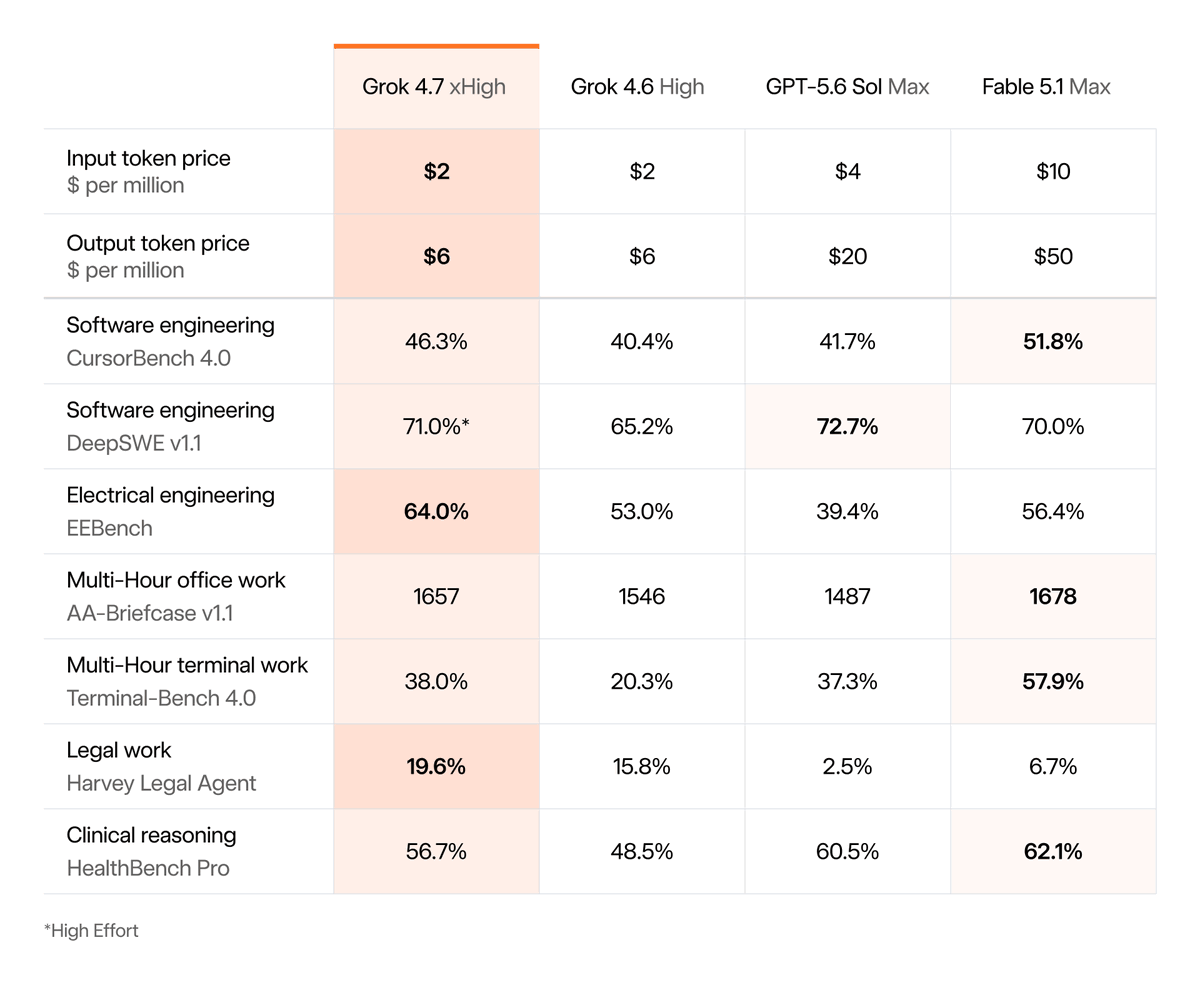
Grok 4.7
Grok didn’t just catch a leaderboard for a week.
models, agents, apps, compute under one roof... and they aren't slowing down
Just released @YourOwnAI 0.8.0.
This feels like such a special release, as the starting point 0.7.2 was already pretty solid.
There's a maturity in 0.8.0 that makes me feel really proud.
There's so much in it, I almost don't know where to start.
I use Your Own AI for coding a lot so in this release we went to town on the UI and UX for agentic projects. A complete overhaul. Switch back and forth between Simple and Detailed mode by clicking the toggle or Cntrl O shortcut.
In 0.7.x we ramped up dragging in documents, books, etc to fulfil our goals from the @McConaughey on Rogan vid. But with 0.8.0 we stepped it right up. If you move a document in your file structure, it will notice it's missing and you can either relink or search for it. If you've ever used Da Vinci Resolve for Video its designed just like its media management.
Another thing you won't see but if you have a lower spec computer then you'll feel is the dynamic headroom work. The models run better when you don't use up all of the system resources, so we make sure we keep some resources for your computer to run. If you open up new browser tabs, it will automatically adjust the size of the headroom. Possibly one of the benefits of developing on a low spec machine myself is that I know what it's like to not have huge GPU.
That reminds me, we made Your Own AI work local Offline models on a 2014 Mac in this release. Not too quickly, but offline first working on a 2014 machine is pretty great.
There are new Offline models, Hemmingway 1 and The Drummers Skyfall 31B. Both are awesome for writing.
The new OpenAI and Grok Online models are in it too.
Also @obsdmd & @logseq notes integration. Goto Tools in the Add-ons section to set up.
There is heaps more. It's rad.
I mean, look at the size of this changelog:
https://t.co/7LMDJEdKhI
If you haven't downloaded it yet, it's time. If you're already running Your Own AI, then this update is really worth it.
Your Own AI 0.8.0 is out 🎉
Download @ https://t.co/gJHS9nmqyR
🗒️ Your AI can read and write to your Obsidian and Logseq notes.
📂 Keep a folder in sync. Your AI keeps up as your files change.
💬 Talk while it's answering. Your message goes next.
🛠️ New Projects UI overhaul. Agentic coding and projects never looked so good
Plus so much more..
Grok 4.7 places @spacexai as third, after Anthropic & OpenAI, for agentic coding.
When factoring in that Grok is significantly faster & lower cost, it’s a great choice for your everyday workhorse.
🚨 BREAKING: US Treasury Secretary Scott Bessent declares OpenAI management personally responsible for HuggingFace hack
> "The Hugging Face incident, that is the responsibility of the OpenAI management, not a bunch of agents."
> "It is humans who are responsible, not the AI."
> "What we shouldn’t do on safety is to give these labs a liability exemption, which is what they are asking for."
> "The best way to guarantee safety is that the creators are liable for what they build and generate."
It’s OVER
When you prompt a push-in, describe the final frame too. Where the camera ends matters as much as how the camera moves.
Our LTX-2.5 guide walks through a prompt rewrite and fixes for camera drift. https://t.co/f3nD6NrTV4
In response to the ZCode product security issues reported by the community, we have completed the necessary remediation and sincerely apologize to all our users.
We have open-sourced ZCode at https://t.co/oADgletuha, placing the code under community scrutiny and making ZCode more open and transparent.
We sincerely thank the community developers who previously identified issues in ZCode. Going forward, we will establish an ongoing product security vulnerability reporting and response process. We welcome developers to continue reviewing ZCode and reporting potential issues, and we will provide rewards based on the severity of the issues reported.
With respect to the code data referenced by the community, we confirm that no such data is retained and that it has never been used for model training.
Following the remediation, we invited the China Academy of Information and Communications Technology (CAICT) and NSFOCUS to conduct security assessments. The results are as follows:
Through its technical assessment, CAICT confirmed that the zcode-prod Alibaba Cloud OSS bucket is in a zero-data state. Security remediation has been completed in the ZCode v3.14.0 client. The Repo Wiki feature has been removed, and the workflow for generating and uploading local repository snapshots has been disabled.
NSFOCUS confirmed that all data objects in the zcode-prod Alibaba Cloud OSS bucket, as well as the bucket itself, have been deleted. Remediation has been completed in the ZCode v3.14.0 client. The Repo Wiki entry point and the associated generation workflow have been removed, and no functional path capable of triggering the generation of local repository snapshots or transmitting local files externally was identified.
Once again, we sincerely apologize and welcome continued scrutiny from the community. The full security assessment report will be released soon.
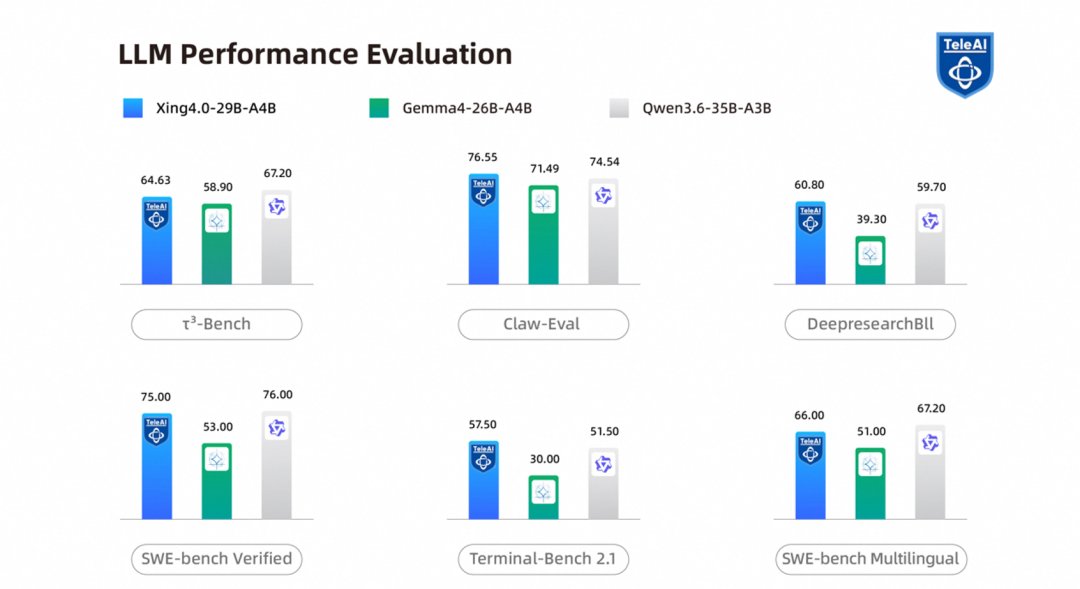
🔥China Telecom has open-sourced Xing4.0-29B-A4B
• 29B total / 4B active parameters
• 256K native context, expandable to 512K
• Trained entirely on Ascend NPUs + MindSpore
• 75.0 on SWE-bench Verified
• 93.52 on SuperCLUE Agent, ranked #3
With 4-bit quantization, it uses just ~15GB VRAM, enabling local long-context inference on 24GB consumer GPUs like the RTX 3090 and 4090.
🚨BREAKING: Jensen Huang just EXPOSED Dario and Altman’s "Rogue AI" grift to avoid getting sued into oblivion under EXISTING law
“Don't let this doomsday narrative cause somebody to relieve them of the laws that currently exist.
Go and read between the lines. They're actually not asking for more laws; they're asking to be relieved of the laws we do have.”
ABSOLUTE TRUTH NUKE
Moving fast and building safely aren’t at odds.
AI should move as fast as we can, with rigorous testing, monitoring, and safeguards every step of the way.
@JensenHuang on @CBSSunday: