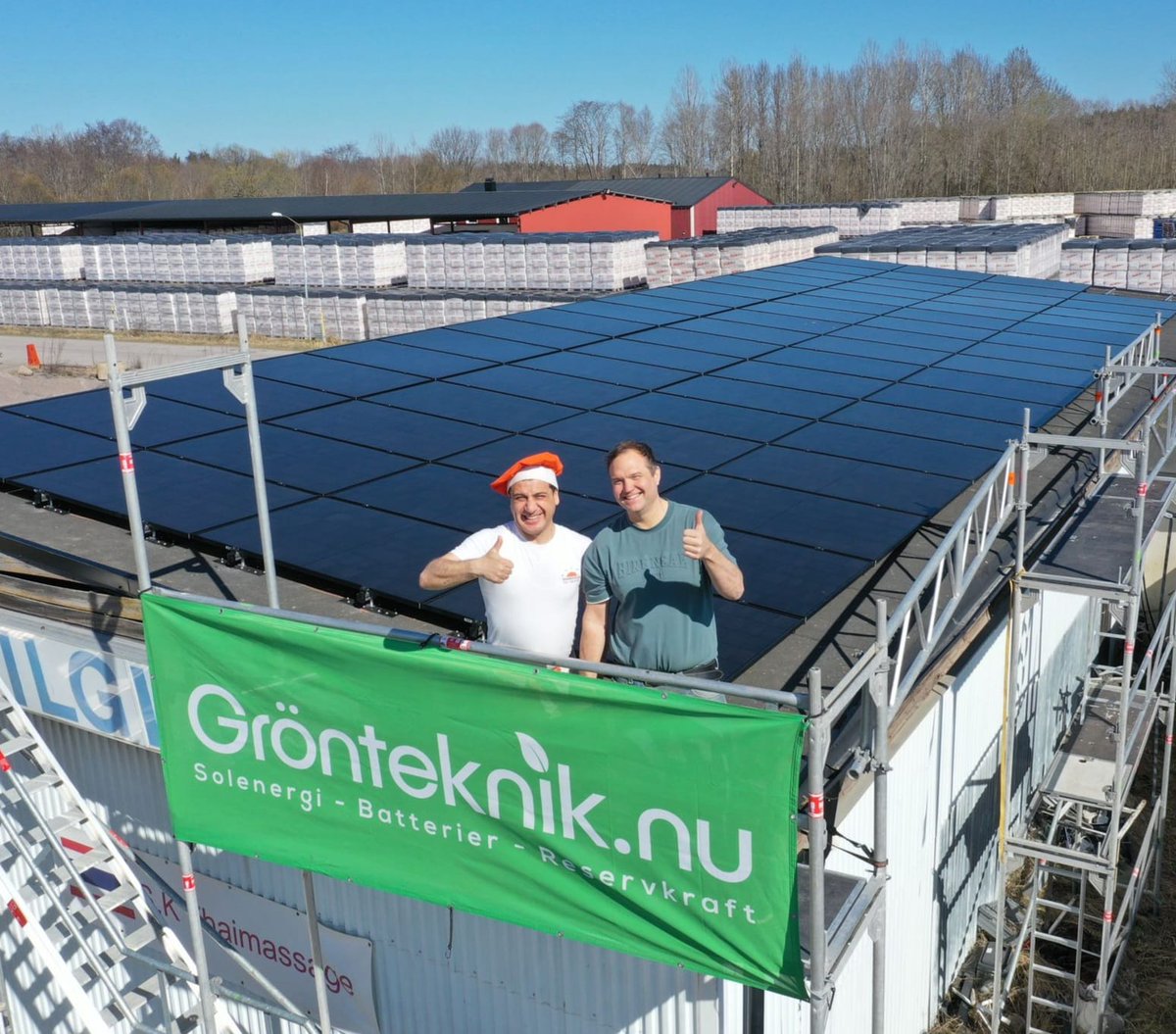
A few weeks ago we ran the power for the University of Gävle's STEM and AI Day — 250 people in one hall. We'd planned for about 11 kilowatts (kW); with the crowd and ventilation it climbed to ~44 kW. The whole room ran off-grid on rooftop solar and Pelle's Tesla.
We're back. After a short rebrand, IntelliShares is live again, same team and the same projects. We turn real, producing green infrastructure into tokenized real-world assets (RWA) you can own a slice of. https://t.co/1sBYR7VP4G.
Our first asset is live: Casa Latina, a pizzeria in Skutskär, Sweden. 31.28 kWp of solar on the roof, commissioned in May. The meters are public and refresh live on the project page. People already own about a fifth of it.
Infrastructure risk: weather, equipment, energy contracts.
Crypto risk: narratives, sentiment, depegs.
One you can model with decades of data.
The other changes with a tweet.
Know what you own.
Utility-scale solar farms get funded.
Banks understand them.
Ticket sizes justify the due diligence.
Commercial rooftops sit in a dead zone:
→ Too large for residential financing
→ Too small for institutional infrastructure funds
→ Due diligence costs exceed what the project can absorb
But rooftops have advantages farms don't:
→ Energy consumed on-site - minimal transmission loss
→ No farmland conversion - zero land-use conflict
→ Faster to deploy - weeks, not years
The projects are good. The financing model is broken.
Batteries don't just store energy.
They keep the grid from collapsing.
European grids run at around 50 Hz.
When demand exceeds supply, frequency drops.
When supply exceeds demand, it rises.
Even small deviations can cascade into blackouts.
Batteries respond in milliseconds - injecting or absorbing power to maintain balance.
Grid operators pay for this capability continuously.
Not for the energy. For the speed.
This is one of the most reliable income sources in energy infrastructure, and most people don't know it exists.