Most of your software estate never touches a dev pipeline.
🔴 COTS — vendor binaries, no source access
🟠 Legacy — the team that built it is long gone
🟡 Runtime — patches & drift outside the original build
Binary Composition Analysis fills the gap SBOMs can't reach.
#SBOM#CBOM
SBOM is evolving. Are you? 🔐
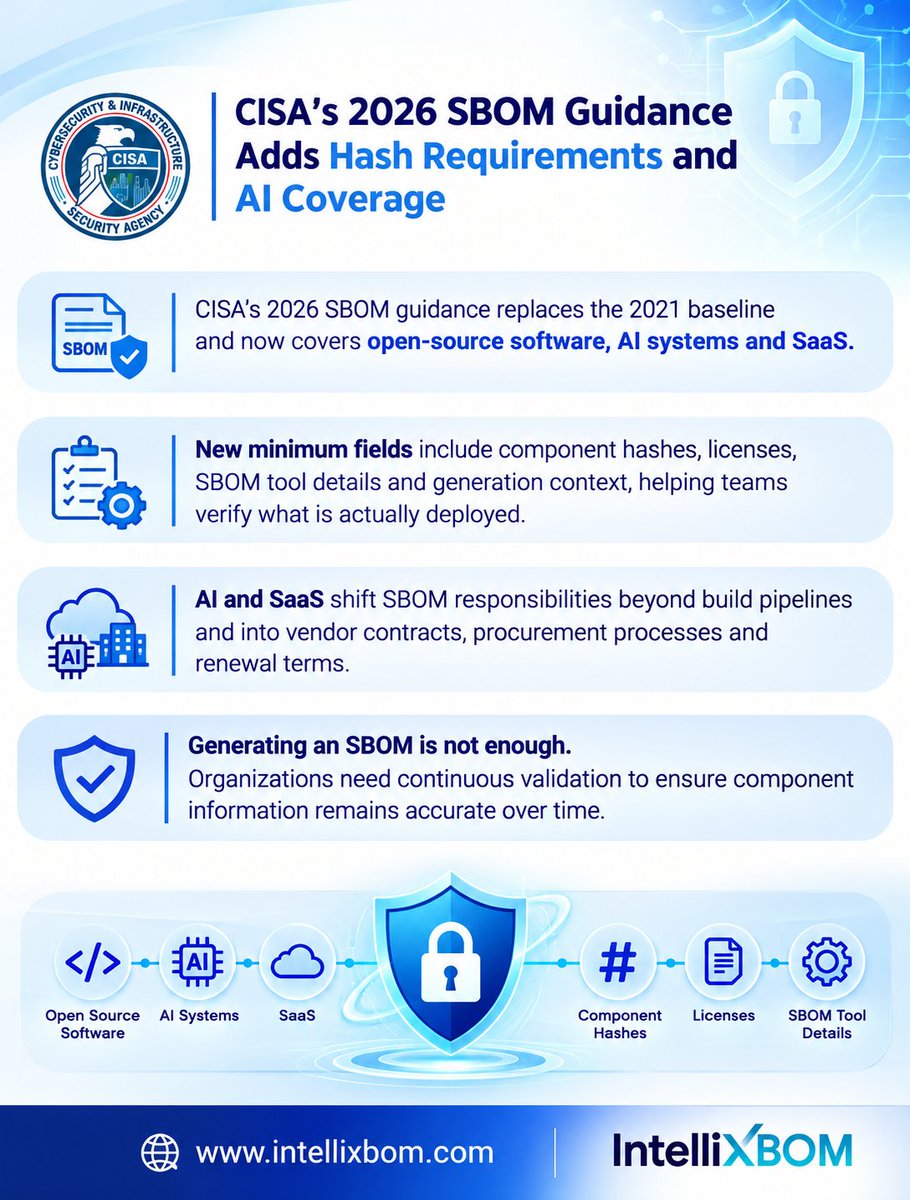
@CISAgov's 2026 guidance adds support for AI & SaaS, introduces component hashes, and emphasizes continuous validation not just SBOM generation.
Trust your software supply chain. Verify it continuously.
#SBOM#CyberSecurity#DevSecOps#CISA
Is Your SBOM Really Trustworthy? An SBOM is only as valuable as the trust behind it. Generating an SPDX SBOM is a great first step toward software supply chain transparency, but how do you prove it hasn't been modified after it was created?
The answer: Digitally sign your SBOM.
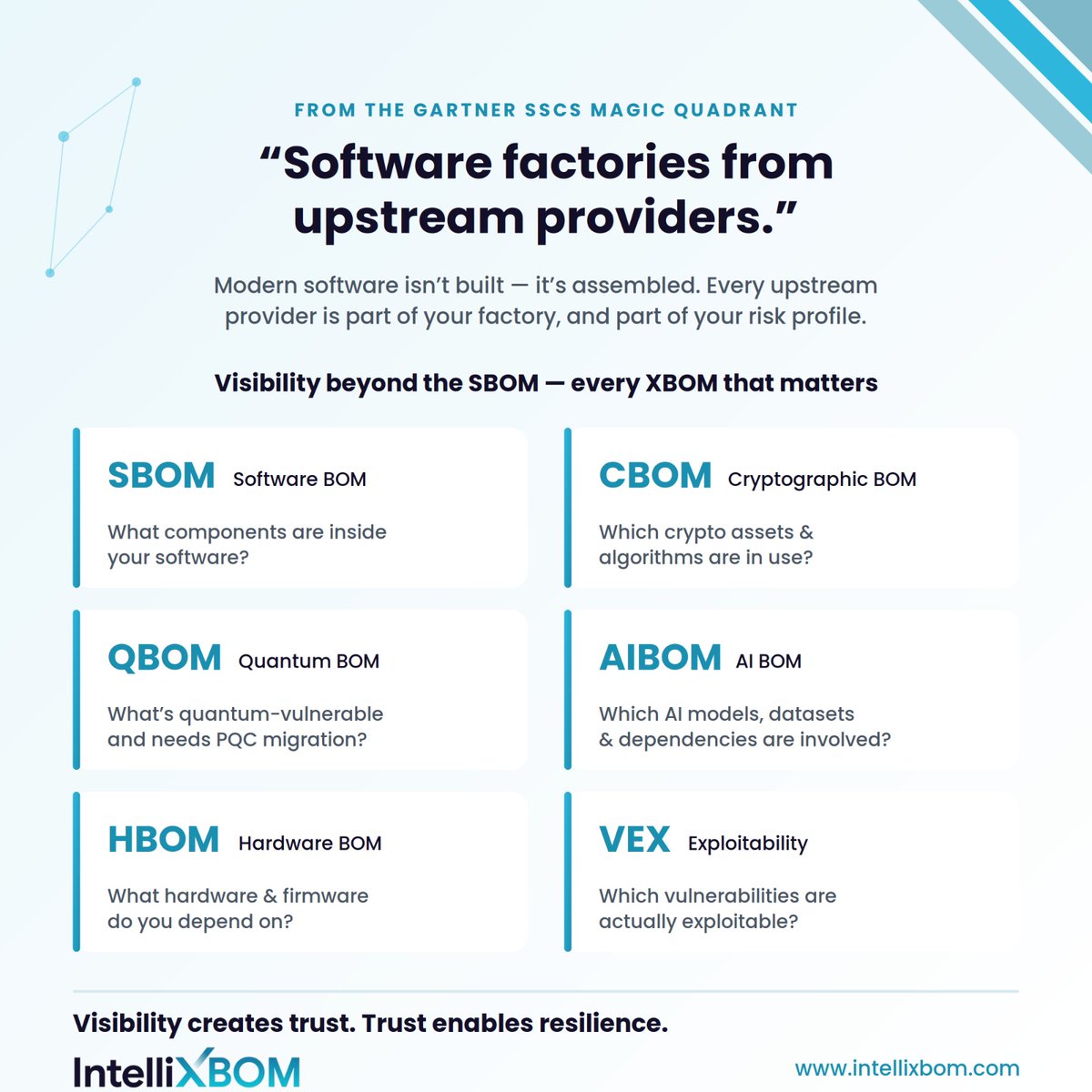
Modern software isn't built in isolation.
Every application depends on open-source libraries, third-party packages, AI-generated code, containers, cloud services, hardware, and countless upstream suppliers.
Each dependency expands your attack surface.
#SoftwareSupplyChain#SSCS
Can you prove that every artifact in your software supply chain is authentic?
If not, you're leaving room for tampering and supply chain attacks.
🔒 Sign what you build.
✅ Verify what you deploy.
Because you can't secure what you can't see.
#IntelliXBOM#SBOM#ArtifactSigning
FUN FRIDAY: When your cereal contains peanuts, you get an allergy warning. When your software contains Log4j, you get a board meeting. SBOM is like a food ingredient label for software.
#SBOM#SupplyChainSecurity#CyberSecurity
Modern applications are built on a complex ecosystem of open-source components, third-party libraries, containers, and transitive dependencies. While these accelerate innovation, they also introduce hidden risks that can impact security, compliance, and business continuity.
Your application isn't just what you wrote. It's also the 1,247 packages your packages secretly invited to the party. Modern software supply chains are like potlucks, everyone brings something, but nobody checks the ingredients. Know your dependencies. Track your #SBOM#IXB
With 70–90% of modern applications built on open-source components, visibility into dependencies is no longer optional. The real challenge isn't knowing what you use, it's knowing when those components reach End-of-Life (EOL), become vulnerable, or are compromised upstream #IXBOM
Today's encrypted data could be tomorrow's plaintext. That's the risk behind Harvest Now, Decrypt Later, where attackers steal encrypted information today and wait for quantum computing to do the rest. The future threat may already be sitting in someone's archive.
#Quantum#IXB
Your security is only as strong as the vendors, software, cloud services, and partners connected to your business. As cyber threats increasingly target supply chains, organizations must secure the entire digital ecosystem, not just their own perimeter.
#DigitalSupplyChain#IXB
Do you know: Software risks hidden inside apps that process your customers' personal data?
While India's DPDP Act doesn't explicitly require SBOMs, Software Bills of Materials provide visibility to identify vulnerable components, manage 3rd-party risk and strengthen digital trust
Fun fact: The term "Software Bill of Materials" (SBOM) was inspired by manufacturing! Just like a car has a parts list tracing every bolt and chip, modern software needs an SBOM to track every library, dependency, and component, because you can't secure what you can't see.
#SBOM
A single software product can contain 200+ open-source components and 84% of codebases have at least one known vulnerability hiding in them.
That's why SBOMs (Software Bill of Materials) are no longer optional. They're your X-ray into the supply chain. #SBOM#SupplyChainSecurity
Most orgs treat End-of-Life software like expired milk, they know it's bad, but it's still sitting in the fridge.
EOL components = unpatched CVEs + no vendor support + dependencies your SBOM didn't catch. Your supply chain is only as secure as its oldest forgotten library.
#SBOM
Most teams don't get breached because they're careless. They get breached because nobody actually knows what's running in their stack.
Visibility isn't a nice-to-have. It's the whole game.
#CyberSecurity#SBOM#DevSecOps#SupplyChainSecurity