Making religion part of the solution to global challenges by promoting mutual recognition and respect between Judaism and other religions.
🕎 ✝️ ☪️ 🪯 🕉️ 🛐 🔯
Going to the UAE now says something about what we believe interfaith partnership is for: not a fair-weather pursuit, but a foundation for the future we want to share.
Last week, JIC and @TheMinistryofR2 led 30+ interfaith leaders to Abu Dhabi for the Third International Dialogue of Civilizations and Tolerance Conference.
@Dralnoaimi of @manaraccd captured what this visit was really about: "The Abraham Accords are meant to create connections among people, communities, and nations." At JIC, our work is built on exactly that premise. This delegation was one expression of that responsibility.
Stay with us this week for the full story from the delegation.
Jerusalem.
A name that carries the weight of millennia, for Jews, Muslims, Christians, and, of course, for the world. That's why it's in our name.
Watch to see why this city is the ultimate point of connection between heaven and earth.
The point was clear: diversity, coexistence, and a shared covenant of citizenship are not modern inventions or borrowed ideals. They are ancient foundations, and the work now is to bring them back to the forefront.
That is the bridge we are building together.
Diversity and coexistence aren't modern ideals, they're fourteen centuries old!
At the Third International Dialogue of Civilizations and Tolerance Conference in Abu Dhabi, Rabbi Dr. Yakov Nagen turned to the work of our partner Dr. Ali Rashid Al Nuaimi, Chairman of the Manara Center for Coexistence and Dialogue.
In his books "Diversity and Coexistence" and "National State," Dr. Al Nuaimi envisions a society that holds many faiths, races, and languages within one shared civic covenant, and shows that coexistence is rooted in Islam itself. Rabbi Nagen drew the line back even further to the Constitution of Medina, drafted some fourteen centuries ago, which already recognized Jews and other communities as partners with their own faith and their own rights within a single society.
@dralnoaimi@manaraccd
@rabbiyakovnagen
More than 30 Israeli interfaith leaders traveled to the UAE during one of the most sensitive moments in the region's recent history. It was the first Israeli delegation since the outbreak of the war with Iran, and believed to be the largest of its kind with support from @TheMinistryofR2.
Rabbi Dr. @arilavi moderated the panel on Jewish-Muslim religious fraternity, and when Rabbi Dr. @YakovNagen stood up and quoted the Quran from memory, the entire hall went quiet. That moment said more than any policy statement could.
Thanks to our partners like @emiratesscholar for helping with everything!
Read more in @IsraelHayomEng's full article on the delegation: https://t.co/WoHw72f2cf
If you believe in God, what are you actually supposed to do about it?
Surah Al-Baqarah verse 3 answers that directly. Those who believe in al-ghayb, the unseen, do two things: they pray, reaching upward toward God, and they give charity, reaching outward toward other people.
Those same two movements run through Judaism as well, and that shared structure is what makes serious Jewish-Muslim dialogue possible.
New episode of People of the Book drops every Wednesday.
At IDCT 2026 in Abu Dhabi, Dr. Firas Habal, President of the Emirates Scholar Center, said, "We realize that the key to changing the Middle East is education... We see this partnership as a significant bridge for reconciliation, and for having a long-lasting impact on the region in the spirit of tolerance and mutual understanding."
We joined the conference to advance interfaith diplomacy through serious, sustained engagement. Rabbi Dr. @arilavi moderated a panel on Jewish-Muslim religious fraternity featuring Rabbi Dr. @YakovNagen alongside @DrAlsarrah and Qadi Iyad Zahalka of the Sharia Court of Appeals.
A follow-up delegation of Israeli educators will continue the work in the weeks ahead.
Exposing antisemitism alone rarely defeats it. Rabbi @arilavi's research points toward a different path: building a broad coalition of non-Jewish supporters to counterweigh the forces driving it.
Monday, June 8th, 1:30pm EST / 8:30pm Israel time
Register here:
https://t.co/1skZoQ7zTg
The ant teaches us not to steal, yet it leaves a friend struggling under a grain too heavy to carry. Nature holds both lessons at once, and that is why we were given a Book. Join along every Wednesday.
Christians have lived in Israel for centuries, so why do so few of us really know them?
"Between Hostility and Brotherhood" brings three years of documentation and dialogue on Jewish-Christian relations in Israel into one room. Convened with leading Israeli institutions, the École Biblique, and the RFDC Hotline.
Save the date.
The longest chapter in the Quran is named after a cow.
The reason is a wild scene where Moses has the Israelites slaughter a cow and a murdered man briefly revives to name his killer. Readers of the Hebrew Bible will recognize echoes of their own cow rituals.
We are reading all 286 verses to see how they connect. New episode every Wednesday.
The Quran and the Torah do not compete over Abraham, they complete each other. Yitzhak is given great blessings by God, Ishmael too is saved and receives a blessing from God, and both sons are loved. This shared heritage is one Jews, Muslims, and Christians can build peace on.
Eid Mubarak!
The conversation about faith and responsibility keeps growing, and there is room for you in it. Our WhatsApp community gathers leaders, educators, and partners for curated readings, JIC updates, and weekly reflections explored with real openness.
Join us at https://t.co/1ybfbYxpEl
The verse that ends the Qur'an's opening chapter was never about us. Here is why that matters.
The closing verse of Surah al-Fatiḥah has carried readings that stretched its warnings onto entire communities. The text itself does not go there. It speaks to individual moral failure. The Torah holds the same kind of criticism and the same distinction applies.
Join us every Thursday. Next week, Surah al-Baqarah.
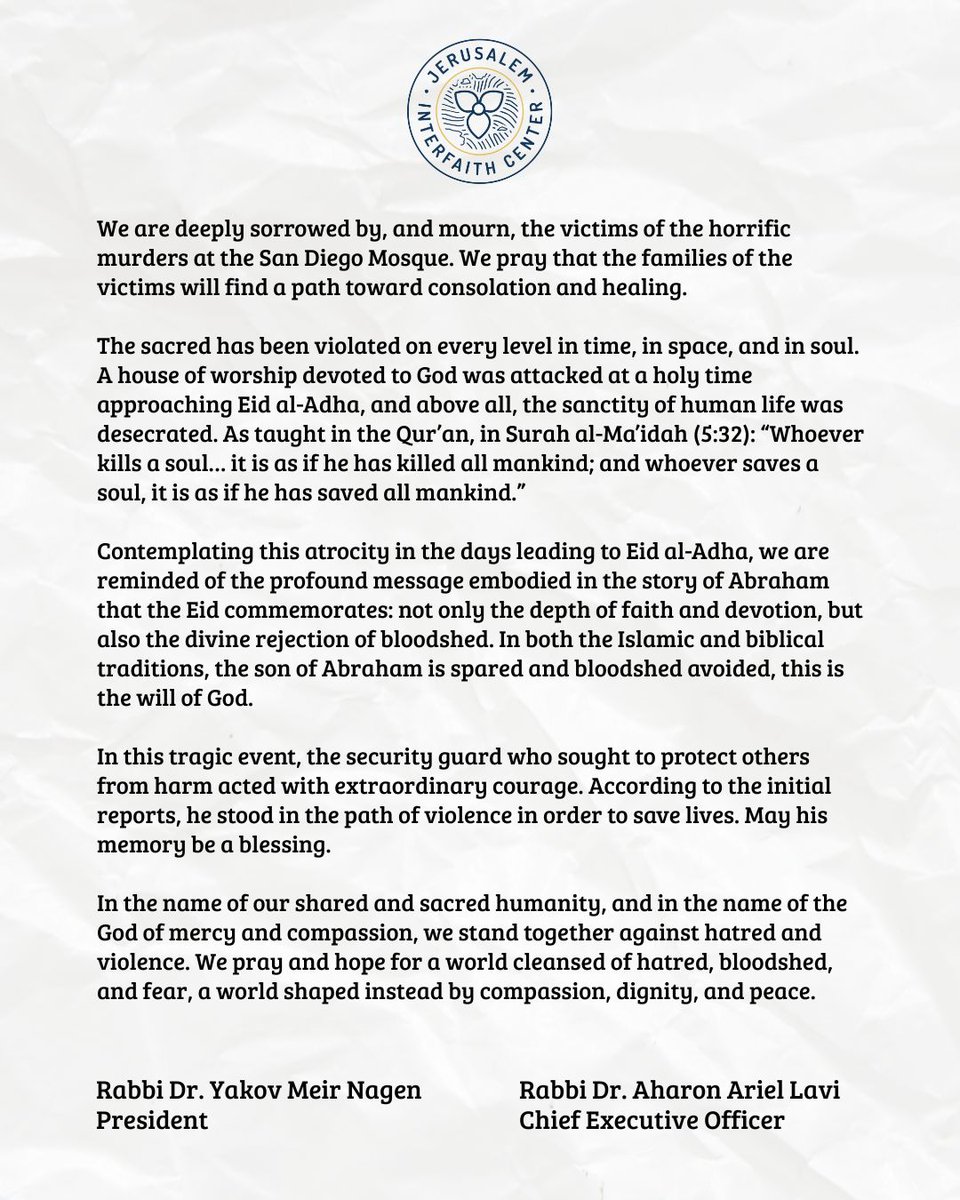
Heartbroken by the attack on the San Diego Mosque. Our prayers are with the victims and their families.
Faith means choosing compassion over violence. The Qur'an is clear: saving one life is saving all humanity.
We honor the security guard who protected others. That's true courage.
We stand together against hate. Always.
Is Man's relationship with God a bottom-up or top-down approach?
One verse from daily Islamic prayer holds two movements at once. The human reaching upward. The Divine reaching down. And Jewish tradition carries the same instinct in strikingly similar language.
Join us every Wednesday.
Forty years ago, a Pope walked into a synagogue and changed history.
On April 13, 1986, John Paul II entered the Great Synagogue of Rome and called the Jewish people the Church's "dearly beloved brothers and, in a certain way, our elder brothers." This spring, JIC was represented at the 40th anniversary commemoration in Washington, D.C.
The work John Paul II began is the work we continue every day in Jerusalem.
Maliki Yawm ad-Din. In Hebrew, that's Melekh Yom HaDin.
The King of the Day of Judgement. What does that refer to?
People of the Book, episode 4. Arabic and Hebrew share more than roots as they share a vision of accountability. Judgment Day, in both traditions, is there to orient us and remind us that what we do in this world carries weight.
Every Wednesday with Rabbi @alavi. Watch below.
Jewish and Muslim traditions share incredible similarities.
Rabbi Dr. @YakovNagen shared the Jewish practice of whispering the Shema to a newborn and we explored the beautiful Islamic parallels with the Shahada. Discovering these shared practices breaks down fear and builds mutual respect.
Listen to the full podcast right here: https://t.co/02APcOx9T7