Interfor International‘s Weekly Security Digest - June 30, 2026
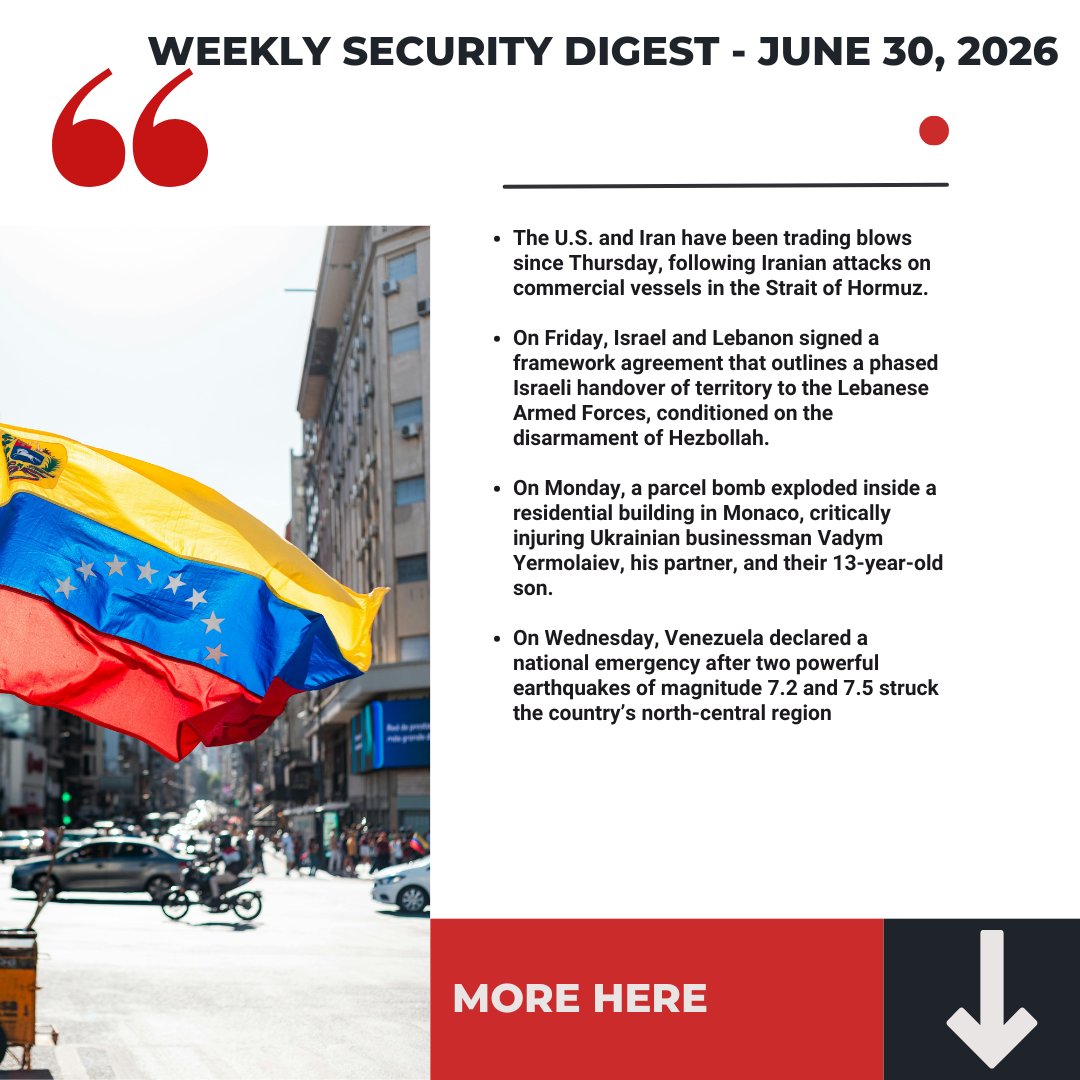
The U.S. and Iran have been trading blows since Thursday, following Iranian attacks on commercial vessels in the Strait of Hormuz
On Friday, Israel and Lebanon signed a framework agreement that outlines a phased Israeli handover of territory to the Lebanese Armed Forces, conditioned on the disarmament of Hezbollah
On Wednesday, Venezuela declared a national emergency after two powerful earthquakes of magnitude 7.2 and 7.5 struck the country’s north-central region
#geopolitics #iran #hormuz #lebanon #venezuela
https://t.co/cuxShxN7MO
The world got a little more dangerous this week.
From Iran sanctions relief to Chinese espionage convictions and political instability in Europe, the signs were hard to ignore.
Several developments caught our attention this week:
➜ The U.S. issued temporary sanctions relief to Iran as negotiations continue over the Strait of Hormuz and a broader regional de-escalation agreement. Questions remain over whether meaningful nuclear concessions will follow.
➜ Israeli and Lebanese officials held another round of U.S.-mediated talks aimed at reducing tensions along the border and preventing escalation involving Hezbollah.
➜ U.K. Prime Minister Keir Starmer announced his resignation, triggering a leadership contest that could reshape British politics.
➜ A U.K. court sentenced a Border Force officer and a Hong Kong trade official for gathering information on behalf of Chinese intelligence services, underscoring continued concerns around espionage and foreign influence operations.
➜ African and Caribbean leaders endorsed a 19-point reparations framework calling for formal apologies, financial compensation, debt relief, and the return of cultural artifacts linked to the transatlantic slave trade.
➜ Hundreds of demonstrators gathered in New Delhi to protest alleged irregularities in India's national medical entrance examination, reflecting broader concerns around transparency and governance.
➜ A Washington Post investigation renewed scrutiny over the alleged influence of the Science of Identity Foundation on former Director of National Intelligence Tulsi Gabbard.
While these stories span different regions and issues, they point to a common trend:
Geopolitical risk, intelligence activity, political instability, and reputational threats are becoming increasingly interconnected.
For organizations operating internationally, staying ahead of these developments isn't just about awareness, it's about preparation.
Follow the @InterforInt International Company Page for weekly insights on the #geopolitical, #security, #intelligence, and #cyber developments shaping the global #risk landscape.
Interfor International‘s Weekly Security Digest - June 23, 2026
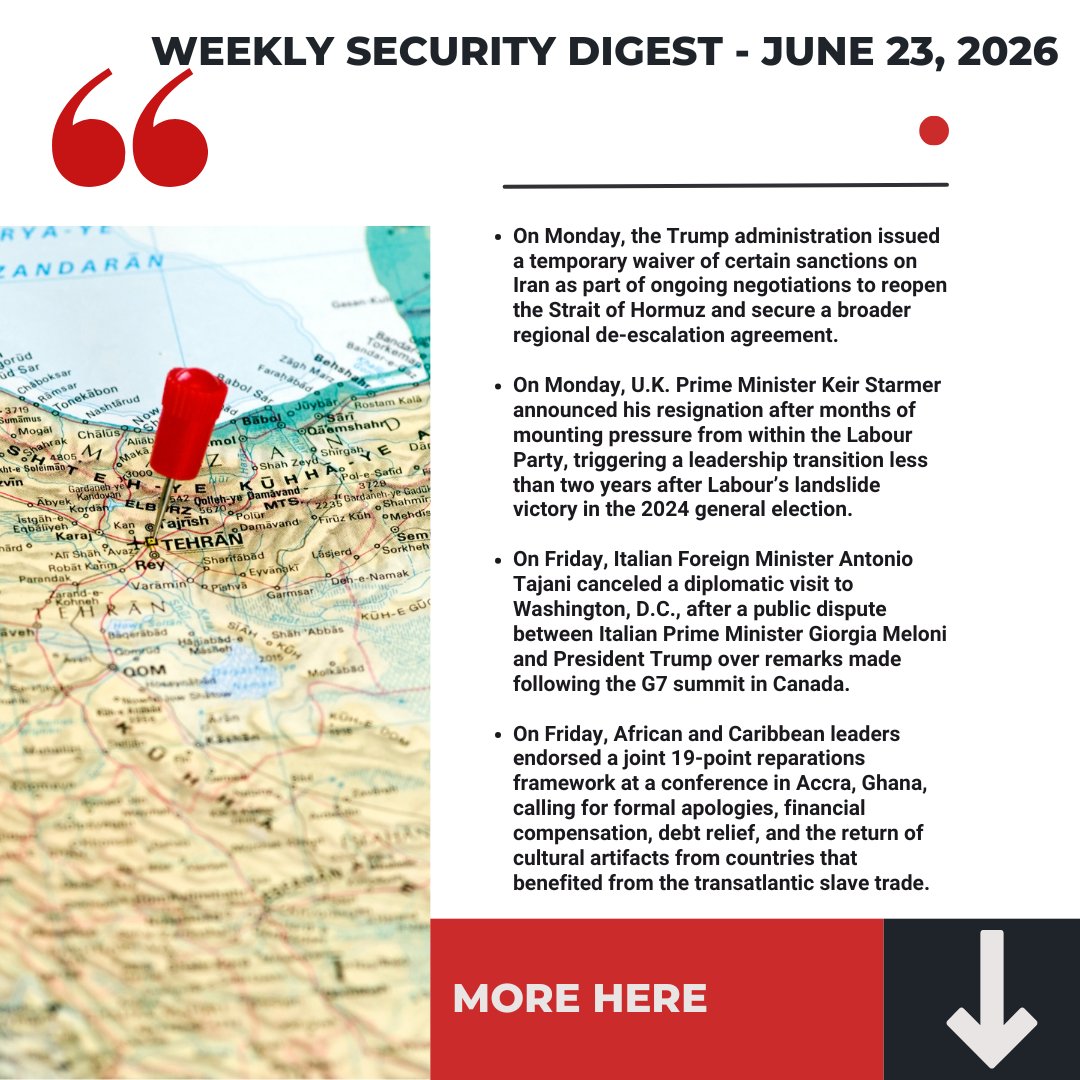
→ On Monday, the Trump administration issued a temporary waiver of certain sanctions on Iran as part of ongoing negotiations to reopen the Strait of Hormuz and secure a broader regional de-escalation agreement.
International Affairs
→ On Monday, U.K. Prime Minister Keir Starmer announced his resignation after months of mounting pressure from within the Labour Party, triggering a leadership transition less than two years after Labour’s landslide victory in the 2024 general election.
#safety #security #Geopolitics #HormuzStrait #iran #MiddleEast
https://t.co/mH0GXeHtNP
During a recent presentation to @ASIS_Intl International's Extremism & Political Instability Community, I shared a perspective on why AI is becoming a target of growing hostility.
The biggest threat to AI might not be AI itself.
It might be the fear that surrounds it.
Throughout history, people have struggled with emerging technologies. Not necessarily because the technologies were dangerous, but because they were unfamiliar. What we don't understand creates uncertainty. And uncertainty has a way of making people uncomfortable.
We're seeing that play out with AI today.
The resistance comes from many different places. For some, it's concern about jobs. For others, it's distrust of large corporations. Some worry about environmental impact. Others simply don't know what AI means for their future. The motivations may differ, but the underlying emotion is often the same.
Fear of the unknown.
When people feel threatened by change, they don't always engage with it. Sometimes they fight it. Sometimes they reject it. Sometimes they work to slow it down or push it away entirely.
That's a very human response.
And that human reaction is part of what makes this issue so important to understand. Watch the full discussion below for more on the growing intersection of #AI, #extremism, and #security risk
The war may be slowing down.
The uncertainty is not.
The United States and Iran have agreed to a Memorandum of Understanding that would reopen the Strait of Hormuz and begin a 60-day period of negotiations around Iran's nuclear program.
On the surface, the agreement reduces the immediate risk of escalation.
Underneath, significant questions remain unanswered.
Three issues stand out.
First, Israel's response.
⤷ If the agreement is ultimately viewed as offering limited concessions from Iran, frustration in Israel is likely to grow. Prime Minister Netanyahu has spent years arguing that Iran represents the central security challenge facing the country. Any deal perceived as falling short of that objective could create political and strategic tensions in the months ahead.
Second, the future of the Strait of Hormuz.
⤷ While both sides have agreed to reopen the waterway, it remains unclear whether Washington and Tehran share the same understanding of how that process will work in practice. Even small disagreements around enforcement, inspections, or coordination could create renewed friction.
Third, the nuclear negotiations themselves.
⤷ A comprehensive agreement within 60 days appears unlikely. Extensions are more probable. At the same time, history suggests that negotiations of this scale remain vulnerable to political pressure, changing regional dynamics, and breakdowns in trust.
The Middle East was not the only source of geopolitical risk this week.
Elsewhere:
⤷ Riots broke out across parts of Northern Ireland and Scotland following a knife attack in Belfast, highlighting growing tensions around immigration, public security, and community relations.
⤷ Russia launched another major wave of missile and drone strikes across Ukraine, including damage to Kyiv's historic Pechersk Lavra monastery, a UNESCO World Heritage Site.
⤷ The United Kingdom announced new sanctions targeting Russia's shadow fleet, financial institutions, and military procurement networks as Western governments continue efforts to constrain Moscow's ability to finance the war.
⤷ South Korea's former President Yoon Suk Yeol was sentenced to 30 years in prison, adding to one of the country's most significant political crises in decades.
The war between Israel, Iran, and the United States may be entering a new phase.
But uncertainty remains the defining feature of the region's security environment.
To stay ahead of the #geopolitical, #security, and business #risks shaping today's world, follow the @InterforInt Company Page.
The longer the Iran war remains unresolved, the more likely Gulf governments are to distance themselves from the US and pursue independent foreign policies, notes @InterforInt’s @DonAviv. https://t.co/WK6OmtT7hW
Interfor International‘s Weekly Security Digest - June 16, 2026
Middle East
→ On Sunday, the U.S. and Iran agreed to a Memorandum of Understanding (M.O.U.) to reopen the Strait of Hormuz and cease hostilities. The official signing is scheduled for Friday in Geneva, initiating a 60-day period for negotiations on the nuclear issue.
#iran #HormuzStrait #middleeast #war #Geopolitics
https://t.co/JjDmNw9M0R
What will the post-war Middle East look like?
Much of today's discussion focuses on #ceasefires, #military operations, #oil prices, and the next round of negotiations between the United States and Iran.
But even if the fighting ends tomorrow, the strategic #uncertainty will not.
The most likely outcome is neither a decisive victory for either side nor a comprehensive diplomatic settlement. Instead, we are likely heading toward an uneasy ceasefire that pauses the conflict without resolving the underlying issues that caused it.
That uncertainty will have consequences across the region.
Gulf states will be forced to make economic and foreign policy decisions without clear answers about America's long-term role, Iran's future intentions, or the durability of regional security arrangements.
As a result, we may see countries increasingly pursue independent strategies, balancing relationships with the United States, Iran, China, Europe, and Russia according to their own interests.
For the United States, the challenge goes well beyond ending the current conflict.
What is ultimately at stake is the future regional order and America's role within it.
The post-war Middle East may prove more consequential than the war itself.
To read the full article, click here: https://t.co/aFimVKM0qw
For decades, #security planners assumed that disrupting global shipping required ships.
Today, low-cost drones are forcing a rethink.
That was one of several important insights discussed during Interfor Academy's briefing featuring Sam Worby and Marc Polymeropoulos, @Mpolymer , moderated by @Selllikeaspy Jeremy Hurewitz.
The one theme that stood out was that technology is changing the nature of conflict faster than many organizations can adapt.
For business leaders, geopolitical developments are no longer distant headlines. They increasingly shape supply chains, operations, investment decisions, and risk management strategies.
Thank you to Sam, Marc, and Jeremy for a thoughtful discussion on one of the world's most consequential regions.
What #geopolitical trend do you think organizations are underestimating today?
Interfor International‘s Weekly #Security Digest - June 9, 2026
Middle East
→ On Sunday morning, #Israel conducted airstrikes on #Hezbollah targets in Beirut. #Iran, claiming that Israel had violated the ceasefire, launched a missile barrage toward Israel. Israel responded with strikes on Iranian air defense systems and other infrastructure used for weapons manufacturing.
International Affairs
→ On Tuesday, thousands of protesters gathered in Tirana, #Albania, to oppose plans for a luxury resort development on the country’s southern coast. Jared Kushner’s investment firm, Affinity Partners, is leading the project.
#geopolitics
https://t.co/YHElVqVZl5
Sam Worby and @Mpolymer Marc Polymeropoulos have spent decades analyzing the forces shaping the Middle East. This Tuesday, they'll help us make sense of what comes next as the U.S. and #Iran explore diplomatic off-ramps while violence continues across the region.
For businesses, governments, and security leaders, the months ahead remain highly uncertain.
During this briefing they'll discuss:
𖧹 Shifting Gulf security dynamics
𖧹 Evolving regional alliances
𖧹 Israel's strategic calculations
𖧹 What the months ahead could mean for businesses, governments, and regional stability
The conversation will be moderated by Interfor Academy's @Selllikeaspy Jeremy Hurewitz and followed by a live audience Q&A.
June 9 | 12:00 PM ET
Join the conversation:
https://t.co/Ei9Wb8RuAw
Very timely webinar briefing tomorrow at noon ET open to all. If you register but can't make it you'll get a link email with the recording afterwards. I will speak with former CIA official @Mpolymer and @InterforInt's top Iran analyst. Don't miss this!
https://t.co/XkqYVpaQRh
Interfor International‘s Weekly Security Digest - June 2, 2026
Middle East
→ On Sunday, an advisor to Lebanese parliamentary speaker Nabih Berri told the Trump administration that Hezbollah “will be ready to totally commit to a comprehensive ceasefire.” According to Berri’s office, the proposed deal put forward by Secretary Rubio includes an initial halt to strikes on Israel’s north and Beirut, before gradually expanding the ceasefire.
International Affairs
→ On Friday, a Russian drone struck a residential apartment block in the Romanian city of Galați in one of the most serious direct implications for a N.A.T.O. state since the start of the war in 2022.
Cyber
→ On Monday, Nvidia unveiled its RTX Spark superchip for personal computers at the Computex technology conference in Taiwan, marking a significant expansion into the market for A.I.-integrated consumer devices.
#middleeast #iran #lebanon #russia #geopolitics #security #internationalrelations
https://t.co/vR5y26k6RG
A single word on a wearable device forced a transatlantic #flight to turn around and return to Newark.
The word?
"Bomb."
It wasn't a threat; it was the name a teenager gave his Fitbit.
Yet it was enough to trigger a full #security response and delay hundreds of passengers.
The lesson?
Technology often gets the attention.
Human behavior creates the risk.
Most disruptions don't begin with sophisticated attacks, insider #threats, or complex failures.
They start with an individual making what seems like a harmless decision without considering the downstream consequences.
For security teams, investigators, and risk professionals, context matters.
When something appears suspicious, treat it as credible until proven otherwise.
That's why organizations invest so heavily in procedures, escalation protocols, and response frameworks.
The cost of a false alarm can be significant.
The cost of ignoring a legitimate #threat can be far greater.
Technology continues to improve.
Managing human behavior remains one of the most difficult challenges in #risk management.
Full article here: https://t.co/meKZaXKi2Q
#Geopolitical risk is no longer just a government problem.
It’s now a business problem.
This week’s developments reinforce a broader reality: geopolitical risk is no longer something companies can afford to treat as background noise.
A few key developments we’re watching closely at Interfor:
→ The U.S. and Iran appear to be moving toward a potential ceasefire agreement, though major questions remain around Iran’s nuclear program and long-term regional stability.
→ President Trump’s push to revive and expand the Abraham Accords highlights how diplomacy, economic interests, and security strategy are becoming increasingly interconnected across the Middle East.
→ Russia continues escalating pressure on Ukraine through large-scale aerial assaults and targeting infrastructure, while testing the limits of Western support and defense resources.
→ Governments globally are increasing scrutiny on technology, cyber risk, and financial exposure:
𖧹 The E.U. is preparing major enforcement action against Google
𖧹 South Korea is tightening oversight on private credit investments
𖧹 Cybersecurity concerns continue rising across both public and private sectors
→ China and Russia continue publicly positioning themselves around a “multipolar world order,” reflecting the ongoing shift in global power dynamics and strategic alliances.
The broader takeaway is that security today is no longer isolated to military conflict. It now impacts supply chains, financial markets, technology regulation, corporate operations, cyber infrastructure, and strategic decision-making at every level.
Organizations that understand these shifts early will be far better positioned to navigate what comes next.
Follow the @InterforInt International Company Page for weekly insights on geopolitical #risk, #cybersecurity, #intelligence, and the global developments shaping today’s business and security environment.
Interfor International‘s Weekly Security Digest - May 26, 2026
Middle East
→ The U.S. and #Iran are reportedly in advanced-stage ceasefire talks, despite an exchange of fire yesterday and repeated Iranian denials that a deal is near. The deal would see Iran reopen the Strait of #Hormuz in exchange for an end to the U.S. naval blockade, though the talks remain stalled on Iran’s nuclear program.
International Affairs
→ #Russia threatened further systematic strikes against #Ukraine this week following one of the largest aerial assaults on Kyiv since the start of the war. The Russian assault included ballistic and cruise missiles, drones, and a hypersonic Oreshnik missile strike near Bila Tserkva.
https://t.co/zquumSDqxg
AI is no longer just a technology story.
It’s becoming one of the biggest forces shaping the future of the global economy and the M&A landscape.
During Interfor Academy’s recent discussion on the future of M&A and global markets, Kevin Stichter of @KLGates LLP and Ryan Breen of @KPMG joined moderator Jeremy Hurewitz @Selllikeaspy to discuss how AI, geopolitics, and market volatility are reshaping the deal environment heading into 2026.
Key themes from the discussion included:
→ The growing importance of AI governance and diligence during transactions
→ Why infrastructure tied to AI growth continues to attract attention across the market
→ How technology is changing workforce dynamics, operations, and long-term company value
As AI adoption accelerates, understanding the intersection of technology, risk, and global business strategy is becoming increasingly critical for investors, executives, and dealmakers alike.
Follow the @InterforInt International Company Page for more insights on global risk, investigations, cybersecurity, and emerging market trends.
To watch the full webinar, click here: https://t.co/Kxjc5JNJhR
Today’s business leaders are navigating far more than markets.
They’re navigating geopolitical instability, cyber warfare, AI competition, supply chain disruption, and global uncertainty, all at the same time.
This week’s Interfor International LLC Security Digest covered several major developments shaping the global landscape right now:
→ Rising tensions involving Iran, the Strait of Hormuz, and the possibility of renewed military escalation in the Middle East.
→ China-U.S. discussions around trade, AI, semiconductors, and global supply chains.
→ A growing Ebola outbreak in Central Africa raising concerns around regional spread and global health preparedness.
→ Escalating drone strikes between Ukraine and Russia, including nuclear force drills.
→ Increasing concerns around cyber threats, national security, and critical infrastructure.
The reality is that leaders today are no longer operating in isolated business environments.
Economic risk, geopolitical instability, cyber threats, supply chains, and market strategy are now deeply connected.
Understanding how these forces intersect is becoming one of the most important strategic advantages organizations can have.
Follow the @InterforInt International Company Page for weekly insights on global #Security , geopolitical #risk, #cybersecurity, #investigations, and the forces shaping today’s operating environment.
Interfor International‘s Weekly Security Digest - May 19, 2026
Middle East
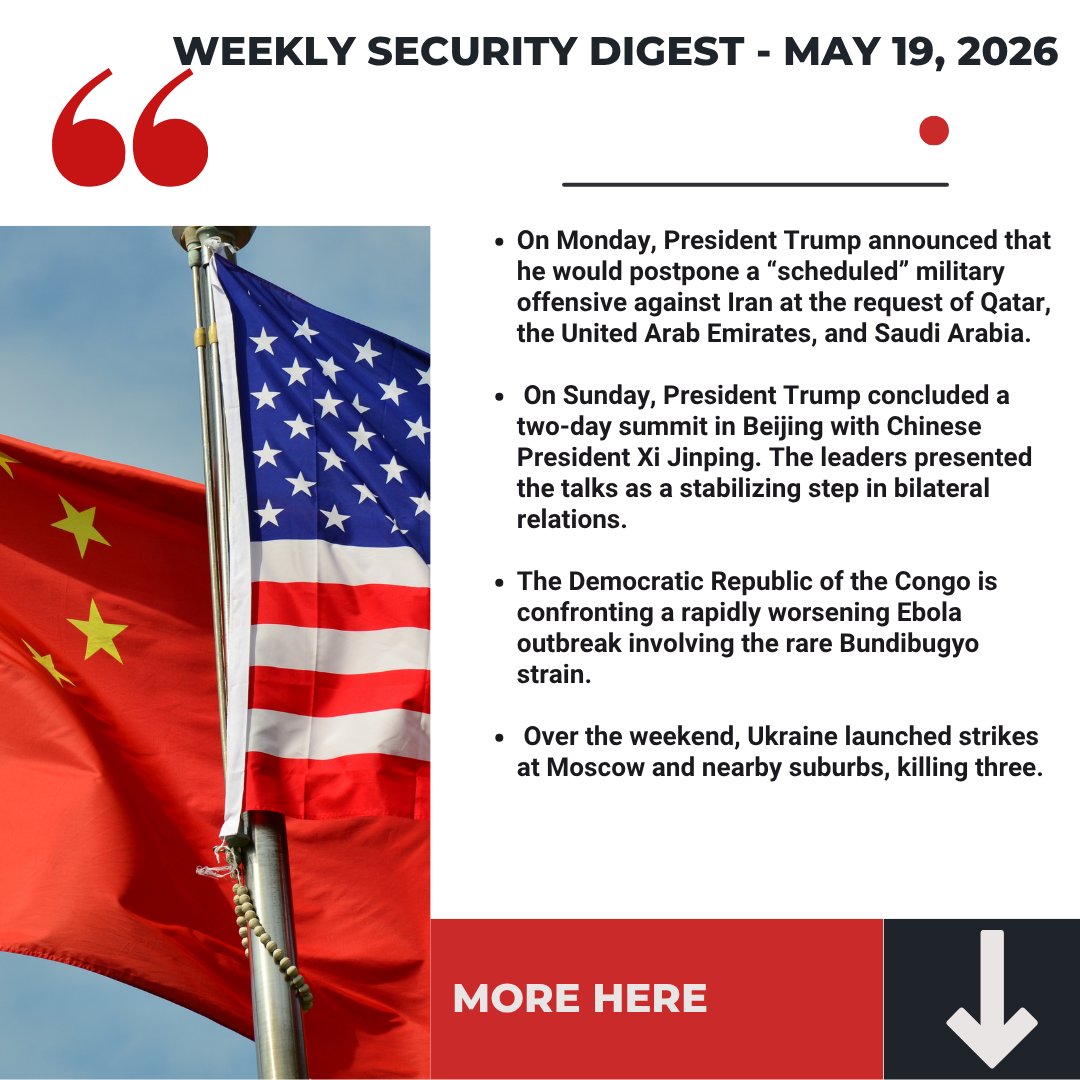
→ On Monday, President Trump announced that he would postpone a “scheduled” military offensive against Iran at the request of Qatar, the United Arab Emirates, and Saudi Arabia. The Gulf states have not confirmed their role in Trump’s decision, but mediators are reportedly pushing to regain diplomatic momentum on two key issues: Iran’s nuclear program and the Strait of Hormuz. President Trump agreed to delay attacks for two to three days but instructed Secretary Hegseth to be prepared to launch attacks at a moment’s notice.
International Affairs
→ On Sunday, President Trump concluded a two-day summit in Beijing with Chinese President Xi Jinping. The leaders presented the talks as a stabilizing step in bilateral relations.
#security #geopolitics #risks #threats #intelligence
https://t.co/gZ9YPHiiJH