The Polyester Brand Kit is now available.
Download or copy Polyester logos, artwork, fonts, colors, stills and more using our curated branding page.
Making Polyester content just got easier and more fun!
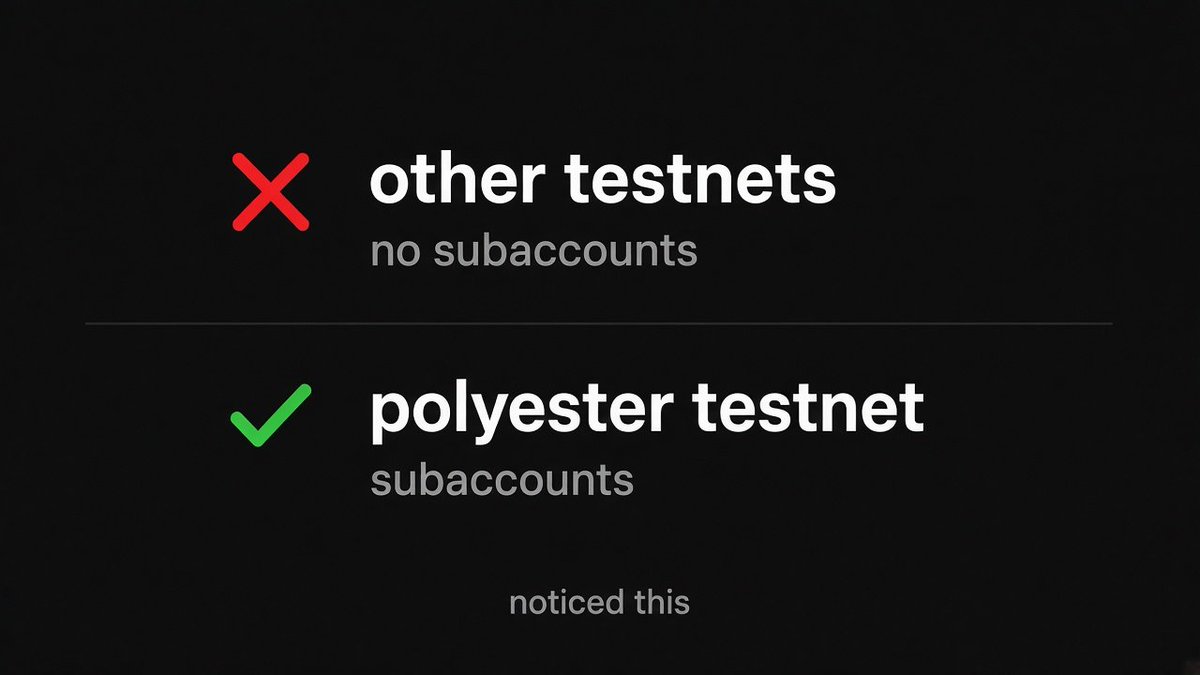
Polyester Subaccounts are available now on Testnet!
Subaccounts let you separate trading strategies, manage separate teams and keep balances organized.
Invite members, assign roles, set permissions, create API keys and track performance across all your subaccounts.
Qwen3.8-27B, one DGX Spark: 7.88 -> 75 tok/s solo, 256 aggregate.
Spent the weekend trying to make Qwen3.8-27B faster on a single DGX Spark and ended up proving myself wrong about almost everything I assumed going in.
Started at 7.88 tok/s. Stock FP8, nothing tuned. My assumption was the same one everybody has: if you want speed, quantize. 4-bit, fewer bytes per token, done.
Wrong. Or at least, it was the smallest part of the answer.
Speculative decoding got me to 58.5 tok/s on the exact same FP8 weights. That's 7.4x with nothing touched, and it cannot change the output at all, because the full model verifies every drafted token and throws away anything it wouldn't have written itself. Free speed. I had been ignoring it.
Then a few things I did not expect.
The drafter architecture mattered more than the draft depth. DSpark is a separate 1B drafter that emits a block of 7 tokens at once. MTP re-runs one in-checkpoint layer 7 times and pays a full vocab projection every time. DSpark accepts FEWER tokens per pass and is still 46% faster. Cost per draft token: 0.046 vs 0.153. Cheap passes beat good guesses.
Acceptance rate is a trap. Going from k=7 to k=14 dropped acceptance from 98.7% to 68.7% and made generation 27% faster. The late draft positions are basically lottery tickets, the early ones are certain. Mean tokens per forward pass is the number that predicts throughput. Not acceptance.
Prefix caching had been silently off the whole time. vLLM disables it by default for hybrid attention models and Qwen3.8-27B reports is_hybrid=True. Nothing in the startup log mentions it. Claude helped me and only found it reading engine source. Turning it on: 14x faster prefill on a 19K shared prefix, 22x on a 53K one.
And then the result I actually care about.
4-bit is 27% faster than FP8 at one request. At 4 requests, 20%. At 8, 10%. At 16 concurrent requests the two are within 0.2% of each other. Basically identical.
It makes sense once you see it. Single-stream decode is memory bandwidth bound, so halving the bytes nearly halves the work. Batch it, and one weight read serves many sequences at once. The bottleneck moves to compute and byte count stops mattering.
So if you're serving agents in parallel, quantization buys you close to nothing. It also costs you 7-9% of prefill at long context, because 4-bit weights get unpacked before every matmul on hardware with no native FP4 path.
Final numbers: 7.88 -> 75 tok/s single stream, 256 tok/s aggregate across 16 streams.
Run your own task before you trust any 4-bit build.
Both serving recipes are public:
FP8: https://t.co/wxEcszQsLY
NVFP4: https://t.co/cldZ1VVZun
BTC ETFs lost about $390M last week. SOL ETFs were the ones that took money.
Spot only drifted. The wrappers dumped.
That’s the tell. New bid isn’t showing up in the BTC wrapper.