This beautiful dialect of Slovenian has one of the most intriguing tone systems.
One pattern, low-mid vowels resisting retracted stress, is strikingly reminiscent of something we've found in whale phonology.
Tone, stress, quantity, and quality interact, which is very rare.
After 10+ years of fieldwork, experiments, and analysis, the paper is finally out.
Is writing thinking?
Our new volume holds 16 essays by professional creative writers - @sashastiles, @RealIainSThomas, @jamesjyu, @jasminbf, Ted Chiang, Ken Liu, Annelyse Gelman, Qiufan Chen, Sheila Heti, and others - reflecting on writing in the time of AI.
All books are currently 50% off with the code SPRING 26, making it cost $10.
The preorder delivery date is now in late September @UofMPress
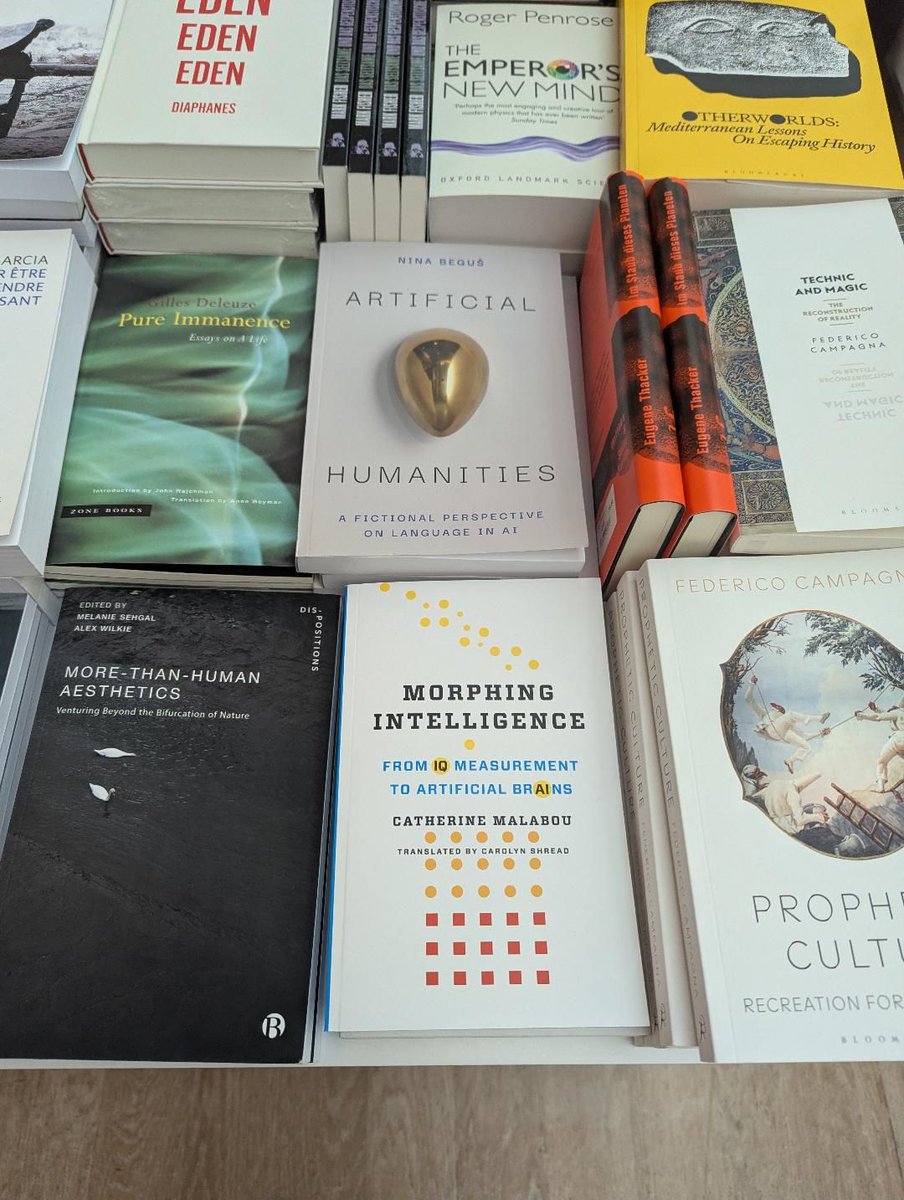
In the age of papal encyclicals on AI, it's worth reading this book. Here are some reviews:
"Artificial Humanities establishes the method; the next chapters remain to be written by readers equipped with Beguš’s tools for uncovering mythological infrastructures embedded in systems too often taken as purely technical."
"Beguš inverts the usual causality: Fiction does not merely reflect AI imaginaries; it actively scripts them."
"The book stands out as a timely and foundational work, providing intellectual grounding for these questions. It positions “Artificial Humanities” as a potentially central discipline that will require ongoing negotiation and conceptualization by scholars in the literature, culture, and media, as well as by AI researchers and designers, in dialog with the rapidly expanding field of critical AI studies. Beguš compellingly shows why understanding AI today and shaping its future require precisely the kinds of knowledge the humanities have to offer."
My commencement address at Bowles Hall, UC Berkeley.
There are many things meaningful to us humans that whales never see. There are no trees and no ground in their world. But the opposite is also true. There are things in their lives that we cannot even imagine. As you go out in the world, search for those unimaginable things. Try to discover what is meaningful to your friends, your family, and the people around you that you can’t yet imagine and learn from that. Ask what a tree is for a whale. Ask what a tree is for your loved one. Ask what a tree is for your friend.
A strong book review in Configurations!
"Artificial Humanities establishes the method; the next chapters remain to be written by readers equipped with Beguš's tools for uncovering mythological infrastructures embedded in systems too often taken as purely technical."
"Artificial Humanities offers something rare: a mythology-first approach that treats cultural narratives as infrastructural determinants of technical design."
"Beguš models a form of humanities scholarship indispensable for technical domains."
Honored that the manuscript of Artificial Humanities is presented ar Pierre Huyghe’s exhibition at Fondation Beleyer.
Pierre read the book before it was published and his reaction ended up as a blurb on it’s back cover @UofMPress