The Dangote Refinery IPO is LIVE! 🇳🇬
Start investing with just ₦5,250 through Interstate Securities. Don't miss your chance to own a piece of history!
Subscribe now 👇
https://t.co/AyS7jT4cyd
#DangoteRefinery#Capitalmarket
📊 DAILY MARKET REPORT | Friday, 23 October 2026 The Nigerian Exchange (NGX) closed the week with a slight dip, as the All-Share Index (ASI) moved -0.33% to stand at 244,190.39 points. Year-to-Date return sits strong at +58.87%.
TGIF! It’s time to wrap up the week and welcome the weekend! 🎉
As you make your weekend plans, remember to spend wisely and invest smartly. 💰📈
Manage your investment portfolio with Intertrade!
#TGIF#Intertrade#InterstateSecurities#SmartInvesting#SpendWisely
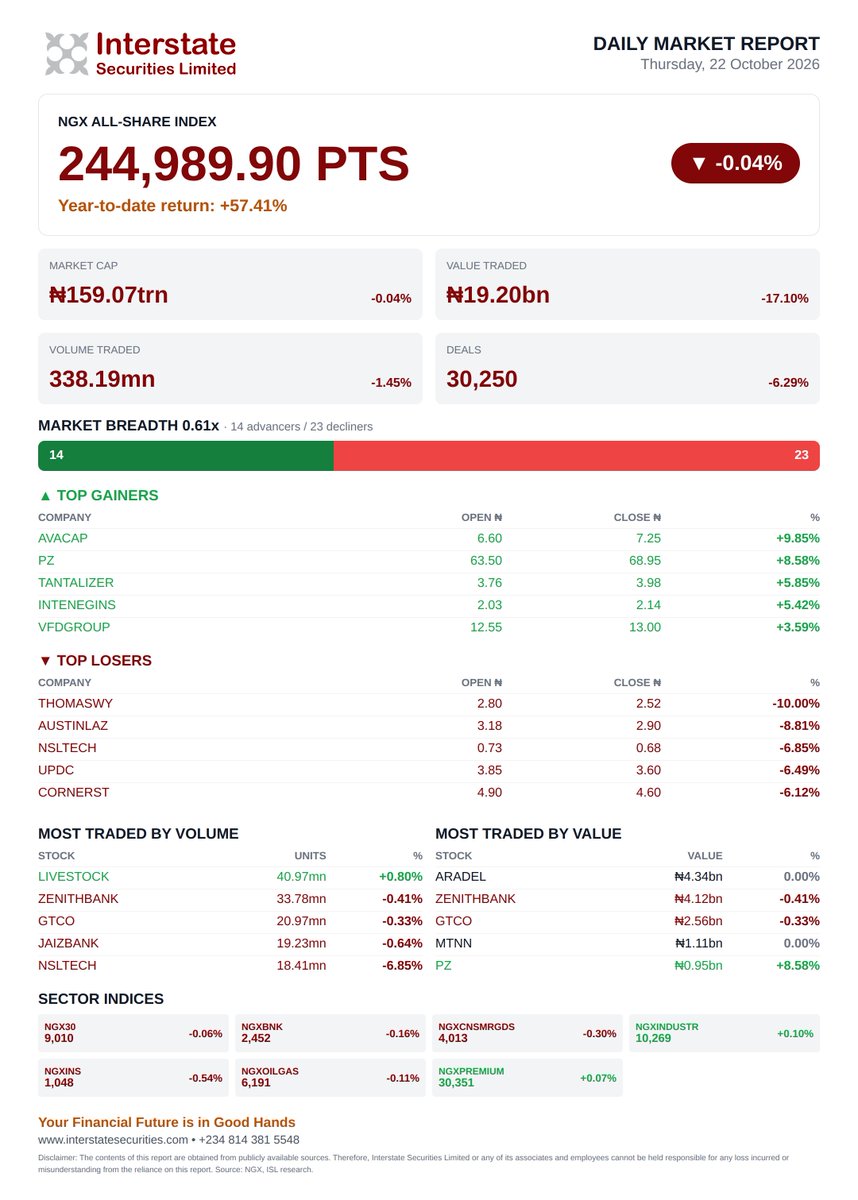
DAILY MARKET REPORT | Thursday, 22 October 2026
The Nigerian Exchange (NGX) closed slightly in the red today, with the All-Share Index (ASI) dropping -0.04% to stand at 244,989.90 points, while Year-to-Date return sits strong at +57.41%.
Market Capitalisation: ₦159.07trn
Nigeria’s Capital Market Masterplan 2.0 sets out a 2026–2036 programme to strengthen regulation, modernise infrastructure, diversify market instruments and expand participation in long-term finance. It follows a decade of reforms, including the Investments and Securities Act 2025, shorter settlement cycles, and the expansion of collective investment schemes, that have supported the market’s institutional development. The implementation record nevertheless leaves questions about coordination, measurable outcomes and the contribution of the market to productive investment.
In this Op-Ed, Suleyman A. Ndanusa, PhD, OON, recognises the progress made by the Securities and Exchange Commission and market participants while examining the limitations of the preceding masterplan. Drawing on Nigeria’s implementation experience and Malaysia’s market development, he argues for accountable regulatory reform, deeper investor participation and stronger links between capital-market development and national economic priorities.
He places particular emphasis on West African integration, cross-border issuance and a credible proposition for African companies considering Nigerian listings. His proposals call for published milestones, coordinated approval processes, reliable settlement arrangements and performance measures that extend beyond market size and listing counts to capital raised, liquidity and investor confidence.
https://t.co/jObZgT2XFZ
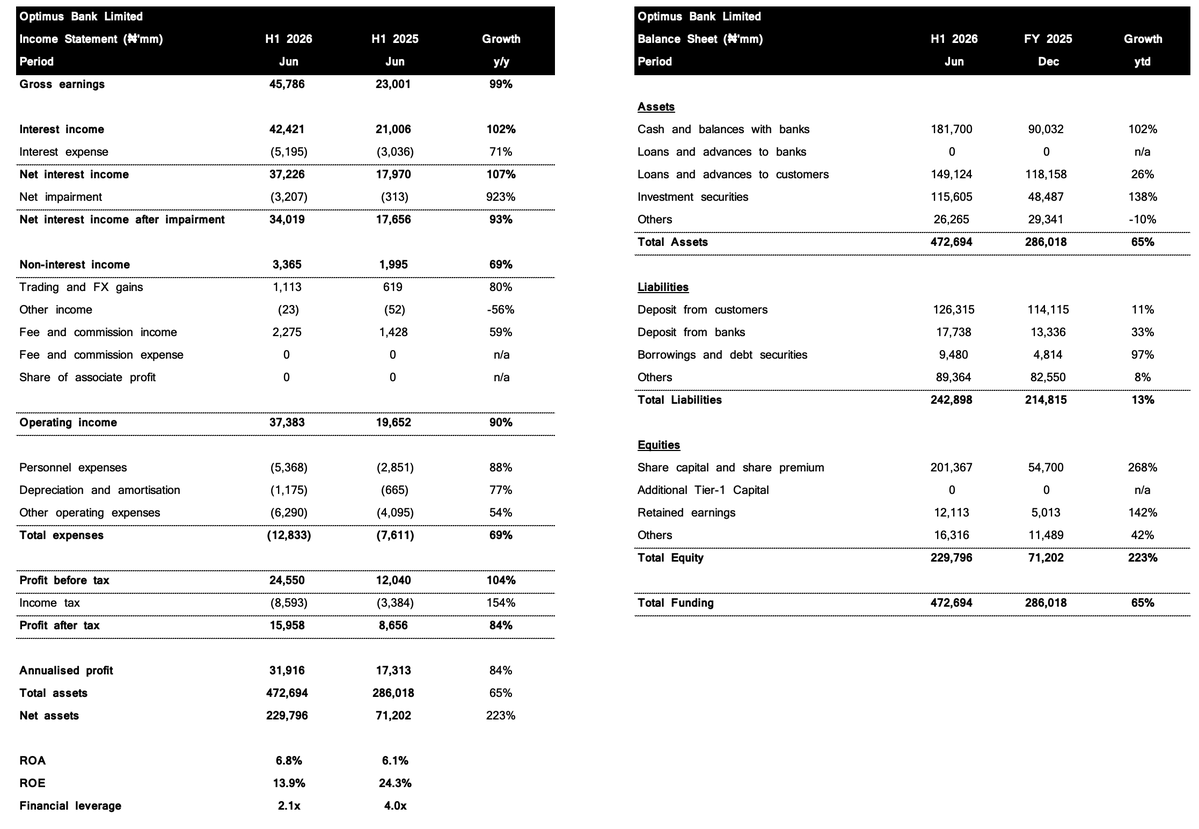
Optimus Bank’s half-year numbers look good. There must be something really interesting in the low- to mid-market that most tier-2 and tier-3 banks are playing in.
The asset yields are typically higher. Optimus, for instance, earned an average asset yield of over 24%. The average among tier-1 banks is 10%- 12%. Fidelity and Wema Bank, other examples of tier-2 banks, also earn really high asset yields.
The idea is that these banks serve a market the bigger players often overlook, either because of their risk tolerance or the small average ticket size. For example, a Zenith Bank may not consider a ₦500mm or ₦1bn loan worthwhile, while for an Optimus, it could be a big deal.
As a result, these tier-2 banks can charge a premium on those loans (smaller or lower-rated businesses often face higher costs of capital). Established players have greater buyer power, so they incur relatively lower costs of capital, which keeps tier-1 banks’ average asset yields lower. Tier-1 banking is also a volume game.
Similarly, tier-2 banks face a higher cost of funds, often around 5%-10%. The largest banks generally incur a cost of funds of 2%–3% (with Access Bank consistently closer to 4%-6%). The idea is that big banks run on “transaction money.” Their brand trust, size, depth, and distribution make them the default institutions where people keep their money.
The smaller banks, however, need to do extra to attract deposits. This is why they tend to pay higher interest rates.
Optimus’ net interest margin of 17% is exceptionally strong - even higher than Wema’s. The high asset yield more than offsets the high cost of funds. Ordinarily, this dynamic would make you watch the cost of risk.
The idea is that operating in the riskier lower- to middle-market makes you more susceptible to impairment charges and loan losses; in other words, a higher cost of risk. Interestingly, Optimus’ cost of risk is only 2%. That seems unbelievable, but first we may need to understand its business model, competitive advantage, and credit policy or strategy before we conclude.
Even more surprising about Optimus’ H1 2026 performance is its cost-to-income ratio. I didn’t get the memo. Optimus, really? I mean, I knew their CEO was an ex-GTCO, but the cost-to-income is really, really fantastic for a bank that is just starting. You’d typically see higher marketing costs, administrative expenses, and all when a bank is just newly starting out.
ROA at 6.8% is the highest figure I have seen so far for a Nigerian bank - even higher than GTCO, Stanbic, or Wema, the three most profitable listed banks. ROE is low, however, because the business has too much equity. Before the recapitalisation, financial leverage was 4x, compared with a banking average of around 8x. Further equity injections reduced leverage even more, shrinking ROE.
It wasn’t the equity injection itself that caused ROE to shrink, but the failure to deploy the additional capital into operating assets. For example, equity rose by ₦159bn following the new capital raising. However, much of that money remains in cash (see the ₦91bn movement in cash and balances) and investment securities (see the ₦67bn movement in investment securities). The loan book rose by only ₦31bn.
Either lending opportunities are limited, or the bank is reluctant to simply lend money freely. It may be weighing its options carefully. This brings me to how smaller businesses can grow very quickly, often at very high rates. But as they get bigger, the base effect increases, smaller loans are no longer worthwhile, and they are “forced” to take on bigger risks. Once they enter that territory, regulatory constraints and other forces also come into play.
It is also one of the reasons why “corporate finance” lads often trot out “a company can not grow at a high rate forever, hence you might want to be careful with the terminal growth rate (or terminal multiple) used in your valuation”.
Overall, this looks like a good performance. I hope they maintain their momentum, and perhaps list on the NGX someday.
📊 NGX closes higher! The ASI rose 0.26% to 245,911.13 PTS (YTD +58.03%). Value traded jumped 33.22% to ₦23.86bn. Top gainer: AUSTINLAZ (+9.97%). Top loser: LIVESTOCK (-9.76%). Breadth stayed negative at 0.38x.
Full report 👇 https://t.co/h90l8gZdgG
#NGX#InterstateSecurities
Strategy isn’t just a part of the game, it is the game. ♟️
Whether you are looking to diversify through Equities, Bonds, Corporate Finance, or expert Advisory Services, having the right partner makes all the difference in positioning your portfolio for long-term success.