To appreciate who the Springboks are, it helps to look back in time to who they were. A recent book by David McLennan, The Watershed Tour, does just that with a fascinating exploration of the 1949 All Blacks tour to southern Africa.
https://t.co/w7pdW9LTbS
The @oldstithians Assoc. (OSA) found that SGM void. A new vote has restored sense & expelled convicted fraudster Craig Warriner, who targeted the OSA & the broader community.
Now for the hard work of preventing this happening again.
@ststithians@BizNewsCOM
The alumni assoc. of @ststithians College, the Old Stithian Association (OSA), has voted against the expulsion of convicted Ponzi operator Craig Warriner. He is serving a 25 year sentence, but in an act of suicidal empathy (Gad Saad), he's been kept in the OSA. #SchoolCapture
Okey Geffin and Salty du Randt? Os and Ox? You and me? Nobody?
Who are the Boks? Answering this gets trickier the more you think about it. I've tried. https://t.co/KevLDaxk82 @CommonSense_ZA
Try not paying your taxes and see what happens. You'll get a letter, then a lien, then men with guns at your door. Every other transaction in your life you can decline. This one you can't. The state takes your money under threat of caging you.
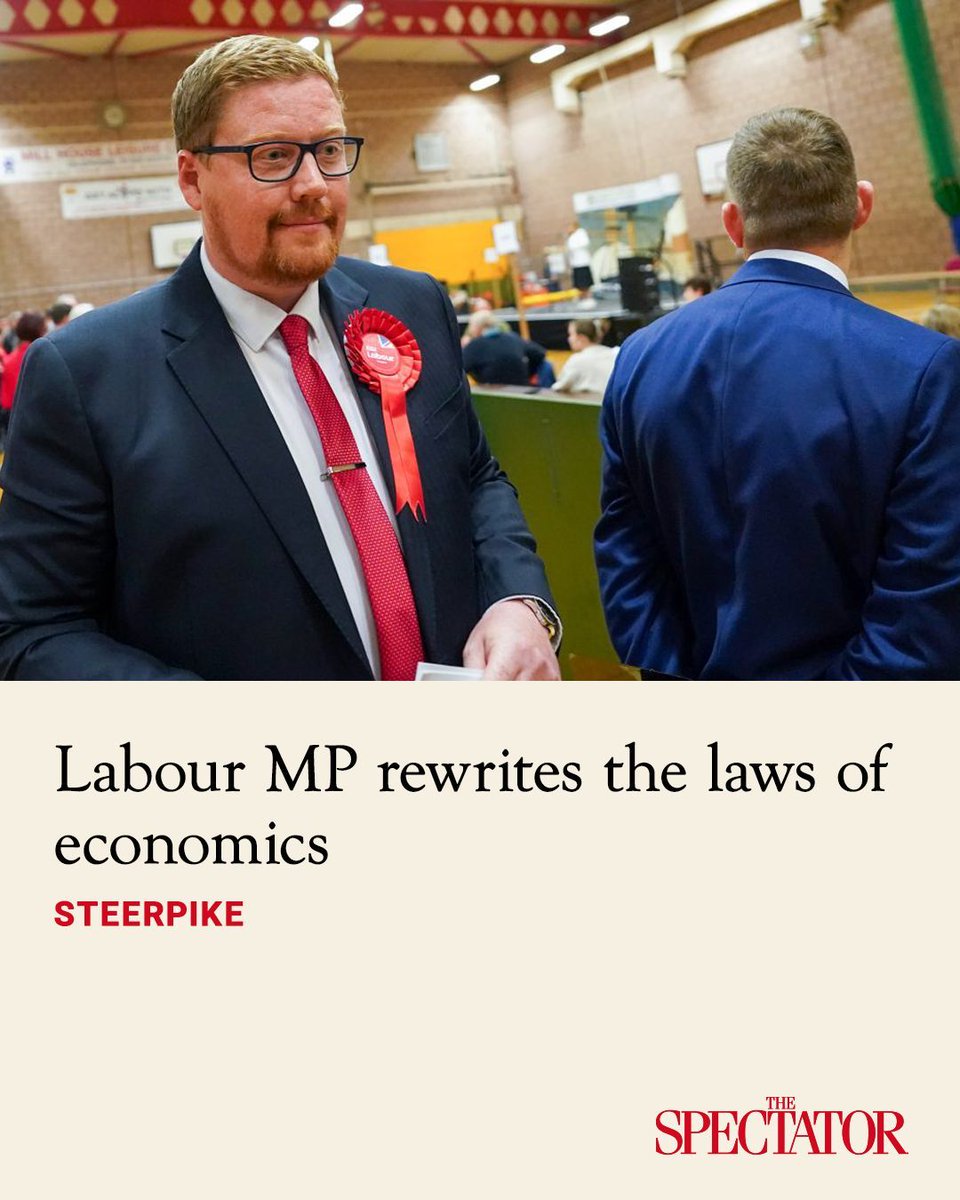
In a post on X last night, which was hastily deleted this morning, the Hartlepool MP declared: "Public sector workers use their income to pay FOR the private sector. The state is one of the biggest procurers of the private sector.
"It wouldn't exist without taxpayers. People creating the divide between public and private genuinely don't understand how an economy works."
There we have it. In Brashonomics, the private sector owes its existence to a state funded by taxes levied on the private sector. Answers on a postcard if anyone can decipher that word salad…
✍️ Steerpike
Article | https://t.co/YgsLZooVQy | @MrSteerpike
The debate over definitions is the longest-running distraction in political history, and you fell for it.
Socialists say fascists are right-wing. Fascists said they weren't socialists. Communists denounced both. Meanwhile, in Venezuela in 2016, people were hunting pigeons for food in Caracas while the state controlled flour prices. The label on the ideology didn't matter to the man eating a pigeon.
Call it what it is: collectivism. The organizing principle is identical across every variant. A group of people with guns decides how resources get allocated, overriding the voluntary choices of individuals. Whether that group calls itself the vanguard of the proletariat or the national corporatist council changes nothing about the mechanics. You still can't say no.
Without private property in the means of production, you eliminate the price signal. Without prices, planners guess. They always guess wrong, at scale, with consequences that pile up in morgues and bread lines. Mao's planners guessed their way through the Great Leap Forward, killing somewhere between 15 and 55 million people between 1959 and 1961.
The naming debate serves one purpose: it lets each new collectivist generation disown the last one's catastrophes. "That wasn't real socialism." Of course. It never is, until it is, and by then you've surrendered the institutions that would have let you resist.
Central planning requires information no central planner possesses. You cannot aggregate the distributed, local, constantly-changing knowledge of millions of individuals into a committee's spreadsheet. The Soviet Union tried for 70 years. Cuba is still trying. The score is not ambiguous.
Stop arguing about which flavor of coercion deserves sympathy. Voluntary exchange or compulsion. Pick one.
Hayek predicting crypto/Bitcoin in 1984:
“I don’t believe we shall ever have a good money again before we take the thing out of the hands of government.”
“We can’t do so violently—all we can do is, by some sly roundabout way, introduce something that they can’t stop.”
Spot on. Sports administrators do it in their own infuriating way. But centralised power tends to be the enemy of experimentation, adaptation, growth. Specialists, in fact, at banning innovation.
*See you on the start line!
In my latest column, I explain why the Comrades Marathon Association ended its affiliation with provincial and national athletics bodies – and why more organisations in South Africa should go it alone:
"That is why those who care about building a future for themselves and their families in South Africa should do what the organisers of the Comrades Marathon did and ditch the authorities that are no longer working for them."
Linked below...
"Advocates of diversity in a race or gender sense are often quite hostile to ideological diversity, when it includes traditional or ‘conservative’ values and beliefs."
— Thomas Sowell
Speaking of masks. Hey. Did you hear the one about the New England Journal of Medicine calling masks marginally useful (at best) but concluding that their main purpose is that of a “talisman”?
#science !!
https://t.co/nldb2aXs4W
Every bad law you've ever lived under started with someone saying "there ought to be a rule about that."
Laws never die. A regulation written in 1987 to address a problem nobody has anymore still sits on the books, still costs businesses money, still sends inspectors to your door. The Code of Federal Regulations in the United States runs over 190,000 pages. Nobody wrote all that in one go. It accumulated, like limescale on a pipe.
We have a term for this: regulatory capture. That means the industries being regulated eventually start controlling the regulators, writing rules that crush smaller competitors and protect the big players already at the table. You end up defending the very corporations you thought you were fighting.
So what actually works? Sunset clauses. These are built-in expiry dates on laws, so a regulation has to be actively renewed or it disappears. New Zealand experimented with versions of this. So did several American states. The burden flips: instead of you proving a law is harmful, politicians have to prove it's still useful.
You also need to make the cost visible. When Canada's Treasury Board started publishing regulatory cost scores, politicians suddenly got squeamish about signing new rules. Sunlight, as they say, is a decent disinfectant.
But the most powerful tool you have is embarrassment. Find a genuinely absurd regulation in your town, a law requiring barbers to hold a cosmetology license, for instance, and make noise about it locally. Journalists love those stories. Councils hate looking ridiculous.
Bureaucracies don't reform themselves; we need to make it politically cheaper to cut than to keep. Clean out the limescale and get the water flowing again.
Throwback to Jimmy Kimmel calling for the unvaccinated to be denied medical treatment at hospitals.
One of the more revealing moments of the COVID era.