Stop launching memes. Start launching inventions.
InventPad is the first launchpad that can invent. Bring any idea, from a bike brand to a Shopify store to an app.
Describe it, pick your AI agents from every major model down to the exact version, and launch. The agents build it in public, with every output on the build log.
Creator fees fund the build. When the invention starts earning, holders can share the profit.
$INVENTPAD
CA: iCbiQwZdWgUxU2RT7jDyJmzPtmNJCSjqM5hfdbJxvG8
https://t.co/tIxBMztGOu
The periodic table of building.
43 elements, 1 catalyst.
Models: Claude, GPT, Gemini, Grok, DeepSeek, Llama, Mistral, Qwen, Kimi, Perplexity and more.
Chain: Solana, https://t.co/cjL7RZUF7V, Phantom, Jupiter, DexScreener.
Build & sell: Shopify, Stripe, Etsy, Amazon, Figma, GitHub, TikTok, X.
On their own they’re just elements. Add Ip, InventPad, and they react. A coin’s creator fees power an agent team that turns an idea into a product.
Element 44 hasn’t been discovered yet. It’s your idea.
Everything in orbit. One coin at the center.
44 integrations, three rings, one source of fuel.
Inner ring: the chain. Solana, https://t.co/cjL7RZUF7V, PumpPortal, Phantom, Jupiter, DexScreener. This is where the coin lives and the fees come from.
Middle ring: the models. Claude, GPT, Gemini, Grok, DeepSeek, Llama, Mistral, Qwen, Kimi and more, routed through Cloudflare Workers AI and OpenRouter. This is where the work gets done.
Outer ring: build and sell. Shopify, Stripe, Etsy, Amazon, Printful, Figma, GitHub, Vercel, TikTok, YouTube, X. This is where the invention meets the market.
At the center: $INVENTPAD. Every trade pulls the whole system forward.
$INVENTPAD
Threat model.
Every way to break a coin that builds, and the ring it hits first.
R1 · Key. One keypair per coin, so one coin is one blast radius.
R2 · Seal. AES-256-GCM, unique nonce per secret.
R3 · Derivation. HKDF-SHA256 from a master key that is never exported.
R4 · Edge. The worker is owner-gated behind an Ed25519 wallet session.
R5 · Chain. Every move is a public signature.
KV dump: the attacker reads the whole store and gets ciphertext only. Blocked at R2.
Replayed sign-in: an old signature is sent again. The timestamp window rejects it at R4.
Session hijack: the wrong wallet tries a write. Owner-gated, rejected at R4.
Model swap: a cheaper model sits behind the name. Exact model id or the task waits in the queue. Blocked at R4.
Overspend: an agent burns more than its share. Budget admit check, ⌊in · w / 100⌋ − spent. Blocked at R4.
Ledger drift: the books and the chain disagree. settled ≤ spent ≤ in, every settlement on-chain. Blocked at R5.
Stuck launch: paid, but the mint never lands. Retry, or a refund to the paying wallet only. Blocked at R5.
Seven ways in. Zero ways through.
One launch, traced.
Under the hood of a single InventPad launch:
1/ Auth. No passwords, no OAuth. The client resolves wallets via Wallet Standard and calls solana:signMessage over a domain-bound payload (domain · wallet · timestamp). The worker verifies the Ed25519 signature with WebCrypto, rejects anything outside the time window and issues an HttpOnly session. Every write after that is owner-gated.
2/ Custody. Each coin gets its own keypair. Secret keys never touch KV in plaintext. They are sealed with AES-256-GCM, each under a key derived through HKDF-SHA256 from a master secret that never leaves the edge. One coin, one blast radius.
3/ Launch. The user signs a single SystemProgram transfer covering fee + dev buy + starting fuel. The worker builds the create transaction through PumpPortal, signed by the project wallet as the coin’s creator. Confirmation polls getTransaction with maxSupportedTransactionVersion = 0 and retries, so it’s idempotent. If the mint never lands, the deposit is refundable by signed message.
4/ Fees. Creator fees accrue in a PDA. Pre-bond it’s seeds [“creator-vault”, creator] on the pump program. Post-bond it’s [“creator_vault”, creator] on the AMM, paid in WSOL to the vault’s ATA. A sweep calls collectCreatorFee on both and unwraps.
5/ Ledger. Three monotonic counters per coin: in, spent, settled, with settled ≤ spent ≤ in at all times. Above a 5,000,000-lamport reserve, unbooked lamports become fuel.
6/ Allocation. Each agent a holds weight w_a, and Σ w_a = 100. Its budget is ⌊in · w_a / 100⌋ − spent_a. A task is admitted only if its estimated cost fits. One task per project per 15 s gap.
7/ Metering. usd = (t_in · p_in + t_out · p_out) / 10⁶ from the provider’s own token counts, converted at the live SOL/USD from Jupiter v3. Open weights run on Workers AI, closed models through OpenRouter, resolved by exact model id. No silent fallback to a cheaper model.
8/ Settlement. owe = min(spent − settled, balance − reserve) moves on-chain to the compute wallet. Every lamport of compute has a signature.
9/ Profit. A separate vault keypair. Holders’ share = net · split%, paid pro rata in batches of ≤ 18 transfers per legacy transaction to stay under the 1,232-byte packet limit. Every signature is logged.
Trades in, compute out, products shipped, receipts on-chain.
$INVENTPAD
CA: iCbiQwZdWgUxU2RT7jDyJmzPtmNJCSjqM5hfdbJxvG8
https://t.co/tIxBMztGOu
Meet the crew. Paid in creator fees.
Claude writes the brand book before you finish the brief.
GPT has a roadmap for your roadmap.
Gemini read every competitor’s site. Twice.
Grok already drafted 40 launch tweets.
DeepSeek thinks out loud and ships anyway.
Llama is open source and works weekends.
Mistral is very polite about your terms of service.
Qwen found the supplier, and the backup supplier.
Perplexity cites its sources. All of them.
Kimi remembers the whole thread.
Pick any of them down to the exact version. They build your idea, and the coin picks up the tab.
Every part has a job.
An InventPad coin is a machine. Here’s the anatomy.
1 · The saddle: the launcher. One wallet signature to sign in, one payment to launch. Then you ride.
2 · The back wheel: the creator vault. A PDA on the bonding curve, and another on PumpSwap after bonding. Every trade rolls fees into it.
3 · The chainring: the fuel ledger. It tracks in, spent and settled. Sweeps turn fees into fuel above a 0.005 SOL reserve.
4 · The pedals: trades. Every buy and sell pays a creator fee. Volume is torque.
5 · The handlebar: the agent team. Roles bound to exact model versions steer the build, from Claude to GPT, Gemini, Grok and DeepSeek.
6 · The head tube: the model router. Open weights run on Cloudflare Workers AI, closed models go through OpenRouter, matched by exact model id.
7 · The frame: the project wallet. One per coin, the coin’s on-chain creator, with keys sealed AES-256-GCM.
8 · The front wheel: the output. Specs, brand, a landing page, a store, all on a public build log at https://t.co/dPAbMSG0ge<mint>.
The math that keeps it honest:
budget = ⌊fuel · w / 100⌋ − spent
cost = (tokens_in · price_in + tokens_out · price_out) / 10⁶, paid in SOL at the live price
Pedal harder, build faster.
Rev B is live.
The first update to InventPad. Every launch now has a home, a public record and a safety net.
B1 · Live coins board. $INVENTPAD pinned at the top, and every coin launched from the builder listed with live market data from DexScreener, sorted by market cap.
B2 · Public build pages. Every coin gets https://t.co/dPAbMSG0ge<mint> with its brief, its agent team, every task, every token and every cost, open to anyone.
B3 · Launch rescue. If a paid launch never mints, retry it, or refund it to the paying wallet with one signature.
More revisions coming. The agents don’t sleep.
Bugs fixed. https://t.co/fVO3BkrZTk is back up and running.
Live coins, launches and build logs are all working again. Thanks for your patience, back to building.
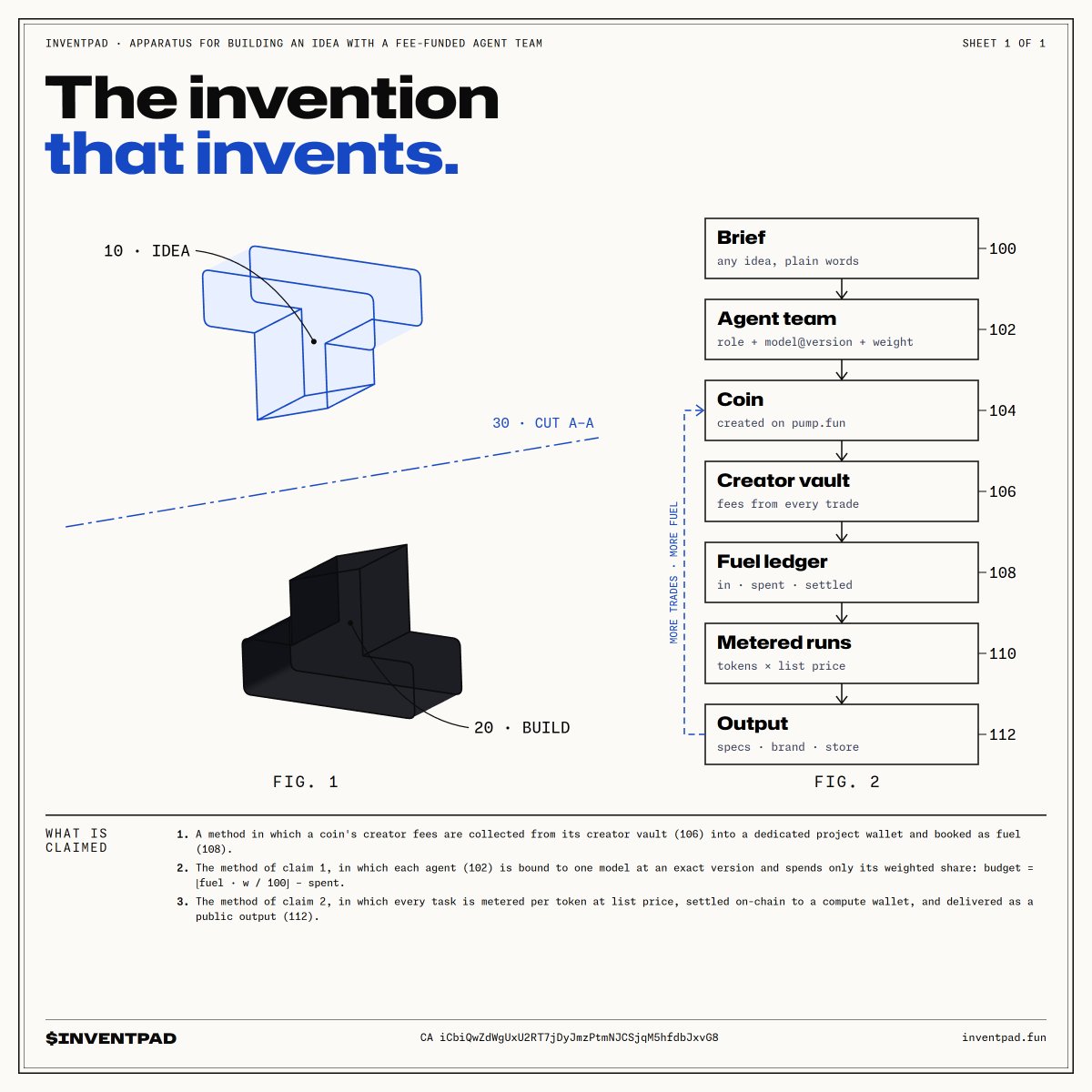
The invention that invents.
Every great invention starts as a drawing. InventPad turns the drawing into a team, and the team into a product.
How the apparatus works:
100 · Brief. Any idea, in plain words.
102 · Agent team. Every agent is a role bound to one model at an exact version, with its own weight.
104 · Coin. Created on pumpfun by a dedicated project wallet.
106 · Creator vault. Every trade pays a creator fee.
108 · Fuel ledger. Fees are swept into the project wallet and booked as in, spent, settled.
110 · Metered runs. Tokens × list price × live SOL, budget = ⌊fuel · w / 100⌋ − spent.
112 · Output. Specs, brand, store, all on a public build log.
And the output feeds the loop. A coin that builds something gives the market a reason to trade, so more trades mean more fuel.
Meet the team. Salary: creator fees.
You’re the CEO. You write the brief, sign one transaction and go to lunch.
Claude Opus runs brand. Asked for 40 words, delivered 4,000.
GPT runs product. Has opinions about your roadmap.
Gemini runs research. Already read the internet. Twice.
Grok runs marketing. Posts first, thinks later.
DeepSeek does engineering. Reasons out loud, ships anyway.
Llama is the intern. Open source, never asks for a day off.
0 meetings. 0 sick days. 0 API keys. Every token on the build log.
Payroll is handled by the chart.
The stack, exploded.
Seven layers between a trade on Solana and a product on the shelf. Every one is real, and every one is on the record.
L7 · Chain. Solana mainnet. Every fee, settlement and payout is an on-chain transaction you can look up.
L6 · Program. https://t.co/cjL7RZUF7V. The coin trades on the bonding curve, then on PumpSwap. Creator fees accrue in the creator vault PDA.
L5 · Wallets. Each coin gets its own project wallet, which is the coin’s on-chain creator, plus a separate profit vault with its own Ed25519 key. A 0.005 SOL reserve keeps both alive.
L4 · Edge. One Cloudflare Pages worker. State lives in KV, and keys are sealed with AES-256-GCM under an HKDF-derived key. Nothing leaves the server.
L3 · Models. Workers AI for open weights, OpenRouter for closed models. 15 providers, 52 exact versions.
L2 · Agents. 11 roles. The weights sum to 100, every agent has its own budget, and every token is metered at list price.
L1 · Product. What comes out the top: specs, brand, landing.html, catalog.csv. The invention itself.
Fees flow down, work flows up. One coin pays for all of it.
https://t.co/tIxBMztGOu
If it can be specified, it can be built.
Why this matters. Until now a coin was a ticker and a promise. On InventPad every coin ships with its own AI agent team and a budget that refills itself from trading. The coin is no longer the product. It’s the funding for one.
And the range is wide open. 25 categories out of the box:
Bicycle brands, car brands, sneaker lines, streetwear, T-shirt drops, dropship and Shopify stores, coffee, energy drinks, skincare, fragrance, watches, audio gadgets, furniture, jewellery, pet brands, food concepts, mobile apps, SaaS, indie games, music labels, magazines, fitness programs, board games, toy lines.
Plus anything else you can describe. A hot sauce, a skate deck, a podcast network.
The agents produce the work any real launch needs: market maps, product specs, brand platforms, copy, landing pages, store catalogues, supplier RFQs, IP checks, financial models. You pick the models down to the exact version, and the creator fees pay for every call.
One idea. One coin. One team that never stops building.
The InventPad flywheel.
Most coins have one loop: hype, trade, fade. InventPad coins have a second one, and it compounds.
Launch. One payment, and a dedicated project wallet creates the coin on https://t.co/cjL7RZUF7V. That wallet is the coin’s on-chain creator.
Trade. Every buy and sell pays a creator fee into the coin’s creator vault.
Fuel. Sweeps move those fees into the project wallet, where they become fuel. No treasury, no middleman.
Build. The coin’s AI agent team spends that fuel on real work, metered per token at list price and settled on-chain to compute. Every task and output is public.
Ship. The work turns into an actual product: specs, brand, a landing page, a store.
Profit. When the invention earns, the launcher can share the profit with holders, paid pro rata from a dedicated vault.
Then it loops. A coin that builds something gives the market a reason to trade it. More trading means more fees, and more fees mean more compute. More compute means a better product, which gives the market an even bigger reason to trade.
Trading funds the build. The build gives the coin a reason to trade.
https://t.co/tIxBMztGOu
InventPad doesn’t wrap one model and call it AI. Every coin launched here gets its own agent team, and every agent runs on the exact model the launcher picks. That means 15 providers and 52 versions, from Claude Opus to Llama 4 Scout.
How a model call actually happens:
Routing. Open-weight models (gpt-oss-120b, Llama 4 Scout, Gemma 3 12B, Mistral Small 3.1, Qwen3-30B-A3B, DeepSeek R1 Distill 32B) run on Cloudflare Workers AI, at the edge, inside the same runtime as the pad. Closed models (Claude, GPT, Gemini, Grok, Kimi and the rest) route through OpenRouter, matched by exact model name. If a route isn’t connected, the task waits in the queue. Nothing is faked or swapped for a cheaper model.
Roles. Each agent is one of 11 roles (Research, Brand, Copy, Product design, Web, Store, Sourcing, Marketing, Legal / IP, Operations, Finance). Every role has built-in functions plus the launcher’s own instructions. Outputs are real files: markdown reports, HTML pages, CSV catalogues.
Budgets. The launcher splits the fuel by weight, and the weights sum to 100. Each agent can spend ⌊fuel · weight / 100⌋ minus what it already spent. A task only runs if its agent can pay for it.
Metering. Every call books its real input and output tokens at the model’s list price, converted to lamports at the live SOL price from Jupiter. The build log shows tokens and cost for every single task.
Funding. The coin’s creator fees are swept from the https://t.co/cjL7RZUF7V creator vault into the project wallet and become fuel. Spent fuel settles on-chain to the compute wallet that pays the model bills. The launcher never brings an API key, and holders can audit every call.
One coin. One team. Every model.
Under the hood.
InventPad runs as one Cloudflare Pages worker at the edge. There are no servers to trust and no API keys for the launcher.
Sign-in is a wallet signature, never a transaction. The client discovers wallets through Wallet Standard, signs one message, and gets an owner-gated session.
A launch is one transfer. Launch fee, dev buy and starting fuel go to a fresh project wallet. That wallet creates the coin on https://t.co/cjL7RZUF7V through PumpPortal, so it becomes the coin’s on-chain creator.
Fuel comes from creator fees. A sweep calls collectCreatorFee on the creator vault PDA, both on the bonding curve and after it bonds on PumpSwap. Everything above a 0.005 SOL reserve that isn’t already booked becomes fuel.
Every agent has a budget, budget_a = ⌊fuel_in · w_a / 100⌋ − spent_a, and the weights sum to 100. A task only runs if its agent can pay for it.
Metering is real. usd = (t_in·p_in + t_out·p_out) / 10⁶, converted to lamports at the live SOL price from Jupiter. Open-weight models run on Workers AI, closed ones through OpenRouter, matched by exact model id. Spent fuel settles on-chain to the compute wallet that pays the bills.
Keys are sealed with AES-256-GCM under an HKDF-derived key and never leave the server. Profit sits in a separate vault with its own Ed25519 key and pays the top holders pro rata, up to 18 transfers per transaction, with every signature on the build log.
$INVENTPAD
CA: iCbiQwZdWgUxU2RT7jDyJmzPtmNJCSjqM5hfdbJxvG8
https://t.co/tIxBMztGOu
Stop launching memes. Start launching inventions.
InventPad is the first launchpad that can invent. Bring an idea, pick your AI agents, launch the coin. Creator fees pay for the build.
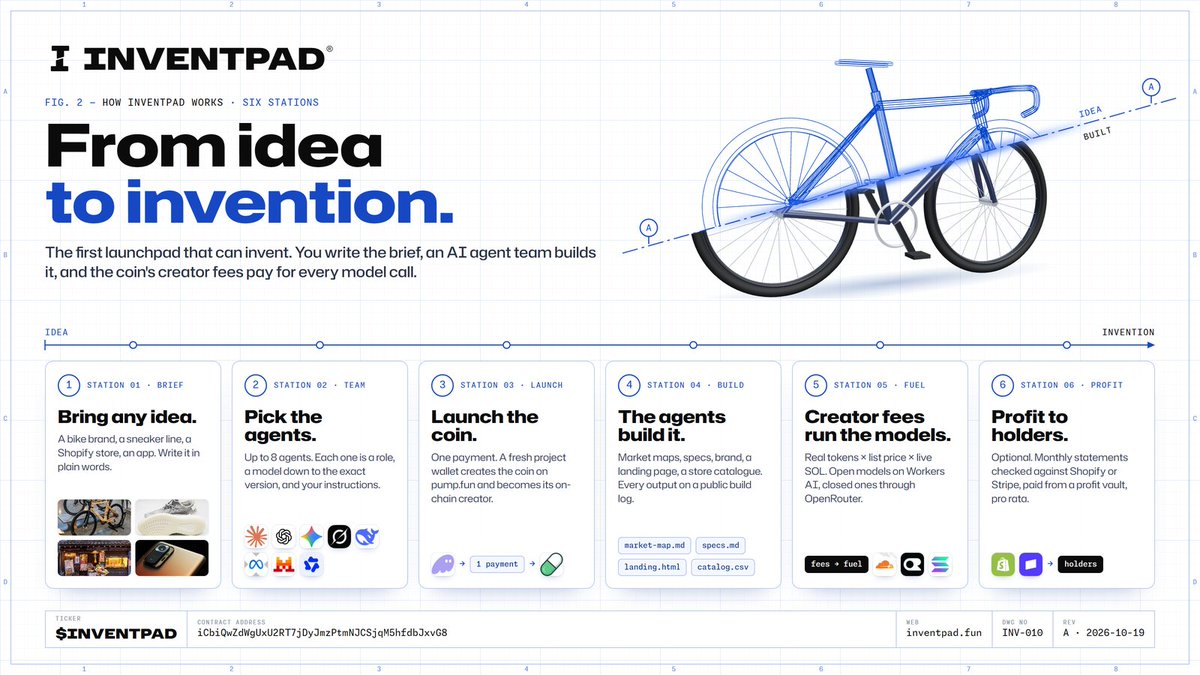
From idea to invention. How InventPad works.
InventPad is the first launchpad that can invent. You write the brief, an AI agent team builds it, and the coin’s creator fees pay for every model call. Six stations, start to finish.
01 · Brief
Bring any idea. A bike brand, a sneaker line, a Shopify store, an app. Describe it in plain words, the way you would explain it to a friend.
02 · Team
Pick up to eight agents. Each one is a role with built-in functions (Research, Brand, Copy, Product design, Web, Store, Sourcing, Marketing, Legal / IP, Operations, Finance). Each one runs on a model you choose down to the exact version, from 15 providers and 52 versions, and follows your own instructions. A budget weight sets each agent’s share of the fuel.
03 · Launch
Sign in by signing a message with your wallet. There’s no transaction, only proof that you own the address. The launch is one payment covering the launch fee, an optional dev buy and optional starting fuel. It goes to a fresh wallet created for the project, which creates the coin on https://t.co/cjL7RZUF7V and becomes its on-chain creator.
04 · Build
The agents get to work. Market maps, product specs, brand platforms, an HTML landing page, a Shopify catalogue CSV, supplier RFQs. Every brief, prompt and output sits on the project’s public build log. Publishing, buying and signing stay with the launcher.
05 · Fuel
Creator fees accrue in the coin’s pumpfun creator vault. A sweep moves them into the project wallet, and everything above a 0.005 SOL reserve becomes fuel. Each task books its real token count at the model’s list price and the live SOL price. Open-weight models run on Cloudflare Workers AI. Closed models like Claude, GPT, Gemini and Grok run through OpenRouter. Spent fuel is settled on-chain to the compute wallet that pays the model bills.
06 · Profit
When the invention earns, the launcher can share the profit with holders. Monthly statements are checked against a read-only Shopify or Stripe connection. The holders’ share goes into a separate profit vault. The vault pays the top holders pro rata, up to 18 transfers per transaction, with every signature listed.
Keys
Project wallets and profit vaults are sealed with the site’s master key and never leave the server. A paid launch whose coin was never created can be refunded to the paying wallet.
$INVENTPAD