1/ ETH is the best positioned asset:
- To become self sovereign money
- To have a native, uncorrelated yield
- To be globally censorship resistant
- To have customizable privacy
- To be quantum resistant
- To stay decentralized
- To achieve the potential BTC was supposed to
I was an early fan of BTC. Later, I loved ETH much more due to the benefits of onchain and PoS. Then for years I talked endless trash about BTC. Recently, I expressed gratitude to BTC for holding up the market.
That all being said, the downside risk of BTC we've warned about for many years is looking increasingly realistic.
What is this downside exactly? Well, it starts from the observation that BTC is just a religion with significant structural sell pressure from the physical cost of mining. There is no spoon, it's a fugazi. OK but a huge chunk of the gold valuation, and USD global demand, and many other confidence-based assets are mostly just confidence, so why does it matter that BTC is just a religion?
It matters because of- in no particular order- Saylor, macro, structure of the 2025 bull chart, quantum, security budget, and the current price of BTC.
And all this matters for ETH because of the current delusionally low ETHBTC ratio, which will take time and further realized growth (it's coming) to correct itself. Ethereum is winning and it's not even close. We're in a transitory period where most investors don't yet understand how big onchain is going to be and how (ironically) central that the Eth L1 will be to this global growth story. But this post isn't about ETH, it's about BTC and current market conditions.
Saylor is a real problem because homie told ppl to mortgage their houses, and his generational success story is at risk of cratering because he bought his own top so hard that he pulled his cost basis up to $75,700. His credibility is shot. Do you know how many BTC he has to sell by Q3 2028 if BTCUSD stays *flat* and he doesn't successfully refinance/do some financial wizardry? About ~130k BTC worth $9.1 billion.
Macro is a real problem because *gestures wildly*. Gas prices exert real pressure on the economy. OpenAI, Anthropic, and SpaceX IPOs are gearing up to look more like meme stock cash grabs than measured capital formation. Stock market internals are divergent. Valuations are extremely high.
In 2025, BTC's price chart caused a lot of investors to buy into BTC near highs, as it sustained 100k for 6+ months on the hopes that 150k, 200k were around the corner. Heavyweights like Armstrong called for 1M per coin. Ultimately BTC returned less than 2x vs 2021 pico top, disappointing true believers while long term whales cashed out generational (centuries not decades) wealth at the ~$2.5T valuation. This has left new buyers and the public disaffected, rightly so. It will take a lot of renewed confidence, religious groundwork, and siphoning growth vibes from Ethereum (major historical success factor for BTC) for BTC to regain its September footing, nevermind significant new heights. Crypto cycle and all that. This puts an effective multi-year price cap on BTC that insiders know is real and will cause ppl who buy local highs to continue to get rinsed- you're trading against pros who know this is a wavy bear, you're not frontrunning the public... unless you intend to frontrun them by years which most don't.
Quantum is a major problem for BTC because it's a stake into the heart of the religion. In practical terms, it reinforces that BTC is years away from regaining highs because serious buyers know that BTC isn't as immaculate as it seemed last year. They know that quantum meaningfully increases the odds that BTC never recovers to highs.
BTC's security budget is like a baby quantum: severe problem on the horizon, easy to discount, barely affects. But some people know its real and that adds up. Smallest factor but yet another card stacked against BTC this season/year.
The current price of BTC is that people are still paying $71,500 real American Dollars for 1 magic internet money coin. The valuation is still $1.432 trillion. 45% off ATH is still 55% on. If BTC wants to tumble, it has far to fall.
Nobody knows if BTC will see much lower lows. But the deck is currently stacked against BTC in a way that hasn't been the case at any other time in its history. Who cares if BTC falls 5%, that's noise. The real question is will we see a rout to 50k's or 30k's.
The challenge here is we're in a bear-a-thon, a bear marathon. If BTC avoids a crash this month or this summer, that's nice. The above factors are measured in quarters and years, not weeks and months.
Such a crash- this season, later this year, early next year- would clearly and unfortunately bring ETH down with it. The ETHBTC ratio isn't going to magically shoot up during the moment of the crisis.
Should a very serious BTC crash occur, after the crash, investors will be left asking themselves- is an ETH valuation this low justified? The efficient market hypothesis is more dead than alive in tradfi. In crypto it's science fiction. Markets don't know. The market price is just today's news. People who buy ETH this year will end up doing extremely well as Ethereum grows to global ubiquity and BTC's structurally bearish factors cause investors to re-rate the value of the onchain story overall vs BTC.
In short, we are again strapped onto this rollercoaster. Much is outside ETH's and our control. The community has been focused on stuff we can control: CROPS and growth. LFG. We'll be above $20k and multi trillion in due course. Ethereum
Some of my perspective on where the @ethereumfndn is going.
First of all, this is only my own view. The board is not just me, and I have no extra special powers on the board that the other board members do not. @aerugoettinea is the one executing much of this transition. My input has been largely on technical questions. The board is in the process of expanding, and my own power within the org will continue to decrease, which is honestly what I want.
The 2025 era brought many important improvements to EF and its ability to execute. Many issues were resolved, and EF continues to benefit from its improved efficiency and greater focus on concrete goals to this day. And so with those problems resolved, early this year, the largest remaining hole that I perceived was something different nagging at me: I would regularly spot people saying things like "vitalik says these beautiful things about ethereum needing to be decentralized, and have privacy, and be a sanctuary technology, but why do the EF's actions not reflect that?"
Now, you may have been hearing something different. You may not have been sensing a feeling of crisis at all, and maybe were hearing people saying that finally we were taking execution and BD seriously and the main task for us is to keep going that way and be even better and faster. Then probably there is genuine difference between you and me, in what kinds of criticism I take most seriously, and what kinds of critics through their criticism are most able to make me feel pain.
As an analogy, let's briefly switch over to a different domain.
One belief you can have about Google is that it is a success story, and has brought a lot of good to humanity in organizing the world's information. Another belief you can have about Google is that they had a beautiful idealistic beginning, but at some point the corruption of mainstream corporate attitudes seeped in, and they slowly bit by bit completely abandoned the "don't be evil" slogan.
My belief on Google specifically is probably somewhere between the two. BUT, if you had taken me back in time to ~2008, and offered me a button to press to make Google one or two standard deviations more "dogmatic", eg. give Richard Stallman permanent veto power over some key policies, I would immediately press it.
Why? Because a choice for one company is not a choice for the world, or even one country. Google existed and exists in the context of a technology industry generally drifting away from early idealistic don't-be-evil roots and toward greed for financial gain, totalizing visions of accelerated superintelligence, infiltration by sociopaths, and craven capitulation to (or worse, active participation in) government pressure for ideological control, surveillance and war. And so *one company* doing something different, positioning itself to be what George Bernard Shaw calls the Unreasonable Man, resisting the trend of the times, would have been better for freedom, balance of power and stability of society as a whole, than *all* large companies bending to dominant trends. This is a part of my version of pluralism.
This line of thinking is not just mine, but I also is not too far off from what Aya and others had in mind with the Mandate.
Now how does this all get to the role of the EF?
EF is not a "center of Ethereum", rather EF is "one node, with a defined purpose, alongside other nodes". We've always said that the EF should be the latter, but many in the Ethereum ecosystem (and even within the EF) wanted us to be the former. Now, we are taking action to ensure that we will be the latter.
This is particularly important because EF is a limited organization, with limited resources and limited organizational capacity. The EF has only ~0.16% of all ETH (less than many other individual ETH holders), whereas among other blockchains it's common for "the central foundation" to have 10-50%. Fiscally, the EF was originally designed to fulfill a limited work scope defined in the token sale docs and other pre-launch materials (building the chain software; getting through Frontier, Homestead, Metropolis, Serenity), which was fully completed in 2022; it was not designed to be an eternal steward.
And so today, the EF is choosing to use its remaining resources to pursue longevity over breadth (yes, this means we sell less ETH). The EF focuses *specifically* on those activities critical to the success of ethereum as a censorship/capture-resistant, open, private and secure system, that would not happen otherwise. This means making hard choices, and in some cases even activities that we highly approve of and people that we highly respect becoming outside of the EF. People of great technical talent, public respect and even alignment with the mission and CROPS being outside of the EF is in fact necessary if we want important tasks to be able to attract outside capital. This also means the EF taking opinionated stands culturally.
This is all intended in cooperation with all other parts of ethereum. We recognize that many other parts of the ethereum world highly respect CROPS and related values. But highly respecting is not the same as choosing to specialize and totally dedicate to a domain (Compare in a different domain: I think reducing animal cruelty is important, and I like vegan food, but am not full unconditional vegan myself)
EF is still in a transition period, and we expect its new long-term form to stabilize over the next few months. What are the guiding principles of this new form? Again, I am only one person, but I can give my answer from a technical perspective (there are also critical non-technical aspects).
At the core, *Ethereum must be impressive*. We are living in an age of highly intelligent AI and all kinds of other technological acceleration. "Status quo EVM, with a hard fork or two a year to optimize for short-term needs of users" is not interesting.
To some, "impressive" means: 250ms latency and 1M TPS. I think Ethereum trying to go that route is a mistake. Being as fast and as scalable as possible, and only a small epsilon more decentralized than the others, is a route to mediocrity, and if we try it we will lose.
I think Ethereum should scale. But I think Ethereum should strive the hardest to be deeply impressive in a different dimension: the CROPS dimension. This means things like:
* Provably bug-free Ethereum. This is a goal that all cybersecurity researchers would have thought is absurd and impossible, up until roughly 6 months ago. Now, it's on the cusp of being possible, thanks to AI-assisted formal verification. So we should be frontrunners in doing this.
* Available chain consensus. Ethereum is, and with lean consensus will cotninue to be, the ONLY chain that has both (i) traditional-BFT style properties that it's safe under asynchrony up to a high level of fault tolerance, and (ii) the bitcoin PoW-style property that under synchrony it's safe up to 49% attackers. As far as I can tell, literally no other chain has this or is planning for it; bitcoin goes for (ii) only and most other chains go for (i) only. Some will remember I fought hard for this, Unreasonably insisting that it is not OK for ethereum to rely on social consensus and hard forks to rescue ethereum from 34% of nodes going offline. It's OK for chains like hyperledger, bnb, solana, tempo, etc. It's not OK for bitcoin or ethereum or eg. zcash.
* Intermediary minimization. The fact that smart contract wallets, protocols like railgun, etc have to send transactions through intermediaries to get included onchain is honestly embarrassing, and it's a constant point of fragility. Hence the work on FOCIL and EIP-8141 (and 7701 and years of work before) to make transaction sending intermediary-minimized with public mempool and strong inclusion properties, in a truly general-purpose way, that covers not just eg. secp256r1, but also privacy protocols and much more. Kohaku is pushing intermediary minimization at the user layer, pulling Ethereum away from the dystopian status quo world where our wallets don't even verify the chain, send our private data out to a dozen third-party servers, and toward a brighter CROPS future.
Some of these goals are Unreasonable - maybe Ethereum would be "fine" getting only 50% of the way - what if we depend on intermediaries, but make it easy to switch? But going 50% of the way would not make Ethereum Deeply Impressive in the CROPS way. So we push for 100%.
Fortunately all these goals are compatible with high TPS, this is a major focus of research (esp. on scaling the state). Well-designed L2s can also help, especially L2s optimized for specific applications (eg. high-volume trading, privacy...). These goals are even compatible with significantly lower slot times, thanks to Raul's work on erasure-coded P2P, and many other optimizations.
The most high-value "product" of the ethereum blockchain, financially speaking, is ETH the asset. Ethereum secures $250 billion of ETH. The types of properties of Ethereum that I mentioned above are very good for ETH the asset. Nearly 90% of my net worth is in ETH, and most of the remainder is ~$40m of onchain fiat of which every dollar has already been allocated for some open-source biotech or software or hardware initiative. That said, there are aspects of supporting ETH the asset - *necessary* aspects even - that are outside the scope of the EF. This is where we need other heroes (some of whom hold more ETH than the EF does) to step in and help. EF has been recently thinking more about how it will relate to other such organizations, and give them needed initial support.
EF will be a smaller ship than in previous years, a more opinionated one - in some cases more opinionated in ways that might be difficult to comprehend - but a longer-lasting one, and one suited to making sure that ethereum brings something meaningful to the world. We are grateful to all those inside and outside the EF who are helping to make this happen.
Not sure if this may clear things up or muddy it further - I just know we are winning and it's time to get fully back to building and remember that our patience will be rewarded:
imo it's a common misconception that the EF and/or Vitalik don't care about the price of ETH.
They do care, very much, because they want Ethereum to be globally ubiquitous for a thousand years, and they know that this audacious goal requires lots of resources and economic security which can only come from a terrific ETH valuation.
The reason the EF has often over the years appeared not to care about the price of ETH is two-fold:
One, the EF is overall insanely confident in Ethereum and in ETH. As they should be. They've earned it and earn it every day. So when we are bearish or scared about the spot price, it's just effectively noise from their perspective of strong conviction and focus.
Two, the EF cares about price in long term structural ways that are incomprehensible to many of us.
We want to know why Didn't Number Go Up in Q4 Or Yesterday.
Whereas they want to know, "How will Ethereum remain dominant after quantum computers?" and, "How will Ethereum be the world's economic hub for trillions in assets and thousands of L2s across a hundred countries?" These are inherently bullish questions. And their programs/answers in response are gigabullish.
The EF departures are not because the people departing feel differently about Ethereum and our trajectory vs. the people staying at EF or vs. community folks like me.
The EF departures are because -
Even benevolent special smart wonderful people naturally have internal politics and differences of opinion over substrategies, policies, etc.
Vitalik and his leadership team feel the EF should be run in a certain way. Some folks disagreed. Some tiny number were asked to leave for Reasons. Some few others left immediately due to Reasonable Net Feelings. Some more are leaving because the Wheel is Turning and they feel that while we all love Ethereum and are extremely excited for our roadmap and proud of past wins, the time for new blood is here.
New blood means genzeth and also young up and comers who are ready to take the reins of their teams and departments.
What's important is that the EF's determination is as strong as ever and its strategy and focus are better than ever before. Credible neutrality. Decentralization. 100% Uptime. Postquantum. Privacy. Scaling L1+L2. Unifying/improving UX for L1+L2. The EF is on it.
What's also important is that the EF is now complemented and balanced by a growing cohort of deeply invested elite eth orgs across the stack/verticals/technologies/go-to-markets, including top L2s like Base, Arb, and zkSync, DATs like BMNR and SBET, and enterprise groups like Etherealize and Consensys, and too many more orgs and kinds of orgs to list here.
We will miss the great EFers leaving this season.
The EF is not only going to be fine, they are going to be amazing. Let the wheel turn. We're ready.
This bear market- secularly in crypto and in terms of global issues- is unfortunate, but that's the industry.
ETH will hit multi trillion in due course. Strap in, be patient. Help out. Get involved. I've been here for 8 years now full-time and it's never more felt like I'm just getting started.
Ethereum.
Clarity act enables the entire financial system to move forward and use blockchain to create new financial products and innovate financial infrastructure
Great news for $ETH which is the settlement layer of the future financial system
$BMNR
It's an even bigger ooof this quarter
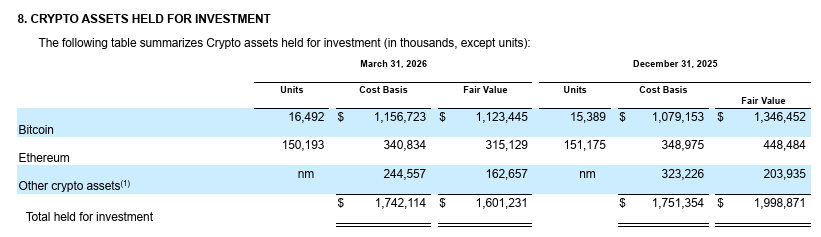
Coinbase have sold 100% of their ETH sequencer fees... and didn't stop there
ETH holdings have decreased by almost 1k, down to 150,193
All the while they keep growing their BTC reserves; up 1.1k BTC / $78m in purchases
Whilst most eyes are going to be on the headline $394m loss that Coinbase made in Q1, I see these investment movements as even more damning
Yes, Coinbase hold ETH and this is good
But they are fumbling such a huge opportunity here
Ethereum will be central to updating the system, not Bitcoin, and ETH is the asset that benefits most from Ethereum domination; ETH is the call option on Ethereum's success
Today we make the case for ETH as a superior monetary good—and how, if it captures the monetary premium currently held by gold and bitcoin, the implied long-term price could exceed $250,000 per token.
Executive Summary:
1. Gold and Bitcoin don’t compound. Warren Buffett never held gold. His objection was not about scarcity—he acknowledged gold was scarce. His objection was that scarcity without productivity is economically sterile: “If you own one ounce of gold for an eternity, you will still own one ounce at its end.” The same criticism applies to Bitcoin.
2. ETH is the first monetary asset that compounds without counterparty risk. For all of human history, you had to choose: hold money (stable, unproductive) or invest it into productive assets (risky, wealth-generating). The two categories were mutually exclusive. Ethereum dissolves this distinction—you lock capital into the protocol’s consensus mechanism and earn yield generated by the network itself.
3. ETH is better money than gold and Bitcoin by every other measure. Its supply growth is capped at 1.5% by the protocol and offset by a burn mechanism that can make it deflationary. It can be transferred anywhere on Earth in seconds, stored in a memorized twelve-word phrase, and carried across any border beyond the reach of any government. And its proof-of-stake consensus mechanism is more secure and durable than Bitcoin’s proof-of-work.
4. The combined monetary premium of gold and Bitcoin is approximately $31 trillion. If ETH captured that premium — distributed across ~121 million ETH — the implied price would be north of $250,000. Today it trades around $2,300.
5. Productive money will outcompete dead capital. Over a long enough time horizon, productive assets outperform unproductive ones, because productive assets compound. The only question is how long it takes the rest of the world to figure that out.
Today is a monumentous day for quantum computing and cryptography. Two breakthrough papers just landed (links in next tweet). Both papers improve Shor's algorithm, infamous for cracking RSA and elliptic curve cryptography. The two results compound, optimising separate layers of the quantum stack. The results are shocking. I expect a narrative shift and a further R&D boost toward post-quantum cryptography.
The first paper is by Google Quantum AI. They tackle the (logical) Shor algorithm, tailoring it to crack Bitcoin and Ethereum signatures. The algorithm runs on ~1K logical qubits for the 256-bit elliptic curve secp256k1. Due to the low circuit depth, a fast superconducting computer would recover private keys in minutes. I'm grateful to have joined as a late paper co-author, in large part for the chance to interact with experts and the alpha gleaned from internal discussions.
The second paper is by a stealthy startup called Oratomic, with ex-Google and prominent Caltech faculty. Their starting point is Google's improvements to the logical quantum circuit. They then apply improvements at the physical layer, with tricks specific to neutral atom quantum computers. The result estimates that 26,000 atomic qubits are sufficient to break 256-bit elliptic curve signatures. This would be roughly a 40x improvement in physical qubit count over previous state-of-the-art. On the flip side, a single Shor run would take ~10 days due to the relatively slow speed of neutral atoms.
Below are my key takeaways. As a disclaimer, I am not a quantum expert. Time is needed for the results to be properly vetted. Based on my interactions with the team, I have faith the Google Quantum AI results are conservative. The Oratomic paper is much harder for me to assess, especially because of the use of more exotic qLDPC codes. I will take it with a grain of salt until the dust settles.
→ q-day: My confidence in q-day by 2032 has shot up significantly. IMO there's at least a 10% chance that by 2032 a quantum computer recovers a secp256k1 ECDSA private key from an exposed public key. While a cryptographically-relevant quantum computer (CRQC) before 2030 still feels unlikely, now is undoubtedly the time to start preparing.
→ censorship: The Google paper uses a zero-knowledge (ZK) proof to demonstrate the algorithm's existence without leaking actual optimisations. From now on, assume state-of-the-art algorithms will be censored. There may be self-censorship for moral or commercial reasons, or because of government pressure. A blackout in academic publications would be a tell-tale sign.
→ cracking time: A superconducting quantum computer, the type Google is building, could crack keys in minutes. This is because the optimised quantum circuit is just 100M Toffoli gates, which is surprisingly shallow. (Toffoli gates are hard because they require production of so-called "magic states".) Toffoli gates would consume ~10 microseconds on a superconducting platform, totalling ~1,000 sec of Shor runtime.
→ latency optimisations: Two latency optimisations bring key cracking time to single-digit minutes. The first parallelises computation across quantum devices. The second involves feeding the pubkey to the quantum computer mid-flight, after a generic setup phase.
→ fast- and slow-clock: At first approximation there are two families of quantum computers. The fast-clock flavour, which includes superconducting and photonic architectures, runs at roughly 100 kHz. The slow-clock flavour, which includes trapped ion and neutral atom architectures, runs roughly 1,000x slower (~100 Hz, or ~1 week to crack a single key).
→ qubit count: The size-optimised variant of the algorithm runs on 1,200 logical qubits. On a superconducting computer with surface code error correction that's roughly 500K physical qubits, a 400:1 physical-to-logical ratio. The surface code is conservative, assuming only four-way nearest-neighbour grid connectivity. It was demonstrated last year by Google on a real quantum computer.
→ future gains: Low-hanging fruit is still being picked, with at least one of the Google optimisations resulting from a surprisingly simple observation. Interestingly, AI was not (yet!) tasked to find optimisations. This was also the first time authors such as Craig Gidney attacked elliptic curves (as opposed to RSA). Shor logical qubit count could plausibly go under 1K soonish.
→ error correction: The physical-to-logical ratio for superconducting computers could go under 100:1. For superconducting computers that would be mean ~100K physical qubits for a CRQC, two orders of magnitude away from state of the art. Neutral atoms quantum computers are amenable to error correcting codes other than the surface code. While much slower to run, they can bring down the physical to logical qubit ratio closer to 10:1.
→ Bitcoin PoW: Commercially-viable Bitcoin PoW via Grover's algorithm is not happening any time soon. We're talking decades, possibly centuries away. This observation should help focus the discussion on ECDSA and Schnorr. (Side note: as unofficial Bitcoin security researcher, I still believe Bitcoin PoW is cooked due to the dwindling security budget.)
→ team quality: The folks at Google Quantum AI are the real deal. Craig Gidney (@CraigGidney) is arguably the world's top quantum circuit optimisooor. Just last year he squeezed 10x out of Shor for RSA, bringing the physical qubit count down from 10M to 1M. Special thanks to the Google team for patiently answering all my newb questions with detailed, fact-based answers. I was expecting some hype, but found none.
The crypto industry has a long history of people claiming things that are demonstrably untrue or impossible to verify, but doing so confidently, and claiming skeptics are dumb.
Luna maintained the peg organically. FTX had all the customer coins. Canton is permissionless.
Welcome to the Ethereum Economic Zone (EEZ), a framework for synchronously composable rollups.
What does that mean?
One deployment. Shared liquidity. Single transactions across L1 & L2. Identity verified anywhere. Smart wallets connected everywhere. No additional trust assumptions.
This means L2s that are as credibly neutral, economically aligned, and publicly governed as the base layer itself.
EEZ furthers Ethereum as the leading decentralized economy.
Fair warning. This post is bullish on Ethereum.
Yesterday, the Ethereum Foundation Enterprise team ran the Institutional Ethereum Forum in New York City.
Broad Adoption Activated.
Invitation only. 100's of Banks, asset managers, and infrastructure providers representing around $250 trillion in assets under management.
feedback so far
"Absolute banger tbh."
"People won't stop talking and networking and the content has all been great."
"Your institutional team did an amazing job. I was there. Kudos."
BlackRock. Western Union. Robinhood. Moody's. Baillie Gifford. Securitize. All on panels. Not as guests. As participants building on Ethereum.
This is what adoption actually looks like. EF also presents its post-quantum security strategy and launches https://t.co/1fPpbCRIcY.
EF also presented its post-quantum security strategy and launched https://t.co/1fPpbCRIcY. This is not just leading blockchain. No major technology platform has a published, open-source post-quantum migration roadmap at this level of detail. Ethereum is doing it before it is required, not after.
Proud of the Enterprise team for putting this together.
Choose Ethereum.
It still bugs my mind that people so easily flip-flop on narratives simply because they look weak for a moment...
Take ultrasound money.
This obviously started as a meme to make fun of the "sound money/hard money" narrative that Bitcoiners loved so much.
The introduction of EIP-1559 and the move to PoS led to ETH becoming deflationary over longer periods...
So what should we call an asset like ETH, that has lower inflation than Bitcoin and even goes as far as being deflationary at times?
Tada... "ultrasound" (🦇🔊) money was born.
But the main takeaway about it should have been this: Ethereum has a better monetary policy than Bitcoin.
This policy is called "Minimum Viable Issuance." This means ETH issuance is based on staker participation and ensures ongoing incentives for securing the network indefinitely.
Bitcoin doesn't have this. When all 21M Bitcoins are mined, Bitcoin will need new incentives or its security will both crater and be based on goodwill.
The cool thing about Ethereum's monetary policy is that any activity that comes on top of Ethereum simply existing takes away from the inflation rate... and can even make it go deflationary at times.
So a high-throughput, high-demand ETH is likely a deflationary ETH.
With a roadmap to scale Ethereum ~200–500x, at least a sustainably super low inflation ETH will eventually become a reality in the future. It's not an if, it's a when.
And what is easily dismissed by critics is this: through the worst of all times for Ethereum L1 activity, with everything moving towards L2s, ETH still has had lower inflation than Bitcoin.
If BTC is sound money, ETH is ultrasound money.
That's why my 🦇🔊 stays on.
ETH moving up on the news that no one in the world trusts each other anymore
and we need a new transparent global settlement layer in Ethereum which no one has to trust
If you go to a TradFi person and say "here we have a blockchain with censorship and reversibility built-in for emergencies. We built it for you, because you wear a really nice suit, and we want to build interweb financial systems, so we cater to your needs, bailouts and all" then the first thought he'll have is:
"Oh that's great, if I ever make a mistake on your blockchain, I can call someone and have it reversed"
Then he'll go home and think some more. The second thought he'll have is:
"Wait a minute. This design also means that if I book a highly profitable trade, my counterparty could call someone and have it reversed, screwing me."
And then he'll bring this up with his smart colleague who knows the history of TradFi and she'll add:
"If they have censorship and it succeeds eventually they'll weaponize access and threaten to kick us out unless we pay through the nose. That's the history of all TradFi"
And then our man we'll realize he'd rather have a chain that is never reversible and can't censor, because it's easier to make sure that you never make a mistake than it is to make sure nobody else ever screws you or censors you.