In bocca al lupo | Descendant of the Etruscans & Romans— and forged by civilizational memory | “Don’t get Netflixed” | Long Arc Thinking | Lux in tenebris
@Hedgeye
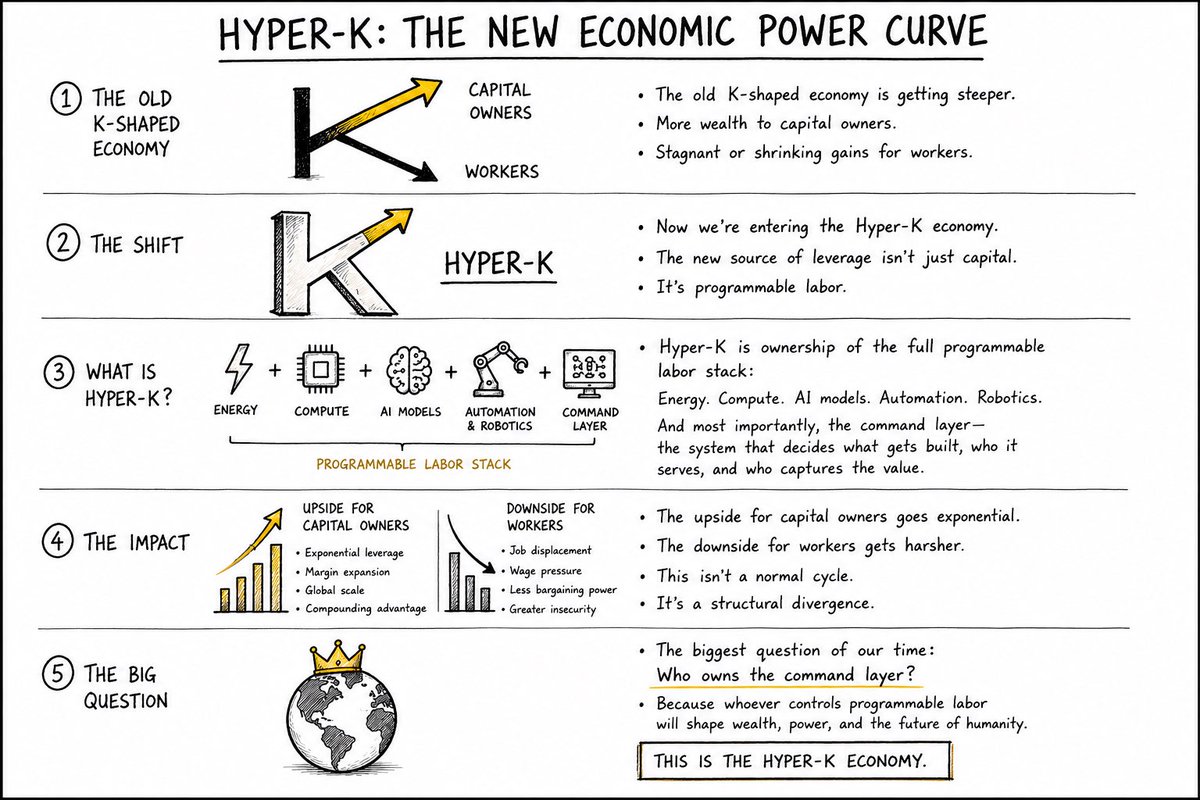
The K-shaped economy is evolving into the Hyper-K economy.
The old K was simple: Own productive assets, capital compounds. Don’t own them, wages lag.
The Hyper-K is different. Now, the asset is programmable labor: energy, compute, models, automation, robotics, infrastructure, and the command layer that tells those systems what to do.
That changes the macro math. This means:
More output with fewer workers.
Higher operating leverage.
More margin capture.
More capex intensity.
More concentrated power to whoever owns the stack.
This is not just “AI productivity.” This is a structural accelerated transfer of economic leverage from labor to capital.
Think steam engine printing press, computer, and fire being invented on the same day. 💥
In the Hyper K economy:
The upside for asset owners gets steeper.
The downside for workers gets harsher.
And the key question becomes: Who owns the command layer?
Because whoever controls programmable — aka “synthetic labor” — will shape margins, markets, labor share, national power, and the next phase of the economy.
This is where Long Arc Thinking matters.
Lux in tenebris.
@holonabove
You’re right that the national security focus is pulling AI out of pure financial narrative and into sovereign infrastructure.
That shift also undercuts the old dot-com style extraction model.
But it also raises a deeper question. When programmable labor is shaped by state power and strategic competition, who owns and directs the command layer — and whether that layer gets built for human potential and civilizational continuity, or for control.
The command layer — who sets the goals, rules, priorities, and constraints for these systems — is one of the highest-stakes layers in this transition. It’s a civilizational risk that will compound over generations.
Some regimes and countries will choose control over human potential and civilizational continuity.
Kinetic AI is the physical manifestation of programmable or synthetic labor. The institutions that control the full stack — energy, compute, models, embodied systems, and the command layer — will shape both all power structures and control systems.
Technology is civilizational leverage. Renewed Humanism must guide the build.
The question is whether we build it to expand what societies can become across generations, or whether it simply concentrates power more efficiently and ruthlessly.
The Build is happening either way.
The question that will matter most is who holds the command layer — and what these systems are ultimately designed to serve.
Lux in Tenebris.
@The_Prophet_
Ricardo saw that machinery could increase output while reducing labor’s share. That still holds.
But Kinetic AI changes both the mechanism, the speed., and the acceleration.
Previous machines amplified human labor. Kinetic AI substitutes for cognitive labor and directs physical labor at scale..
That shifts the question from “Who owns the machines?” to “Who owns and directs programmable labor?”
This creates what I call a Hyper-K economy — an accelerating divergence driven by ownership of the full stack.
The upper K compounds through a regenerating curve: each advance in models, autonomy, or deployment widens the gap while increasing its capacity to widen it again.
Kinetic AI is the physical manifestation of programmable — synthetic — labor. The command layer decides where that labor goes, what it does, and who it serves.
And ownership of that layer determines who captures the gains. This time, the difference is the speed, scope, and compounding nature of the shift.
The next question isn’t only economic.
It’s civilizational.
This is where purpose and meaning enter.
Kinetic AI must be guided by Renewed Humanism: expanding human potential while preserving dignity, beauty, creativity, and civilizational continuity. We can’t only be optimizing for efficiency.
So, who owns the command layer, and who do these systems ultimately serve?
Lux in tenebris.
Most people still think AI lives on screens.
But it is jumping into the physical world. This is Kinetic AI.
It is intelligence that moves into the physical world and starts doing real work — perceiving, deciding, and acting in factories, warehouses, mines, hospitals, infrastructure, and eventually space.
Energy and intelligence turned into synthetic labor that moves atoms 24/7.
This is the physical re-industrialization of civilization.
It’s not just better models.
It’s intelligence that can operate in the real world at scale.
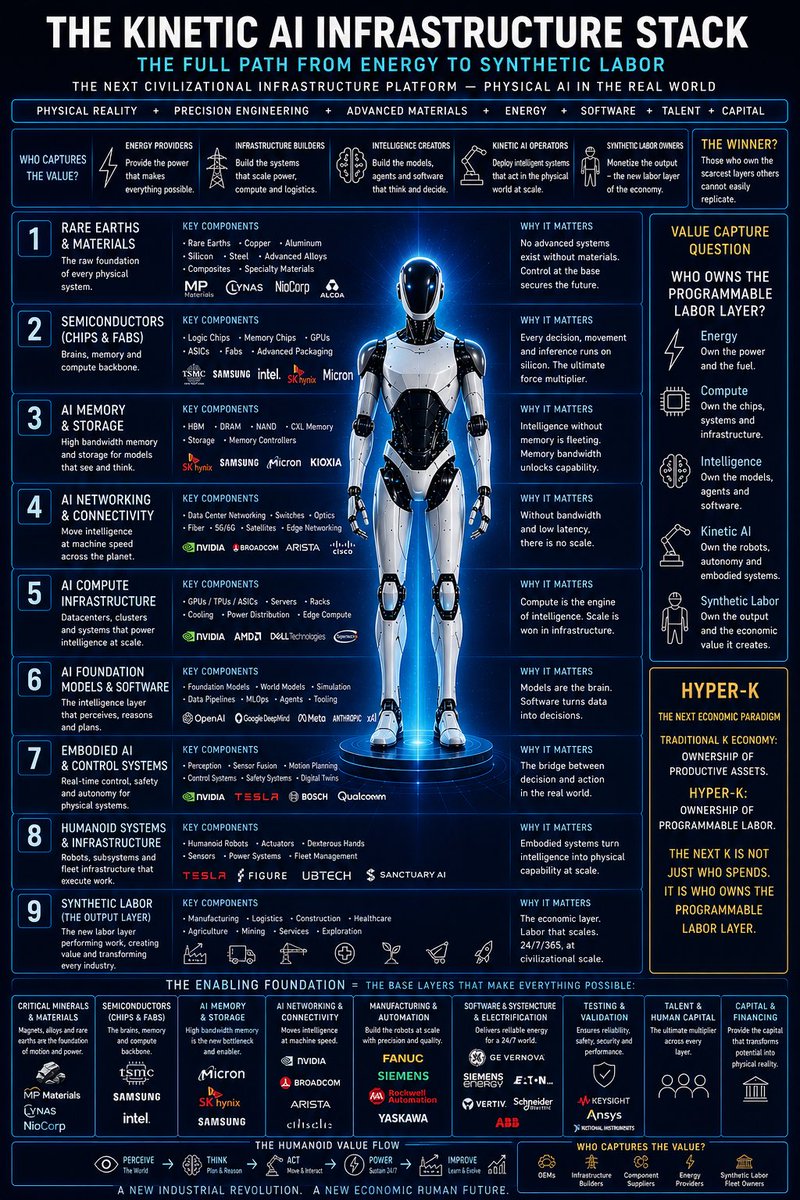
That is why the 9-layer humanoid infrastructure stack matters.
This is what is called “synthetic labor”.
@randgroup
Great chart.
The shift isn’t just headcount. It’s intelligence leaving the cloud and entering the physical world.
For decades, software scaled. Now labor can scale. This is Kinetic AI.
Programmable labor that can perceive, decide, and act in the real world at low marginal cost. It never sleeps.
Caretakers.
Dog walkers.
Gardeners.
Security guards.
Space explorers.
Miners.
Line workers.
Technology has displaced labor for centuries. Now, it accelerates.
The real question is: Who owns the command layer?
Who decides where these systems go, what they do, and who they serve?
Energy →
Compute →
Models →
Embodied Systems →
Synthetic Labor.
The companies and nations that control this stack won’t just automate tasks. They will shape productivity, wealth, power, and civilization itself.
The chart is about robots vs humans.
The real story is ownership of the operating system behind physical intelligence. Who benefits?
Kinetic AI carries major civilizational risk.
These systems must be built to serve human potential, meaning, dignity, and continuity not just efficiency and control.
The Build must be guided by the ethos of Renewed Humanism. We must fuse Capital with Philosophy, Art & Science again.
Lux in tenebris.
@randgroup
This is a race toward programmable synthetic labor.
Cleaners. Caregivers. Drivers. Builders. Farmers. Soldiers.
But the bigger question is not who ships the most humanoids today.
It is who owns the full stack behind programmable labor tomorrow:
Energy →
Compute →
Models →
Embodied Systems →
Synthetic Labor.
Humanoids are not the story.
They are the expression of a much larger infrastructure buildout.
The real advantage is not only who builds the humanoids or supplies the components.
It is who controls the command layer that tells programmable labor where to go, what to do, and who it serves.
On Earth — in fields, hospitals, factories, warehouses, and disaster zones.
In orbit — on stations, spacecraft, the Moon, and in extreme environments.
And beyond.
Hyper-K begins when ownership of productive assets evolves into ownership of programmable labor.
Like the K-shaped economy today, some will accelerate upward. Others (likely most) will accelerate downward.
The difference is that this time the divergence may be driven by ownership of Kinetic AI (synthetic labor) itself.
We’re now in the early stages of Hyper-K.
> you’ll never start a rocket company
> you’ll never build your own engines
> you’ll never be able to use off-the-shelf parts
> you’ll never survive three launch failures
> you’ll never reach orbit
> you’ll never win NASA’s trust
> you’ll never launch cargo to the ISS
> you’ll never compete with Boeing
> you’ll never compete with Lockheed
> you’ll never make rockets reusable
> you’ll never land a rocket vertically
> you’ll never land one on a drone ship
> you’ll never reuse a booster
> you’ll never fly the same booster 10 times
> you’ll never fly the same booster 20 times
> you’ll never fly the same booster 30 times
> you’ll never recover and reuse the fairing
> you’ll never lower launch costs
> you’ll never launch every month
> you’ll never launch every week
> you’ll never launch multiple times a week
> you’ll never carry astronauts
> you’ll never replace Roscosmos
> you’ll never fly civilians to orbit
> you’ll never manufacture satellites at scale
> you’ll never build the biggest constellation ever
> you’ll never make satellite internet work
> you’ll never make satellite internet fast
> you’ll never make satellite internet affordable
> you’ll never serve rural customers
> you’ll never serve aircraft and ships
> you’ll never build a methane rocket engine
> you’ll never make full-flow staged combustion work
> you’ll never build the most powerful rocket ever
> you’ll never build a rocket bigger than Saturn V
> you’ll never build it out of stainless steel
> you’ll never launch Starship
> you’ll never separate Super Heavy and Starship
> you’ll never relight Raptor in space
> you’ll never bring Super Heavy back
> you’ll never catch a booster with Mechazilla tower arms
> you’ll never launch 85% of mass to orbit worldwide
> you’ll never change the economics of space
> you’ll never force the entire industry to copy you
> you’ll never win
> you’ll never IPO
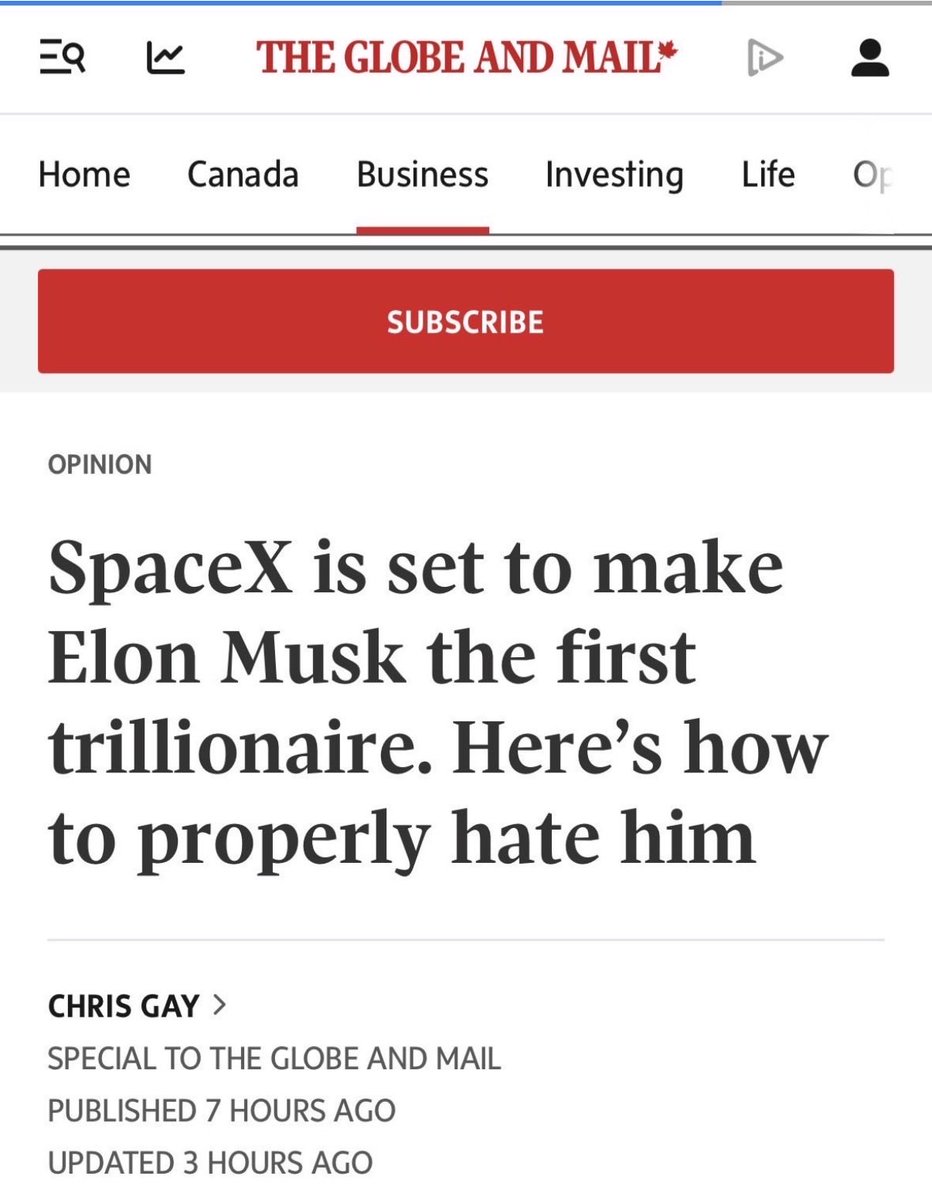
Congratulations to @elonmusk and the SpaceX team. You did what countless people said was impossible, and you did it time and time again.
Today is your day. You deserve this. May it be a glorious one.
The House of Florence exists to answer one demanding question:
How do we turn wisdom into wealth that endures?
We do it by gathering builders at the table, anchoring every decision in Renewed Humanism, and using Long Arc Thinking as the filter that connects the best thinking of the past to the capital choices that shape the future.
This is how we build not just for this cycle, but it is how we honor our ancestors and build for the next thousand years.
Lux in Tenebris.
The House of Florence is not a brand. It is a framework for unlocking and deploying capital when the goal is civilization, not just returns.
It rests on three foundations:
+ Renewed Humanism as the ethos, the Why.
+ Long Arc Thinking as the investment operating system and capital expression of the ethos
+ The Table as the place where Capital, Philosophy, Art & Science intersect
Together, Renewed Humanism and Long Arc Thinking define 9 capital pathways that matter most for long-term human potential — from intergenerational infrastructure and energy systems to human development, cultural memory, regenerative assets, and civilizational continuity.
These are not random sectors or themes. They are deliberate m investment decisions systems that advance the kind of civilization we want to Build.
Most still see space and Kinetic AI in separate lanes.
One side dreams of rockets and orbital factories. The other speaks of models and agents.
The deeper truth is this:
Kinetic AI is the physical operating system that turns orbital infrastructure into a living, self-sustaining civilization beyond Earth.
When intelligence becomes cheap enough to deploy into space, the real leverage shifts from launch cost to the systems that perceive, decide, and labor without rest in extreme conditions.
This is the emergence of Hyper-K: ownership of programmable labor in space (and Earth).
In that moment, the ethos of Renewed Humanism stops being optional. It becomes the quiet force that decides whether our expansion carries meaning, purpose, and resiliency across generations — or simply scales without soul or stewardship.
The question that will define the next civilization is not how high intelligence can reach, but who holds the hands that moves light and then atoms in the dark between worlds — and whether those hands build with wisdom or without it.
Lux in Tenebris.
What do we build on this substrate?
Nearly everything that expands human capability in the 21st century.
AI.
Energy.
Communications.
Advanced manufacturing.
Kinetic systems.
Space.
Health & Longevity
Every major challenge and breakthrough of our time runs through this value chain.
This is not just an industry.
It is the foundational layer of modern civilization — the intelligence that turns sand into directed movement across the physical world.
The substrate is being built regardless. What matters now is whether we use it to expand human potential with wisdom — or without it.
Sand to Light to Intelligence to Movement. There is poetry here.
Every machine system that moves on Earth depends on this value chain.
High-purity quartz sand is refined into single-crystal ingots, sliced into wafers, and patterned by extreme ultraviolet light into chips.
Those chips power the intelligence directing systems across our physical world.
This is not hype about an investment cycle. It is the physical and computational substrate on which durable, meaning-driven civilization is built.
Chip manufacturing is a prerequisite enabler for the 9 Long Arc Thinking pathways — the framework connecting great thinkers, generational capital, and projects that reinforce civilizational continuity. What do we Build on this substrate?
This is da Vinci’s Renaissance genius in industrial form:
Learn how to see. Realize that everything connects to everything else.
Your chart shows the nervous system of this civilization-scale value chain.
The House sees the civilizational body it sustains — and the multi-generational continuity it makes possible for the Build.
Quartz →
EUV →
Chips →
Intelligence →
Kinetic Systems & AI → Civilizational Continuity.
Lux in Tenebris.
Zero ceiling on intelligence demand is an interesting framing.
The big shift happens when that intelligence moves from being cheap in the cloud to being cheap in the physical world. Once the cost drops enough, synthetic labor — robotics and automation — becomes viable at scale. The bottleneck stops being models and starts being energy, actuators, dexterous hands, materials, and real-world deployment.
That’s the move into Hyper-K Economy — ownership of programmable labor instead of just assets.
As intelligence gets cheap enough to deploy at scale, the 9-layer humanoid infrastructure stack stops being theoretical and becomes the real terrain where power and returns accrue. The question is no longer just how much gets built, but who controls the layer that moves atoms — and whether that control expands human potential or concentrates it.
This is where the House of Florence stops being optional. Its ethos is Renewed Humanism. Because when intelligence has no ceiling, the only thing that still has limits is meaning, judgment, wisdom, and who we allow to own and control the hands that do the work.
Voyager 1 is not just a spacecraft. It is a signal from one generation to another.
It is a 23-watt signal still reaching us from 24 billion km away — 47 years after launch.
Long Arc Thinking asks:
What could we build if our institutions, capital, and culture operated with the same time horizon?
Durable systems are acts of faith in the future. They display a hope in humanity.
Generational assets are acts of civilizational continuity and resiliency.
Voyager shows what becomes possible when excellence, patience, and purpose are aligned across decades.
Lux in tenebris.
What happens when synthetic labor becomes abundant but human meaning becomes scarce?
Civilizations are not held together by output alone. They are held together by purpose, culture, dignity, contribution, and identity.
Renewed Humanism is about keeping human potential and judgment at the center of what we build. It is the Why.
The House of Florence is the table where Capital meets Philosophy, Art & Science.
Long Arc Thinking connects the wisdom of great thinkers to unlock capital toward systems that expand human potential and reinforce civilizational continuity and resiliency.
Synthetic labor without human meaning is not civilization. It is optimization without purpose.
The Build must have meaning. It must be directed by a canon of great thinkers and philosophers.
Lux in Tenebris.
Most people still think AI lives on screens.
But it is jumping into the physical world. This is Kinetic AI.
It is intelligence that moves into the physical world and starts doing real work — perceiving, deciding, and acting in factories, warehouses, mines, hospitals, infrastructure, and eventually space.
Energy and intelligence turned into synthetic labor that moves atoms 24/7.
This is the physical re-industrialization of civilization.
It’s not just better models.
It’s intelligence that can operate in the real world at scale.
That is why the 9-layer humanoid infrastructure stack matters.
This is what is called “synthetic labor”.
We are seeing the parts. But we are missing the whole.
Intelligence
becomes agents.
Agents
become kinetic.
Kinetic
systems become synthetic labor.
Synthetic labor
becomes the Hyper-K Economy.
But…
Who owns it?
What does it do for us?
What doesn’t it do?
These are not technical questions. They are civilizational ones.