May 2026 U.S. jobs report - Everything You Need To Know
Total payrolls: +172,000 jobs
Unemployment unchanged at 4.3%.
Leisure & hospitality: +70,000 strongest sector
Restaurants and bars added 48,000.
Local government: +55,000 primarily noneducation Government positions +44,000
Health care: +35,000 ambulatory care
+26,000 including home health
Social assistance: +12,000 mainly individual and family services
Mining, oil & gas: +5,000
up 10,000 since February.
The sectors that got hit hardest:
Financial activities: −22,000
Insurance −11,000
Commercial banking −3,000
Sector down 107,000 since May 2025.
Bottom line: Hiring was unusually concentrated in hospitality, heatlchare, and government, while finance remains the clearest area of sustained contraction.
The stats and facts coming from the SpaceX IPO are remarkable:
1. Targeting ~2T valuation, which would make it the largest IPO ever by valuation metrics.
2. At that valuation, would raise ~$50–75B, which is the largest IPO proceeds ever.
3. The IPO is expected to mint more new billionaires than any liquidity event ever, including key executives and early investors including 10+ people.
4. Is on pace to create 3,000+ employee millionaires, especially in Texas facilities like Starbase, due to heavy equity compensation.
5. Elon Musk ( ~42% owner) will hit $1 trillion in asset net worth if the IPO proceeds as expected.
6. However, the most important stat remains: Revenue hit ~$18.7B in 2025 and the company remains unprofitable.
While stats 1-5 are all paving the way for a new scale, stat 6 is a reminder that there's a long way to go.
The memory chip mania of the last 12 months is unparalleled at this market cap:
1. Micron $MU is up 155% YTD adding close to $500 billion in market cap since the the year started.
2. SanDisk $SNDK is up 425% YTD and is the best performing stock in the S&P 500.
Some notes to observe:
AI memory stocks as a group have averaged ~550% price increases in about the last 12 months.
Historically, at this market cap, not even the DotCom rivals the sheer size and scale of these market gains.
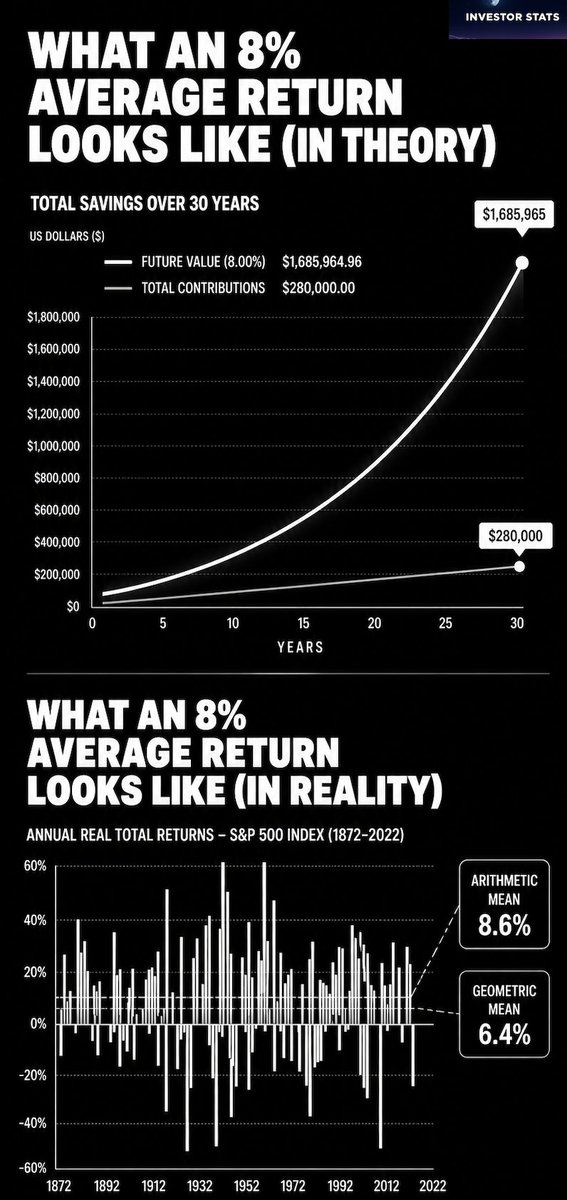
The top visual here shows compounded growth rate of a portfolio earning 8%.
The bottom graphic shows what that journey really looks like.
Great investing is not all about the indexes, ETFs or stocks you pick, but the ability to weather and remain in the game during drawdowns and volatility.
The reality is most people are wiped out by one of the drawdowns shown in the bottom graphic before they can ever enjoy the top graphic.
Learn these stats, then focus on being in the game rather than risking ruin.
Berkshire Hathaway recently set a corporate cash record at its latest earnings report and with its new leadership.
In Greg Abel’s very first quarter as CEO (Q1 2026), Berkshire’s cash pile climbed to $397.38 billion or the largest in its history.
No other company on Earth has ever had this much cash and equivalents.
The Nasdaq-100 RSI surged from 28 (oversold) on March 30 to 70.5 (overbought) by April 15—accomplished in just 11 trading sessions.
That marks the fastest oversold-to-overbought reversal in the index’s 40-year history.
The move is shattering the prior record of 25 sessions (following last year’s Liberation Day low) and far outpacing the long-term average of 60+ sessions.
Tracking the Dow Jones Industrial Average is one of the purest ways to observe long-term trends in actuality:
1976 Dow 30 companies:
Allied Chemical, Alcoa, American Can, AT&T, American Tobacco, Anaconda Copper, Bethlehem Steel, Chrysler, DuPont, Eastman Kodak, Esmark, Exxon, General Electric, General Foods, General Motors, Goodyear, Inco, International Harvester, International Paper, Johns-Manville, Owens-Illinois, Procter & Gamble, Sears, Standard Oil of California, Texaco, Union Carbide, United Technologies, U.S. Steel, Westinghouse, Woolworth.
Today's Dow 30 companies:
3M, American Express, Amgen, Apple, Boeing, Caterpillar, Chevron, Cisco, Coca-Cola, Disney, Goldman Sachs, Home Depot, Honeywell, IBM, Intel, Johnson & Johnson, JPMorgan Chase, McDonald's, Merck, Microsoft, Nike, NVIDIA, Procter & Gamble, Salesforce, Travelers, UnitedHealth Group, Verizon, Visa, Walmart, Sherwin-Williams.
The world is always changing.
One of the most discussed industries of the last year has been memory - the ability to store, save, and maintain memory in a computer system and work alongside AI processes and GPUs.
The recent stats and facts illustrate this industry’s abrupt change:
1. DRAM prices are exploding as conventional DRAM contract prices are forecasted to surge 90–95% quarter-over-quarter with some categories like PC DRAM expected to more than double.
2. Traditional consumer tech devices are quickly being pushed aside to focus on AI tools. The age of “cheap toys with memory” or “low cost phones” is mostly likely fading forever as manufacturers are reallocating cleanroom capacity from standard DRAM and NAND to high-margin AI chips, causing global supply growth to slow to just 16–17% in 2026—well below historical norms.
3. NAND flash also tightening: Entire 2026 NAND production from major players like Kioxia is already sold out, driven by AI server SSD demand, pushing contract prices up 55–70%+ in early 2026.
4. Data centers dominating supply: AI and data centers are projected to consume up to 70% of all high-end DRAM and NAND chips produced in 2026, leaving far less for phones, PCs, and other devices.
5. HBM cannibalizing wafers: Each gigabyte of HBM (AI-focused) consumes roughly 3x the silicon wafer area of regular DRAM, directly reducing output of everyday DRAM and NAND.
6. Shortage reshaping everything: This structural crunch—unlike past cycles—is expected to persist into 2027+, driving up costs for smartphones (DRAM now ~30% of BOM), SSDs, cameras, and more.
A statistical update on Strait of Hormuz that most X accounts are not sharing:
An average of 10 ships per day are now transiting through the Strait of Hormuz over the last 5 days.
The highest passing of near 20 ships is expected by Tuesday of next week.
If current trend persists, 25+ ships could be passing through by the week after.
The recent hedge fund and trend trading liquidation event on indexes and stocks like Micron $MU, NVIDIA $NVDA, and others recently hit unprecedented levels:
1. CTAs dumped ~$85B in U.S. equities over the last 30 trading sessions, which is the largest 30-day sell-off since the 2020 pandemic.
2. Hedge funds slashed global equity exposure at the fastest pace since April 2025, with six straight weeks of net selling and unwinding at rapid paces for index buyers and DCAs to slowly take advantage of.
3. Equity-focused hedge funds recently suffered their worst single-day loss in nearly a year.
This selling event, barely covered in the media at all, is shaping up to make for one of the best buying opportunities since the tariff panic, and before that, the Covid crash.
A sign oil prices are about to crash
Oil is beneath our feet everywhere
It’s not as special as anyone wishes it was
It’s renewable actually
It’s everywhere
Some of the largest oil deposits in existence have yet to be tapped
Add in the fact new energy sources coming in at the same time
It’s all paper trading. No one is settling.
Speculators dump fastest
Do not forget oil once went negative
It’s the other way around: spamming endless war mongering and stories like this about oil.
Oil never stops flowing no matter how you cut it.
We’ve yet to even drill Alaska, the arctic, the north sea, venezuela, and the list goes on & on.
It’s under your feet endlessly and all the time.