AI infrastructure investor since 2019. Making investing less complicated and finding where capital will flow next.
NFA. $BTC $TSLA $OPEN $CIFR $SMH $SOXX $GRID
This is the whole IREN bull case in one number: JPMorgan's own sensitivity math shows going from $10/W to $20/W swings the model from -$6.2B to +$11.3B in value. If management actually locks $25/W contracts on the same footprint, JPMorgan's own base case is underestimating this by tens of billions before a single new megawatt gets built. The upside here isn't more capacity, it's the price per watt already on the table.
This is the AI infrastructure thesis getting bigger in real time.
It’s no longer just GPUs.
CPUs. Memory. Networking. Edge compute. Power. Data centers.
Anthropic spending $11.6B on distributed CPU capacity is another signal that agentic AI will consume the entire compute stack.
The picks-and-shovels trade is expanding.
We’re bullish on $TSLA precisely because this isn’t just a bet on humanoid robots.
Tesla is building the **robotics platform** — hardware, AI, manufacturing, autonomy and eventually millions of units at scale.
The sensing layer matters.
But if anyone can turn humanoids from an impressive demo into a mass-produced product, Tesla is one of the companies I’d watch most closely.
$1.2T of AI capex in 2027 sounds insane.
But here's the question I care about:
What happens when intelligence becomes cheap enough that companies can consume **$1.2T+ worth of compute and still generate multiples of that in economic value?**
The capex is the investment.
The real story is what gets built on top of it. Follow for more.
This is the part of Microsoft’s AI strategy that gets overlooked.
Copilot isn’t just another chatbot.
It’s becoming the interface between **AI and the entire enterprise** — data, apps, agents, workflows and eventually autonomous work.
Microsoft doesn’t need to build the best model.
It needs to own where the work happens.
The 30-year Treasury yield just hit its highest level since 2004. Not 2007. 2004. Two decades of borrowing costs, gone in a matter of weeks.
That's the real number tonight, buried under an Oracle headline and Trump-Xi photos. Every 30-year mortgage, every long-dated corporate bond, every piece of government debt issued at this maturity just got priced at levels this country hasn't seen in over 20 years.
Bitcoin closed flat through all of it. Not up big, not down big. Flat, while the long end of the bond market had its worst stretch in two decades.
That's not nothing. That's an asset absorbing a genuine historic bond move and shrugging.
bitcoin:native
The real signal isn't the ETF number, it's what's happening underneath it: Binance open interest just dropped $500M during this dip — that's leveraged traders getting shaken out, not long-term holders selling. Meanwhile wallets holding 100-1,000 BTC have added nearly 114,000 coins since July. Weak hands are leaving. Accumulators are still buying the same dip.
We're sitting almost exactly at the pivot point on this chart right now — 10-year near 5%, right at that 5.5% inflection where the relationship flips from "rising yields, rising multiples" to "rising yields crush multiples." Historically, once you cross that line, every basis point higher gets paid for in valuation, not growth. That's the actual risk in these Fed hikes — not the rate itself, but which side of 5.5% it eventually pushes us to.
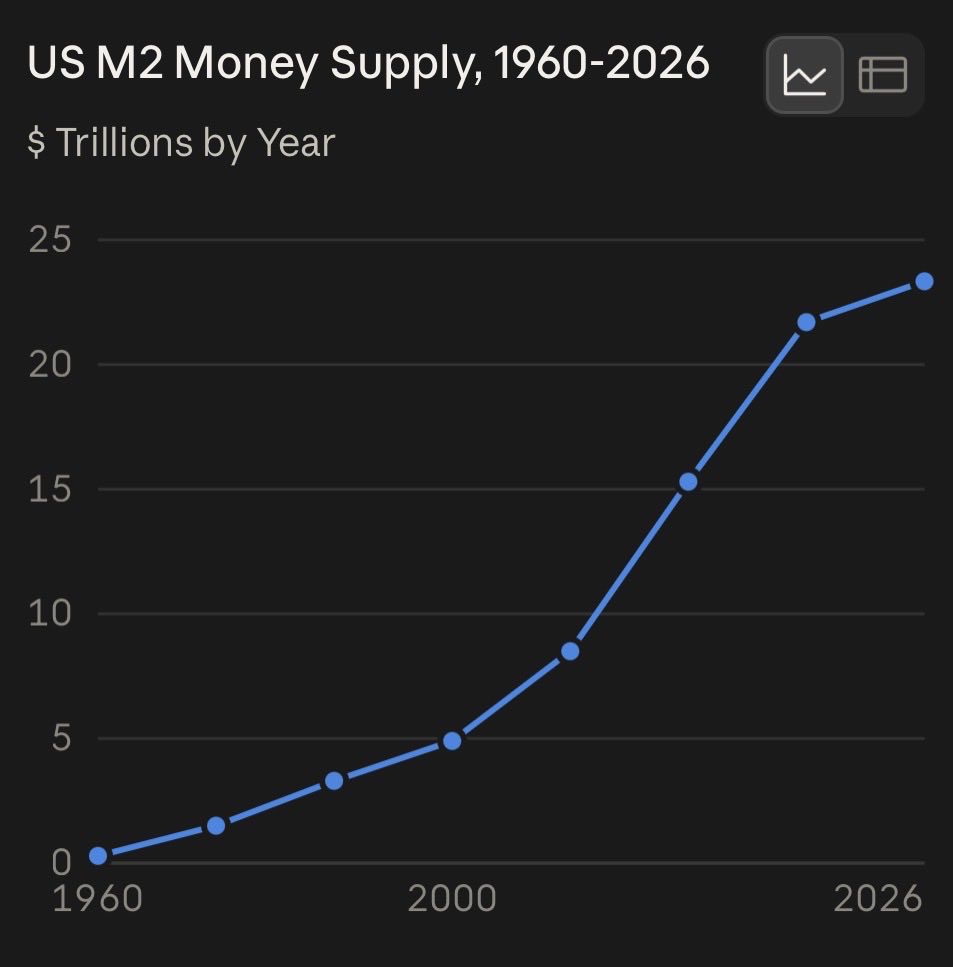
US money supply just hit a new all-time high, $23.34 trillion. It does this every single cycle, recession or not, crisis or not, "this time we'll be responsible" or not.
I stopped being surprised by these charts a while ago. They don't have a down decade. That's not a warning anymore, it's just the plan. Own things that can't be printed.
@BitcoinMagazine@paoloardoino The irony is that USDT started on Bitcoin in 2014.
Now it’s coming back with much better infrastructure.
Bitcoin doesn’t need to become a stablecoin.
It just needs to become the settlement layer underneath a global digital dollar economy.
That’s the interesting part.
@charliebilello This chart never has a down-and-to-the-right decade. Every recession, every crisis, every 'this time we'll be disciplined' promise still ends at a new high on this line. That's not a cycle, that's the only policy tool that's ever actually been used. Plan accordingly.
This is the power bottleneck showing up in a legal filing, not just a headline. Oracle's own data center is being delayed by a gas pipeline that can't get permitted on time. The GPUs were never the constraint. It's permitting and power delivery — and now it's costing a $700B+ company real money to protect itself from it
Quickly, the odds of another Fed hike in October jumped from 55% to 70%. That's a 15-point move in a single data release, not a slow drift.
Every asset reacted exactly how you'd expect: gold fell below $4,300, yields climbed further, bitcoin dropped 2.4% on $280M+ in liquidations. Nothing defied the textbook today — this was rate expectations repricing in real time, and every asset class felt it the same day.
The part worth remembering: a 15-point swing in hike odds off one data print means the Fed is now genuinely data-dependent meeting to meeting, not on a preset path. That's more volatility ahead, not less, regardless of which asset you're watching.
Ignore the noise and stay long high quality, scarce, and productive/differentiated assets.
@DeItaone Watch the 7-year auction closest today. After a weak 5-year sale pushed yields to 20-year highs, this is the market's next real test of whether buyers show up at these levels or demand more yield. Everything else on this list is a headline. That auction is a receipt.
@saransh12141 Good data used to be good news. Now it just means higher borrowing costs on $40T+ in debt. A market that sells off on strength isn't reacting to the economy, it's reacting to the balance sheet.
Today's selloff happened because the economy is too strong. Business activity just hit its fastest pace since 2021 — and stocks dropped on the news (S&P -0.75%, Nasdaq -1.13%, Dow -352 points), because strength now gets read as more rate hikes, not less. A weak 5-year Treasury auction pushed yields to fresh two-decade highs the same day.
Bitcoin pulled back too, over 2% off its highs. Context matters here: that's profit-taking after a 13% run in seven days, not a change in trend. A fast, sharp move higher almost always cools off before it continues — that's normal, healthy price action, not weakness.
Don't confuse a one-day pullback after a strong run with a reversal. Bitcoin's setup hasn't changed. It just went up too fast to keep going in a straight line.
The bigger story isn't Claude controlling lab equipment.
It's AI closing the loop between hypothesis → experiment → results → next experiment.
Once intelligence can operate physical labs 24/7, biology starts looking less like a human-limited process and more like an optimization problem.
That could be enormous for drug discovery.
We like biotech that has proven AI capabilities. Biotech is one of the largest beneficiaries of the AI buildout.
@StockSavvyShay The real story isn't the 5% hike.
It's that TSMC can raise prices because customers need the capacity more than they need a discount.
AI demand → scarce leading-edge capacity → pricing power → higher margins → more capital to expand capacity.
That's what a moat looks like.
The 10Y is now 5.125%.
Stocks are falling.
October Fed hike odds are ~71%.
And yet U.S. PMI just hit 58.4 — the strongest since 2021.
This isn't a recession trade.
It's a repricing of the cost of capital.
And that creates opportunity:
Own the companies that generate cash, increase productivity and/or control scarce assets.
Let the highly leveraged businesses worry about 5%.
That valuation gap should be way bigger than it is. One company is growing units low single digits with same-store sales going negative. The other is growing revenue near 90% at 65% margins, building the infrastructure layer for the biggest capex cycle in a generation, and physical AI hasn't even shown up in the numbers yet. The market's pricing these like similar risk. They are not similar businesses.