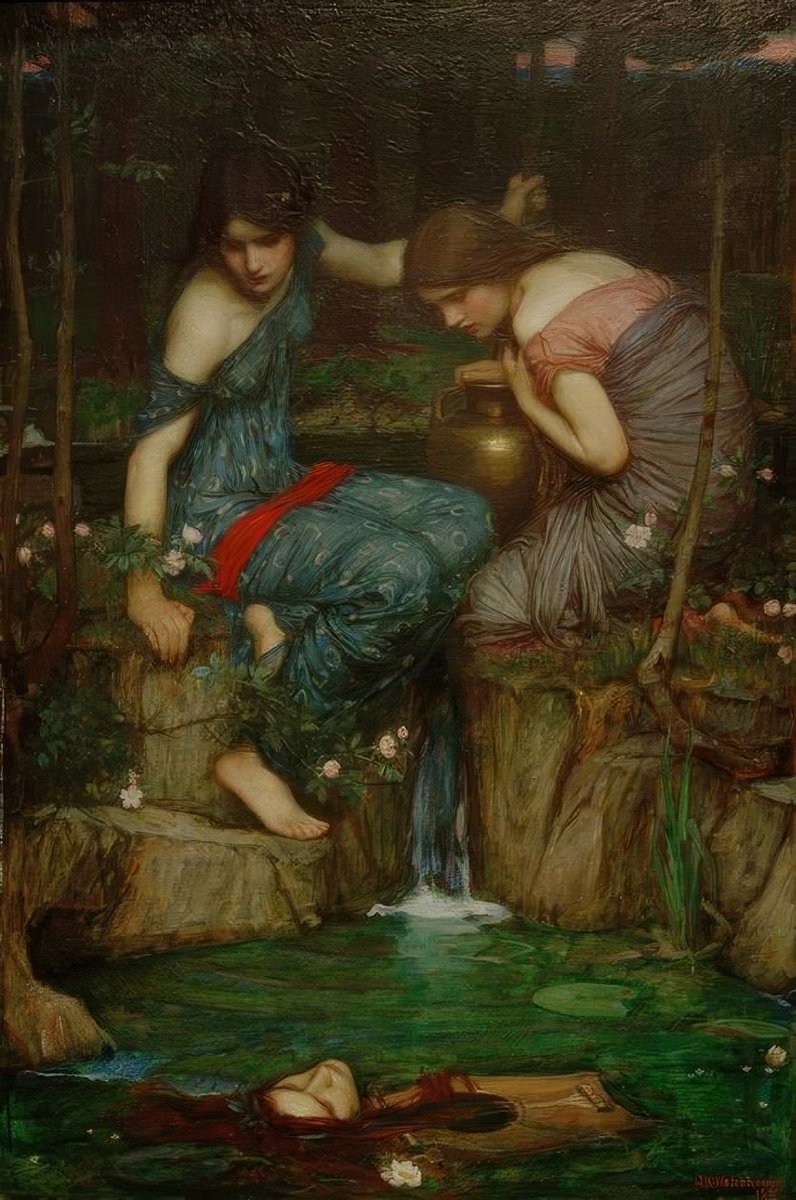
¿Te imaginas que los dioses y héroes griegos vivieran en el siglo XXI? Así lo imaginamos nosotros. ¡No te pierdas el último porque va a robarte el corazón! https://t.co/gZxCjIRI1r
Nijmegen Roman Cavalry Helmet (late 1st Century - early 2nd Century AD), an iron mask sheathed in bronze and silver discovered in 1915 CE, in a gravel bed on the south bank of the Waal, under a railway bridge and below Dutch city Nijmegen. Inside it were two cheek guards, evidently from a separate helmet, and several melon-shaped blue glass beads.
On 2 March 1915 James Curle, a Scottish archaeologist, read a paper on the helmet to the Society for the Promotion of Roman Studies, which published paper in its journal later that year; helmet was described as "recently discovered", and "a recent addition" to the collection of Roman antiquities of Gerard Marius Kam, also of Nijmegen. According to Arrian of Nicomedia, face mask helmets were used in cavalry parades and sporting mock battles called “hippika gymnasia”
Nijmegen helmet would have been worn by the élite Roman cavalry. The head portion of the helmet is made of iron, while the mask and diadem are of bronze or brass. The helmet provides neck protection via a projecting rim overlaid with a thin bronze covering plated with silver. Diadem features two male and three female figures. Helmet indicated by its hairless brow and the shape of its eyes, lips, and chin. It is broadly classified as a cavalry sports helmet—type D, according to the typology put forward by H. Russell Robinson. Type D cavalry sports helmets are distinguished by two features: a horizontal hinge that attaches face mask to the head piece, and a head piece made to resemble a decorated helmet.
The remaining portions of the helmet consist of three main parts: a face mask, a brow band, and ear and neck guards on either side. An iron skull cap was designed to closely follow the outline of the wearer's head, although due to significant oxidation, only fragments remain; what remains shows that it was originally skillfully hammered to represent elaborately dressed hair. Mask, made of silvered bronze, depicts a youthful face. The eyes, mouth and nostrils have openings and lips and eyelids are gilded. The face extends outwards on the sides to cover the ears. These are covered by a separate piece of silvered bronze to protect the ears and neck. On the dexter cheek is scratched a name, suggested to be "Marcianus".
The brow band, or diadem, of the helmet is attached to head-piece by a single horizontal hinge; additional straps would likely have originally been used to hold the helmet in place over the wearer's head. At the top and bottom of the brow band are beaded lines, between which five raised busts, three female and two male, are depicted. The band is silvered, and the beaded lines, like the busts' drapery, lips, eyelids, and hair, are gilded.
Museum het Valkhof, Nijmegen
#archaeohistories
https://t.co/LIYkfuTDvT Sé que es un rollo firmar este tipo de cosas porque luego te bombardean con emails con otras iniciativas, pero ¿me ayudáis a firmar la petición? Es para que el Griego sea obligatorio en el Bachillerato de Humanidades, el cual no se entiende sin el Griego.
Feliz día de la lengua más hermosa de mundo: la griega. Y gracias a la vida por permitirme vivir de ella, expandiendo su conocimiento. https://t.co/LecTX8lZs4
Cuando dices que vas a estudiar filología, filosofía, arte, historia, geografía, humanidades, te anuncian la catástrofe. Ahora que tantos jóvenes están tomando sus decisiones, quisiera compartir mi experiencia contra corriente: elegí clásicas. Y no me he arrepentido ni un día.