Iranian President Masoud Pezeshkian said at the COP31 UN climate summit in Antalya that US-Israeli strikes on fuel facilities in Iran released 1.5 million tons of CO2, including 500,000 tons in Asaluyeh and 1 million tons near Tehran, Turkey's state-run Anadolu Agency reported Wednesday.
Pakistani Prime Minister Shehbaz Sharif said Wednesday in a post on X that he had conveyed Pakistan's deep concern over the prolonged regional conflict during a meeting with Iranian President Masoud Pezeshkian on the sidelines of the COP31 climate summit in Antalya, Turkey.
“Dialogue, restraint, de-escalation and sustained diplomacy are the only path to lasting peace,” Sharif wrote.
He added that Pakistan would continue its efforts toward regional peace and stability, building on the understandings reached under the Islamabad memorandum of understanding.
Iran is adding 23 commemorations to its official calendar, including days marking the US-Israeli war, the killing of former supreme leader Ali Khamenei and the selection of his son Mojtaba as his successor.
https://t.co/OTeNEf1HvY
China has never pursued colonial policies and its centuries-old relations with Iran have been free of negative experiences, Iranian lawmaker Alaeddin Boroujerdi said Wednesday.
In remarks reported by the parliament's news agency, Boroujerdi, who also heads the Iran-China Friendship Association, said the Islamic Republic had consistently prioritized relations with Beijing since the 1979 revolution.
He described the 25-year comprehensive cooperation agreement between Tehran and Beijing as evidence of the two countries' long-term commitment to strengthening bilateral ties.
Boroujerdi said the late supreme leader Ali Khamenei had placed particular importance on relations with China and argued that his directives should form the basis of Iran's foreign policy.
He said the foreign ministry should follow Khamenei's approach, citing the supreme leader's constitutional authority to set the country's broad policies.
Iran's armed forces have prepared an updated list of potential targets covering locations in the region and beyond that could be used by the United States or Israel, deputy chief of staff Keyoumars Heydari said.
Heydari said the list was awaiting formal communication to army and Revolutionary Guards commanders, adding that the confrontation with the United States had become a regional war.
"Our response has no geographical limitations," he said, adding that if an aircraft flew from any country to bomb Iran, Iranian forces would be authorized to strike similar locations in that country.
https://t.co/70sv1mwujg
The United Nations General Assembly on Wednesday elected Iran to its Committee for Program and Coordination with 144 votes, giving Tehran another three-year term on a body that reviews UN programs and recommends priorities across the organization.
In a post on X, Hillel Neuer, executive director of UN Watch, condemned the decision, criticizing Iran's election to a committee that reviews UN programs covering human rights, women's rights, disarmament and counterterrorism.
https://t.co/tyXKzD47FJ
Yemen's Iran-backed Houthi forces said on Wednesday they had carried out a drone attack on an oil pumping station in the Saudi Red Sea city of Yanbu, according to the group's military spokesperson Yahya Saree.
Saree also rejected a Saudi-led coalition accusation that a Houthi drone had been intercepted over the holy city of Mecca, saying the group's operations targeted Saudi oil facilities and military bases.
A supermarket refrigerator might seem an unlikely instrument of geopolitical confrontation. Yet France’s attribution of cyberattacks targeting refrigeration systems to Iran’s Revolutionary Guards brings a distant war into Europeans’ everyday lives.
https://t.co/y6GcZTOVyl
Iran attacked ship navigation systems on Oman's Didamar island in the Strait of Hormuz, targeting infrastructure used to help restore oil shipments through the waterway, Reuters reported, citing three sources familiar with the matter.
The sources confirmed the attacks on Wednesday but provided no assessment of the damage. Reuters said it could not independently establish whether any navigation systems had been destroyed.
Tehran had claimed responsibility for the attacks on Tuesday. The reported strikes targeted infrastructure used to facilitate shipping through the Strait of Hormuz as efforts continue to restore oil flows from the Persian Gulf.
Iran's Revolutionary Guards have developed aerospace capabilities powerful enough to counter a global superpower and bring it to a standstill, IRGC spokesman Hossein Mohebbi said Wednesday.
Speaking to the Guards-affiliated Tasnim news agency, Mohebbi said the IRGC Aerospace Force had become a symbol of the Islamic Republic's military power, enabling Tehran to establish a balance of power against a global superpower.
He credited the force's development to the directives and guidance of the late supreme leader Ali Khamenei, as well as the expertise and efforts of military commanders who helped establish and expand its capabilities.
Mohebbi singled out Hassan Tehrani Moghaddam, widely regarded as the architect of Iran's ballistic missile program, for his central role in developing the Guards' aerospace capabilities.
Tehrani Moghaddam was killed in November 2011 in an explosion at a Revolutionary Guards missile base near Tehran that also killed 16 other Guards members.
Hezbollah Secretary-General Naim Qassem said those who believe Israeli attacks will continue until the group is disarmed should let Israel carry out its strikes, questioning why the issue concerned them.
In remarks Wednesday, Qassem accused Lebanese advocates of disarming Hezbollah of presenting what he described as a US and Israeli demand as a national Lebanese priority.
He said the entire world knew that Washington and Israel wanted Hezbollah disarmed and criticized those in Lebanon who insisted the demand originated domestically.
Qassem also called for expanding the regional resistance front, signaling his support for a broader alliance of groups opposed to Israel.
US President Donald Trump said the conflict with Iran would end soon but insisted Washington wanted a "total victory," saying Tehran would need 25 years to rebuild what US forces had destroyed.
"America did not start a war with Iran. Iran has been waging war on America since 1979," Trump said.
"We want to make sure we have a total victory, not a 93 percent victory," he added.
"When this conflict is over, and it will be soon, the entire world will be a much safer and better place," he said.
Tehran has dismissed US plans to restrict Iran’s overland trade routes as ineffective propaganda, but Iranian businesses report sharp increases in transportation costs and insurance premiums.
https://t.co/M9DrnP3Cab
Israel is making “maximum use” of the supernatural and jinn, spirits in Islamic belief, against Iran, hardline cleric Alireza Panahian said, recounting that someone versed in such matters had told him Israel tracked officials not through their mobile phones but through jinn. “A lot can be done through these means,” he said.
Iranian diesel and gasoline are smuggled into Pakistan using small boats, trucks, motorbikes and even pack animals, with networks operating around Gwadar, Jiwani and Pasni along Pakistan's Baluchistan coast. An estimated 6 million liters of fuel cross into Pakistan daily.
Iran is determined to end its prolonged state between war and peace with the United States through sustained deterrence, potentially without negotiations, Parliament Speaker Mohammad Bagher Ghalibaf said Wednesday.
In an interview with Al Jazeera, Ghalibaf said Washington had yet to provide a formal response to Tehran's seven conditions for reopening the Strait of Hormuz and resuming negotiations.
He said Iran had submitted a clear response setting out its demands and insisted that the United States must fully implement the seven conditions before talks could resume and the waterway could reopen.
Ghalibaf said distrust of Washington and what he described as excessive US demands remained obstacles to an agreement, adding that a deal would be possible if Washington honored its commitments and refrained from actions that undermined trust.
He also said there had been no changes to Iran's negotiating team and that he remained responsible for negotiations with Washington.
https://t.co/AmdQTclfgi
Iranian President Masoud Pezeshkian said Wednesday that the late supreme leader Ali Khamenei considered the use of nuclear and other unconventional weapons tantamount to destroying human life and future generations.
Speaking at the COP31 United Nations climate summit in Antalya, Turkey, Pezeshkian said Iran had pursued reductions in greenhouse gas emissions and expanded clean energy despite what he called unjust sanctions that restricted the country's access to international financing and technology.
He also said Iran's renewable power generation capacity had increased approximately fivefold over the past two years.
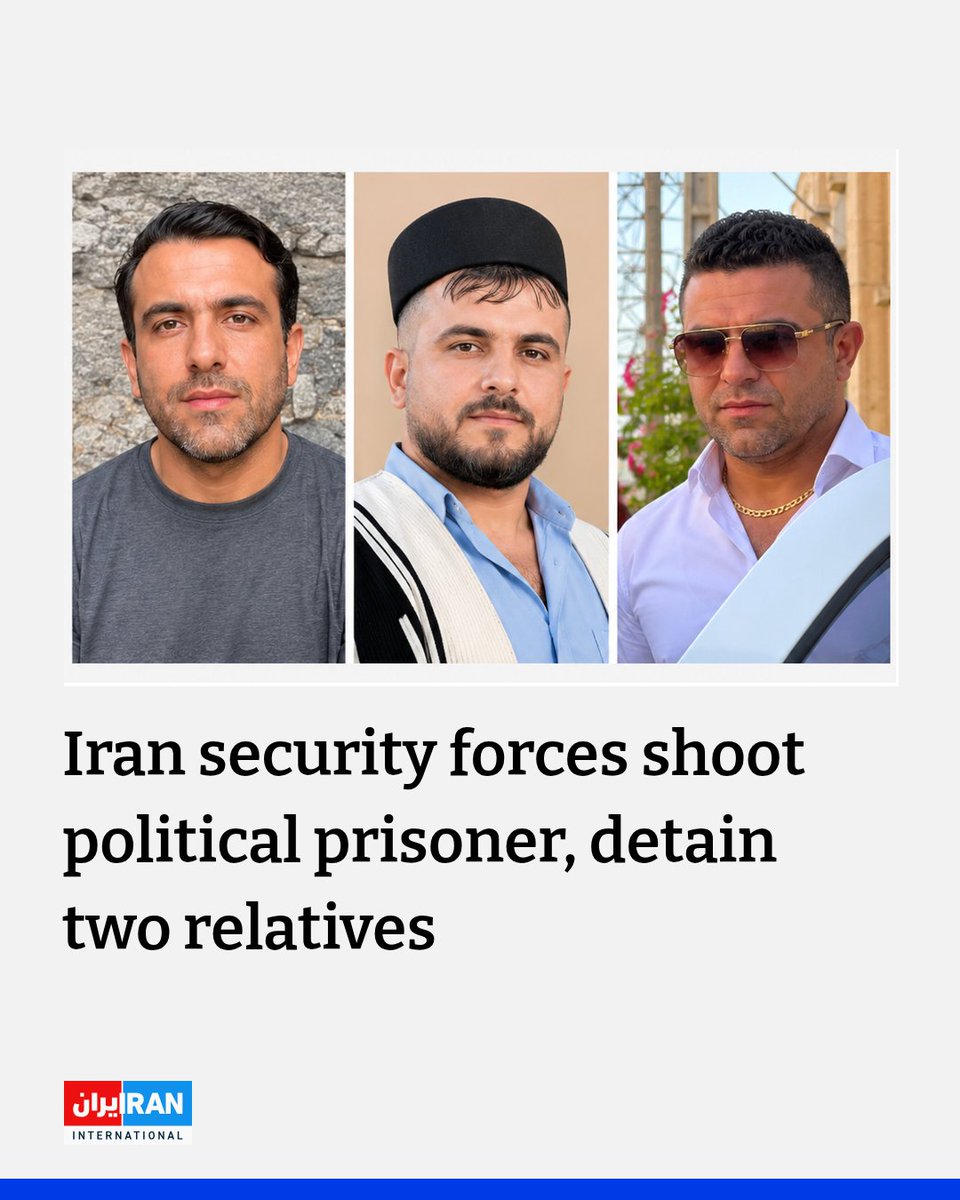
Iranian security forces shot political prisoner Kayhan Manteghi in the leg and detained him along with his brother and cousin, according to information obtained by Iran International.
Kayhan Manteghi, his brother Iman Manteghi and their cousin Hossein Manteghi were arrested on November 7. Their whereabouts and condition have remained unknown since their arrests.
A source familiar with the case told Iran International that armed security personnel opened fire on Kayhan Manteghi during an encounter, wounding him in the leg. The source said his brother and cousin were also arrested after going to the scene to help him.
The lack of information about the three detainees has raised concerns about their safety, particularly Kayhan Manteghi's health following his gunshot injury.
In a separate case, Iran International reported in September that security forces shot protest detainee Alireza Sepahi in the legs during his arrest and detained his mother, brother and teenage sister.
https://t.co/GMzAEpHQ4y
Russia's offer to receive Iran's enriched uranium remains on the table, Foreign Ministry spokeswoman Maria Zakharova said Wednesday, emphasizing that Tehran alone has the authority to decide what happens to its nuclear stockpile.
Speaking at a press briefing in Moscow, Zakharova said Russia would also consider alternative proposals.
Her remarks came as Iran's Supreme National Security Council Secretary Mohsen Rezaei said Tehran had informed Moscow that "not a single particle" of enriched nuclear material would leave Iran.