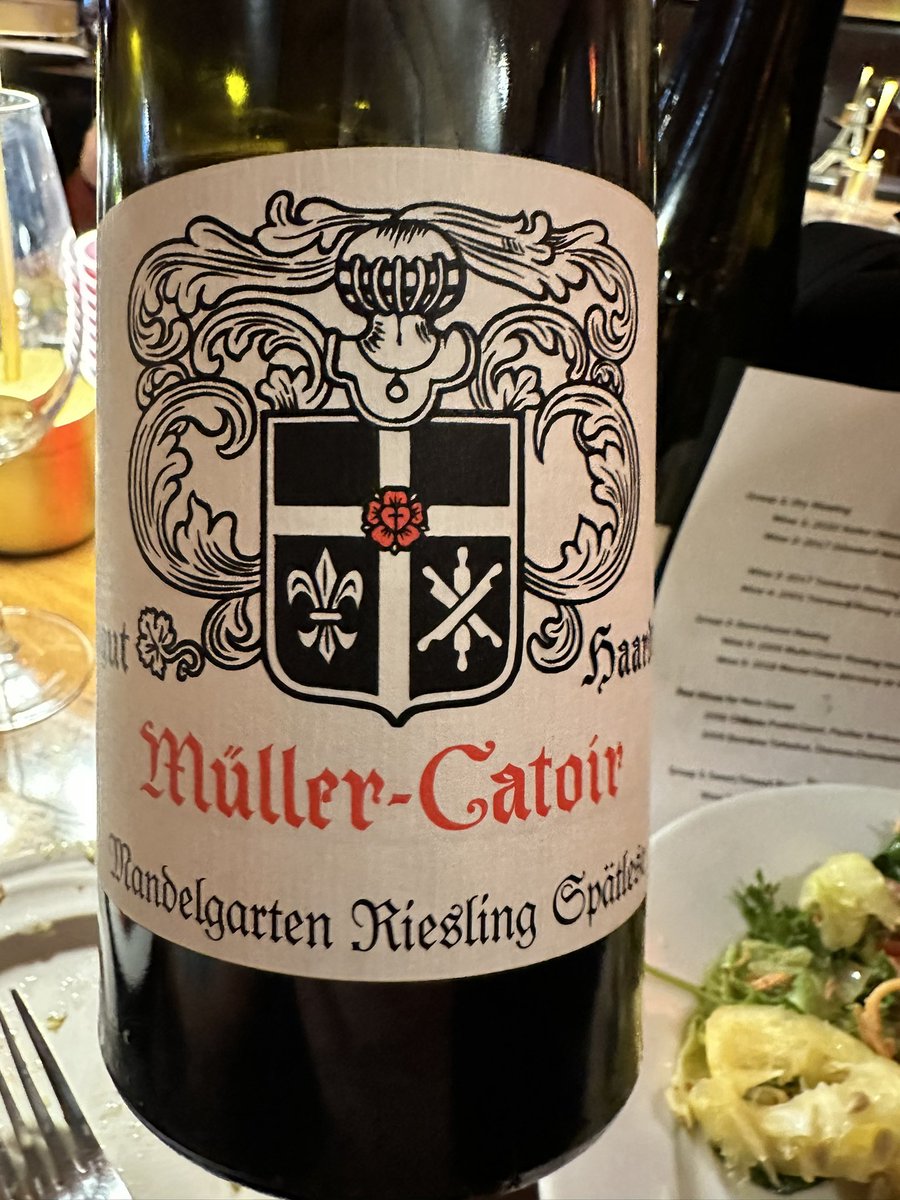
2009 Müller-Catoir Mandelgarten Spätlese. One of the most enjoyable wines of the evening from one of my favorite German Riesling producers, alongside Dönnhoff.
Müller-Catoir has been producing wine in the Pfalz for more than 250 years and has built a reputation for some of Germany’s most distinctive Rieslings. The wines often combine generous fruit, exotic aromatics, and richness with the precision and balance that define great German Riesling.
Mandelgarten, literally “almond garden,” is one of the estate’s historic vineyards in Haardt, a warm corner of the Pfalz where almond trees actually thrive. The 2009 vintage was a ripe one, and this wine reflected that character beautifully.
At 17 years old, the wine still felt surprisingly youthful. Lush and expressive, with honeyed citrus, floral notes, stone fruit, spice, and excellent balance. There was plenty of richness, yet enough acidity to keep everything energetic and focused.
One of the things I love about great Spätlese is its versatility. Less sweet and concentrated than Auslese, it often feels lighter on its feet while still carrying enough richness to work throughout a meal. At this age, the wine seemed equally comfortable on its own, with cheese, or at the table.
Not the rarest or most expensive bottle of the evening, but one of the most enjoyable to drink. A beautiful example of how richness and elegance can coexist in Riesling.
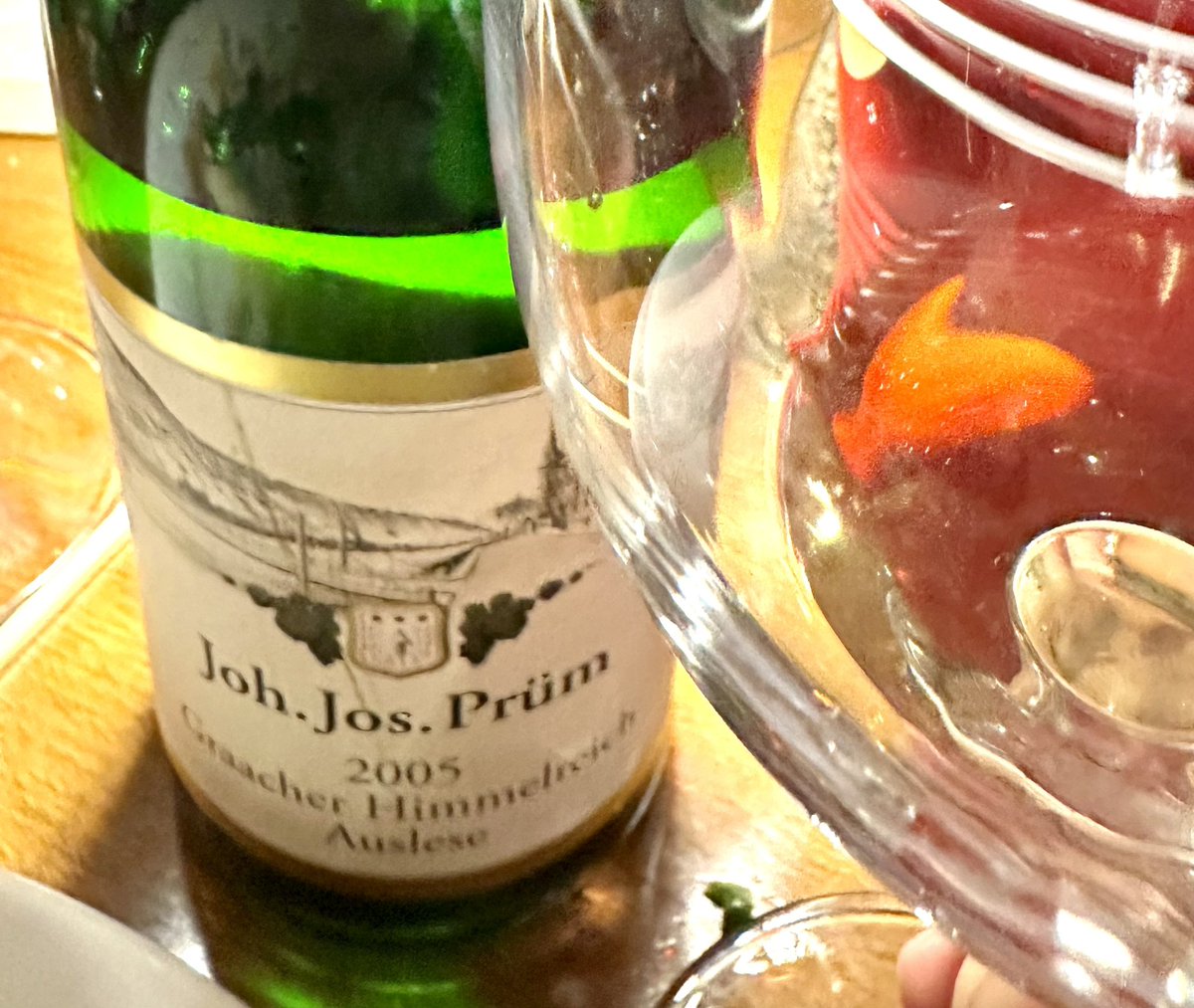
2005 J.J. Prüm Graacher Himmelreich Auslese. The best showing I’ve had from J.J. Prüm. I realize this is probably a gross generalization, but in youth I’ve often found Prüm’s wines a bit too dominated by fruit for my personal taste. The quality is obvious, yet I sometimes struggle to see what all the fuss is about. This bottle helped me understand it better.
J.J. Prüm is one of the Mosel’s most revered estates, and Graacher Himmelreich is one of its classic vineyards, known for producing wines that combine delicacy, elegance, and remarkable longevity. Auslese sits above Spätlese in the German ripeness hierarchy and is often viewed as a dessert wine, but the greatest examples can be far more versatile than that.
At 20 years old, this wine still tasted remarkably young. I wouldn’t describe it as especially tertiary, but the exuberant fruit of youth had settled into something more restrained and harmonious. The sweetness felt better integrated, allowing the wine’s balance, minerality, and structure to take center stage.
One of the things I find fascinating about mature Auslese is that it gradually moves beyond the dessert-wine category. The fruit and sweetness remain, but they no longer dominate. Instead, the wine occupies a middle ground between dessert and savory courses. I particularly enjoy aged Auslese with cheese, where the richness, acidity, and sweetness all find a natural balance.
This wine is still remarkably young. It hasn’t yet developed the petrol, smoke, and tertiary complexity that I love in mature Riesling, but for the first time I felt I could clearly see where the wine is headed. If this is what the 2005 looks like at 20 years old, I can only imagine what another decade or two might bring.
1976 Baron Knyphausen Erbacher Michelmark Trockenbeerenauslese.
A rare opportunity to taste a nearly 50-year-old German dessert wine.
Baron Knyphausen is one of the historic estates of the Rheingau, with roots stretching back centuries. Erbacher Michelmark is not among Germany’s most celebrated vineyards, which made the performance of this bottle all the more impressive. The hot, dry 1976 vintage produced wines of exceptional concentration, and this bottle is clearly built to last.
Deep amber-brown in color, the wine delivered immense concentration and surprisingly vibrant acidity. The comparisons around the table naturally drifted toward Tokaji Eszencia and old Madeira. It wasn’t quite as thick as Eszencia, nor did it possess the extraordinary complexity of the finest Madeiras, but it occupied an intriguing space somewhere between the two.
What impressed me most was the balance. With wines this sweet and this old, the risk is that they become heavy or tiring. Here, the acidity kept everything alive, carrying deep flavors through a remarkably long finish.
Not the most complex sweet wine I’ve tasted, but certainly one of the most memorable bottles of the evening, and a reminder of just how long great Riesling can live.
2001 Trimbach Clos Ste. Hune.
The wine of the night for me. Trimbach is one of Alsace’s benchmark estates, family-owned since 1626, and Clos Ste. Hune is its legendary 1.67-hectare monopole within Rosacker, widely regarded as one of the greatest dry Rieslings in the world.
The 2001 vintage in Alsace produced structured, long-lived wines, and this bottle showed exactly why it has such a reputation. Many wines at the dinner had greater concentration, sweetness, or sheer power, but Clos Ste. Hune wasn’t trying to impress that way. Instead, it kept evolving.
Every revisit brought something new: white pepper, flowers, smoke, burned tire, citrus oil, and crushed stone. The aromas seemed to continuously unfold over the course of the evening.
One of the things I love most about mature Riesling is watching youthful slate and citrus transform into smoke, petrol, spice, and tertiary complexity. This bottle captured that evolution beautifully.
At 25 years old, Clos Ste. Hune is fully mature, but far from over the hill. If anything, it feels like a wine still finding new ways to express itself. I suspect it will continue evolving for many years to come.
One of the world’s great dry white wines, and the most compelling bottle on the table.
Riesling dinner last night, spanning dry, off-dry, Auslese, and TBA styles.
The biggest takeaway was how differently Riesling ages.
The younger stars—2020 Keller RR, 2017 Dönnhoff Hermannshöhle GG, 2017 Trimbach Frédéric Emile, 2009 Müller-Catoir Mandelgarten Spätlese, and 2005 J.J. Prüm Graacher Himmelreich Auslese—showed tremendous quality, but most still felt youthful. The material was there, yet they haven’t fully arrived.
One reason I love Riesling is that both ends of the aging spectrum are so compelling. In youth, the best examples seem almost electrically charged, with slate-driven minerality, citrus, and that nearly fizzy sense of energy that makes the wines feel weightless despite their intensity. With age, those youthful notes evolve into the aromas I wait for: petrol, smoke, spice, honey, and layers of complexity that seem to emerge endlessly from the glass.
The wine that kept revealing itself throughout dinner was the 2001 Trimbach Clos Ste. Hune. One of the world’s great dry white wines, and at 25 years old finally beginning to show the complexity that makes it legendary. Every revisit brought another layer of citrus oil, smoke, petrol, spice, and minerality. For me, the most compelling wine of the night.
The surprise was a 1976 Knyphausen Trockenbeerenauslese. Deep amber-brown in color, with remarkable acidity carrying immense concentration. Comparisons around the table drifted toward Tokaji Eszencia and old Madeira. Not quite as thick as Eszencia, nor as complex as the finest Madeiras, but still a fascinating and memorable bottle after nearly 50 years.
Unfortunately, the 1989 Langwerth von Simmern Auslese was lightly corked, which robbed us of what could have been an interesting comparison.
2018 Jean-Marc Millot Savigny-lès-Beaune with a smoked roast chicken.
Millot is based in Nuits-Saint-Georges, while Savigny-lès-Beaune is one of Burgundy’s classic villages for honest, food-friendly Pinot Noir. The warm 2018 vintage brought more richness than usual, and this bottle showed plenty of black cherry fruit, spice, and a touch of earth.
At nearly eight years from harvest, the wine is in a very good place. The fruit remains vibrant, but the wine is beginning to pick up the savory complexity that makes mature Burgundy so appealing.
The chicken was wet-brined overnight, lightly smoked, and finished in the oven until the skin crisped. The smoky, savory flavors paired beautifully with the ripe fruit and emerging secondary notes of the wine.
Nothing fancy. Just a reminder that village Burgundy and a well-cooked chicken remain one of the great values in wine and food. 🍷🐓
Best steak I’ve made so far.
American Wagyu, dry-brined for 3 hours, then smoked low and slow before a final hot sear with herb, garlic, and anchovy butter.
The result was exactly what I was chasing: edge-to-edge pink, fully rendered fat, a great crust, and just enough smoke to add complexity without overpowering the beef.
A reverse sear, but with smoke. This one’s going into the permanent rotation. 🥩🔥
Classic example of why I love Italian whites. This @klwines tasting featured three bottles from two of Italy’s benchmark white wine regions: Campania and Veneto. All three were terrific values in the $15-25 range.
My favorite was the 2024 Mastroberardino Morabianca Falanghina. Falanghina is often considered the least prestigious of Campania’s great native white grapes, but it can be incredibly charming: bright, salty, energetic, and easy to love. This bottle delivered all of that.
The 2024 Mastroberardino Radici Fiano di Avellino showed a different side of Campania. Softer, more elegant, and more layered, with the texture and complexity that make Fiano one of Italy’s finest white grapes.
The outlier was the 2022 Inama Foscarino Soave Classico. Different region, different grape, different personality. More structured and mineral, still very youthful. Good Soave ages remarkably well, and while I tend to reach for producers like Pieropan and Suavia, Inama remains one of the appellation’s strongest estates.
Mastroberardino is my benchmark producer in Campania. The family has been making wine since the 1800s and played a major role in preserving the region’s indigenous grapes when many were being abandoned. Few wineries are more closely tied to the modern revival of southern Italian wine.
These wines aren’t defined by oak. They don’t have the polish of a great white Burgundy or the sheer weight and power of a wine like Chave Hermitage Blanc. Instead, they offer freshness, minerality, energy, and a strong sense of place. These are wines built for the table: affordable, versatile, and packed with character. And while they may not chase richness, the best examples of Fiano and Soave can age beautifully and develop remarkable complexity over time.
These are the kinds of bottles that make Italy such a rewarding place to explore. Affordable enough for everyday drinking, yet distinctive enough to hold their own at a serious dinner table.
I brought home the Falanghina and enjoyed it with a modified salade Niçoise topped with fresh crab. A perfect match.
1999 Château Rauzan-Ségla.
Tasted at @klwines from Ralph Sands’ cellar, and it was a spectacular showing.
1999 was a lighter, more classic Bordeaux vintage, and today that translates into exactly what makes Margaux special: elegance, perfume, and finesse. Silky and fully resolved, with notes of violets, cedar, tobacco, and red currants. Not a wine of power, but one of harmony.
Rauzan-Ségla has become one of the leading “Super Seconds” of Bordeaux, and this bottle showed why. At 26 years old, it was completely mature yet still vibrant, with all the grace and complexity that make aged claret so rewarding.
A beautiful reminder that great bottles don’t always come from great vintages.
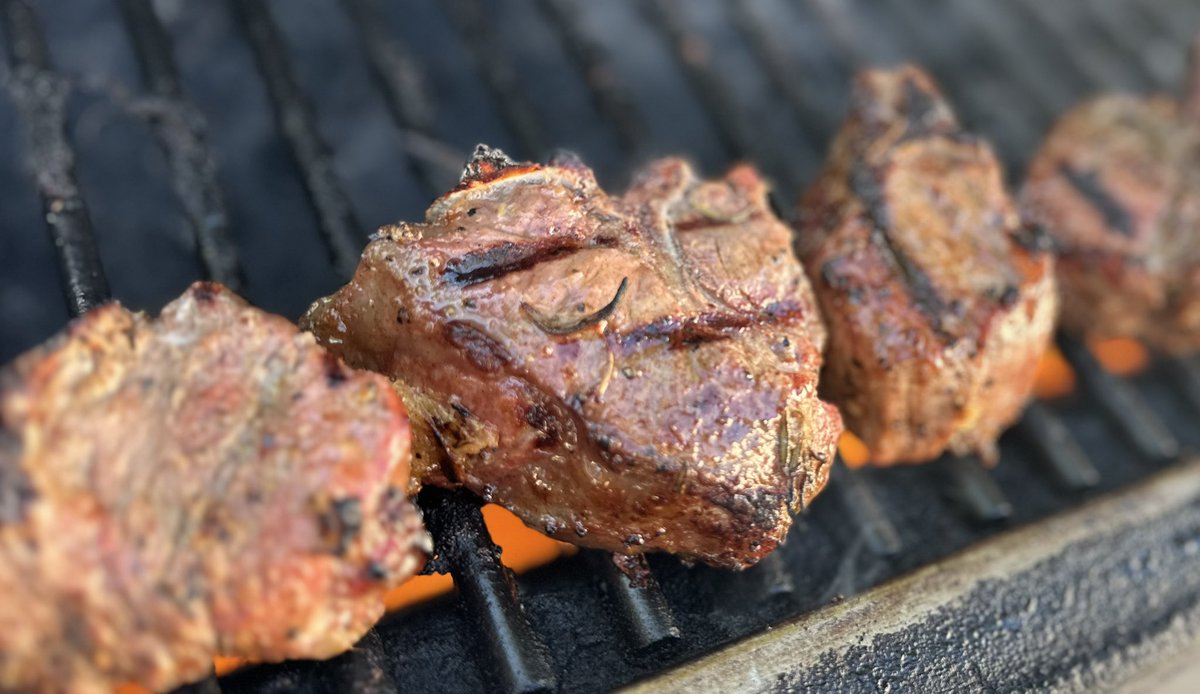
Levet Côte-Rôtie Les Journaries 2017 with grilled lamb chops. A classic Northern Rhône pairing.
First experience with Bernard Levet, one of Côte-Rôtie’s great traditionalists. At 9 years old, this wine remains remarkably unyielding. Dense, meaty, smoky, tobacco-driven, and firmly structured, with iron, olive tapenade, grilled meat, and earthy savory notes dominating the profile. Even on day two it felt monolithic and tightly wound.
What surprised me is that many traditional Northern Rhône producers show more generosity at this age. Young Clape can already reveal its Cornas character. Vincent Paris often offers plenty of pleasure early on. This Levet feels cut from an even sterner cloth.
The 2017 vintage in the Northern Rhône was warm and concentrated, producing many wines that are already showing well. That makes this bottle even more striking. I suspect what I’m seeing is less about the vintage and more about Levet’s uncompromising style. The domaine has long been known for Côte-Rôties that can seem almost rustic and impenetrable for 15-20 years before developing their full complexity. That’s also why Levet has such a devoted following among traditional Rhône lovers.
There is depth here, but today it feels more like a glimpse of the future than a wine at its destination.
The lamb chops, fortunately, were right on schedule. 🍷🥩
New Iron Chevsky blog post: https://t.co/IQYsXYhNN5 — Selosse, 2022 Northern Rhône legends, and a Clos des Lambrays walked into Scott & Kate’s.
Highlights:
• oxidative Selosse with pâté
• spectacular 2022 Chave blanc
• semi-blind Chave vs Jamet vs Allemand
• Hermitage vs Côte-Rôtie vs Cornas
• wood-fired lobster + charred lemons
• Époisses + Grand Cru Burgundy
One of the best wine dinners I’ve had in years.
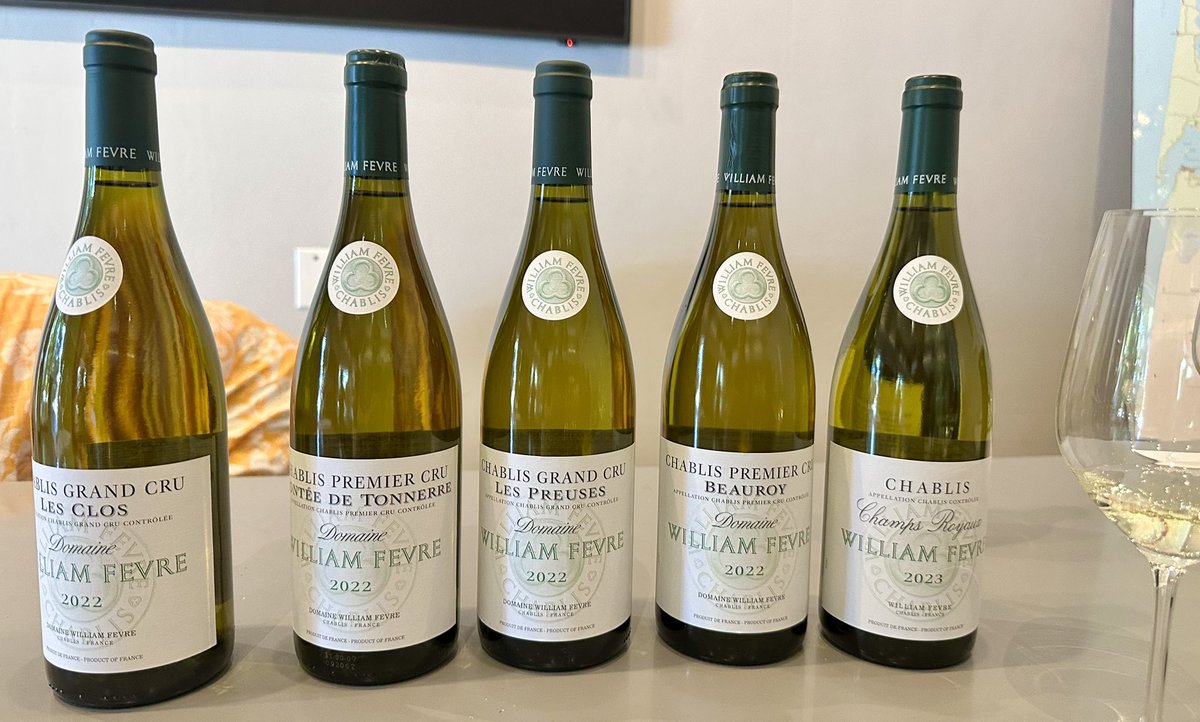
William Fèvre has always been one of those producers I respect as solid and reliable, but rarely find truly exciting. The wines are clean, classic, well-made Chablis, yet they seldom have the distinctive personality or electric edge that I look for in my favorite producers.
Still, this @klwines lineup was a fun snapshot across different terroirs and levels. The 2023 Champs Royaux was straightforward and fresh. 2022 Beauroy pleasant and easygoing. 2022 Montée de Tonnerre showed especially well, bringing much more tension, minerality, and energy.
The 2022 Grand Crus were interesting. Les Preuses felt refined and restrained, while Les Clos was serious and tightly wound, clearly needing time. But the surprise favorite for me was the 2018 Bougros. Not the most prestigious bottle on the table, and far less expensive than Preuses or Clos, yet easily the most flavorful and enjoyable today. Broad, expressive, generous, and the wine I would drink today.
A good reminder that the “best” vineyard on paper is not always the bottle that gives the most pleasure in the glass.
@profdwh I think you are right, they are pretty interchangeable, though I think of forest floor as inclusive of the dirt, while sous bois is more the underbrush.
There was a long stretch where this wine felt stubbornly adolescent. Strange for a warm, generous Burgundy vintage like 2018, but very much in line with Chevillon’s old-school style.
For years, this Bourgogne Passetoutgrain showed more angles than charm: tart cranberry, herbal notes, firm acidity, a bit rustic and disjointed, with the Pinot Noir and Gamay never quite coming together. Easy to respect because it came from Chevillon, but not always easy to enjoy.
And then, almost suddenly, it arrived.
Now the 2018 finally drinks beautifully. The fruit has softened into that earthy, savory red Burgundy register Chevillon does so well: sour cherry, dried rose, forest floor, spice, and a touch of sous-bois beginning to emerge with age. The once-angular structure now gives freshness and energy instead of austerity.
Passetoutgrain is one of Burgundy’s humblest appellations, traditionally blending Pinot Noir with Gamay and usually meant for early drinking. But producers like Robert Chevillon treat even their simplest wines seriously. Sometimes pedigree wins out over hierarchy, and patience gets rewarded in unexpected places.
A humble bottle that ended up needing — and deserving — real cellar time.
Fun night at the 2026 Meals on Wheels SF Gala. Great cause, great crowd, and one of those very San Francisco evenings where people casually pour things like Rousseau Clos St. Jacques, Rousseau Clos de Bèze, Mugnier Musigny, Leflaive Bâtard, Krug, and old Burgundy like it’s normal.
Tasted everything pretty quickly, but overall the 2004s felt solid rather than profound. Interesting to revisit that vintage across such elite producers though, especially when the bottles themselves now cost absolutely ridiculous amounts of money.
Ironically, the wine that probably impressed me most was the 1993 Christian Clerget Echézeaux. Mature, savory, resolved, and just drinking beautifully. Nice reminder that sometimes vintage wins over producer prestige.
And Krug? Always a treat.
One of the crown jewels of Drouhin’s Côte de Beaune portfolio, and arguably their signature wine from Beaune — in both red and white.
Clos des Mouches has long been one of the benchmark Beaune 1er Crus. The rouge is prized for its silky texture, perfume, earthy complexity and finesse rather than sheer power. The blanc, meanwhile, is one of the great white wines of Beaune, with a long reputation for aging beautifully and often standing alongside far more famous appellations.
In the Drouhin lineup, Côte de Nuits collectors may gravitate toward Amoureuses or Vosne Petits Monts, but in Côte de Beaune, Clos des Mouches is the historic reference point.
The 2021 rouge is very much a classic vintage expression: soft, approachable and already charming, with lifted red fruit and floral notes, but still carrying a slight youthful bitterness and structural grip that suggest more unfurling ahead.
Not a monumental rendition of Clos des Mouches, but a graceful and beautifully balanced one.
2020 Domaine de Montbourgeau L’Étoile. One of the classic traditional Jura producers, founded in 1920 and still flying the flag for old-school oxidative whites from the tiny L’Étoile appellation.
This cuvée is mostly Chardonnay with small amounts of Savagnin interplanted in the old vineyards. Fermented in stainless steel, then aged about two years in old barrels and demi-muids, partially under voile, the thin yeast layer that gives Jura wines their signature oxidative character.
The result is exactly the style I love: hazelnut, walnut skin, preserved lemon, curry spice, Comté rind, bruised apple, saltiness, and incredible savory complexity, yet still fresh and energetic underneath.
These wines are almost absurdly versatile with food. Seafood, mushrooms, roast chicken, sushi, smoked fish, creamy sauces, aged cheese — Jura just seems to thrive on umami.
Not about fruit. About texture, tension, and layers that keep unfolding with air.
1986 Château Climens Barsac.
Climens is one of the reference-point estates of Barsac and Sauternes, often known for a more precise and acid-driven style compared to some of the richer wines of the region. The 1986 showed classic mature notes of apricot, honey, saffron, citrus peel, and wax, still carried by good freshness.
Very good wine.
That said, this bottle also reinforced something I’ve realized about my own palate over time. I tend to gravitate toward sweet wines with even more acidity, tension, and complexity. Madeira especially, but also Tokaji, BA and TBA Rieslings, and even wines like Ben Ryé. Wines where the sweetness feels almost secondary to the energy and complexity underneath.
And unfortunately for the Climens, it was poured right before a superb old Madeira, which made that contrast impossible to ignore.
1964 V. J. Hauenstein Madeira Boal
One of my wines of the night, alongside the Chevillon. Climens was very good, but once this Madeira hit the table, it completely shifted the conversation. So much more complex and interesting aromatically. Salty, nutty, smoky, caramelized, endlessly layered, yet still carried by that piercing Madeira acidity that keeps everything alive rather than heavy.
Boal/Bual sits in the middle of the Madeira sweetness spectrum, richer than Verdelho but drier than Malmsey, often combining sweetness with a savory and saline edge that makes old Madeira uniquely compelling.
And unlike most wines, Madeira is intentionally exposed to heat and oxygen during production, then effectively becomes almost indestructible. The best old Madeiras can stay vibrant for centuries.
This 1964 had that feeling of infinite life ahead of it. Walnut, toffee, burnt citrus peel, sea salt, old wood, coffee, spice — constantly changing in the glass.
Kenny commented that versions from the 1940s can be even better, which is both exciting and slightly terrifying to think about.
An unforgettable bottle.
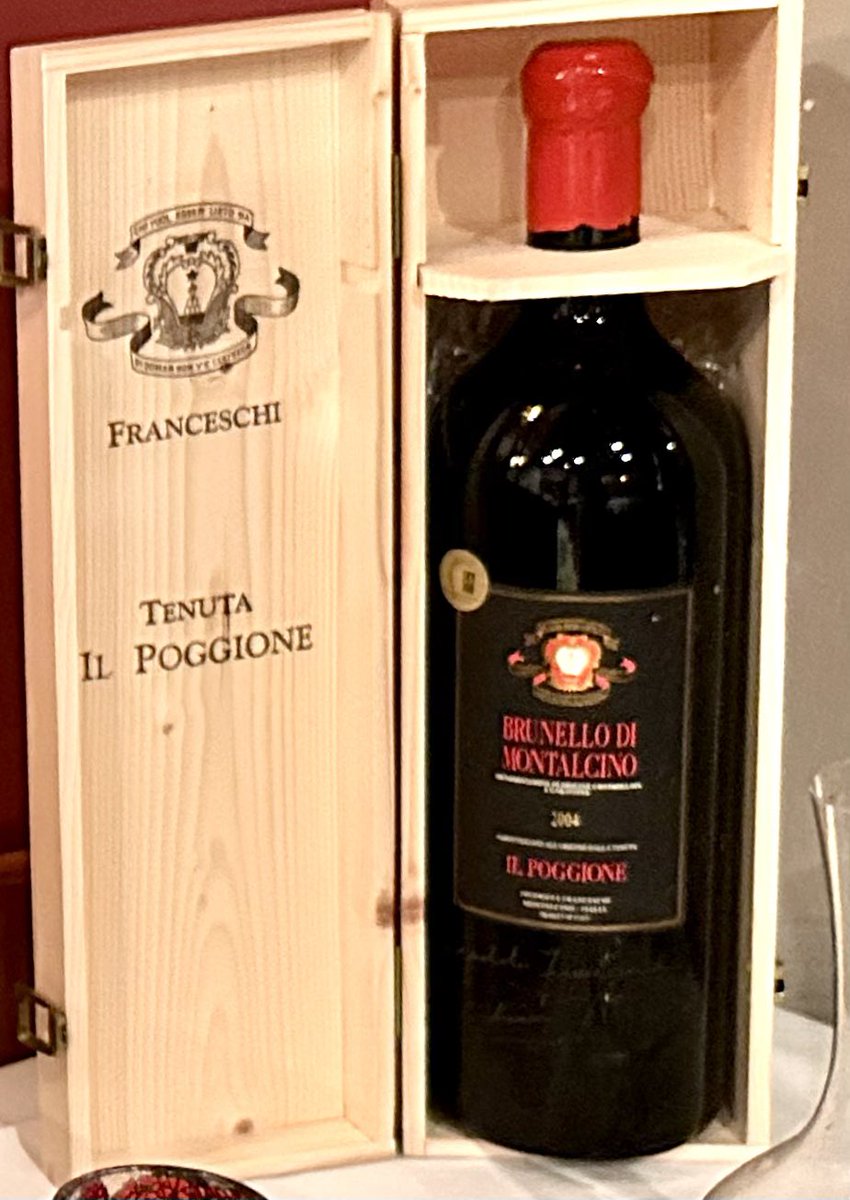
2004 Il Poggione Brunello di Montalcino (3L) - Served from 3-liter format, and it clearly showed. The host mentioned that the regular 750ml version of this wine drinks much more evolved and almost Burgundy-like at this stage, while the 3L still comes across far more youthful. That tracked with what was in the glass. Not immature, but still very primary, energetic, and structured for a 21-year-old wine.
Il Poggione is one of the historic traditional producers of Brunello, known for wines built around acidity, structure, and long aging rather than sheer extraction. 2004 is also considered one of the strongest Brunello vintages of the modern era, combining ripe fruit with freshness and balance.
The contrast with the 2002 Chevillon Les Saint-Georges earlier in the lineup was especially striking. Next to the layered complexity and tertiary nuance of mature Burgundy, the Brunello came across almost simple by comparison, despite being excellent wine in its own right.
Still, the wine showed beautiful energy and plenty of future ahead of it. Large formats age slowly, and this 3L still felt firmly on its upward curve.