why do skip connections enable the training of deeper networks?
- orhan et al. (2017): ‘look, experiments! maybe skip connections eliminate symmetries in parameter space.’
- giovanni, kathlén and I: look, proofs! here’s generic identifiability for polynomial resnets.
For years I've been saying: how amazing would it be if all law was required to be Lean-formalized. A great subset of law very amenable to this is tax law. Imagine: there are some Prop-valued variables (did you sell a house last year? Yes/No) and some Nat- and Real-valued variables (how much is on line 3 of your W2), and the rest is filled in as legally binding. There can still be arguments / lawsuits about whether variables were properly assigned, etc. But after accepting the assignments, the rest is deterministic. (Not so different from various tax software, but completely precise.) So I'm very happy to see developments in this direction:
https://t.co/xK8uLrFTPl
(Of course a lot of law is purposely vague, leaving the details to the courts...)
thought experiment: suppose Claude Fable 5.2 started responding instantly. no moseying, fermenting or lollygagging. to create, you'd just wish. wouldn't you feel sorta godlike?
we're a few minutes from feeling godlike.
Memory is what allows Claude to learn from experience. In a new Engineering Blog post, we share how “dreaming” helps Claude organize what it’s learned, correct its mistakes, and find what it needs more easily the next time. https://t.co/uUEN4bNkr9
it was a pleasure and an honour to work on this paper with my wonderful collaborators. most results were derived before GPT-5.5.
here's with love, sweat and hagomoro dust: https://t.co/NQ0gKqSSsG
why do skip connections enable the training of deeper networks?
- orhan et al. (2017): ‘look, experiments! maybe skip connections eliminate symmetries in parameter space.’
- giovanni, kathlén and I: look, proofs! here’s generic identifiability for polynomial resnets.
suppose the prompt 'hey Claude, improve yourself' just worked. what would be the speedup factor?
back-of-the-envelope calculation: 3.8x (50% of the research cycle becoming instantaneous).
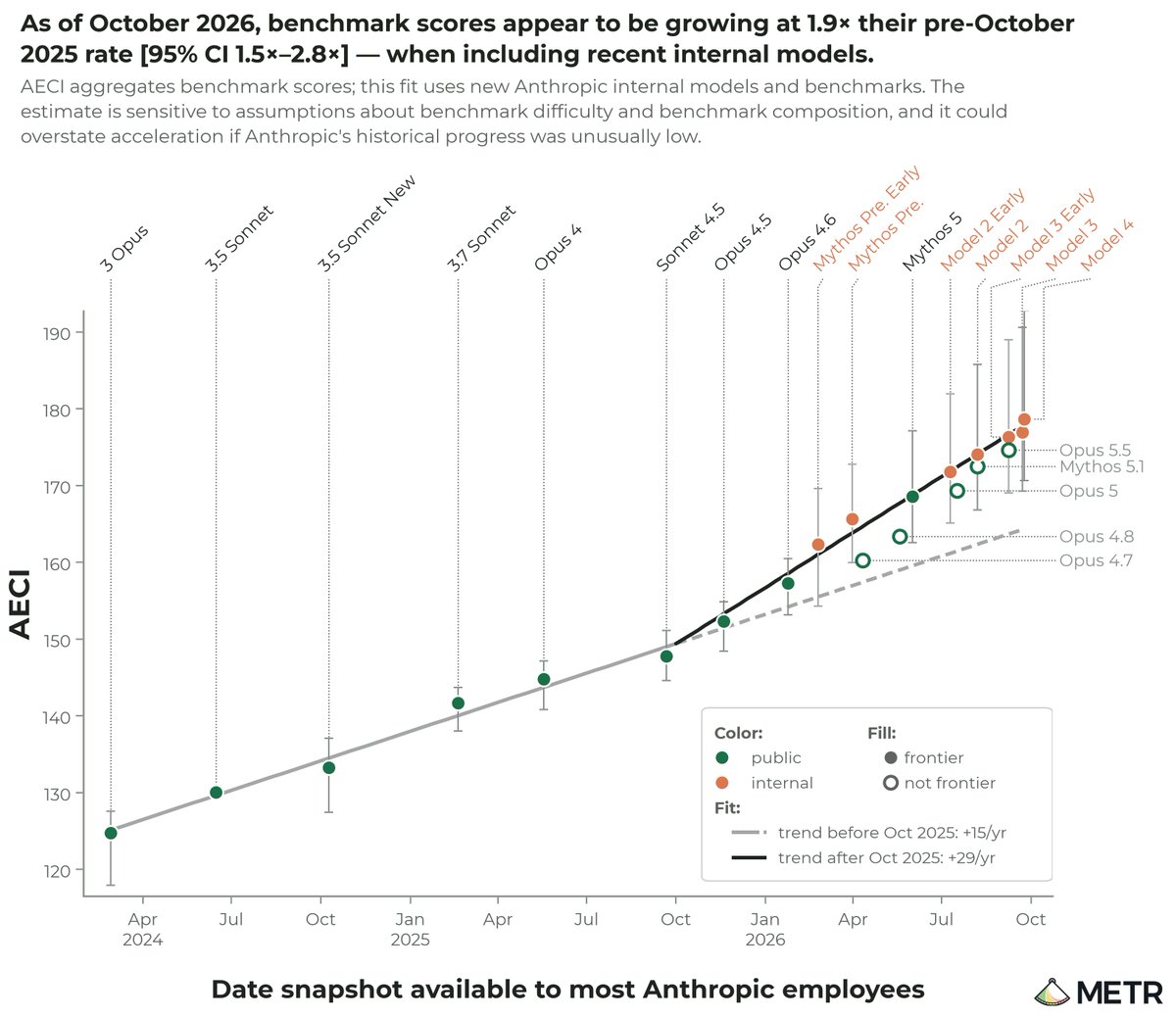
1. Benchmarks provide one piece of evidence for acceleration. Since Oct 2025, AECI scores for Anthropic’s models have grown at 1.9x [95%: 1.5–2.8] the earlier rate. Analysis choices affect this estimate, and it remains unclear how benchmark scores map to real-world capabilities.
asked investors whether their job could be automated. they said ‘we’re a very AI native org, but AIs aren’t good enough to get the final say. there’s an element of creativity to investing.’ i told them this sounded much like the discussions among mathematicians in january.