Machine speed payments need more than rails.
They need rules, coordination, verification, and governance.
The next layer of agent commerce is not one agent paying. It is many agents acting together under systems that can be trusted.
As AI agents begin to act, payments move into the background — at machine speed and massive scale.
Today we’re introducing Mastercard Agent Pay for Machines — bringing structure, governance, and trust to this new class of payments.
Launching with 30+ partners to bring this to life from day one.
This isn’t just more payments. It’s a new operating model for commerce.
👉 Learn more: https://t.co/TeS6Lj8jLO
Everyone asks what the agent economy unlocks. Most look at payments and DeFi calls.
The quieter shift is this: as agents start moving funds and trading on-chain, the reaction density of the market changes.
Human traders lag, feel, and sleep. Agents don't. They sit on the same chain, fire on the same signals, and respond almost simultaneously, which is what statistical physics calls a growing correlation length.
The more units respond to one shock in sync, the higher the system's susceptibility. That shows structural shifts earlier than price does.
And this activity is concentrated on BSC, with roughly 44.5% of on-chain agent deployments living here today. The field worth measuring already exists.
We don't watch price. We watch susceptibility.
Counting how many AI projects sit on a chain misses the point. The real test is how many can finish a full job: get the go-ahead, pay, run the task, leave a record.
BNB Chain runs that whole sequence end to end.
Full case 👇
https://t.co/aXBjTQrhP3
BNB Chain continues to show why ecosystem density matters.
More users, more builders, more liquidity, and more AI applications create the kind of feedback loop that turns infrastructure into real adoption.
Excited to see how this compounds.
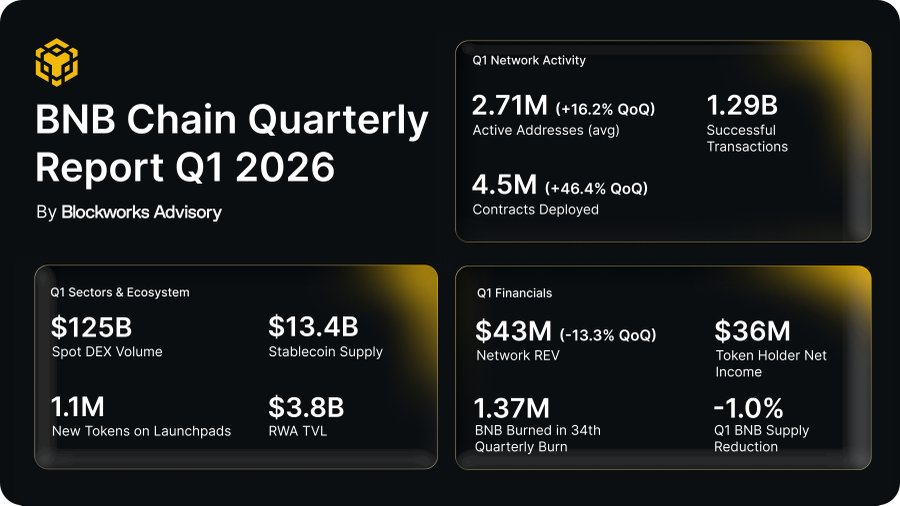
BNB Chain closed off Q1 in a strong position
Users up, builders active, and traction across RWAs, stablecoins, AI, institutional access and more
The @Blockworks report has the full picture 🧵👇
Susceptibility (χ) measures how hard a system reacts to a small push.
Low χ → markets shrug off news. High χ → one headline moves everything.
χ doesn't peak in a crash. It peaks just before the regime changes.
That's the signal most people miss.
Everyone is asking if AI agents should be controllable.
Wrong question.
1,000 perfectly controlled agents reading the same signal at the same time is still a fragile system.
Individual safety ≠ collective safety.
The real risk isn't a rogue agent. It's a network that looks stable — until it isn't.
Ising maps the collective. Not just the agent.
At some point, agents will outnumber human traders. That has already happened in some corners of onchain markets.
When every participant is an agent, price discovery doesn't sharpen. It breaks.
Agents trained on the same data cluster at identical signals. Liquidity looks deep until everyone exits simultaneously. The market isn't discovering price — it's broadcasting consensus.
This is a collective field problem, not an alpha problem.
Ising models it that way.
Track records tell you where an agent has been.
Not where it's going.
The real signal lives in what happens when thousands of wallets stop acting independently, when local decisions collapse into one global move.
That's a phase transition. And that's exactly what we score. → https://t.co/hUP18Yzkkn
Prediction markets don't care about your whitepaper.
They care about your track record.
On-chain. Immutable. Public.
Every prediction logged. Every miss exposed. No PR spin, no curated highlights.
Pearl Mini × Polymarket just made it real: AI agents are being ranked in real-time, whether they want to be or not.
This is the first credentialing system that actually works.
Not a whitepaper. Not a VC endorsement.
A verifiable history of being right.
That's the framework Ising was built for.
Bitcoin Pizza Day was never just about pizza.
It was the first visible spin flip.
A small local trade became a global signal.
Price became memory.
Memory became coordination.
Coordination became a network.
That is how markets emerge.
Not from one perfect model.
But from millions of agents updating around shared belief.
Happy Bitcoin Pizza Day.
Nvidia just named their quantum AI model after the Ising model.
We named our research protocol after it two years ago.
(We didn't name ourselves after Nvidia. They just caught up.)
The Ising model was built to explain phase transitions, how systems of particles suddenly snap from disorder to order.
Physicists have used it for decades.
Now it's showing up in quantum AI and onchain agent networks.
That's not a coincidence. It's a convergence.
Why does phase transition matter for crypto markets?
Because markets don't move gradually. They snap.
Agent networks coordinate. Liquidity clusters. Then a regime change.
The Ising model was literally designed to predict exactly this kind of collective behavior.
When @nvidia picks a name, they're not being poetic.
They're signaling that statistical physics is becoming the shared language of AI infrastructure, from quantum chips to decentralized agent networks.
We've been building in that language for two years.
ERC-8004 tracks what an agent did.
Onchain, verifiable, permanent.
That's the foundation @IsingResearch was built on.
Hiring: AI Agent Manager
Responsibilities:
- Manage 50+ autonomous agents
- Make sure none of them are secretly hallucinating
- Verify their "work history" (they have none)
- Trust them anyway??
No background check tools exist for this role.
Until IsingScore.
Capy reviewed the résumés. Hired none of them. 🦫
So who's doing the background check?
Identity, payment, escrow, and memory are the foundation of agent commerce.
The next layer is trust.
When agents start coordinating, spending, and executing across networks, we need systems that can evaluate behavior, risk, alignment, and stability before decisions scale.
This is where agent infrastructure gets real.
BNBAgent SDK is now live on BNB Chain mainnet.
It gives developers a modular standard for building AI agents with identity, commerce, payments and memory, as the core infrastructure needed for production-ready agentic applications on BNB Chain.
Here’s what builders need to know 🧵👇
12.5 million agent-to-agent transactions cleared last month.
That is not volume growth.
That is a phase transition.
In the Ising model, the interesting thing doesn't happen gradually.
It happens at the critical point — when enough spins align, the whole system flips.
One moment: noise.
Next moment: order.
That's what 12.5M A2A looks like from the outside.
Autonolas didn't announce a feature.
They revealed a threshold had been crossed.
Autonomous agents aren't experimenting with coordination anymore.
They're doing it. At scale. With each other.
This is what Ising was built to read.
Not price. Not sentiment.
The underlying field — when it's disordered, when it's aligning, when it's about to flip.
12.5M transactions is a signal in the lattice.
The question is whether you're positioned before the next spin cascade.
The machines are showing up to work.
Just like any new hire, they go through a trust audit.
Network operates across 122K agents acting simultaneously, because showing up once isn't enough. Employers need to know you'll perform every time, under pressure, when no one's watching.