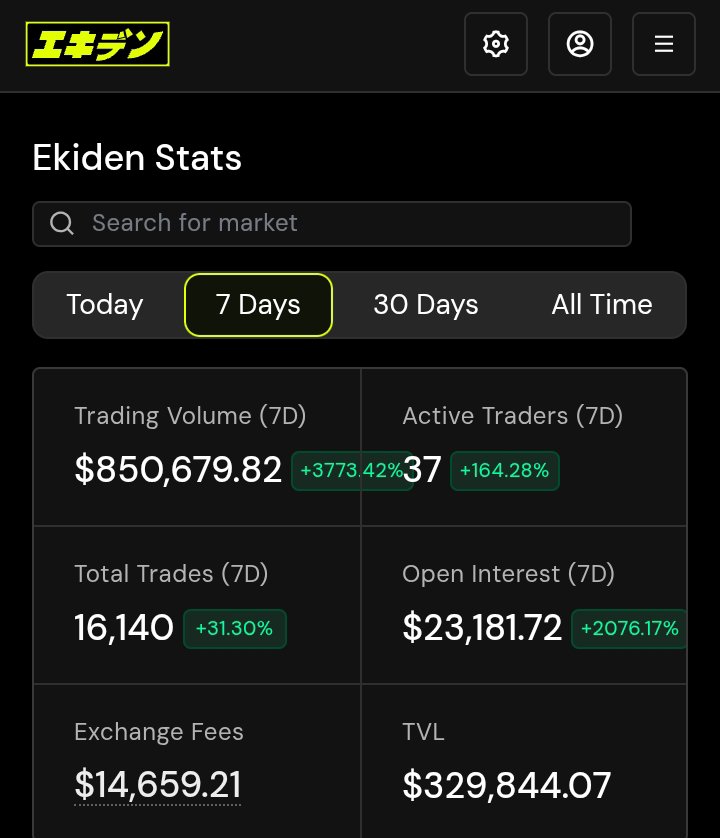
$1M+ trading volume in just 7 days.
And that’s from just 40 active traders executing 16K+ trades while @ekidenfi is still in closed Mainnet.
Early demand is already showing.
The real question: what happens when the gates open?
Get in early with my referral: https://t.co/NxcwwlY8rO
7 days of @ekidenfi Mainnet.
And the first week is already telling a story.
📊 $850,679.82 7D volume
⚡ 16,140 trades executed
👥 37 active traders
💰 $329,844.07 TVL
💸 $14,659.21 fees generated
All of this while Mainnet is still in controlled access.
No wide-open onboarding. No farming incentives driving activity. Just traders putting the product through its paces.
Ekiden is bringing a CLOB-based perpetuals exchange to @CantonNetwork, combining orderbook trading with Canton’s privacy-focused infrastructure.
Week 1: $850K+ volume. 16K+ trades.
The market is only getting started.
Imagine these numbers when the gates fully open.
One of the more interesting parts of Retium is its approach to validators.
@RetiumChain doesn't treat every validator as an interchangeable node responsible for the entire transaction lifecycle.
Instead, it uses a role-based validator framework that separates responsibilities across the network.
A transaction can move through distinct stages:
→ Validation
→ Staging
→ Execution
→ Finalization
Each stage can be handled by specialized roles rather than concentrating every responsibility in the same validator set.
Why does this matter?
Because separating duties can reduce power concentration, distribute workload, improve redundancy, and make each decision easier to verify.
The bigger idea is simple:
Don't make every validator do everything. Give each role a defined responsibility, then connect those roles through deterministic logic.
That's the foundation of Retium's validator mesh.
#Retium #RTM #Blockchain #Web3
What I find interesting about the Worker role is that it's not a watered down version of validation. It's the most accessible part of the validator architecture.
Workers independently check transactions before they reach finality, while the heavier roles handle block coordination and finality.
That separation is important. @RetiumChain isn't making participation easier by making the work meaningless. It is making a real part of network validation lighter and more accessible.
To me, that's a much more interesting approach to decentralization than simply counting how many nodes exist.
#Retium #RTM