Philip II was King of Macedon and the father of Alexander the Great. At his death (336 BC) the king was buried with a royal ceremonial under the Great Tumulus in Vergina. It is fortunate that this truly monumental tomb was never plundered and was unearthed in 1977 by renowned Greek archaelogist Manolis Andronikos, making it a worldwide sensation.
Among the grave findings of the Tomb II was an impressive suit of armour, which, given unique body form of the wearer described in ancient texts, most probably belonged to Phillip personal atire. At present the fully restored armour is displayed at the underground Archaelogical Museum at Aigai which has been designed and constructed so as to preserve the authenticity of the royal tombs of that era. It is in fact a modern tumulus-shaped shelter built to cover the original cluster of royal tombs.
After the ceremonial cremation of body, suit of armour was placed inside the main chamber, suit of armour was placed inside the main chamber of Tomb II, next to Phillip’s golden funeral box (larnaka) to accompany him in his journey to after-life. Archaeologists managed to assemble scattered elements of the suit and were able to fully restore it to its original condition. The excellence of their work enabled a serious attempt at a reproduction.
The main body of the suit is made of iron, in seven anatomical shaped plates securely connected between them with long, vertical and horizontal hinges. It is obvious that it was designed to resemble the basic structure of a Linothorax i.e. with upper shoulder pads (epomides), main body corselet and double row of leather pteryges for the lower body and groin. The two long flaps at the shoulder, the epomides, also cover the wearer’s neck areas bending over the top to latch onto the upper part of the chest area. Two horizontally arranged hinges in bronze (the originals were made of gold) connect iron bases of flaps with sizable dorsal plate. Lion-shaped bronze rings are rivetted at the ends of each of these. Purple leather is used to embellish the external surfaces of the epomides as well as all external rims, together with a delicate, narrow bronze band with embossed lesbian ornaments. The front area bears Royal Sun emblem from Vergina handstiched of pure silk.
All the plates are manufactured with the hammered technique to conform to a curved anatomical shape of the short, round body. The lower half of the right side plate bears an embossed depiction of goddess Athena. The other half, on the front, bears a floral decoration in silk copied from Phillip’s funeral box, while the upper half has a pair of stylized lion rings fitted. On the left side there are two more identical pairs of lion-shaped bronze rings also fastened horizontally. Finally, the upper curved section of the back plate bears a silk panel consisting of three blue margarita blossoms, copied once again from the King’s treasury. All inner surfaces have been padded with wool and silk.
Two rows of narrow leather strips with fringe decorations are attached to the rim of the cuirass, enabling freedom of movement along with protection for the groin and thighs. The pair of bronze greaves have been recreated using traditional techniques from an example found in same chamber of Tomb II, next to the suit of armour. The extra decorative elements (external leather, silk decoration and padding) were included by the artist in his attempt to restore the thorax to its full glory. The suit offers a glimpse into the luxurious royalty of ancient Macedon.
Museum of the Royal Tombs of Aigai
#archaeohistories
How did Christianity go from a small sect in a corner of the Roman Empire in the first century, to the religion that emperor converted to in early 4th Century AD?
Its spread was greatly aided by the empire’s political unification and extensive road system, as well as the belief among many Christians that the religion was something anyone could adopt, regardless of regional or religious background.
Missionaries like Paul, a major figure in Bible’s New Testament, traveled around the empire with intention to spread Christianity. However, most of the people who helped spread the religion did so just by talking about it with their neighbors, friends and family members, says Edward Watts, a history professor at the University of California San Diego and author of The Final Pagan Generation: Rome's Unexpected Path to Christianity.
“Missionaries are a part of the story, but most of the story is about regular Christians talking to regular people,” he says. “And that, I think, is the most important reason that Christianity emerges in the way that it does in the Roman world. It’s not mission activity by people like Paul so much as it is people whose name we don’t know.”
At Roman Empire’s height in 2nd Century, it stretched into Europe, North Africa and Middle East. One key reason Christianity was able to spread throughout this vast empire was that many people viewed the new religion as something they could easily adopt without having to change their existing cultural and religious practices.
In 1st-2nd Centuries, most people in Roman Empire worshiped multiple gods at once. When they heard about Christianity, they didn’t necessarily think that worshiping Jesus Christ meant they had to stop worshiping their other gods, like Jupiter, Apollo and Venus. Rather, many adopted Christianity by adding Jesus to the group of gods they already worshiped, Watts says.
The belief that Christianity was compatible with what we now call paganism helped Christianity spread through Roman Empire. Although some Christians argued there was only one god and Christians shouldn’t worship any others, this wasn't how many people in Roman Empire understood Christianity at the time, Watts says.
Christianity also got a boost from idea that it was a religion for anyone not just people in a certain region with specific religious background. Though some Christians debated this point, missionaries like Paul preached that a person didn’t have to obey Jewish laws around circumcision and kosher food practices to become Christians.
“This is a key change because it makes the bar to entry much lower,” Watts says. “If you are a male who wants to convert to Christianity, and there’s an assumption that first you have to convert to Judaism, it’s literally physically painful and dangerous for you to convert.”
In addition, fact that authors of Christian gospels wrote them in Koine Greek, a common language version of Greek, made gospels accessible to more people in the empire. Unlike Aramaic, a regional language in Judea that Jesus spoke, Greek was spoken throughout Roman Empire.
#archaeohistories
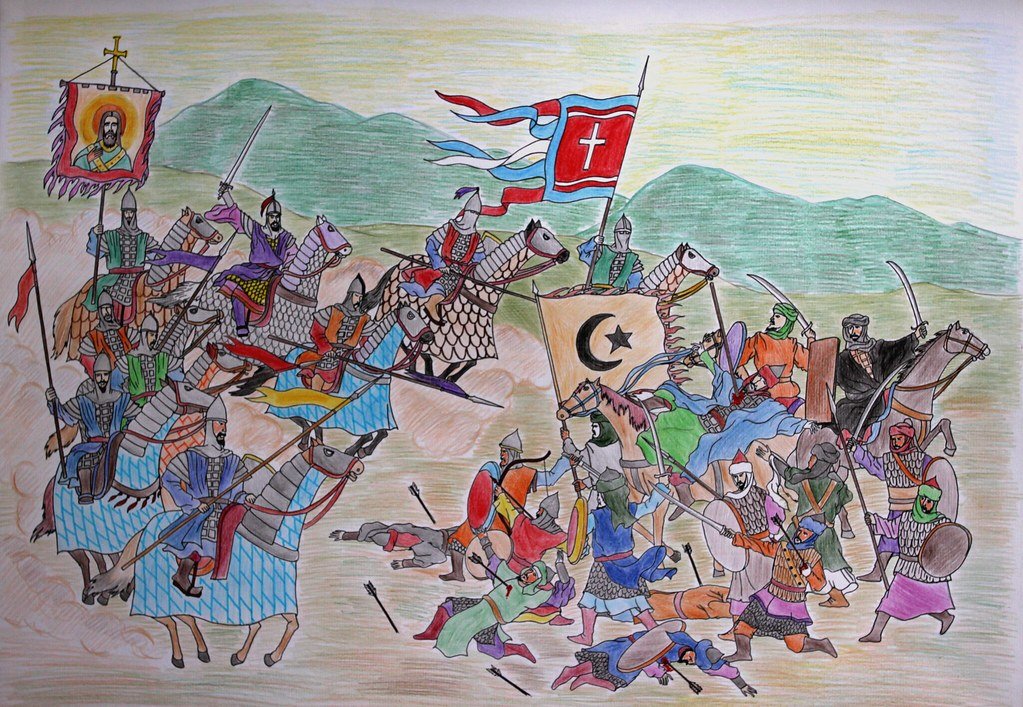
September 3, 863. This is the day the Byzantine Empire stopped losing.
For roughly two centuries the story of Byzantium had been one long defensive crouch. Arab armies raided into Asia Minor nearly every year. You did not stop them. You survived them and rebuilt.
In summer 863 Umar al-Aqta, emir of Melitene, drove deep into Byzantine territory, reached the Black Sea and sacked Amisos. He had been doing this successfully for about thirty years.
Emperor Michael III sent his uncle Petronas, and Petronas did the thing the Byzantines were world class at and never get credit for.
He did not chase him. He coordinated three separate armies converging from three different directions across an enormous distance, with no communication faster than a man on a horse, and closed them around Umar near the Lalakaon river in Paphlagonia.
The night before, both sides raced for the same hill. The Byzantines got there first.
On the morning of September 3, Umar attacked westward at Petronas. Petronas held. Then the other two armies arrived on his rear and both flanks at once.
The rout was total. Umar died on the field. His son got away and was captured within days.
Melitene never threatened the empire again, and the direction of two hundred years reversed. From here Byzantium went from absorbing raids to expanding, and kept expanding for roughly a century.
Then there is the second order consequence, which is the part worth sitting with. With the eastern emergency resolved, Constantinople could finally apply serious pressure in Europe. The very next year, in 864, the Bulgarian ruler Boris accepted Christianity from Constantinople instead of from Rome.
Which is a very large part of the reason the Slavic world is Orthodox and writes in Cyrillic today. All of it downstream of one river in northern Turkey and a raid that went one town too far.
If ISIS had advanced any further, this monastery from 363 AD would be lost forever.
It narrowly escaped ISIS' wrath, as they were stopped in the valley below.
ISIS attacked >90 Christian sites in Iraq.
[Syriac Monastery of Mor Mattai in the Assyrian heartland of Nineveh.]
Every Christian should see this monastery one day.
Overlooking the Nineveh Plains, it is from 640 AD.
The same Old Testament land Jonah walked when he preached to the Assyrians.
The same people who still speak Aramaic till this day & custody these ancient holy sites.
The 'Sea Peoples' were a group of seafaring raiders that existed during the Late Bronze Age collapse. They gained notoriety for their attacks on several regions in and around the Mediterranean Sea, specifically ancient Egypt. Very little is known about the Sea Peoples due to a lack of documentation from the group itself, but historians have done what they can to estimate their origins, structure, and culture. There is evidence that sometime around 1150 BC, three powerful civilizations in the eastern Mediterranean region collapsed: the Mycenaean Civilization in Greece, the Hittites in Asia Minor and New Kingdom in Egypt. This event became known as Bronze Age collapse. Historians don't know for sure what caused this great event, but it is theorized that it was due to invasions by the aggressive Sea Peoples. However, this is just a theory and the collapse could have just as easily been due to famine, earthquakes, or tsunamis.
The term "Sea Peoples" didn't exist until the 1800s. It was originally used as a way of describing the people depicted in ancient Egyptian inscriptions from the 12th century. These inscriptions showed these people invading a number of regions in the eastern Mediterranean during this time. This is essentially the only information historians have to go off of. The identity of the Sea Peoples remains hypothetical because there exists little to no evidence that specifically links the group to a specific Mediterranean people. Archaeologists are unable to determine where they came from, what language they spoke, or even whether they were a single group of people. Despite this, it is believed that the Sea Peoples were comprised of Mediterranean, European, and Asian members, and they likely originated from areas on the northern and eastern Mediterranean coast.
Historians and archaeologists know for sure that Bronze Age collapse occurred around 12th Century BC. Many already settled civilizations collapsed for seemingly no reason, leading to completely destroyed cities and enormous shifts in the population at some locations. Sites were abandoned and then resettled by inhabitants who were ethnically different than the previous groups. Shortly after this collapse, Greece entered "Dark Ages," and remained in that period for the next three hundred years. Though all this information can be proven, there is one thing that cannot: why it happened. It could have easily been caused by famine, earthquakes or tsunamis. However, with the help of ancient inscriptions created by the Egyptian people depicting unknown peoples attacking civilizations, historians can credit most of these collapses to the attacks of the Sea Peoples.
Many cultures, such as the Greeks, Romans, French, and Egyptians have, over the years, left behind documents that historians were able to discover and analyze to see what life was like during that era. The reason it is so difficult to determine exactly where the Sea People came from is that the Sea Peoples left no documentation of themselves. This means the only evidence historians have to go off of is second-hand information from cultures that encountered the Sea Peoples. The term "Sea Peoples" doesn't exist in any known ancient source. French Egyptologist Emmanuel de Rouge coined the term when describing a peculiar foe that was fought by Ramses II, the Egyptian pharaoh.
#archaeohistories
🚨 BREAKING: Archaeologists beneath the Church of the Holy Sepulchre, the traditional site of Jesus’ tomb, found evidence of a 2,000-year-old garden.
John 19:41 says there was a garden beside His tomb.
The archaeology keeps matching the Gospel.
Atheists are seething 😭
Three thousand years ago, in the space of a single lifetime, every great power in the eastern Mediterranean collapsed at once. Almost every great city on earth was burned to the ground within a few decades, writing itself was forgotten, and no one has ever fully worked out why...
We call it the Late Bronze Age Collapse, and to understand how strange it is, you have to see how advanced the world was before it. Around 1200 BC the eastern Mediterranean was a connected web of superpowers: the Mycenaean Greeks, the world of Homer's heroes. The Hittite Empire in Anatolia. The wealthy port kingdom of Ugarit. Egypt at the height of the New Kingdom.
They traded metals and gold across thousands of miles, sent letters back and forth, married into one another's royal families, and ran vast economies that had held together for centuries.
And then, within roughly two generations, nearly all of it was gone...
The cities burned: Mycenae, Pylos, the Hittite capital of Hattusa, Ugarit, and dozens of others were destroyed by fire, many never rebuilt. The Hittite Empire vanished so completely that its capital was lost for three thousand years. In Greece the palaces fell, the population dropped, and the Greeks forgot how to write, plunging into a dark age so total that literacy did not return for roughly four hundred years.
No one has ever agreed on what caused it, only a list of overlapping catastrophes that struck at once: waves of mysterious searaiders the Egyptians called the Sea Peoples, decades of drought and famine, earthquakes, and the breakdown of the trade routes that every kingdom depended on.
What should make us reflect is that these were the most advanced civilizations of their age, and they never saw it coming. Once it began, they could not stop it. As the historian Robert Drews once wrote: "Within a period of forty to fifty years at the end of the thirteenth and the beginning of the twelfth century almost every significant city in the eastern Mediterranean world was destroyed, many of them never to be occupied again."
The people who lived through it did not know they were living at the end of an age. No one ever does...
On the Greek island of Delos, you could live your whole life there — but you could not be born there, and you could not die there...
In 426 BC, the Athenians issued a formal decree ordering the complete purification of Delos. Every grave on the island was dug up. Every set of human remains was loaded onto boats and transferred to the neighboring island of Rheneia, just across a narrow stretch of water.
From that point forward, the rule was absolute. Anyone close to giving birth had to be ferried to Rheneia. Anyone judged to be near death had to be removed from the island entirely. No one could draw their first breath on Delos, and no one could draw their last.
The reason was religious. Delos was believed to be the birthplace of Apollo and Artemis, two of the most powerful gods in the Greek world. Human birth and death were considered ritually impure — the kind of thing that would pollute sacred ground and offend the gods.
The historian Thucydides recorded the decree in detail, noting that in future it would be forbidden to die on Delos or to give birth there. This was not a legend or a custom. It was codified law, backed by the full authority of Athens.
And it lasted for centuries.
What makes the story even stranger is that Delos was not some quiet, empty temple. By 167 BC it had become one of the busiest commercial ports in the entire Mediterranean. Foreign merchants, traders, and their families lived there year-round.
All of them lived under a rule that said the most fundamental moments of human life — birth and death — could not legally happen where they lived. Pregnant women near their due date had to leave, sometimes urgently, regardless of weather or circumstance. The elderly and the gravely ill were carried onto boats and taken to Rheneia so they would not die on sacred soil.
Families watched loved ones ferried away from their own homes so they could die on a neighboring island.
There had actually been an earlier purification under the Athenian tyrant Peisistratos in the 6th century BC, when graves near the sanctuary were already being relocated. The 426 BC decree was not the beginning of the idea — it was the formalization of it.
Some historians also note a practical side to the law. By banning births on Delos, no one could claim the island as their ancestral homeland. No birthright claims, no inheritance tied to graves. It kept Delos as neutral religious ground shared by all Greek cities rather than belonging to any one family or people.
Today, Delos has no permanent residents. It is one of Greece's most significant archaeological sites and a UNESCO World Heritage Site. The island that once buzzed with trade and worship now stands largely empty — a place where, for centuries, thousands of people lived full lives without ever being allowed to fully arrive or fully leave.
Sources: Thucydides, History of the Peloponnesian War; French School at Athens archaeological records; UNESCO World Heritage documentation
#archaeohistories
The left love using Saint George as an excuse to sneer at Englishness, as if pointing out he wasn’t born in England somehow weakens what he represents.
He was a Greek Christian from Cappadocia in the Roman Empire, born centuries before the Turks arrived in Anatolia. He was not Turkish.
Nor was he Palestinian. Saint George lived around AD 280–303, more than three centuries before the Arab conquest of Palestine in the 630s. He lived under Roman rule and was a Christian martyr of the Roman Empire.
England chose Saint George because he stood for courage, honour and unwavering Christian faith. He refused to renounce Christ and died a martyr.
The dragon represents good against evil, faith against fear and courage against cowardice. That is why his Cross became England’s flag.
Christ is King.
🏴 WE ARE THE ENGLISH 🏴��
Como se provoca a autodestruição de uma cultura?
Em 1984, o desertor da KGB soviética Yuri Bezmenov explicou as quatro fases que, segundo ele, eram identificadas pela inteligência soviética como etapas capazes de levar à implosão psicológica de uma sociedade.
Estágio 1: Desmoralização (15–20 anos)
Segundo Bezmenov, cerca de 85% das atividades da KGB não estavam relacionadas à espionagem tradicional, mas à chamada guerra ideológica. O objetivo seria alterar gradualmente a percepção da realidade dentro de uma sociedade, a ponto de muitas pessoas perderem a capacidade de chegar a conclusões sensatas. Essa perda de referência enfraqueceria a família, a comunidade, o país e até o próprio indivíduo.
Uma pessoa desmoralizada, afirmava ele, torna-se incapaz de avaliar informações verdadeiras. Os fatos deixam de ter impacto. Mesmo que seja apresentada uma quantidade enorme de evidências, essa pessoa continuaria incapaz de aceitar a realidade, algo que, segundo Bezmenov, só mudaria quando a realidade se impusesse de forma dura e inevitável.
Estágio 2: Desestabilização (2–5 anos)
Uma vez desmoralizada, a sociedade se tornaria mais vulnerável. Nesse estágio, a fraqueza institucional e a falta de disposição para se defender seriam exploradas para enfraquecer áreas fundamentais do país, como as forças armadas, a economia e as relações exteriores.
Estágios 3 e 4: Crise e Normalização (cerca de 6 semanas)
Após esse processo, a sociedade enfraquecida poderia ser levada a uma crise aguda, provocando mudanças abruptas no poder político, na estrutura do Estado e na economia. Nesse cenário, surgiria espaço para a ascensão de um líder ou regime que prometesse restaurar a ordem e trazer uma nova "normalidade".