Instead of watching Netflix, watch this 1-hour Yale lecture by Professor Ben Polak.
It will change how you think about decisions in negotiations, business, and everyday life.
INSTEAD OF WATCHING NETFLIX TONIGHT. Spend 2 hour with this. Claude AI FULL COURSE that teaches you how to BUILD and AUTOMATE anything. The people who watch this tonight will wake up tomorrow with a new skill. Watch it and Bookmark it now.
INSTEAD OF WATCHING AN HOUR OF NETFLIX TONIGHT.
This 1 hour Stanford lecture by Joel Peterson will teach you more about negotiation and getting what you want than most people learn in years.
Bookmark it and give it an hour, no matter what.
A man spends 50 years teaching at MIT.
He knows his time is running out.
So he records one last lecture — everything he knows, distilled into a single hour.
He died 5 months later.
This is that lecture.
The most important hour you'll watch this week. 👇
Bookmark it for later
Tawakkul hits different when you realise this:
You are not chasing rizq. You are living inside it. This realization kills two of the heart's greatest sicknesses:
• Anxiety: If it’s written for you, it’s coming.
• Envy: If it’s written for someone else, it was never yours to begin with.
We spend so much energy worrying about our "security." But your ultimate security is the fact that you are still breathing.
PhD Students – How to extract data from papers for your literature review in seconds?
Extracting data from papers takes a lot of time.
You can automate this process with @Bohrium_AI4S
𝐇𝐨𝐰 𝐭𝐨 𝐚𝐮𝐭𝐨𝐦𝐚𝐭𝐢𝐜𝐚𝐥𝐥𝐲 𝐞𝐱𝐭𝐫𝐚𝐜𝐭 𝐝𝐚𝐭𝐚 𝐟𝐫𝐨𝐦 𝐩𝐚𝐩𝐞𝐫𝐬?
1. Go to https://t.co/H5HNsNkXTR and log in
2. Click on 𝐾𝑛𝑜𝑤𝑙𝑒𝑑𝑔𝑒 𝐵𝑎𝑠𝑒 from the left menu
3. Upload the papers you selected for literature review
4. You will see the following option against each paper
- Read PDF
- Key Takeaway
- AI Poster
5. Click on 𝑅𝑒𝑎𝑑 𝑃𝐷𝐹 for the first paper in your list
6. Write a prompt for the data you want to extract
7. For example, you can enter datasets, methodology etc.
8. It will extract the required data from the paper
9. If you want to extract Key Takeaways from the paper
10. Go back and click on 𝐾𝑒𝑦 𝑇𝑎𝑘𝑒𝑎𝑤𝑎𝑦𝑠
11. Bohrium will extract Key Takeaways from the paper
12. In addition to this, you also have 2 more options
- AI Poster
- Podcast
13. Click on 𝐴𝐼 𝑃𝑜𝑠𝑡𝑒𝑟 and it will create a poster for you
14. This is the poster based on the given research paper
15. If you click on 𝑃𝑜𝑑𝑐𝑎𝑠𝑡, it will convert the paper to audio
16. You can listen to the paper instead of reading it
Repeat this cycle for all the papers in your pool.
You will end up with the required data.
You can use this data to write your literature review
Try Bohrium today for FREE: https://t.co/H5HNsNkXTR
Anything you’d like to add?
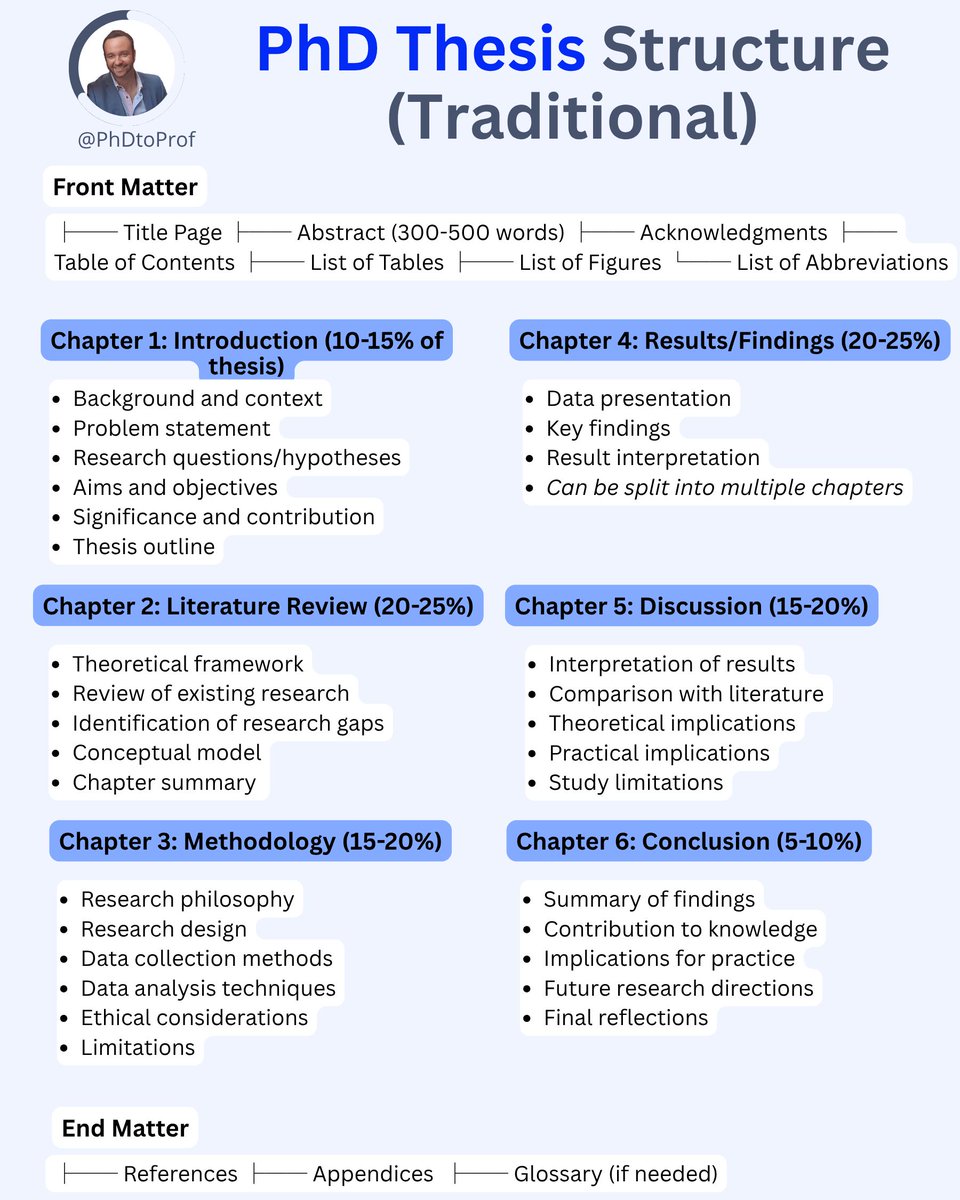
After studying several successful theses, I found this pattern works every time:
Chapter 1: Introduction (10-15% of thesis)
→ Background and context
→ Problem statement
→ Research questions and hypotheses
Most PhD students treat their thesis like a collection of essays.
They dump everything they know into random chapters.
But the best theses follow a proven structure.
How to turn 400 pages of chaos into a coherent PhD thesis
My PhD student came to me with a mess.
She had 6 chapters that didn't connect.
Her arguments jumped around like a broken GPS.
She thought more content meant better research. She was wrong 🧵
Found this thread helpful?
1. Scroll to the top and repost the first post to share it with your friends.
2. Follow me for more threads on how to use AI apps for academic purposes.
When it comes to academci texts, Claude seems to perform relatively better than every other model.
I'd suggest using any app you find helpful. Don't copy and paste what AI generates. Use it as your thinking/critique partner and write your own content.
5. Grok 3
Understands the argument and starts the abstract quite nicely.
Adds a couple of details that aren't useful, but overall it's helpful. Also, it stays within the word limit.
4. Deep Seek
This is more of a summary of the paper. It understands the argument but doesn't foreground it.
Also, it goes a little over the word limit.
3. Claude 3.7
Very impressive. Stays within word limit. Understands the argument very well and foregrounds it.
This made me think of my paper in a new light.
2. Gemini 1.5 Pro
Disappointing. It summarizes the main points of the paper but a abstract is not a summary.
It doesn't foreground the argument and doesn't stay within the word limit.