🗳️ Civic engagement starts with understanding the rules.
Explore more at https://t.co/iRsq0oeo0r & tell your reps what matters to you. (6/6)
#CivicEngagement#Democracy101#IssueVoter
Don't miss this fantastic piece by @caitlindewey over @voxdotcom.
Primaries matter even more amid the so-called "redistricting wars," as both parties race to redraw electoral maps and squeeze out additional safe seats. Gerrymandering and political self-sorting have made general elections far less competitive since the 1970s.
Today, most members of Congress hail from safely Democratic or Republican districts: Only 18 of 435 House races are considered toss-ups, according to the Cook Political Report. In other words, most members of Congress are effectively chosen in their party’s primary election.
“The root cause of our political dysfunction is that November elections in this country are for the most part meaningless,” the political reformer Katherine Gehl told my colleague Andrew Prokop in 2022. “Most November voters are wasting their time, which is…profoundly undemocratic and unrepresentative.”
Just one in five eligible voters turn out for midterm primaries, and those voters tend to be whiter, older, wealthier, and more partisan than the electorate overall. That helps explain why ideas at the outer fringes of each party tend to take up more oxygen during primary elections.
Read the full piece: https://t.co/CDnTlEpnEt
@uniteamerica@caitlindewey@voxdotcom This touches on such a great insight. There is so much frustration about feeling powerless and yet most Americans only show up for elections every four years, precisely when their vote holds the least power.
Democracy doesn’t stop at graduation.
We just won the Civics Innovators Competition at the Jack Miller Center’s National Summit on Civic Education.
This award will help launch a college-level We the People pilot & expand #civiclearning into higher education.
#America250
📣 Unite America featured in @nytimes 📣
"Unite America published a study on Thursday suggesting that open primaries being used in five states — California, Louisiana, Alaska, Nebraska and Washington — have improved lives by encouraging the election of pragmatic lawmakers likely to enact useful legislation.
@RichardBarton85, a Syracuse University @MaxwellSU political scientist who conducted the study, analyzed 14 metrics and found that states with nonpartisan primaries had seen “statistically significant improvements” in nine of them — even when accounting for other factors.
Mr. Barton’s research offered case studies to back up his statistical observations. In Louisiana, he argued, nonpartisan primaries had prompted the election of moderate Republican lawmakers who were forced to appeal to a broader coalition of voters. The result: Legislators expanded Medicaid under the Affordable Care Act a decade ago, making Louisiana one of only a few Southern states to do so.
Mr. Barton wrote that open primaries are “undercutting the power of each party’s ideological base, incentivizing candidates to build broader coalitions.”
https://t.co/UWktpYZPT6
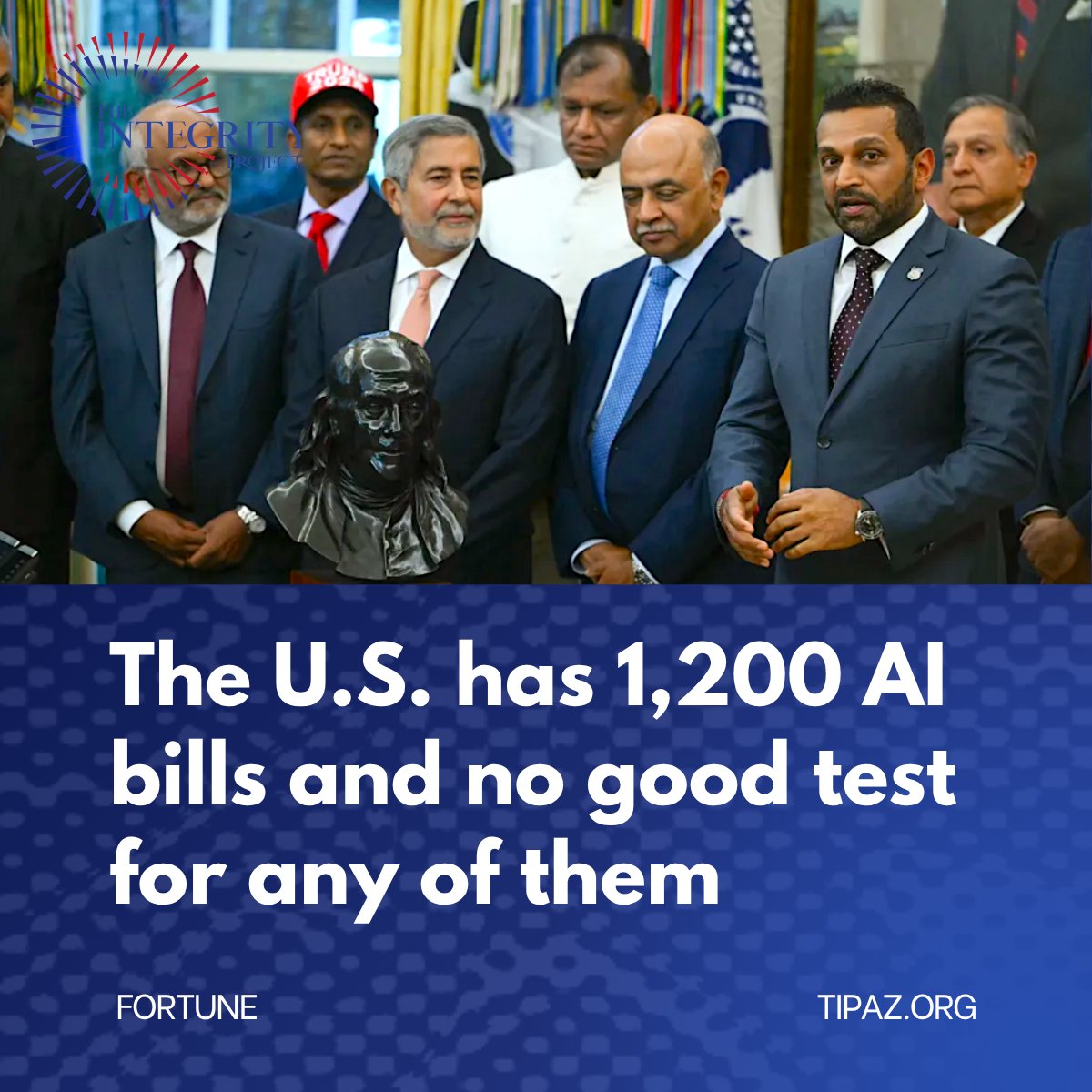
The U.S. faces a chaotic #AI regulatory patchwork with over 1,200 state bills introduced in 2025 and no unified federal framework, researchers @JeffSonnenfeld and Stephen Henriques of @YaleSOM and @GaryMarcus of @CSMAP_NYU write in a recent issue of @FortuneMagazine. The current political and digital information environment and competing legal guidance exposes the dynamic, adaptive technologies to the internet of things – including #misinformation and #disinformation – and hampers efforts by companies and developers to innovate and stay ahead of international competitors and adversaries. The researchers provide a framework that first issues interpretive guidance, then suggests narrow legislation for election disinformation and 'sandbox' situations for high-risk challenges like national security. They detail a three-stage test for each piece of legislation that evaluates national security, harm reduction, product innovation and free competition – and instills confidence and continuity rather than chaos and uncertainty. 👉 https://t.co/6KqEAHVmBx
Farmworkers changed labor rights through strikes, boycotts, and organizing.
Now Congress is debating the Farm Workforce Modernization Act: a legal path for undocumented farmworkers, plus H-2A updates.
Full article in reply. @IssueVoter
In New York, @nysut & @democracyready are calling for increased state approps. of $22.5 million to better prepare students as civic leaders by supporting civic instruction, access, & professional development, and expanding media & AI literacy. Learn more: https://t.co/T76PCAOFyO
Congress is debating new housing legislation, including limiting large institutional investors’ ownership of single-family homes. PPC data shows 67% support for requiring large corporations to sell their single-family homes and townhouses within 10 years.
https://t.co/WXDREVyFHE
Congress has not updated its committee structure since before the internet existed, and you can feel the gap every time a new technology reshapes the world faster than lawmakers can respond.
Think about AI.
TUNE IN with @KornbergMaya: https://t.co/hzpJeA1xfy