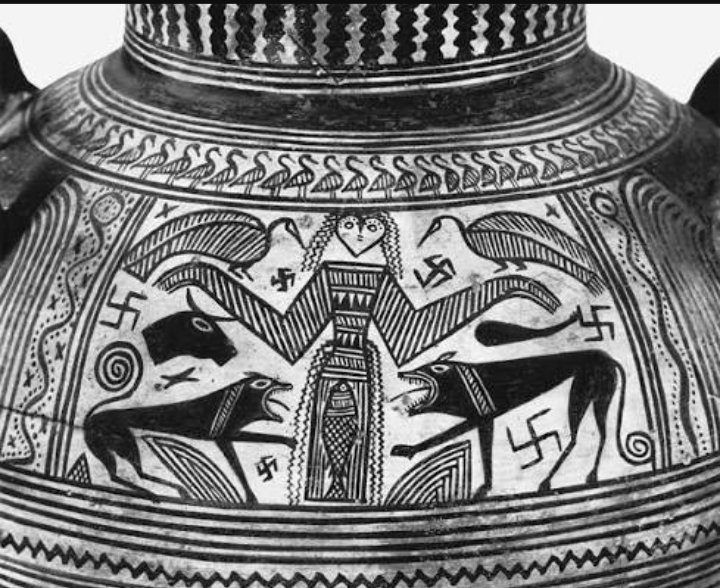
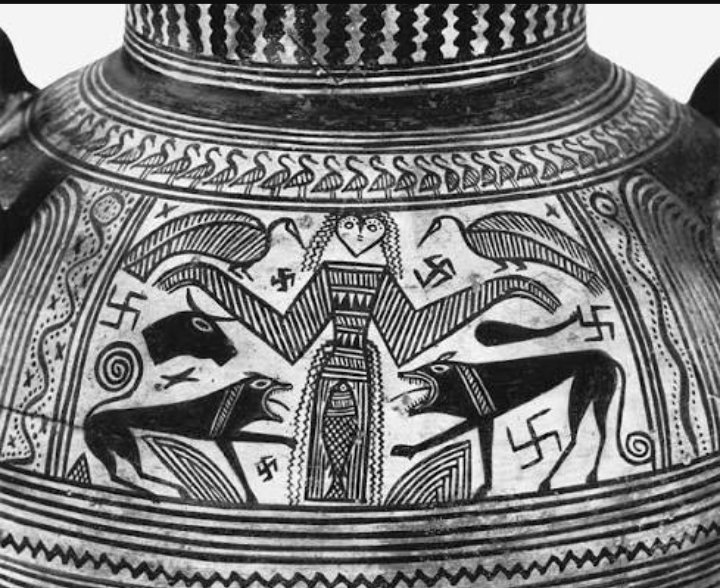
@BrightInsight6@FlintDibble@StijnvdHoven It was @stijnvdhoven who decoded the famous Medusa pediment of Corfu as the kneeler constellation, or the vase as the eastern fish of pisces, not an archeologist.. most of them, including academic institutions, don't even know what they are looking at: https://t.co/atsC4B4JyW
@BrightInsight6 A symbol of the rotating sky. The 4 directions. Eternal creation. That's why on vases, or temples, related to constellations Between lions. Here Potnia Theron, the eastern fish of pisces. @FlintDibble doesn't understand this and blocks anyone trying to discuss it. 👉🏻@stijnvdhoven
@drleeclare Instead of feeding the trolls, can you please make a post on the dating techniques used at sayburc and gt and how the current dating is established. Who is the lead archeologist at sayburc?
@BobSonders@DrDavidMiano They are in mutual symbiosis. One needs the other to
make their money. Two sides of a YouTube revenue coin. It's a show.. And a boring one. @BrightInsight6
@DonovanNagel@lucasanswers@noahsarkscans It is syncretized. Retold, names changed. The saptarishi landed on the Himalayas.. By what you evidence the Noah story is authentic besides in your personal beliefs?
When bees get tired after long periods of flying and gathering pollen, they sometimes rest or fall asleep inside flowers.
Flowers can provide warmth, shelter, and a safe place for bees to recover before continuing their search for nectar and pollen.
the story of a marble worker evrard flignot who devastated by the death of his wife built a mausoleum for her. at first look inside, there is a mourner reaching out to an empty wall. but, once a year, on the day of the summer solstice, the sun draws a light that recalls this love for almost a century.
Roman Wall Painting (1st Century AD), showing Perseus freeing Andromeda, from the House of the Dioscuri in Pompeii.
The wall painting of Perseus and Andromeda was found in the House of the Dioscouri, and was painted around 50-79AD. The painting was probably copied from a painting done by Nicias, a 4th Century BC, Greek artist. The myth tells that Andromeda, daughter of the King of Ethiopia, was described by her mother as the most beautiful. The sea nymphs, the Nerieds took offense at this and complained to the sea God Poseidon. Poseidon threatened to send a flood and sea monster to destroy Ethiopia. The king was advised to sacrifice his daughter Andromeda so she was tied to a cliff near the sea to be killed by the sea monster.
However at this time Perseus sailed past, and seeing Andromeda he immediately fell in love with her. He promised to rescue her if her parents allowed them to be married. Perseus killed the sea monster and released Andromeda, the moment depicted in the wall painting. The painting is the largest discovered depicting these characters, it is 93cm x 106cm.
In the painting, Andromeda has just been freed by Perseus. Her left arm is still in chains and she stands calmly in the rock holding her dress up with her right hand, stepping down with the gentle help from Perseus. The hero, Perseus is naked except for his cloak and he has wings on his feet. The decapitated head of Medusa hangs from his side, shielded from Andromeda's sight, next to his sword. The background is very indistinct, this draws attention to the scene with Perseus as the hero. The painting shows many influences of the original artist, Nicias. Shading and highlighting is used in Andromeda's dress' drapery and Perseus' muscles, giving them a three dimensional sculpture-like effect. The non-existent background draws attention the two figures. This focus on humans instead of landscape is a Greek technique.
The contrast of the male with darker skin and female with paler skin is also a Greek feature. This wall painting of Perseus and Andromeda shows the strong Greek influences in everyday Roman life. The artwork captures a myth, which gives insight into the belief system of the ancient Romans, and also what they found to be attractive to have in their homes.
The piece of art is a statement of wealth as it includes multiple colours and has very effective shading and highlighting. From this we know how Romans decorated their houses, what they liked, and what they saw as impressive, which adds detail to the bigger picture of everyday life in ancient Rome that we have been able to piece together from objects such as this. The preservation of this wall painting through the Mount Vesuvius eruption is valuable as it shows the tastes and views of the people who owned it, and we can see how these differ from today.
National Archaeological Museum, Naples
#archaeohistories