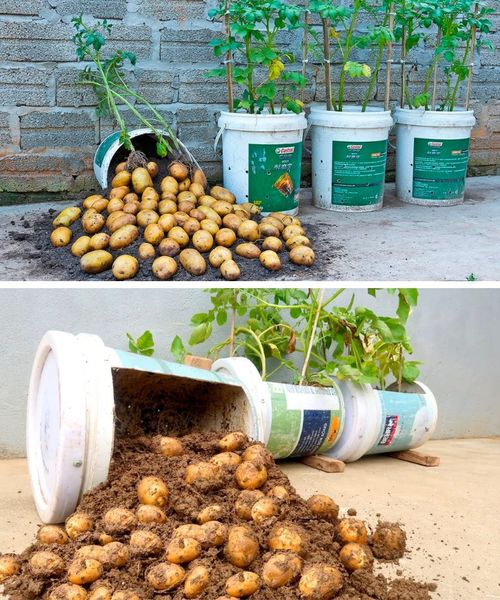
Unexpectedly, Growing potatoes at home is so easy, so many tubers.
1. Choose seed potatoes: Get certified disease-free seed potatoes from a reliable source.
2. Chit potatoes (optional): Let seed potatoes sprout in a cool, dark area for a few weeks.
3. Prepare containers: Fill large containers or bags with potting soil, leaving space at the top.
4. Plant potatoes: Space seed potatoes on soil surface, push them in slightly, cover with soil.
5. Water thoroughly: Keep soil moist but not waterlogged throughout the growing season.
6. Fertilize (optional): Apply organic fertilizer or compost as plants grow, following instructions.
7. Hilling: Mound soil around stems when plants reach 6 inches to encourage more potatoes.
8. Mulch: Add straw or shredded leaves to soil surface to retain moisture and regulate temperature.
9. Harvest: Dig up potatoes when foliage turns yellow and dies back, about 10-12 weeks after planting.
10. Cure and store: Let harvested potatoes cure in a cool, dark place for two weeks, then store in a cool, dry, dark location.
This new microfluidic device was developed to manipulate droplets.
The new design overcomes typical platform restrictions, simultaneous tagging and sequencing thousands of single cells in one experiment 🌀😎
Find out how they did it: https://t.co/Nv3M6RJYBi
⚠️ Alarming decision! Sri Lanka cabinet decided to raise the permissible limit of aflatoxin for internationally recognized food supplements & children's supplements like Triposha.
🆕 New Limits:
1. 5 ppb for type B1 Aflatoxin (most toxic)
2. 10 ppb aflatoxin (total)
⭕️ EU limit for B1 aflatoxins for processed cereal-based foods and baby foods: 0.1 ppb
⭕️ These newly set limits are 50 times higher than the EU standard!
https://t.co/AXh3V6FqGL
☠️ Aflatoxin B1 is a potent carcinogen with strict regulatory limits worldwide due to its high toxicity especially when it comes to products involving children.
We urge Sri Lankan authorities to reconsider this decision in order to protect children's health!
QR code (abbreviated from Quick Response Code) is the trademark for a type of matrix barcode (or two-dimensional barcode) first designed in 1994 for the automotive industry in Japan.
This how it works.
[🎞️ Pillazo]
Researchers develop a low-cost portable sensor to detect heavy metals in sweat.
The study, published in @chemosens_MDPI, outlines the flexible copper sensor crafted from readily available materials, which can be used by non-specialists.
Access the research👇
Turn any paper into audio and listen on your phone!
Listen while walking, making dinner, or exercising. It's easy to fit your learning into your daily routine!
Megha, is one of our satellite-tagged Heuglin’s Gulls from Sri Lanka, who has covered a distance of over 65,000 km in the past 2.5 years. Throughout this time, Megha has completed 05 migration episodes, navigating between Sri Lanka and the freezing waters of the high Arctic.
A movable needle in a Y-shaped nozzle allows precise control over the inner structure of filaments, creating complex structures and multi-material filaments with potential applications in flexible electronics.
Find out more: https://t.co/uZRR5DfEie
"I am strongly against the idea that you need to devote your whole life to your career. You can have a family and a life outside physics and still be successful in your field."
- career advice from 2023 physics laureate Anne L'Huillier
Read more:
https://t.co/L3CHH8eopP
BREAKING NEWS
The Royal Swedish Academy of Sciences has decided to award the 2023 #NobelPrize in Chemistry to Moungi G. Bawendi, Louis E. Brus and Alexei I. Ekimov “for the discovery and synthesis of quantum dots.”
BREAKING NEWS
The Royal Swedish Academy of Sciences has decided to award the 2023 #NobelPrize in Physics to Pierre Agostini, Ferenc Krausz and Anne L’Huillier “for experimental methods that generate attosecond pulses of light for the study of electron dynamics in matter.”
There's still time to register for part three in our nanoHUB Tool for #Semiconductor Education series!
Dr. Gerhard Klimeck will give a brief overview of the ABACUS Tool Suite and demo the Drift-Diffusion Lab.
📅 Aug. 24 at 11 AM EDT
🔗 Register below:
https://t.co/FeP48caany
Nanocellulose-based strain sensors (NBSS) are interesting for wearable electronics, but they are susceptible to damage from water and organic contaminants.
This superhydrophobic, photocatalytic, self-cleaning NBSS provides a solution.
👉https://t.co/wiRVlWhwrd
On exposure to UV light, the different materials in the legs and hinge of this actuator experience differing volume changes, leading to this "walking" behavior.
Check it out: https://t.co/OqCZ8Nlcq3
A battery-free, wireless, miniaturized sensor monitors wound healing and can predict healing rate with 70% accuracy.
@ncstateece@NorthwesternBME
https://t.co/Vsp2dbvZ8j
How to make a Zn ion capacitor with bulldog clips 😅
By using self-healing polyurethanes, this device is designed to be very flexible while staying electrochemically stable.
Check it out: https://t.co/VcG2N3LIJh
Thinking of applying for a #Chevening Scholarship?
Prior to applications opening in September, it’s a good idea to start thinking about what your long-term career goals are and which university courses will help you get there 🎓
What would you study?
https://t.co/7XEAyv9tYF
Have a question about Chevening?
If you’re thinking of applying for a #Chevening Scholarship, tune into one of our live Q&A sessions 👇
⏰ Instagram: 22 August, 4-5pm BST
⏰ Facebook: 24 August, 9-10am BST
We’ll be on hand to answer all your questions!
https://t.co/YOaJqB8iBL
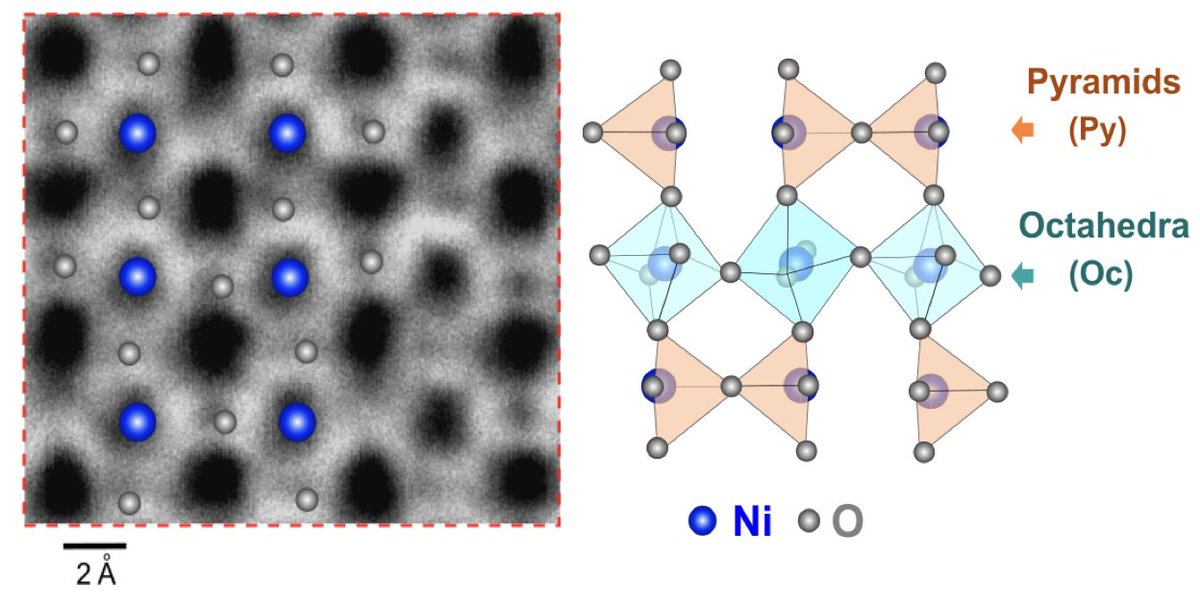
Read our recent paper on topotactically induced oxygen vacancy order in nickelate single crystals. @Yu_Mi_Wu@YESuyolcu@MatthiasHepting https://t.co/fmz4PsYYEB