Last presentation from our group: Cristiano Ciaccio and Asya Zanollo presenting “Reading Between the Clues: A Fine-Grained Analysis of Italian Crossword Solving Systems” (with @AlessioMiaschi, @gsarti_, Dell’Orletta F. and @MalvinaNissim)! 🔥 @CLiC_it_conf@AILC_NLP#NLPRoc
Last day of @CLiC_it_conf! Massimiliano Orsini is presenting “PUNder-IT: Assessing Language Models’ Sensitivity to Italian Puns” (with Dominique Brunato)! 🔥 @AILC_NLP#NLPRoc
🎉 Great news! We got 6 papers (5 regular + 1 research communication) accepted at CLiC-it 2026! Looking forward to presenting them this year in Palermo! #CLiCit2026#NLProc@CLiC_it_conf@AILC_NLP
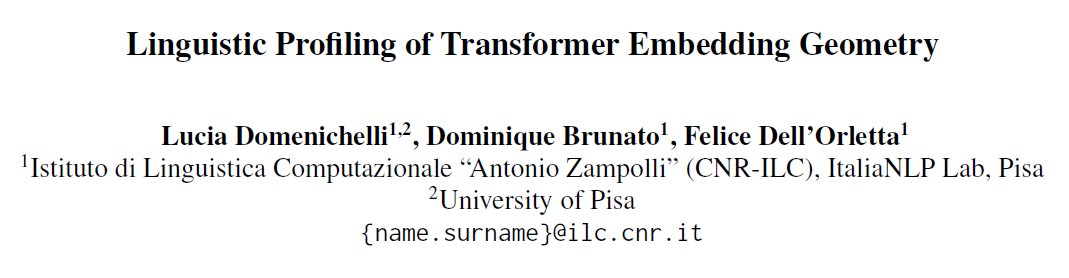
[4/4] One takeaway: no single geometric measure is enough.
Isotropy, linear and nonlinear intrinsic dimensionality capture complementary aspects of representation structure, providing a simple framework to compare models through a linguistic lens.
[3/4] A few findings:
• BERT maintains more isotropic, higher-dimensional representations than GPT-2.
• GPT-2 develops a distinct cluster of sentence-initial tokens.
• Content words and syntactically central predicates occupy richer geometric subspaces.
We are the Lectures on Computational Linguistics in Bolzano! Cristiano Ciaccio and Andra-Maria Florescu just presented their poster “Towards Automatic Lexical Creativity Assessment via the Optimal Innovation Hypothesis” 🔥 @AILC_NLP#NLProc
🧶 3/3
We show that models fine-tuned on IMPaCTS outperform instruction-tuned zero-shot LLMs on controlled sentence simplification tasks, becoming proficient in both simplifying texts and in adhering at the specified target readability level.
Paper: https://t.co/YjECuw90X6
🧶 1/3
We’re excited to share our second paper presented at #LREC2026 in Palma: “Controllable Sentence Simplification in Italian: Fine-Tuning Large Language Models on Automatically Generated Resources” by @mpapucci_, Giulia Venturi and Felice Dell'Orletta
🧶 2/3
In this work, we introduce IMPaCTS: a new multi-level sentence simplification dataset for Italian, automatically generated to support controllable text simplification research.
😊 Dataset on HF: https://t.co/j83FJoar1R
🔧 Dataset on GitHub: https://t.co/sRaKQk5hF6
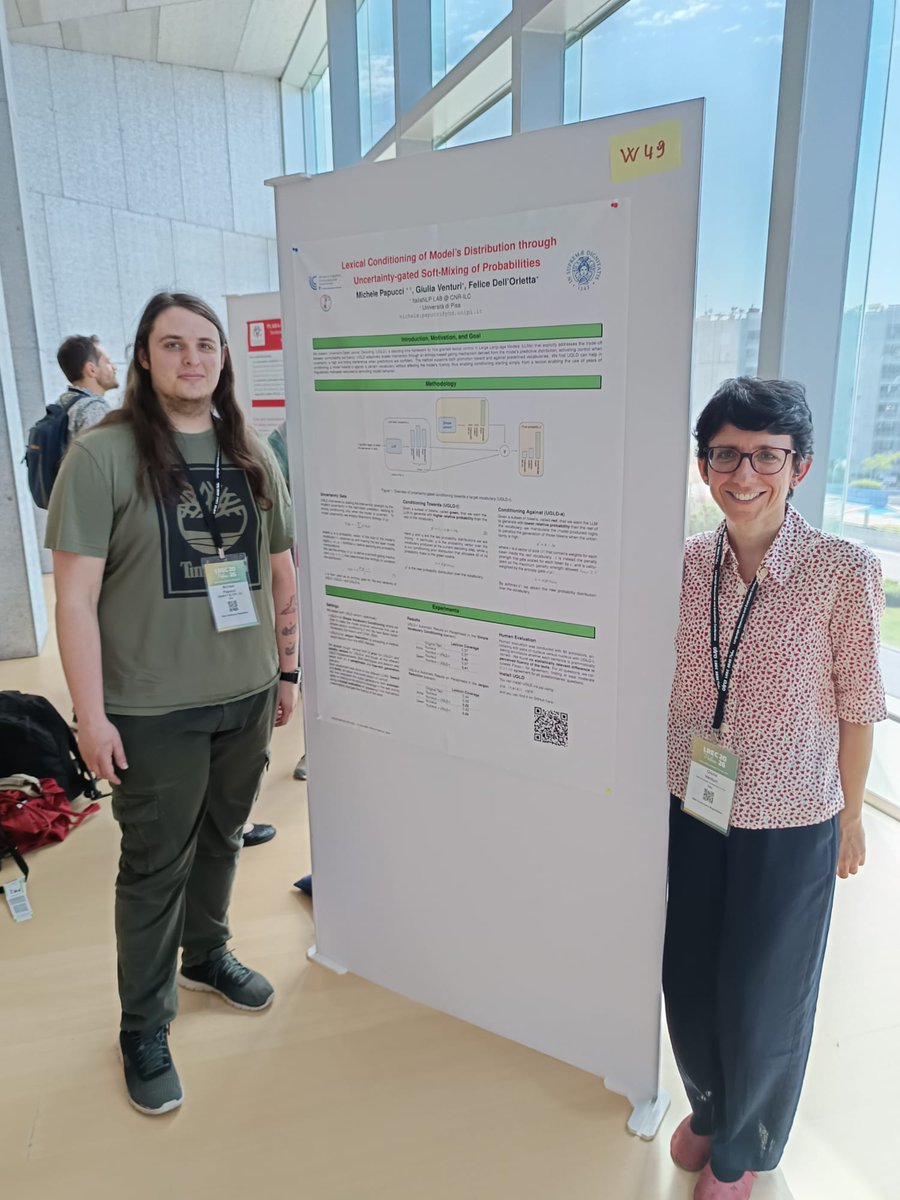
In this work we present UGLD, a decoding method that nudges LLMs toward or against a predefined vocabulary at inference time. No fine-tuning needed and without loss of fluency.
📄 Paper: https://t.co/aJisq2rKTK
🔧 GitHub: https://t.co/xjTVJZQB9i
🐍 Install UGLD: pip install ugld
🚀 Excited to share our latest work at READIxTSAR workshop at #LREC2026
"Lexical Conditioning of Model's Distribution through Uncertainty-gated Soft-Mixing of Probabilities" by @mpapucci_ Giulia Venturi and Felice Dell'Orletta.
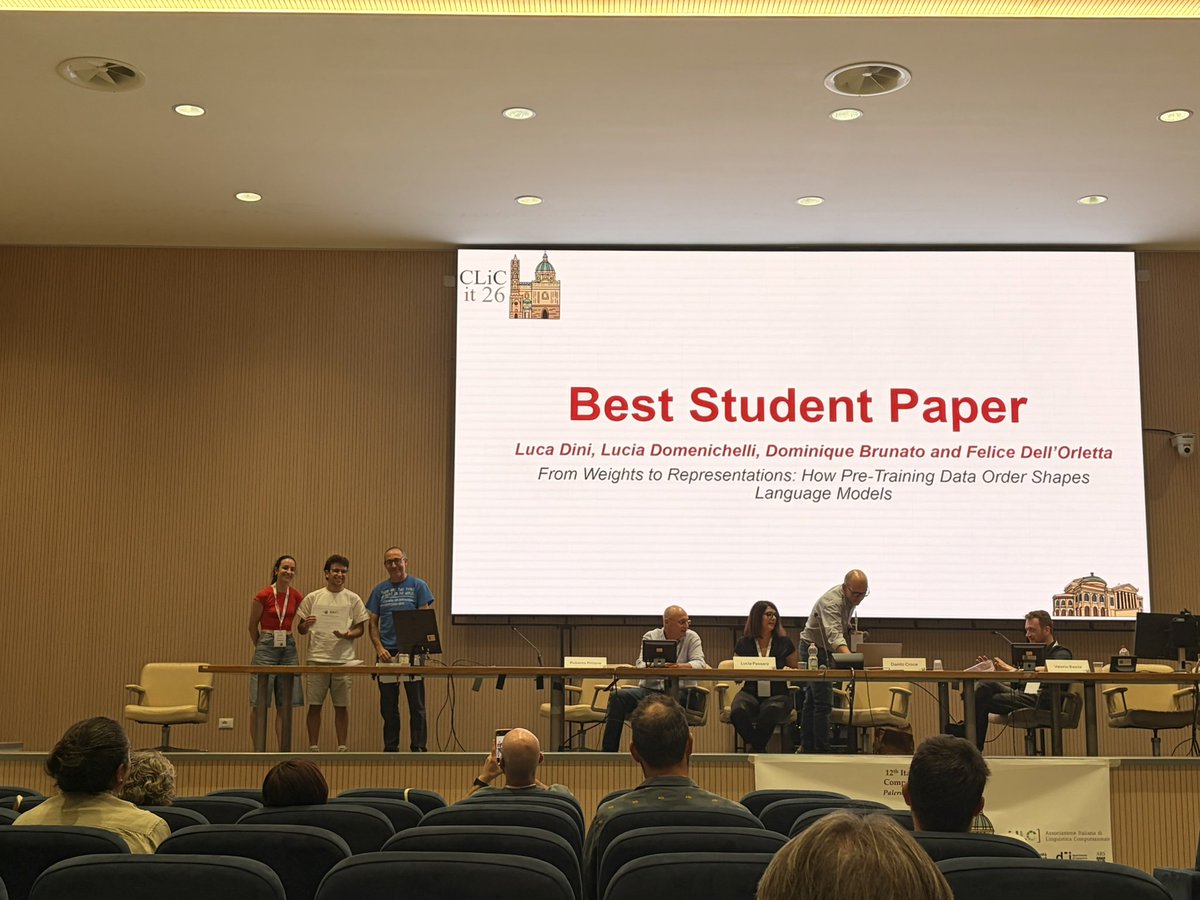
[1/4] How does the order of pretraining data impact Neural Language Models?
We study this in our 🎉new paper🎉:
"On the impact of pretraining data ordering in transformer encoder- and decoder-only language models"
Published in Knowledge-Based Systems
🔗https://t.co/nWrQsLtue3
[3/4] We examine effects on:
• Perplexity dynamics
• Linguistic probing
• Downstream tasks performance
• Embedding geometry
Data ordering shapes both learning dynamics and representations.