🚨 PETROLIO
Il petrolio in ribasso del 12% dopo le indiscrezioni su una possibile tregua di 2 settimane tra USA e Iran.
Secondo le fonti, Donald Trump avrebbe aperto a uno stop temporaneo delle tensioni in cambio della riapertura dello Stretto di Hormuz.
🚨🇳🇱 Dutch Gas Storage Drops To Lowest For Time Of Year Since 2010.
The solution: pouring cement into Groningen gas wells so we can never drill gas again.
Rob Jetten really hates you.
🚨BIG WARNING:
ANTHROPIC’S CEO JUST SAID AI COULD REPLACE UP TO 50% OF JOBS IN LAW, CONSULTING, AND FINANCE WITHIN THE NEXT 12 MONTHS.
https://t.co/HipR54ERv7
Introducing strawmap, a strawman roadmap by EF Protocol.
Believe in something. Believe in an Ethereum strawmap.
Who is this for?
The document, available at strawmap[.]org, is intended for advanced readers. It is a dense and technical resource primarily for researchers, developers, and participants in Ethereum governance. Visit ethereum[.]org/roadmap for more introductory material. Accessible explainers unpacking the strawmap will follow soon™.
What is the strawmap?
The strawmap is an invitation to view L1 protocol upgrades through a holistic lens. By placing proposals on a single visual it provides a unified perspective on Ethereum L1 ambitions. The time horizon spans years, extending beyond the immediate focus of All Core Devs (ACD) and forkcast[.]org which typically cover only the next couple of forks.
What are some of the highlights?
The strawmap features five simple north stars, presented as black boxes on the right:
→ fast L1: fast UX, via short slots and finality in seconds
→ gigagas L1: 1 gigagas/sec (10K TPS), via zkEVMs and real-time proving
→ teragas L2: 1 gigabyte/sec (10M TPS), via data availability sampling
→ post quantum L1: durable cryptography, via hash-based schemes
→ private L1: first-class privacy, via shielded ETH transfers
What is the origin story?
The strawman roadmap originated as a discussion starter at an EF workshop in Jan 2026, partly motivated by a desire to integrate lean Ethereum with shorter-term initiatives. Upgrade dependencies and fork constraints became particularly effective at surfacing valuable discussion topics. The strawman is now shared publicly in a spirit of proactive transparency and accelerationism.
Why the "strawmap" name?
"Strawmap" is a portmanteau of "strawman" and "roadmap". The strawman qualifier is deliberate for two reasons:
1. It acknowledges the limits of drafting a roadmap in a highly decentralized ecosystem. An "official" roadmap reflecting all Ethereum stakeholders is effectively impossible. Rough consensus is fundamentally an emergent, continuous, and inherent uncertain process.
2. It underscores the document's status as a work-in-progress. Although it originated within the EF Protocol cluster, there are competing views held among its 100 members, not to mention a rich diversity of non-EFer views.
The strawmap is not a prediction. It is an accelerationist coordination tool, sketching one reasonably coherent path among millions of possible outcomes.
What is the strawmap time frame?
The strawmap focuses on forks extending through the end of the decade. It outlines seven forks by 2029 based on a rough cadence of one fork every six months. While grounded in current expectations, these timelines should be treated with healthy skepticism. The current draft assumes human-first development. AI-driven development and formal verification could significantly compress schedules.
What do the letters on top represent?
The strawmap is organized as a timeline, with forks progressing from left to right. Consensus layer forks follow a star-based naming scheme with incrementing first letters: Altair, Bellatrix, Capella, Deneb, Electra, Fulu, etc. Upcoming forks such as Glamsterdam and Hegotá have finalized names. Other forks, like I* and J*, have placeholder names (with I* pronounced "I star").
What do the colors and arrows represent?
Upgrades are grouped into three color-coded horizontal layers: consensus (CL), data (DL), execution (EL). Dark boxes denote headliners (see below), grey boxes indicate offchain upgrades, and black boxes represent north stars. An explanatory legend appears at the bottom.
Within each layer, upgrades are further organized by theme and sub-theme. Arrows signal hard technical dependencies or natural upgrade progressions. Underlined text in boxes links to relevant EIPs and write-ups.
What are headliners?
Headliners are particularly prominent and ambitious upgrades. To maintain a fast fork cadence, the modern ACD process limits itself to one consensus and one execution headliner per fork. For example, in Glamsterdam, these headliners are ePBS and BALs, respectively.
(L* is an exceptional fork, displaying two headliners tied to the bigger lean consensus fork. Lean consensus landing in L* would be a fateful coincidence.)
Will the strawmap evolve?
Yes, the strawmap is a living and malleable document. It will evolve alongside community feedback, R&D advancements, and governance. Expect at least quarterly updates, with the latest revision date noted on the document.
Can I share feedback?
Yes, feedback is actively encouraged. The EF Protocol strawmap is maintained by the EF Architecture team: @adietrichs, @barnabemonnot, @fradamt, @drakefjustin. Each has open DMs and can be reached at first.name@ethereum[.]org. General inquiries can be sent to strawmap@ethereum[.]org.
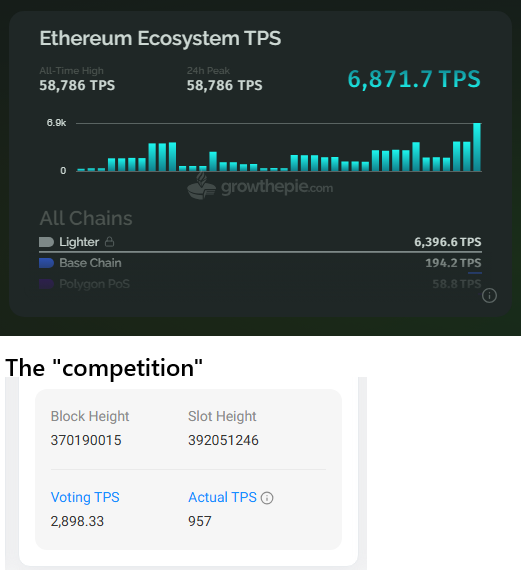
🚨NOW: Ethereum is casually doing 58,786 TPS smashing a NEW ATH throughput
This is 61X FASTER than the "competition"!
There is nothing that comes close to the speed of $ETH 🚀
My response to AI 2027:
https://t.co/hqqXLM5UZl
The AI 2027 post is high quality, I encourage people to read it at https://t.co/84O5mfN5dh
I argue a misaligned AI will not be able to win nearly as easily as the AI 2027 scenario assumes, because it greatly underrates our ability to protect ourselves, especially given the (pretty magical) technologies that the authors admit will be available in 2029 in their scenario.
US semiconductor stocks have never been bigger:
The Semiconductor sector now reflects a record 12.1% of the S&P 500’s total market value.
This share has DOUBLED over the last 3 years, as semiconductor stock prices have skyrocketed.
During this time, the semiconductor index, $SOX, has risen ~111%, outpacing the S&P 500’s gain of 61%.
Now, Nvidia, $NVDA, makes up ~56% of the semiconductor sector’s market cap, followed by Broadcom, $AVGO, at 20%.
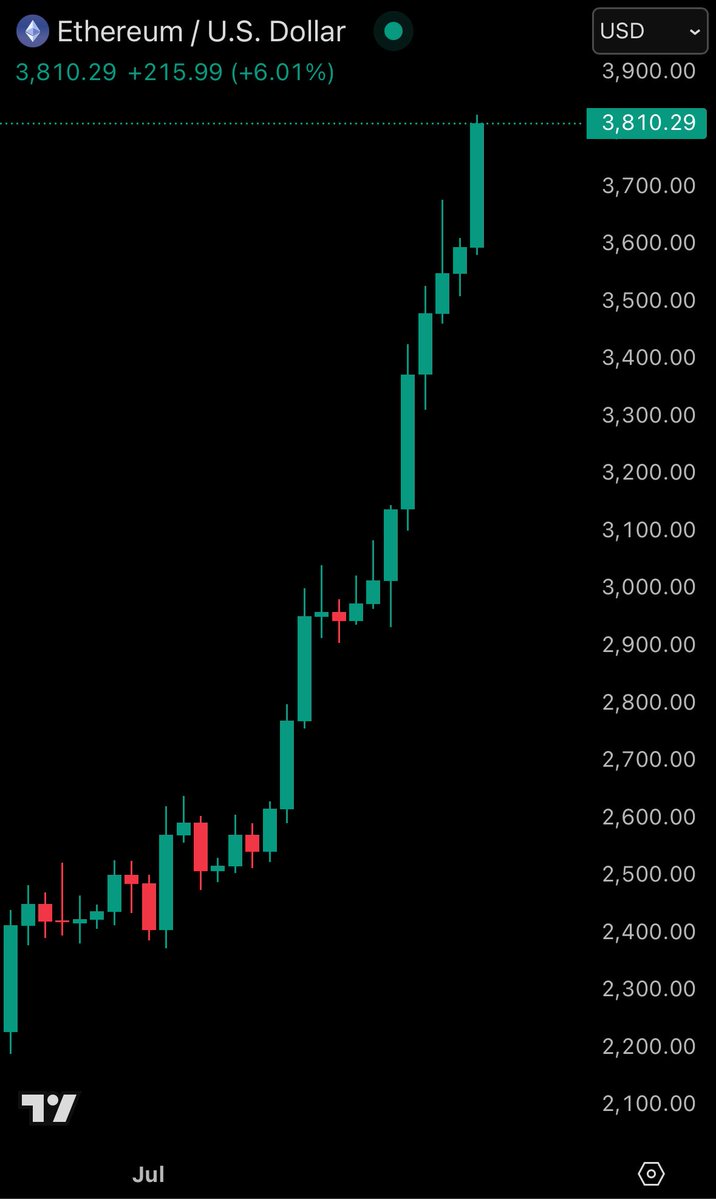
Meanwhile, Nvidia’s market cap just hit a record $3.8 trillion and reclaimed its position as the world's most valuable company.
Semiconductor stocks are on fire.








![drakefjustin's tweet photo. Introducing strawmap, a strawman roadmap by EF Protocol.
Believe in something. Believe in an Ethereum strawmap.
Who is this for?
The document, available at strawmap[.]org, is intended for advanced readers. It is a dense and technical resource primarily for researchers, developers, and participants in Ethereum governance. Visit ethereum[.]org/roadmap for more introductory material. Accessible explainers unpacking the strawmap will follow soon™.
What is the strawmap?
The strawmap is an invitation to view L1 protocol upgrades through a holistic lens. By placing proposals on a single visual it provides a unified perspective on Ethereum L1 ambitions. The time horizon spans years, extending beyond the immediate focus of All Core Devs (ACD) and forkcast[.]org which typically cover only the next couple of forks.
What are some of the highlights?
The strawmap features five simple north stars, presented as black boxes on the right:
→ fast L1: fast UX, via short slots and finality in seconds
→ gigagas L1: 1 gigagas/sec (10K TPS), via zkEVMs and real-time proving
→ teragas L2: 1 gigabyte/sec (10M TPS), via data availability sampling
→ post quantum L1: durable cryptography, via hash-based schemes
→ private L1: first-class privacy, via shielded ETH transfers
What is the origin story?
The strawman roadmap originated as a discussion starter at an EF workshop in Jan 2026, partly motivated by a desire to integrate lean Ethereum with shorter-term initiatives. Upgrade dependencies and fork constraints became particularly effective at surfacing valuable discussion topics. The strawman is now shared publicly in a spirit of proactive transparency and accelerationism.
Why the "strawmap" name?
"Strawmap" is a portmanteau of "strawman" and "roadmap". The strawman qualifier is deliberate for two reasons:
1. It acknowledges the limits of drafting a roadmap in a highly decentralized ecosystem. An "official" roadmap reflecting all Ethereum stakeholders is effectively impossible. Rough consensus is fundamentally an emergent, continuous, and inherent uncertain process.
2. It underscores the document's status as a work-in-progress. Although it originated within the EF Protocol cluster, there are competing views held among its 100 members, not to mention a rich diversity of non-EFer views.
The strawmap is not a prediction. It is an accelerationist coordination tool, sketching one reasonably coherent path among millions of possible outcomes.
What is the strawmap time frame?
The strawmap focuses on forks extending through the end of the decade. It outlines seven forks by 2029 based on a rough cadence of one fork every six months. While grounded in current expectations, these timelines should be treated with healthy skepticism. The current draft assumes human-first development. AI-driven development and formal verification could significantly compress schedules.
What do the letters on top represent?
The strawmap is organized as a timeline, with forks progressing from left to right. Consensus layer forks follow a star-based naming scheme with incrementing first letters: Altair, Bellatrix, Capella, Deneb, Electra, Fulu, etc. Upcoming forks such as Glamsterdam and Hegotá have finalized names. Other forks, like I* and J*, have placeholder names (with I* pronounced "I star").
What do the colors and arrows represent?
Upgrades are grouped into three color-coded horizontal layers: consensus (CL), data (DL), execution (EL). Dark boxes denote headliners (see below), grey boxes indicate offchain upgrades, and black boxes represent north stars. An explanatory legend appears at the bottom.
Within each layer, upgrades are further organized by theme and sub-theme. Arrows signal hard technical dependencies or natural upgrade progressions. Underlined text in boxes links to relevant EIPs and write-ups.
What are headliners?
Headliners are particularly prominent and ambitious upgrades. To maintain a fast fork cadence, the modern ACD process limits itself to one consensus and one execution headliner per fork. For example, in Glamsterdam, these headliners are ePBS and BALs, respectively.
(L* is an exceptional fork, displaying two headliners tied to the bigger lean consensus fork. Lean consensus landing in L* would be a fateful coincidence.)
Will the strawmap evolve?
Yes, the strawmap is a living and malleable document. It will evolve alongside community feedback, R&D advancements, and governance. Expect at least quarterly updates, with the latest revision date noted on the document.
Can I share feedback?
Yes, feedback is actively encouraged. The EF Protocol strawmap is maintained by the EF Architecture team: @adietrichs, @barnabemonnot, @fradamt, @drakefjustin. Each has open DMs and can be reached at first.name@ethereum[.]org. General inquiries can be sent to strawmap@ethereum[.]org.](https://pbs.twimg.com/media/HCBwqPeWoAAC5Kj.jpg)