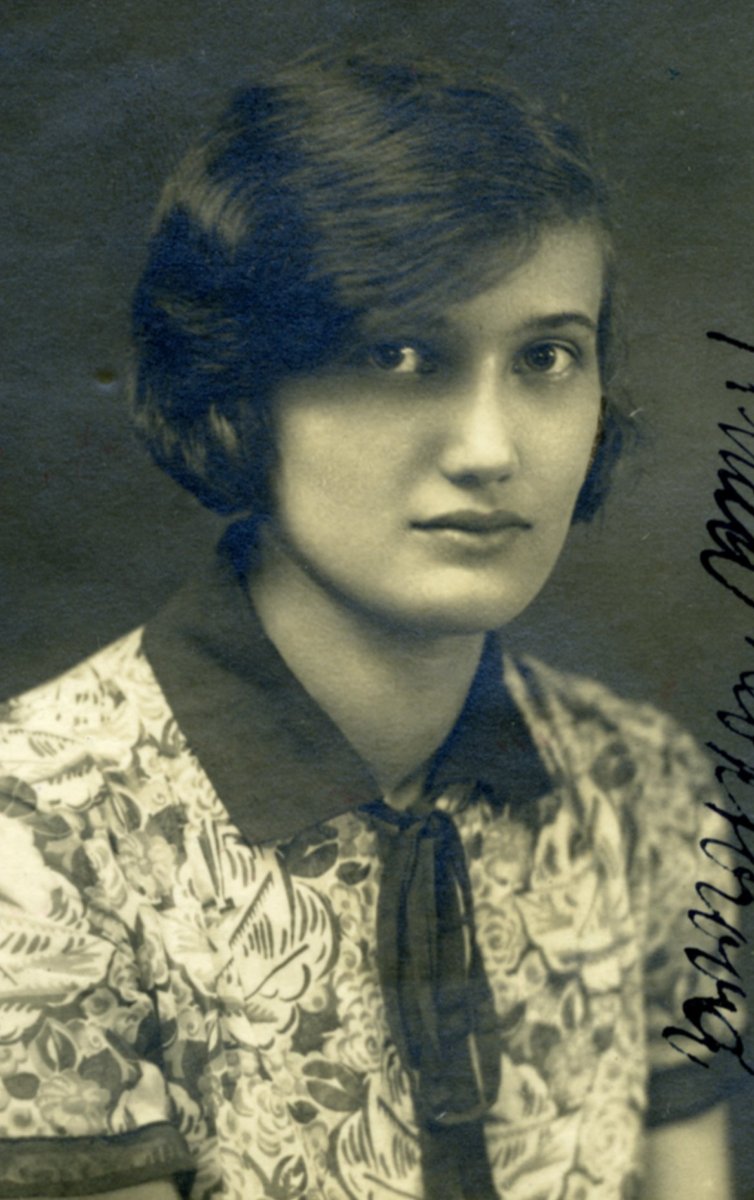
Auschwitz was at the end of a long process. We must remember that it did not start from gas chambers.
This hatred was gradually developed by humans. From ideas, words, stereotypes & prejudice through legal exclusion, dehumanization & escalating violence... to systematic and industrial murder.
Auschwitz took time.
Happening Now: Christians are parading through Jerusalem to celebrate Christmas.
While Hamas has banned public celebrating of Christmas, in Israel Christians are free and celebrating.
How Does a 19-Year-Old Boy Charge at Terrorists with Bare Hands?
The Israeli Spirit
Private Yonatan Elazari, of Blessed Memory
Yonatan Elazari, 20 years old from Alon Shvut, had enlisted two months ago in the elite Duvdevan unit.
During Simchat Torah, he was on leave from his basic training and traveled to celebrate at the pre-military academy in Netivot, where he had studied before his enlistment.
When the rocket sirens sounded, the students and many guests at the academy rushed to the bomb shelter, crowding together inside. Later that morning, the sounds of battle and shouting in Arabic could be heard clearly beyond the shelter’s doors.
It became evident that terrorists had infiltrated and were slaughtering civilians.
Yonatan, unarmed of course, felt compelled to fight them.
“A stone the boy held, his fist a blade of steel,” wrote Yoram Taharlev in his song The Legend of the 35. This is precisely what Yonatan Elazari did. He stepped out of the shelter, armed only with stones, ready to confront the attackers.
Outside, he found a police officer severely wounded and unable to use his Micro Tavor rifle, a weapon Yonatan had no experience handling. He took the rifle, climbed to the roof, and with it—and a handgun he had seemingly retrieved from a fallen terrorist—he began eliminating attackers.
For an entire day, Yonatan was listed as missing. Eventually, his body was found on the roof, wearing his red Source sandals, a commando knife tucked into his belt, surrounded by spent shell casings—evidence of the long battle he had fought. A smile rested on his face.
Like everything else in his life, Yonatan’s final act was carried out with joy.
In His Memory 🕯️
Join the Spirit, Make a Difference:
Yonatan’s story is a testament to bravery, sacrifice, and the unwavering spirit of those who stand up against terror. His courage calls on us all: Take action—in your community, in defense of others, and for the values we hold dear. Whether through service, volunteering, or standing up for what’s right—now is the time to act.
Share his story so others are inspired by his legacy. #A_Moment_of_Zionism
There is no Israeli equivalent for this kind of savagery. Not even Baruch Goldstein, who was roundly condemned by nearly every Jewish person on the planet. The story of the palestinians is a story of people who revel in barbarity and cruelty spurned on by an impenetrable victim narrative.
When I was in fifth grade, Nasrallah and Hezbollah tried to blow up my school with me and my friends in it. He was an evil man, and Hezbollah is an evil organization. God bless Israel for doing what the United States should have done but never did. ❤️🇮🇱
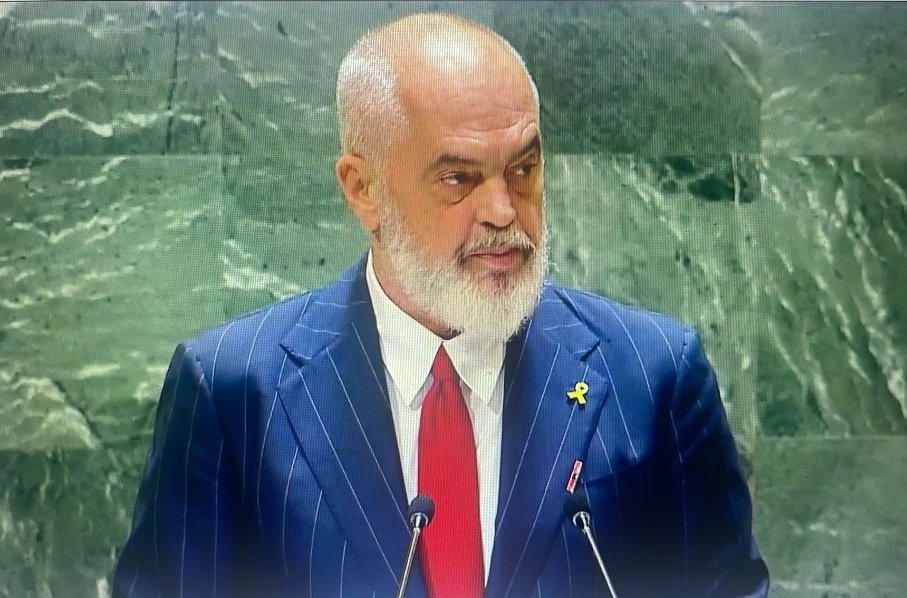
Edi Rama, Prime Minister of Albania 🇦🇱 (the only Muslim majority country in Europe), speaking at the UN 🇺🇳 now with a yellow ribbon 🎗️ in solidarity with Israeli 🇮🇱 hostages 👇
Thank you @ediramaal, for standing with us!
@Ostrov_A I'm Italian, I have never been proud of my country, how could I, but I support Israel with all my heart and my soul. I think that in my blood there's a lot of you and I am celebrating Bibi speech at UN like he spoken for me too. Well done!👏🏼👏🏼👏🏼
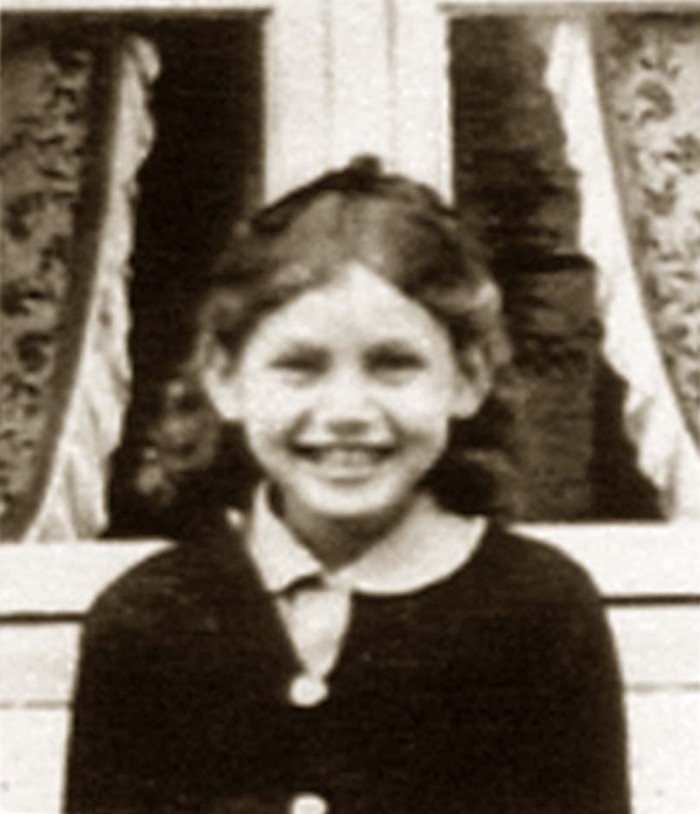
28 September 1932 | A French Jewish girl, Helene Zeligfeld, was born in Metz.
She was murdered in a gas chamber at #Auschwitz II-Birkenau on 18 September 1942.
I'm a Lebanese 🇱🇧 Jew.
The narrative often presented around this image is misleading: “These PLO fighters were protecting the synagogue.” This couldn’t be further from the reality faced by Jews living in Lebanon during that time. This was NOT their modus operandi.
In fact, the Lebanese president deployed the army to protect our community during the Yom Kippur War (1973) — no aggression was directed at us. So, who would the PLO have been protecting us from, if not from themselves?
One of the first Jews killed in our community was my friend’s great-grandfather. He was killed by a sniper while serving as the community’s gravedigger. His body lay unattended in the street for days, too dangerous to retrieve due to the sniper’s presence. The sight of animals desecrating his remains is a memory seared into my mother’s mind—a cruel irony given his role in the community.
In the 1970s, Lebanon was engulfed in a brutal civil war, largely exacerbated by the PLO forces expelled from Jordan after Black September. They attempted to seize control of Lebanon, destabilizing Lebanon. Amidst this chaos, the PLO established strongholds and viewed us as enemies, simply because of our identity. We weren't their only target, but this is the Jewish perspective—from my family and from others who eventually found refuge in New York and Israel after passing through Lebanon.
My family fled Lebanon in 1977 to escape the escalating violence, but my uncles remained. They witnessed Israel’s bombing of the Maghen Abraham synagogue in 1982—a devastating event for our community as this synagogue was our gem, our symbol.
For my uncle, the relationship with Israel was deeply complicated and fraught with mixed emotions.
The PLO’s presence in Beirut was not just political; it was deeply personal. In Wadi Abu Jamil, our Jewish neighborhood, they stored weapons in the very places we lived and prayed. Even the Maghen Abraham synagogue itself was used for storing arms. These weren’t rumors; these were events witnessed by the very people whose lives were threatened—my uncle among them.
Beyond Lebanon, the situation was similarly dire. In Syria, Palestinians didn’t just fight against Israel; they became enforcers for Hafez al-Assad’s regime, targeting Jewish communities there as well. The New York Times reported in 1974 that Jews in Damascus were virtual prisoners in their own homes during the Yom Kippur War, fearing retribution from both Palestinians and Syrians.
Many Syrian Jews fled through Lebanon en route to Israel - many at the time saw Lebanon as “Gan Eḏen” (Garden of Eden) and wanted to stay longer (I've heard this from multiple members of the community).
But safety was an illusion. In the 1970s, my best friend’s family—Syrian Jewish refugees—were abducted right outside the Maghen Abraham synagogue. He was literally thrown into a barrel by Palestinians and held while the Jewish community negotiated his release for a large sum of money. Otherwise, he would have been sent back to Syria, where he would have faced torture or worse. This is just one personal story I'm sharing, with names and faces I can recall, but it’s emblematic of countless others.
Another friend’s grandfather was robbed at gunpoint by PLO thugs in front of his children. To call these people “protectors” is beyond absurd. My father risked everything to smuggle community members to safety in the mountains, navigating through dangerous PLO checkpoints to reach places like Aley and Bhamdoun.
You don’t have to believe me or these accounts. But these are not just stories; they’re the lived experiences of a community under siege.
I know what my family and friends endured, and the scars that the PLO left behind are deep and lasting.
A window into another age - I've tidied-up this photo of Margaret & Mary McCandlish, photographed 181 years ago, the same year Hans Christian Anderson published his fairy tales and Charles Dicken wrote A Christmas Carol. The photo was taken by David Hill & Robert Adamson n 1843.
14 September 1906 | A Czech Jewish woman, Vilma Feiglová, was born in Prague.
She was deported to #Auschwitz from #Theresienstadt ghetto on 15 May 1944. She did not survive.
Arbel Yehud (28) has been held hostage by Hamas for 343 days.
Her brother, Dolev Yehud, was killed in battle while fighting Hamas on October 7th, defending the homeland.
Don’t let her be forgotten.
Thank you for your patience this week, as I've battled computer issues: Here's an enhanced autochrome of a veteran match seller, seated by the Masonry Museum in Canterbury, taken by Clifton Royal Adams in 1928.
It was taken in colour and isn't colourised. 😍
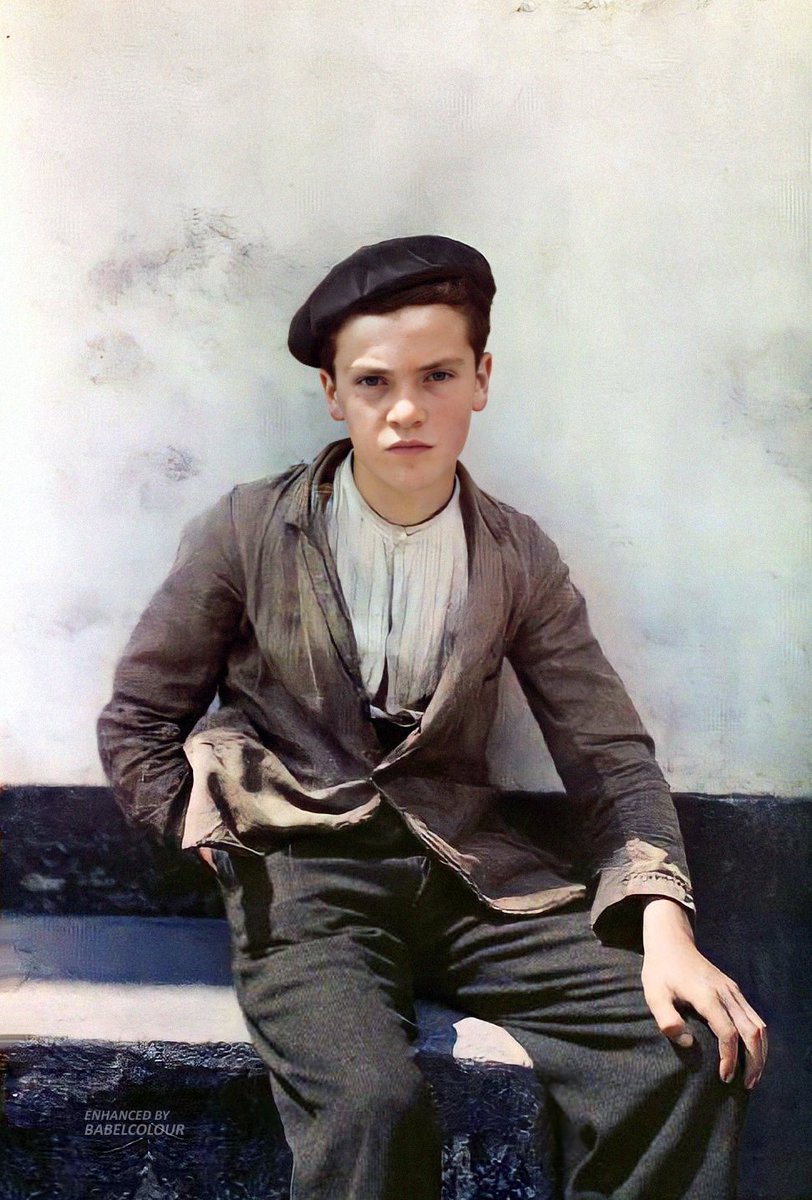
Let me transport you back 103 years to July 1921. I've spruced-up this autochrome portrait of a young lad at Campan, in Hautes-Pyrenees, SW France, shortly after the Great War. It was taken in colour by Fernand Culville and is not colourised.