I had a call with an entrepreneur who hasn’t invested a single dime in the markets because he thinks he needs to be an “expert” first.
He doesn't, and it’s a perfect explanation for what’s wrong with the DeFi industry today.
You need to understand blockchain, wallets, and all this stuff just so you MIGHT make money.
It should be as simple (if not simpler) than online banking, and online banking is already complicated enough.
You shouldn’t need to be an ‘expert.’ You just need the right systems.
So I took that frustration to my business partner, Tan, and we built the software to solve it.
I'm convinced that the most underrated trait in investing is the willingness to wait. Most people wake up in the middle of the night to check their screens and make a few moves. The best investors do nothing, they wait long enough to get paid for it.
I've helped 4,500 investors with a combined $4B portfolio.
If you simply do these things on repeat, you’ll have infinitely better chances to get ahead of every investor you've ever met:
- Position early, while everyone else is still predicting.
- Watch your assets drop and hold anyway.
- Check the price once a week, not once an hour.
- Keep buying when every signal is telling you to sell.
- Buy during the lull, when everyone says the opportunity is gone.
- Keep holding through the slow build, after the crowd loses interest.
- Stay in your position when almost every other investor has sold.
- Keep people around you who hold you to it when you waver.
Wealth vehicles ranked by how likely they are to work for a normal person (from somebody who went from broke at 23 to financially free by 32):
1) Boring automated index investing. It works because it asks nothing of you once it's set up. The only vehicle where doing less improves the result.
2) Owning a small business. Effort actually converts here, but it costs you years, and most people quit inside the first two.
3) Real estate. Leverage is forgiving over a long hold, but the entry ticket filters most normal people out before they ever get in.
4) Digital assets and hard assets. They work inside a structure, sized small, held long, never traded. Most people skip the structure and keep the trading.
5) Stock picking. The one everyone starts with, and the one least likely to work, because a normal person is competing against professionals on the professionals' home field.
The most important lessons to learn at every stage of your portfolio:
A $10K mistake → feels like a cautionary story (it isn't)
A $100K mistake → you start seeing it repeat (you're only noticing it now)
A $1M mistake → it stops being someone else's story
A $10M mistake → the money was never the real cost (the years you lost recovering were)
You have to learn from those mistakes. But nobody said they have to be yours.
Chasing “One piece of crucial advice” is a trap that will get you nowhere.
I launched 12 businesses. 9 of them failed. 3 worked.
On the day I started each one, I could not have told you which category it would end up in, and neither could anyone else, because that information did not exist yet.
The company I run now began the same way, with no proof that any of it would hold.
Within a year, there were 45 of us.
By year two, around 90, serving thousands of members.
Every one of those hires was made while the evidence was still thin, and each looked far too small to matter on the day we made it.
https://t.co/3bRz9McUDc
There isn't one “right point”.
But here’s the advice I’d give to reach it:
1. Set your decisions up in advance
2. Learn from people who've already done it
3. Kill your emotion-driven strategy
4. Build for all cycles, not just one
At the end of the day, the numbers will follow.
https://t.co/IYPLlLgpd0
$1M is basically nothing if it's just sitting in one cycle.
Two people can hold the same amount and end up in completely different places.
The first person masters one cycle and gets rich.
The second person masters them all and gets wealthy.
Most investors never get past the first because they have no strategy. And the problem with having no strategy is that your mind stays glued to the market.
You are constantly thinking about it.
You have the same life as a trader, except that you’re not a trader.
Investments are supposed to be a way to gain more freedom.
Being right on one cycle does not give you that.
Mastering all of them does.
https://t.co/ouXSATZZ39
$1M is a life changing amount of money.
It's also basically nothing.
Both of those are true at the same time and until you can hold both in your head simultaneously you're gonna have a really weird relationship with money.
A million dollars is the difference between "I can't sleep" and "I sleep fine."
It's your mom not worrying anymore. Rent handled. The first time you ever feel like you're not one bad month away from disaster.
That part is real. Respect it.
But zoom out even a little and $1M is a rounding error. In real estate it's a down payment. In venture it doesn't even cover a seed round. In the context of what's actually possible it's the starting line, not the finish.
It's life changing AND it's meaningless. That's the paradox and you have to hold both at the same time.
The reason most people never figure this out is because they think about money wrong from the jump.
They think money is finite. Like there's a pile somewhere and you either get yours or you don't.
Money is not finite. For all intents and purposes it is infinite.
Forget about printing it. Just think about how it moves.
You spend $10,000 on a designer. That designer spends it on software and rent and lunch. Those businesses spend it on employees who spend it on things YOU might sell.
The same dollars circulate through the economy over and over. The money you spend doesn't disappear. It goes to someone who can spend it right back on you.
Once you really internalize that, your entire operating system changes. You stop hoarding and treating every dollar like it's the last one. You move faster because you understand the game is about staying in the flow, not keeping score.
$1M is everything and nothing.
And someone way less talented than you figured that out last year.
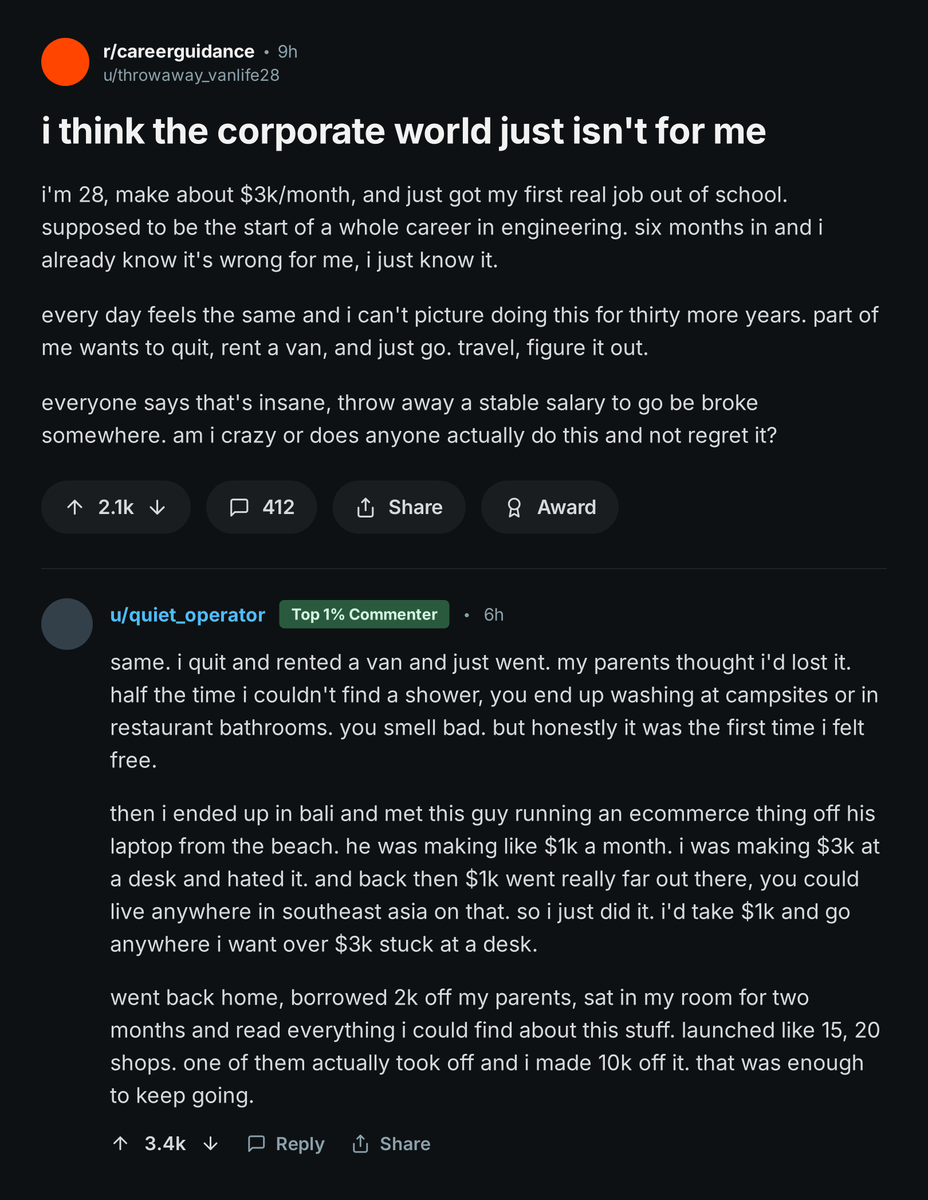
Disclaimer: this is not a real Reddit post.
I packaged the story this way so it's easier to save and come back to.
(Every claim in it, however, is real and came straight from my own story.)
This Reddit post is exactly the answer I would have wanted before I left my job to travel and live on a fraction of what I earned.
Can’t say it’s the right move for everyone, but here’s why it mattered so much for me starting out:
There are only two ways to build wealth over the next decade.
Path A
- One big basket of boring index funds
- You own a little bit of everything
- Bought once, never touched
- Nothing to manage
- You forget about it for ten years
Path B
- No risky bets
- Allocation set by risk tolerance
- Half in hard assets
- Half sitting in cash
- You keep the two halves even
There’s no middle path.
The difference between how winners and losers allocate their money (after coaching 4,500 investors on how to master investing):
How losers invest their money:
- Reacting to every news
- Grinding hard inside a shrinking industry
- Allocating because it feels right this moment
- Holding that one coin everyone is talking about
- Believing whatever narrative everyone is talking about
How winners invest their money:
- Positioned in the right vehicle
- Owning a piece of every season
- Sizing to survive rather than to be right
- Letting the position compound while others react
- Riding a growing industry instead of fighting the current
How to become an outlier by rewiring what you believe about effort:
- Understand that human beings are biased to believe effort is correlated with results.
- Stop rushing into the details of your business and start looking at the industry it sits in.
- Pay attention to whether your industry is growing or shrinking.
- Recognise that the industry you choose decides your ceiling before you put in a single hour.
- Remember that there are four ways to create leverage: collaboration, code, content, capital.
- Believe you are the outlier who can do things others cannot, then work relentlessly to make it the truth.
https://t.co/WD4Pj8PbcN
Underrated cheat code:
Believing you are the outlier, that you can do things others cannot do...
... and then working relentlessly to make it the truth.
We got debanked 4 times and lost hundreds of thousands of dollars before we built a community of 4,500 members with a combined $4B portfolio.
- Stripe blocked us during launch week and refunded our customers
- Facebook and YouTube blocked our ad accounts so we can't get more customers
- Pioneer, Mercury, Relay, and Wise debanked us one after another
We thought about giving up. We didn't, because one thing kept nagging at me: If you’re doing everything right and the banks are still cancelling you, it usually means you're on the right track.
Banks laughed at digital assets from 2015 to 2020.
They fought them from 2020 to 2025.
Now they're welcoming them, but our resilience is what earned us institutional partners when people were still calling our community “a scam.”
I helped build a community where every member has at least $100,000 liquid to invest before they even learn how to allocate a dollar of it.
The first thing I teach them is that your relationship to risk changes at every stage of capital:
Early capital → you believe your effort is what got you the result.
Growing capital → you predict the next call instead of building a system.
Maturing capital → prediction stops working and positioning becomes everything.
Sophisticated capital → you stop watching one narrative and start seeing all of them.
Capital as access → your money gets you to the people who give you access to the world.
I know an entrepreneur whose “generational wealth” was never going to reach the next generation and he had no idea.
Me: “If something bad happens to you, who gets all of these?”
Him: “No one.”
This guy has a bunch of digital assets, a digital wallet, and a private key to protect them but nobody in his family can access any of it. He had been exposed to the space for years without ever allocating his resources appropriately.
…Then he showed me how he invests now, and it was unbelievably simple:
He allocates across different asset classes and grows within them, never overallocating in one area or underallocating in another.
Then he set it up properly so his family can access what he owns and benefit from the work he's doing today.
His advice to anyone serious about investing:
Stop obsessing over which digital asset to buy and start learning how much to put where, how to protect it, and how to ensure it actually reaches your family.