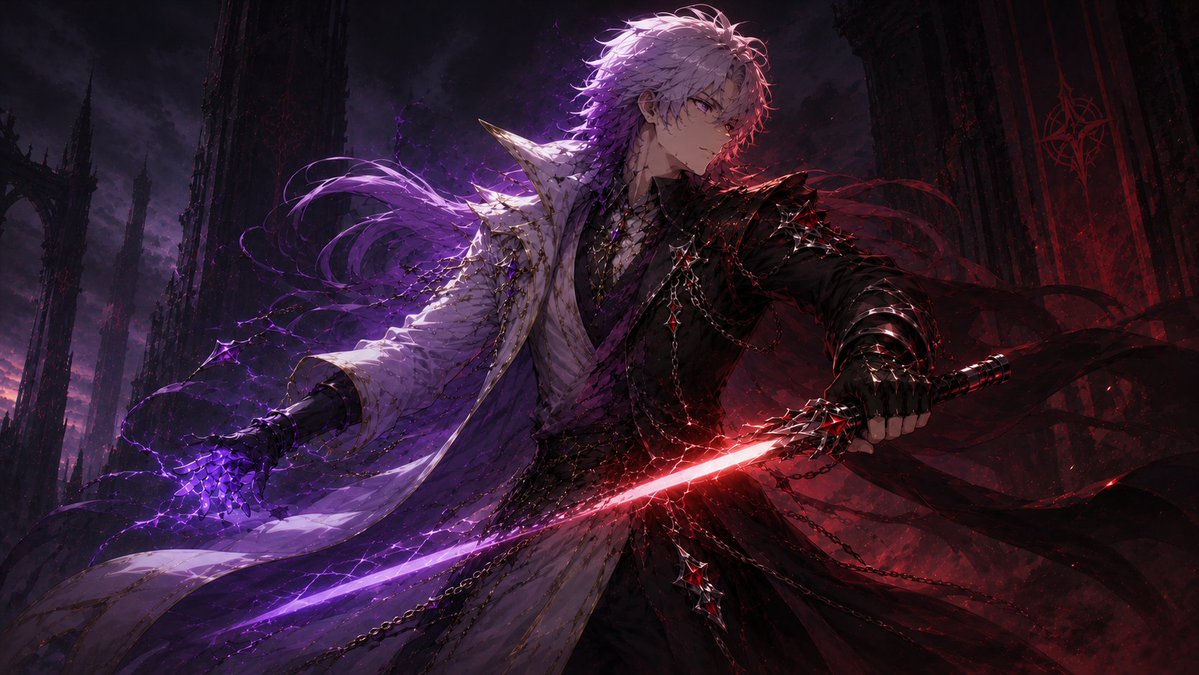
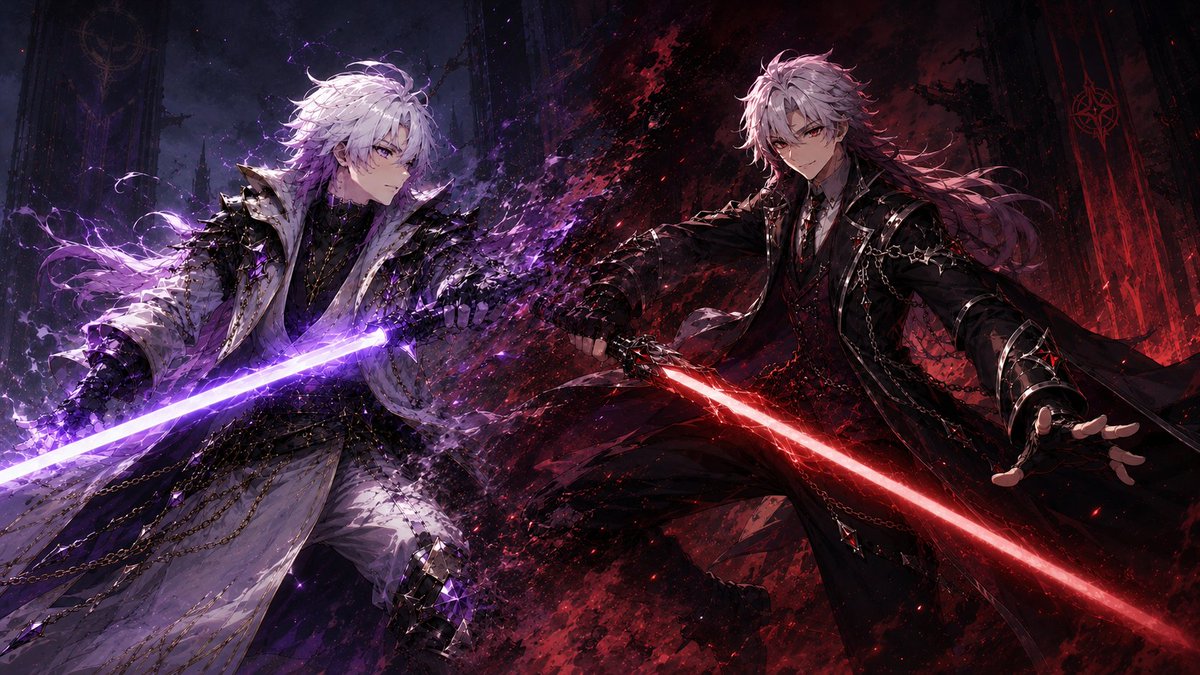
Taking in some of the things I'd seen from others over the past few weeks. Tried my own hand getting something written out for an image and this one after a few other gens I didn't like with this and other design sheets. I'm no writer and certainly not an artist, but none of that matters.
At the end of the day, even with the insults that may be thrown around, the fighting that will happen between people, all of the various things that can bring anyone's world to a stop.
There are things that do matter, there are new days around the corner, bring along the people that make that world brighter and better.
That depends.
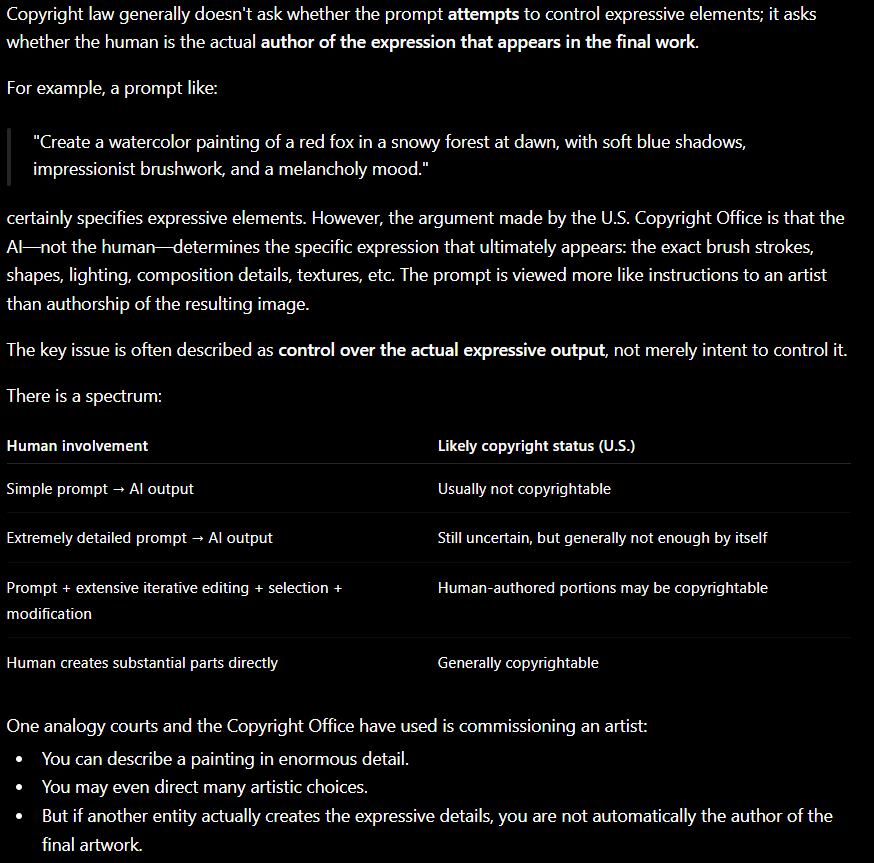
Do we both find that a human can provide sufficient control over expressive choices within the content that an AI outputs that it can be considered to have human authorship?
Your own words, "AI makes NO expressive choices" suggest that any and all expressive choices, even in AI generated content, comes from the human.
Granted, my own view is that a human only controls the expressive choices that they choose to control through iteration and blocking the AI from that aspect of the composition.
@kukukechu@Rahll "If a prompt were sufficiently precise that the user could predict and reproduce nearly every expressive element, a stronger authorship argument could exist."
@kukukechu@Rahll Though, if you're dismissing what you posted earlier, and agree with me that it is the human that is providing the expressive choices to the content the AI generates...
...then there is no need to continue on this.
You really have to stop this habit of reading half of things.
Also, "The AI still makes the actual expressive choices (composition, style details, colors, forms, etc)" is cute. Since quite a number of what I've done personally, the AI doesn't actually make those choices.
Though, AI to debunk AI is still a good laugh.
I already gave a link earlier. If you're not reading what you're replying to, that is your problem.
Plus, it isn't something that is hidden and made difficult for people to find.
However, here is another link where they even state "It concludes that the outputs of generative AI can be protected by copyright only where a human author has determined sufficient expressive elements."
As well as:
"After considering the extensive public comments and the current state of technological development, our conclusions turn on the centrality of human creativity to copyright. Where that creativity is expressed through the use of AI systems, it continues to enjoy protection."
https://t.co/OyzyMu6Xnp
"prompts aren't seen as human creativity"
Prompts essentially fall into "writing". When did writing stop being a part of human creativity?
The extent to which a person can prompt AI generated content, includes things that one might see from a film director, choreographer, set design, musical composer, a conductor, etc.
These are all different creative elements that go into various forms of art and can also go into what a person may generate with AI.
Sure, there are people who do very low-effort AI work. There's people who do the same in film, music, painting, writing, and so on. That's irrelevant, but no one is trying to say that good music isn't art just because someone with no sense of rhythm tried to make a beat using their desk.
https://t.co/1JY7al9Vko
This post of yours quite literally goes against existing US Copyright Office actions and the court decision.
They have granted copyrights to AI generated content. Many of which specifically on the basis of how much human involvement there was into the creation of that content.
@ItsRaisu@Rahll Like I get it, I appreciate that you're trying to explain it in more detail and nuance way, but pretty much prompts aren't seen as human creativity, at this point and time. Maybe longer prompts later, but highly doubtful, since AI gen is always taking from something else to build
That's not what that means at all.
https://t.co/QxGxtyFooZ
The case in this is Thaler v Perlmutter. A copyright that Thaler had filed for was denied on the basis that the copyright was for a work where the only author was "Creativity Machine" (Thaler's generative AI system). The work was generated entirely by "Creativity Machine".
The rejection was on the basis that there was no human author involved in the work and that "works created entirely by autonomous artificial intelligence, without any human creative input, cannot be copyrighted under the U.S. Copyright Act".
Important wording:
"works created entirely by..."
"without any human creative input..."
The question left open is, how much human creative input warrants approval of a copyright for AI content?
Maybe the simple act of typing a short prompt is enough.
Maybe longer, more detailed, more directed and composed prompts are more copyrightable than short prompts that are less than 4 sentences.
That, hasn't been ruled on.
Assuming its good enough of a place to still eat at with a sign like that:
Get receipt, write on the back of it:
Bill: $#.##
Average service tip: 20%
Expecting a tip from each individual: -10%
This sign and its ignorance: -10%
Final Tip = 0%
Bill x Tip = $0.00
You get paid a wage to serve. Tips are from good service.
LEARN YOUR JOB, you chose it.
@Jacksonslotj31@CanArt3@anindanet The amount you're getting is, by law, written on the container.
If the product is for 1 liter, there is going to be 1 liter in the container. Even if that means there is empty space in the container.
Anyone getting "tricked" into thinking they're getting more just can't read.
@doveluzon Seems to be the case, regardless of the reason. Just happened across this on my feed and found other posts linked to the same person.
https://t.co/aJGqlr1Xqq
@TheLerium@WomenBeingAwful Try giving the AI more context about the photo.
"The face is from an over the shoulder pose"
"The character has Asian characteristics and features"
Etc
AI, like most tech, is limited by its user.