XRPL 어제 수수료 수입 $400.
이걸 보고 두 가지 반응이 나온다.
"겨우 $400? 망한 체인이네."
"$400으로 22.5억 달러 RWA가 움직였다고?"
기관은 두 번째 줄을 읽는다.
가스비가 거래 비용보다 비싼 체인에서
$22억짜리 자산을 결제할 기관은 없다.
수수료가 낮은 게 약점이 아니다.
그게 선택받는 이유다.
HOW MUCH is a $ TRILLION?
A trillion is a 1 with 12 zeros after it.
$1,000,000,000,000
If you were to spend $1 a minute it would take you 34,000 years to spend.
It takes the Fed and US Treasury less than a minute to print $1 trillion.
Get the picture?
Savers of dollars are losers.
Cash is trash.
Trade cash in for some gold, silver, Bitcoin, and Ethereum and be a winner.
One day your family is going to ask you, "How did you know?"
You won't be able to explain it in a sentence, because it wasn't one moment, it was a thousand quiet decisions.
Buying when they said to sell, holding when they gave up.
That's the moment where millionaires are made.
yes you are delusional if you still hold xrp.
yes you are delusional if you keep buying xrp.
yes you are delusional if you believe it will reach 3 or 4 digits.
when it all happens, people will start calling you lucky.
Yes, “XRP has a LONG HISTORY of EXPLOSIVE PRICE uncoilings.”📈
Institutions are acutely aware of XRP’s ability to outperform the ENTIRE market in a short period of time.💯
This occurred on several occasions and caught the masses off guard every time.
It’s important to recognize that these periods of outperformance were driven purely by speculation and the token’s characteristics.🙇♂️
Not by utility, adoption, ETFs, or regulatory clarity.😏💨
Excessive speculation alone was enough for XRP to deliver higher returns than the rest of the market.
The crypto market is now shifting from pure speculation to utility driven price action.🔃
Utility is a far more powerful and sustainable force than the hype that drove XRP’s moves in the past.🎯
Explosive price action will return for XRP.💣
It will be even stronger this time around.⏰
This is your warning.😶🌫️
Documented.📝👇
What Would Need To Be True for XRP to justify valuations above $100, several things would likely need to occur simultaneously:
Massive tokenization adoption.
Large-scale institutional settlement usage.
Significant treasury holdings.
Reduced circulating float.
Sustained regulatory CLARITY.
Deep liquidity across major jurisdictions.
Broad integration into payment, securities, and collateral workflows.
👆🏼Those are not impossible conditions, but they are substantially different from merely being used as a payment token.
👉🏼 The Most Important Insight
The most misunderstood concept in crypto is this:
Price does not come from transaction volume.
Price comes from:
{Volume} \ {Velocity}
A bridge asset moving $50 trillion annually can be worth surprisingly little if it turns over instantly.
A bridge asset moving $50 trillion annually can be worth extraordinarily much if institutions must hold it as inventory, collateral, reserves, treasury assets, or strategic liquidity.
That is why the real debate is not:
“How much money moves through XRP?”
The real debate is:
“How much XRP must institutions hold to make the system function?”
If one accepts the premise that Ripple sits at the intersection of the five major institutional rooms - payments, securities, derivatives, regulation, and liquidity - the variable that MATTERS MOST is not transaction volume, but the amount of XRP that must remain parked on balance sheets to support those flows. That single variable is the difference between a $10 asset, a $100 asset, and a $1,000+ asset.
Everyone talks about moving money faster...Few are focused on what happens after the money arrives.
That's where Zebec Network $ZBCN stands out.
While..
* XRP/Ripple>> help power cross-border settlement & liquidity
* Stellar>> focuses on remittances & financial inclusion
*** Zebec is building the infrastructure for real-time programmable payments, payroll, and spending.***
Think of it this way:
• XRP = move value globally
• XLM = low-cost payments and remittances
• ZBCN = real-time payroll, spending, and PayFi
These aren't necessarily competitors. They're pieces of the same financial evolution.
What impresses me most about Zebec is the caliber of organizations it has aligned with:
• Ripple / RLUSD
• Stellar
• Circle (USDC)
• Mastercard
• NatPay ($170B+ annual processing)
• Nacha Payments Innovation Alliance
• JP Morgan
• Wells Fargo
• ADP
• Chainlink
• Canton Network
That's a powerful combination of crypto native innovation & traditional financial infrastructure.
With over $500M annual payroll volume, 250 enterprise clients, 50,000+ monthly users, 20+ chains integrated, and 15B+ ZBCN staked, Zebec is showing real adoption...not just promises.
The future of finance won't be built by one blockchain, one company, or one token. It will be built by ecosystems.
Ripple, Stellar, Circle, Mastercard, & Zebec are all solving different pieces of the same puzzle.
The winners will be the projects that create real utility, real revenue, & real adoption.
Zebec's PayFi vision is becoming increasingly difficult to ignore.
#ZBCN #Zebec #PayFi #XRP #XRPL #XLM #RLUSD #USDC #Tokenization #Fintech #Crypto #ZBCNFAMILY
I disagree that we have no way to value crypto projects.
Is it as straightforward as valuing a company based on revenue, cash flow, and earnings? No. But that doesn't mean we're flying blind.
The first question should always be: What real-world problem does this project solve?
Does it reduce friction? Increase efficiency? Improve interoperability? Lower costs? Move value faster? Secure data? Enable new markets? If the answer is yes, then we're already moving beyond pure speculation and into utility.
Retail gets confused because too many people focus on token supply, logos, influencers, and price action instead of following where actual value and capital may flow in the future.
I look at RWU, adoption, trust, partnerships, network effects, regulatory positioning, and whether the technology solves a problem large institutions are willing to pay for.
Take XRP. The bull case isn't "number go up." It's global liquidity, cross-border settlement, tokenization, stablecoins, custody, and a decade of relationships Ripple has built with financial institutions around the world.
Take XLM. It's focused on efficient value transfer, remittances, financial inclusion, and connecting traditional finance with digital assets.
Take QNT. Its value proposition is interoperability. If the future contains thousands of blockchains, banking systems, CBDCs, tokenized assets, and private ledgers, somebody has to connect them.
Take Zebec. The thesis is programmable money, real-time payroll, streaming payments, and modernizing how money moves between employers, employees, consumers, and businesses.
None of these projects are valuable because they have a cool logo or a low token supply. They're valuable if they become part of the infrastructure that future digital finance runs on.
That's how I think about crypto.
Not "How many coins are there?"
But:
"Will trillions of dollars of value eventually flow through this network, use this technology, or depend on this infrastructure?"
That's the question that matters.
Crypto Twitter still doesn't understand scarcity.
People see 21 million Bitcoin and say "scarce."
They see 14 million QNT and say "even scarcer."
Then they see 100 billion XRP and say "not scarce."
That's not how any of this works.
If scarcity was determined by the number of units, I could launch a coin tomorrow with a max supply of 10 and become the most valuable asset on Earth.
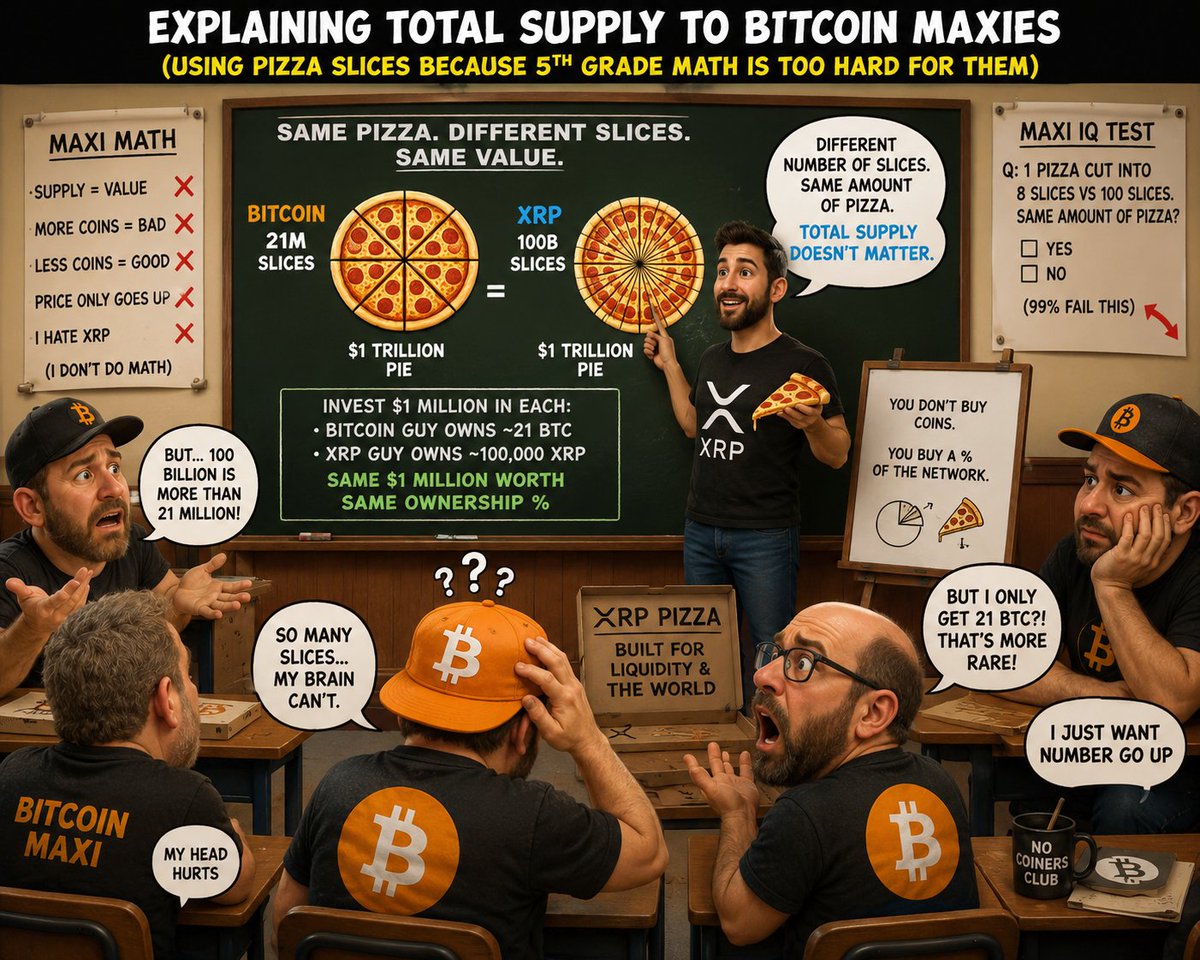
The market doesn't care how many pieces the pie is cut into. It cares how big the pie is and how many people want a slice.
A $2 trillion Bitcoin network with 21 million coins isn't valuable because of 21 million.
A trillion-dollar XRP network wouldn't be valuable because of 100 billion.
A future trillion-dollar QNT network wouldn't be valuable because of 14 million.
They would be valuable because demand exceeded available supply.
That's the entire game.
Scarcity = supply relative to demand.
Not unit count.
Not token count.
Not how big the number looks on CoinMarketCap.
Bitcoin's strength is its monetary policy, decentralization, security, and network effect.
QNT's strength is interoperability and Overledger.
XRP's strength is liquidity, settlement, payments, tokenization, stablecoins, custody, and institutional rails.
The funniest part is watching people call XRP "not scarce" while simultaneously arguing it could be used by banks, payment providers, exchanges, stablecoins, RWAs, and institutions worldwide.
If billions of people, thousands of institutions, and trillions of dollars are competing for a finite asset, that asset is scarce.
The market will decide how scarce.
Unit count doesn't create value by itself. If a pizza is cut into 8 slices or 80 slices, it's still the same pizza. Scarcity is supply relative to demand, not simply having fewer units. What matters is market cap, adoption, liquidity, utility, and how much of the supply is actually available.
People confuse scarcity with unit bias. Having 10 million QNT doesn't automatically make it more scarce than 100 billion XRP. The market prices that in. When you buy QNT you're also buying a much smaller percentage of the network per dollar. Scarcity comes from supply vs demand, not from a smaller unit count.
The "QNT has fewer coins therefore it must be worth more" argument is one of the weakest arguments in crypto. If it were true, I could launch a coin tomorrow with a total supply of 100 tokens and instantly be more valuable than XRP. Obviously that's not how markets work. Most Bitcoin maxies struggle with elementary math, but I guess it's more common in all of crypto than I thought...
@ghostweb3 XRP isn’t ‘value without trust.’ Ripple has spent years building institutional trust around XRP/XRPL: payments, RLUSD, custody, tokenized RWAs, prime brokerage, bank/fintech rails. QNT connects systems. XRP moves value through them. That’s RWU.
I'd invest more in XRP. Safer.
@ghostweb3@Elena_LikeXRP That’s a false split. XRP has value because trust was built around it: Ripple’s bank/fintech relationships, ODL/payment rails, RLUSD, custody, tokenization, Hidden Road, BNY, DBS/Franklin Templeton, etc. QNT is interoperability. XRP is liquidity + settlement + RWU at scale.