The National Assembly’s Departmental Committee on Education is holding Stakeholder Engagement on Seven Education Sector Bills, and young people are among those who will live with the outcome.
These bills touch on university and college funding and placement, curriculum, assessments, teacher training and qualifications. They shape the future of learners, graduates and job seekers across Kenya.
Don’t sit this one out. Participation is how young people make sure our priorities are heard. Read the bills, share your views, and take part in shaping policy.
Dates: Tuesday, 27th – Thursday, 29th October 2026
#NYCAmplifyingYouthVoices
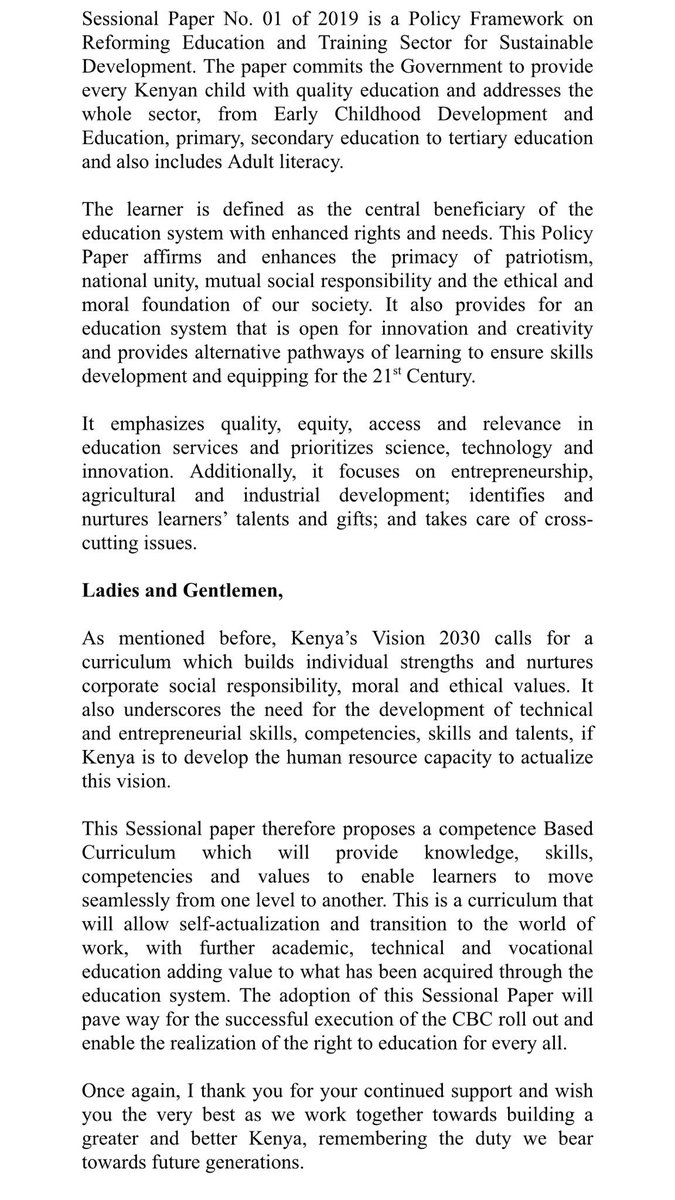
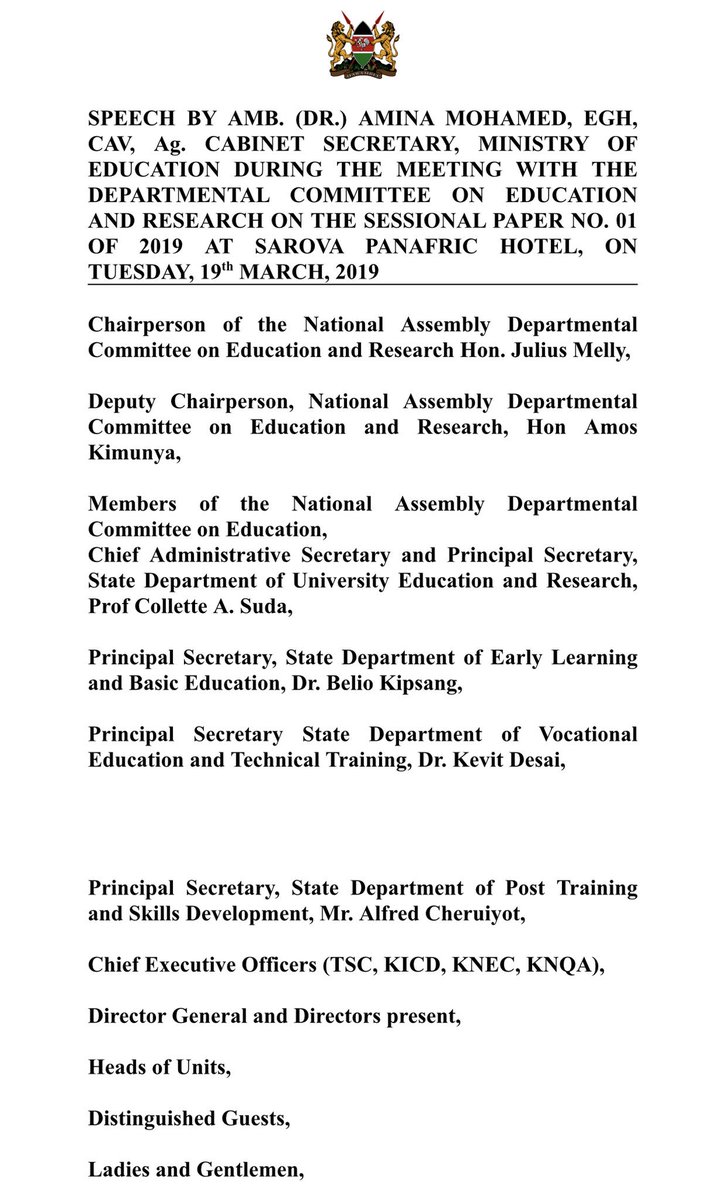
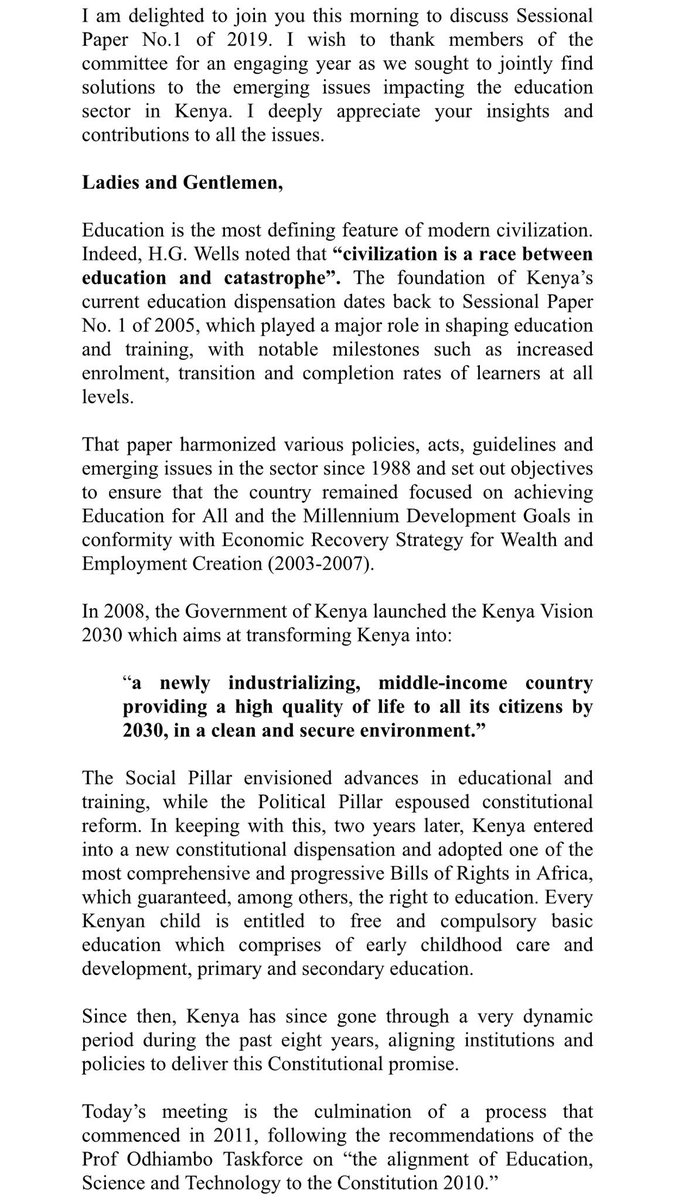
Held a successful session with @NAssemblyKE Committee on Education and Research to discuss Sessional Paper No.1/2019 which lays out the framework for the full roll out of the CBC and other Education Reforms in the country. @EduMinKenya@KICDKenya
Six education Bills are before the National Assembly. What exactly do they propose?
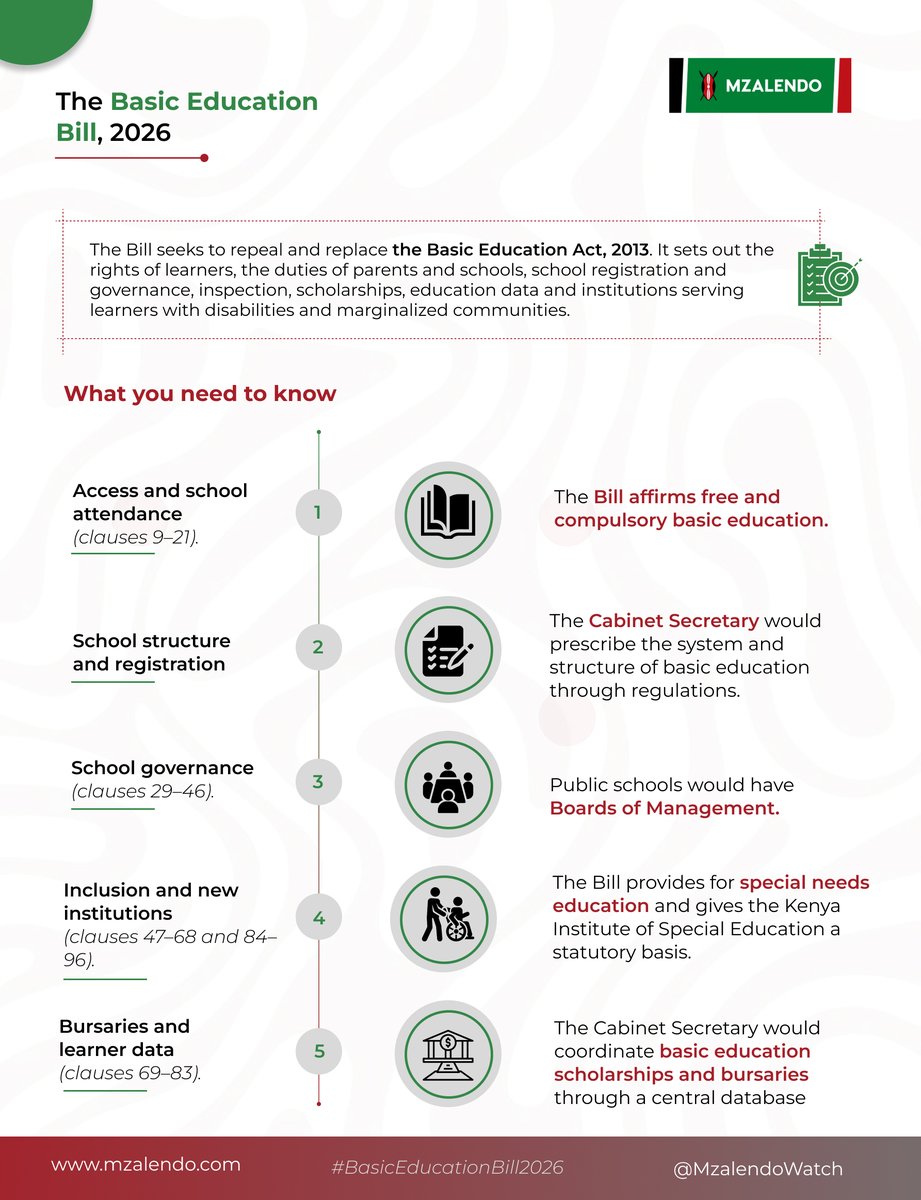
First on the list is the Basic Education Bill, 2026.
The Bill seeks to replace the Basic Education Act, 2013, with new provisions covering learners’ rights, school governance, parental responsibilities, inspections, scholarships, education data, and institutions serving learners with disabilities and marginalized communities.
Here’s what you need to know (thread):
- The Bill guarantees free and compulsory basic education, while addressing attendance, discipline, transition and re-entry, including for learners affected by pregnancy, GBV, child labour and disability.
- The Bill also provides for special needs education and gives the Kenya Institute of Special Education a statutory basis.
#EyeOnParliamentKE. #BasicEducationBill2026
The @NAssemblyKE has extended the deadline for public participation on the following education Bills to 2nd October 2026.
1. The Tertiary Education, Placement and Funding Bill (National Assembly Bill No. 49 of 2026)
2. The Basic Education Bill (National Assembly Bill No. 50 of 2026)
3. The Kenya National Educational Assessments Council Bill (National Assembly Bill No. 51 of 2026)
4. The Pre-Service Education and In-Service Training Bill (National Assembly Bill No. 52 of 2026)
5. The Kenya National Qualifications Framework (Amendment) Bill (National Assembly Bill No. 53 of 2026)
6. The Kenya Institute of Curriculum Development (Amendment) Bill (National Assembly Bill No. 54 of 2026)
Submit your views to [email protected]
#PublicParticipationKE.
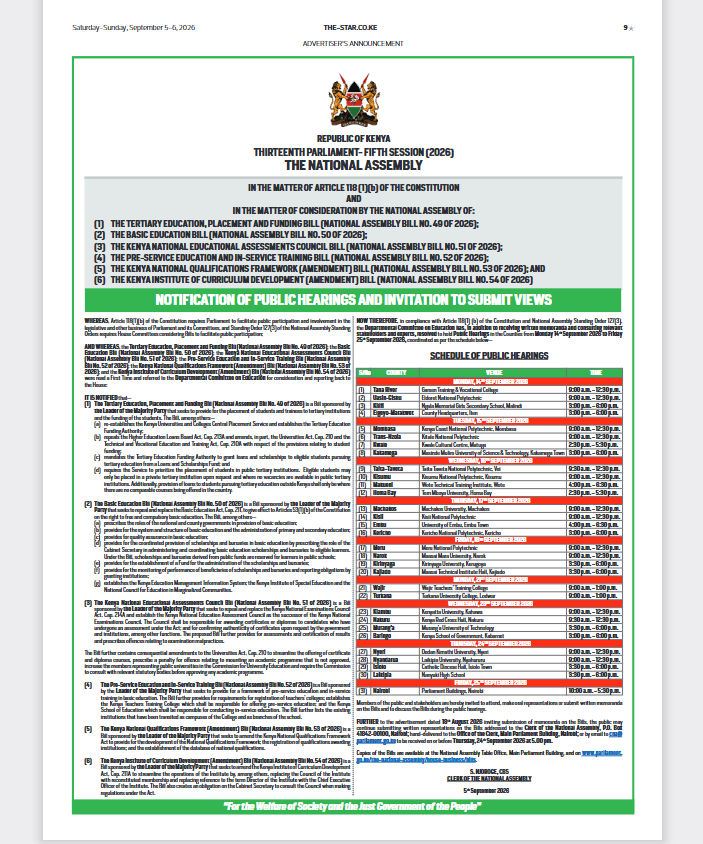
The @NAssemblyKE invites the public and stakeholders to attend public hearings and submit views on the following education Bills:
1. The Tertiary Education, Placement and Funding Bill (National Assembly Bill No. 49 of 2026)
2. The Basic Education Bill (National Assembly Bill No. 50 of 2026)
3. The Kenya National Educational Assessments Council Bill (National Assembly Bill No. 51 of 2026)
4. The Pre-Service Education and In-Service Training Bill (National Assembly Bill No. 52 of 2026)
5. The Kenya National Qualifications Framework (Amendment) Bill (National Assembly Bill No. 53 of 2026)
6. The Kenya Institute of Curriculum Development (Amendment) Bill (National Assembly Bill No. 54 of 2026)
Public hearings will be held across 31 counties from Monday, 14th September to Friday, 25th September 2026.
Written submissions can be sent to [email protected]
or
to the Clerk of the National Assembly,
P.O. Box 41842–00100, Nairobi.
Deadline: Thursday, 24th September 2026 at 5.00 p.m.
#PublicParticipationKE
cc @KICDKenya
Juliana Rotich spent years translating geospatial mapping into civic tools across three continents.
She became one of the most recognized faces of African tech globally.
Most people in Nairobi still couldn't name her.
This is timely. WiFi should ideally be billed the way electricity and water are. Paying for what you actually consume, rather than paying for unused capacity. Na niliwaambia wataanza kuuza internet kama njugu @vilcomnetworks https://t.co/fkS4RwalGx