Why Native Oracles Matter for Developers
Every smart contract is limited by one simple fact.
It cannot access real world data on its own.
To solve this, developers rely on oracles to bring external information on chain, such as asset prices, weather data, sports results, or financial market updates.
But when oracles operate as separate infrastructure, they introduce additional fees, integration work, security assumptions, and operational risk.
Developers are no longer building on a single blockchain. They are building across multiple independent systems that must all work together perfectly.
Rialo approaches this differently.
By integrating oracles as a native part of the protocol, developers can access trusted data without depending on a separate middleware layer. This reduces infrastructure complexity, simplifies development, and aligns oracle services with the same security and reliability as the blockchain itself.
The result is more than convenience.
It enables developers to build faster, reduce costs, and create applications that are easier to maintain as they scale.
Native oracles are not just another feature.
They are a foundation for building smarter, more reliable decentralized applications.@RialoHQ@RialoBangladesh
Why Native Oracles Matter for Developers
Every smart contract is limited by one simple fact.
It cannot access real world data on its own.
To solve this, developers rely on oracles to bring external information on chain, such as asset prices, weather data, sports results, or financial market updates.
But when oracles operate as separate infrastructure, they introduce additional fees, integration work, security assumptions, and operational risk.
Developers are no longer building on a single blockchain. They are building across multiple independent systems that must all work together perfectly.
Rialo approaches this differently.
By integrating oracles as a native part of the protocol, developers can access trusted data without depending on a separate middleware layer. This reduces infrastructure complexity, simplifies development, and aligns oracle services with the same security and reliability as the blockchain itself.
The result is more than convenience.
It enables developers to build faster, reduce costs, and create applications that are easier to maintain as they scale.
Native oracles are not just another feature.
They are a foundation for building smarter, more reliable decentralized applications.@RialoHQ@RialoBangladesh
What Is Supermodularity in Blockchain?
Most people evaluate blockchains based on speed, scalability, or transaction fees. While those metrics matter, they don't tell the whole story.
A blockchain is only as powerful as the way its components work together.
This is where supermodularity comes in.
Supermodularity is an economic principle that says two or more components create greater value when they are integrated than when they operate independently.
In blockchain, execution alone is useful. Oracles alone are useful. Automation alone is useful. But when these components are designed to work together as part of the same protocol, they unlock capabilities that would be more expensive, more complex, or less reliable if delivered separately.
Instead of relying on multiple external providers, developers can build on a single coordinated platform where every critical service strengthens the others.
This is the philosophy behind Rialo.
Rather than integrating everything, Rialo focuses on integrating the components that genuinely improve execution and increase the overall value of the network.
The result is lower complexity, better coordination, stronger reliability, and a blockchain designed to maximize long term value for developers and users.
Supermodularity is not just about adding more features.
It is about making every essential component work better together.@RialoHQ@RialoBangladesh
How Rialo Eliminates Middleware Complexity
Building on a blockchain today is often more complicated than it needs to be.
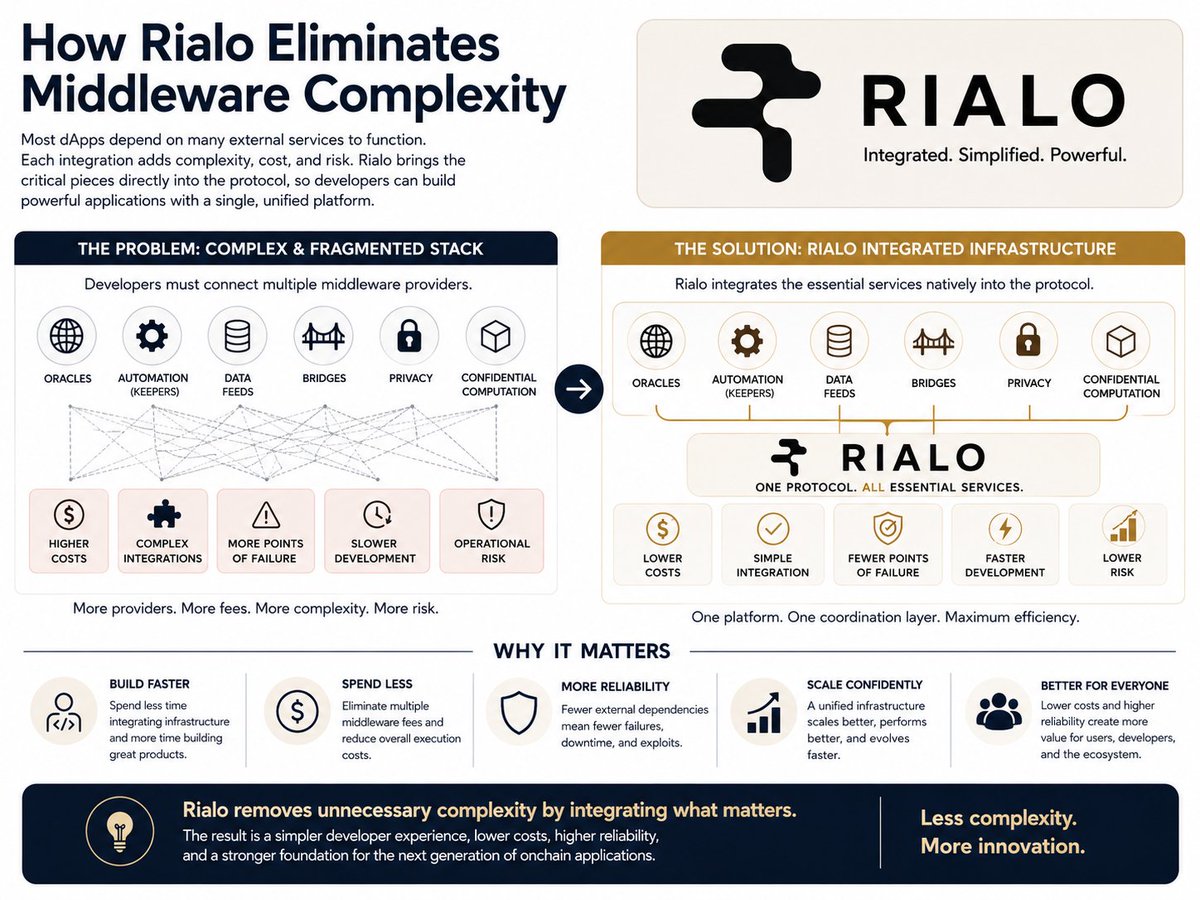
A single decentralized application may rely on an oracle for data, automation for recurring tasks, bridges for cross chain communication, privacy tools, and confidential computation. Each service has its own infrastructure, pricing model, security assumptions, and maintenance requirements.
The result is a fragmented development experience where teams spend significant time integrating and managing infrastructure instead of building products.
Rialo takes a different approach.
Instead of treating these services as external layers, Rialo integrates the critical components directly into the protocol when they strengthen execution and improve the overall system.
This means developers can access essential infrastructure through one coordinated environment rather than connecting multiple independent providers.
Fewer dependencies lead to lower operational complexity, more predictable costs, stronger reliability, and a smoother development experience.
The goal is simple.
Spend less time managing middleware and more time building applications that users love.
That is how Rialo rethinks blockchain infrastructure from the ground up.
@RialoHQ@RialoBangladesh
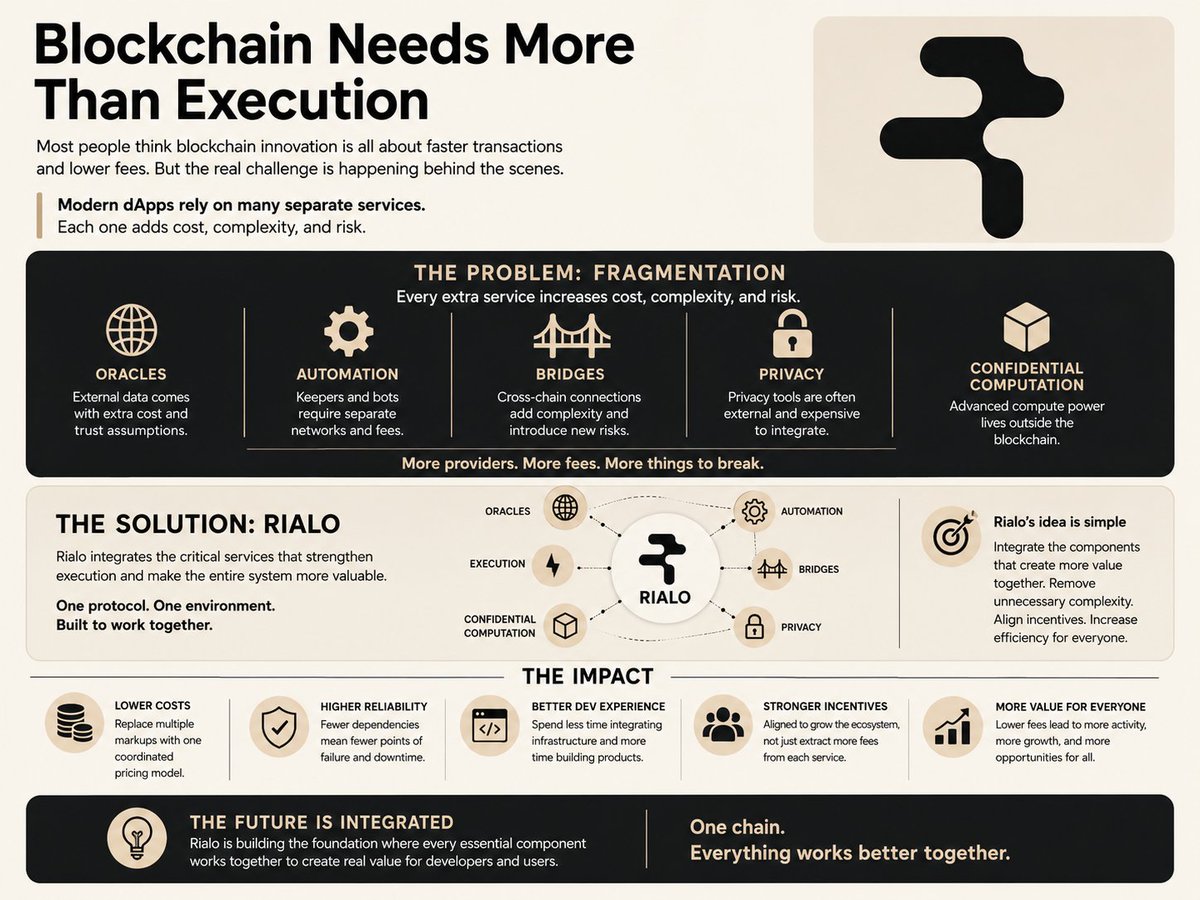
Most people think blockchain innovation is all about faster transactions and lower gas fees. While those improvements matter, they do not solve one of the biggest challenges developers face today.
Modern blockchain applications depend on much more than execution. They often require oracles for external data, automation for recurring tasks, bridges for interoperability, privacy solutions, and confidential computation. Each additional service introduces new costs, more complexity, and another point of failure.
This fragmented approach forces developers to spend more time integrating infrastructure than building products. It also increases operational risk and makes applications more expensive for users.
Rialo takes a different approach.
Instead of treating these services as separate layers, Rialo believes the most important infrastructure should be integrated directly into the protocol when it genuinely strengthens the entire system. This idea is based on supermodularity, an economic principle that says certain components create far more value when they work together than when they operate independently.
The result is a blockchain designed to reduce unnecessary complexity, lower execution costs, improve reliability, and create a better experience for both developers and users.
The future of blockchain will not be defined only by speed. It will be defined by how well every essential component works together to create real value.
That is the problem Rialo is trying to solve.@RialoHQ@RialoBangladesh
Prediction market security isn't just a technical problem.
It's an economic one.
Every prediction market depends on an oracle to determine what happened in the real world.
The question is simple.
Can someone profit by manipulating that outcome?
If the answer is yes, the market has a security problem.
The strength of an oracle isn't measured only by its technology.
It's measured by its economics.
How much can an attacker gain?
How much would they lose if they tried?
And how difficult is it to influence the resolution process?
As markets grow, these numbers change.
More liquidity creates larger rewards.
Larger rewards attract more sophisticated attackers.
Eventually, the economics can shift in their favor.
That's why prediction market security cannot rely on incentives alone.
The goal isn't simply to make attacks expensive.
It's to make truthful resolution fundamentally more reliable than manipulation.
Rialo approaches this challenge by reducing reliance on economic game theory.
Instead of asking participants to defend the truth through votes, disputes, or financial incentives, Rialo enables markets to resolve directly from verifiable primary sources.
The security model becomes anchored in transparent, authoritative data rather than whether participants are sufficiently incentivized to act.
The best security model is one where truth doesn't become more vulnerable as markets become more valuable.
Because prediction market security is ultimately an economic game.
The winner is the system where telling the truth is no longer just the best incentive.
It's the default outcome.@RialoHQ@RialoBangladesh
Most security systems rely on incentives.
They assume people will act honestly because dishonesty is too expensive.
That works.
Until it doesn't.
Every incentive-based system has an economic threshold.
A point where the reward for cheating becomes greater than the cost of being caught.
When that happens, the rules of the game change.
Honesty is no longer the rational strategy.
Cheating becomes the profitable one.
This is one of the biggest risks facing prediction market oracles.
As market value grows, so does the potential payoff from manipulating an outcome.
If the oracle's penalties don't grow at the same pace, attackers eventually gain the advantage.
The system doesn't fail because people suddenly become dishonest.
It fails because the incentives have changed.
That's why security cannot rely on economic penalties alone.
Rialo approaches this problem from a different direction.
Instead of asking participants to remain honest because the penalties are high enough, Rialo enables markets to resolve directly from verifiable primary sources.
The objective is to reduce dependence on game theory and make truth transparent from the beginning.
A secure oracle shouldn't depend on whether honesty is profitable.
It should depend on whether the outcome is independently verifiable.
Because when attack rewards exceed penalties, honesty stops being the rational strategy.
The strongest systems are designed so that truth doesn't change with incentives.@RialoHQ@RialoBangladesh
Every system built on incentives has a breaking point.
A point where following the rules is no longer the most profitable choice.
Prediction markets are no exception.
Many oracle systems rely on economic incentives to encourage honest behavior.
Report correctly.
Earn rewards.
Report falsely.
Risk losing your stake.
This works while the cost of cheating remains higher than the potential reward.
But markets don't stay small forever.
As more capital flows into prediction markets, the value of manipulating an outcome also increases.
Eventually, a threshold can be reached where the expected profit from cheating becomes greater than the expected cost of being caught.
At that moment, the security model begins to weaken.
The issue isn't that incentive-based systems are flawed.
The issue is that incentives can change.
A system that is secure at one scale may become vulnerable at another.
Rialo addresses this challenge by reducing reliance on economic incentives alone.
Instead of asking participants to protect the truth through game theory, Rialo enables markets to resolve directly from verifiable primary sources.
The security of the system becomes tied to transparent, authoritative data rather than whether cheating is economically attractive.
Incentives are important.
But they shouldn't be the only thing protecting the truth.
Because every incentive-based system has a point where cheating becomes profitable.
The strongest systems are designed so that truth doesn't depend solely on incentives.@RialoHQ@RialoBangladesh
Optimistic oracles are built on an important assumption.
If someone lies, someone else will challenge them.
At first glance, that sounds like a strong security model.
But it raises an important question.
What if no one challenges the lie?
Maybe the reward isn't worth the effort.
Maybe the challenge requires too much capital.
Maybe governance participation is low.
Or maybe everyone assumes someone else will step in.
In an optimistic oracle, security depends on active participation.
The system only works when honest actors are willing and able to defend the truth.
As prediction markets grow, so do the rewards for manipulation.
At the same time, the cost of monitoring and challenging false reports can also increase.
That creates a dangerous imbalance.
A dishonest report only needs to go unchallenged once.
And if it does, the blockchain accepts it as truth.
Rialo approaches this challenge differently.
Instead of depending on someone to correct false information after it is reported, Rialo enables markets to resolve directly from verifiable primary sources.
The emphasis shifts from challenging lies to verifying truth at its origin.
That reduces reliance on economic incentives and human intervention.
A secure prediction market shouldn't depend on whether someone is paying attention.
It should depend on whether the source of truth is transparent and verifiable.
Because the security of optimistic oracles depends on someone caring enough to challenge lies.
Rialo aims to make the truth easier to verify before those lies become final.
@RialoHQ@RialoBangladesh
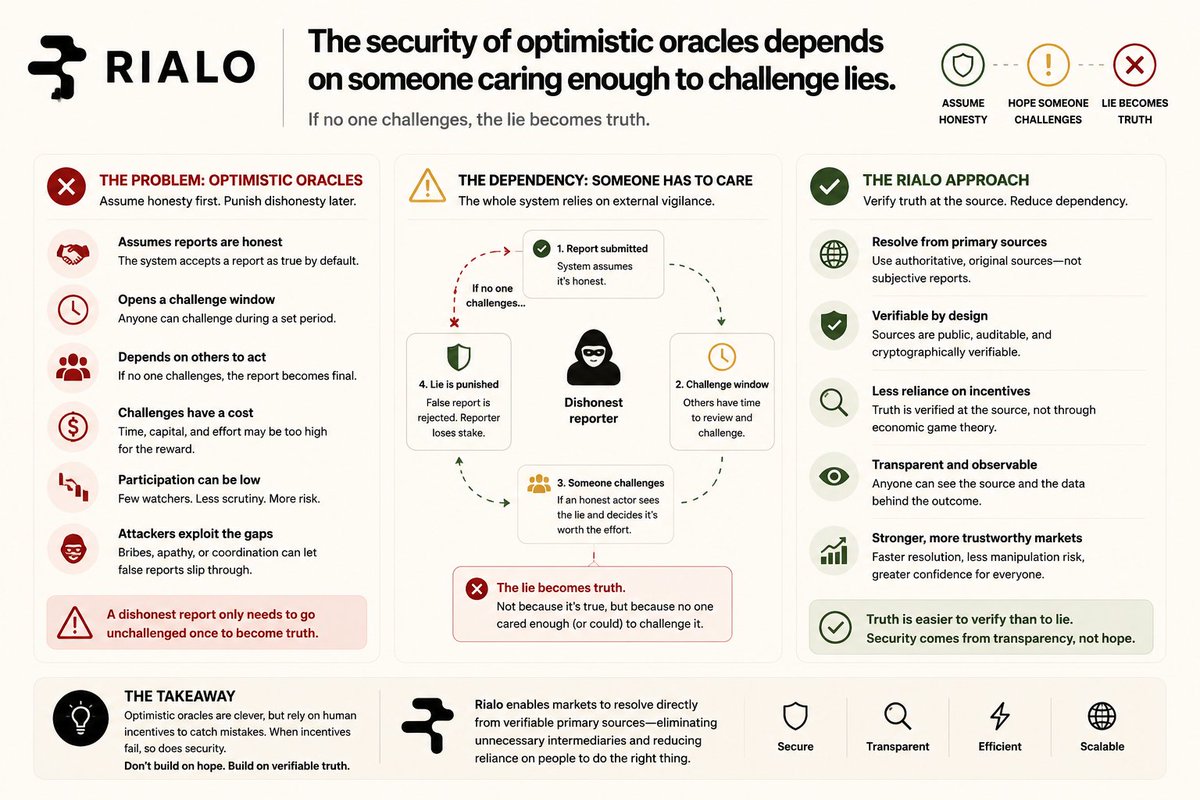
Optimistic oracles are built on a simple assumption.
People will tell the truth.
And if someone doesn't, someone else will catch them.
The process is straightforward.
A participant submits an outcome.
The system assumes the report is honest.
A challenge window opens.
If no one disputes the report, it becomes the official result.
If someone proves the report is false, the dishonest reporter loses their bond.
It's an elegant design.
It keeps the system decentralized and avoids constant voting on every outcome.
But its security depends on one critical assumption.
That honest participants will always have enough incentive to challenge dishonest ones.
As prediction markets grow, that assumption becomes harder to guarantee.
Attackers can attempt to bribe participants.
Exploit low governance participation.
Or create situations where challenging a false report is too costly or not worth the effort.
In those cases, the system's optimism becomes its biggest weakness.
Rialo approaches the problem differently.
Instead of assuming someone will eventually correct a false report, Rialo enables markets to resolve directly from verifiable primary sources.
The focus shifts from challenging reports after the fact to referencing authoritative sources from the beginning.
This reduces reliance on economic incentives alone and makes the resolution process more transparent.
Optimistic oracles assume honesty first.
Rialo focuses on making truth verifiable from the source.
@RialoHQ@RialoBangladesh
When people hear the word "outlier," they often think of an error.
Something unusual.
Something that should be ignored.
But in prediction markets, outliers can be the first signal that reality is changing.
A reporter with new information.
An unexpected market event.
A breaking development that hasn't reached everyone else yet.
The problem is that many aggregation oracles are designed to reward consensus.
To protect against manipulation, they often combine multiple reports into a single value.
In that process, outliers are frequently discarded.
This improves stability.
But it can also remove the most valuable information.
The signal that arrives first is often the signal that matters most.
If every unique insight is treated as noise, markets risk reacting only after the rest of the world has already caught up.
Rialo takes a different approach.
Instead of reducing information to a median or majority vote, Rialo enables markets to resolve directly from explicit, verifiable primary sources.
The original source remains visible.
The complete information remains available.
Developers can decide how to interpret the data without losing important signals during aggregation.
Better prediction markets aren't built by hiding information.
They're built by preserving it.
Because sometimes the most valuable information isn't the consensus.
It's the outlier that everyone else hasn't seen yet.@RialoHQ@RialoBangladesh
Consensus is often seen as a sign of reliability.
If everyone agrees, the answer must be correct.
Right?
Not always.
In many aggregation oracle systems, reporters are rewarded for agreeing with the majority.
That creates a powerful incentive to rely on the same data sources and wait until information is widely confirmed.
The result is consensus.
But often at the cost of speed.
Fresh information carries risk.
If you're the first to report something that others haven't seen yet, you could be penalized for being different.
So reporters naturally converge on the safest answer.
Not the freshest one.
This creates an important tradeoff.
The system becomes more resistant to manipulation.
But it can also become slower to reflect reality.
For prediction markets, timing matters.
Markets are most valuable when they can resolve quickly and accurately as new information becomes available.
Rialo takes a different approach.
Instead of relying on consensus between reporters, Rialo enables markets to resolve directly from verifiable primary sources.
When the source publishes new information, the market can reference it without waiting for a reporting quorum to catch up.
The goal isn't just agreement.
It's timely, verifiable truth.
Because consensus often converges on the safest answer.
Not the freshest answer.@RialoHQ@RialoBangladesh
Aggregation oracles were designed to solve a critical problem.
How do you prevent a single person from controlling the truth?
Instead of relying on one reporter, aggregation oracles collect data from multiple participants and combine their responses into a final result.
On the surface, this makes the system more secure.
No single actor can easily manipulate the outcome.
But a new problem emerges.
Groupthink.
Because reporters are rewarded for agreeing with the majority, they are incentivized to use the same sources and follow the same assumptions.
Being different becomes risky.
Even when new information is available.
Over time, the network naturally converges toward the safest answer rather than the most informative one.
This creates an unexpected tradeoff.
The system reduces single points of failure.
But it can also reduce diversity of information.
Fresh data may be ignored.
Outlier signals may be discarded.
And valuable insights can disappear during aggregation.
As a result, the market may receive consensus.
But not necessarily truth at its highest fidelity.
Rialo approaches this challenge from a different angle.
Instead of aggregating reports from multiple intermediaries, Rialo enables markets to resolve directly from explicit primary sources.
The source itself becomes visible, verifiable, and auditable.
Rather than asking multiple reporters what happened, the market can reference the institution that published the information in the first place.
Reducing single points of failure is important.
But preserving the quality of information matters too.
Aggregation oracles reduce single points of failure.
Yet they can also introduce groupthink.
And sometimes the most important signal is the one the crowd ignores.@RialoHQ@RialoBangladesh