A man tries to flee Ukraine to avoid being forced to the military. Border guards hit him with a paddle and try to run him over with a boat’s propeller. Moldovian people film it and save him.
They’ll kill you for refusing to die. What the fuck kind of “freedom” is this?
Why the hell does Ukraine have to stand alone for the whole Europe?????? Each country has a professional army with dudes that went there to retire at 30 years old with a bunch of benefits!!!!! Army is their own conscious choice!!!! Let them go to Ukraine and fight!!!!!!!!!!!!
https://t.co/b11dpuJkM1
Illegal construction → DBR threats → 143 apartments as bribes → protection. Illegal deals protecting illegal deals.
Journalists found 143 properties acquired by Ukraine’s DBR chief’s brother.
Where are the answers?
https://t.co/KRdGAZ10nb
HUMAN LIVES AS LEVERAGE
Ukraine asks Europe for billions more while anti-corruption reforms remain unfinished. Europe is trapped: refuse the money and more Ukrainians may die; keep paying and the system has less incentive to change.
That creates a dangerous dynamic where human suffering becomes leverage for continued funding - and, critics fear, continued illegal enrichment.
The EU itself says funding is conditional on rule-of-law and anti-corruption reforms:
https://t.co/aLTLnNfqgt
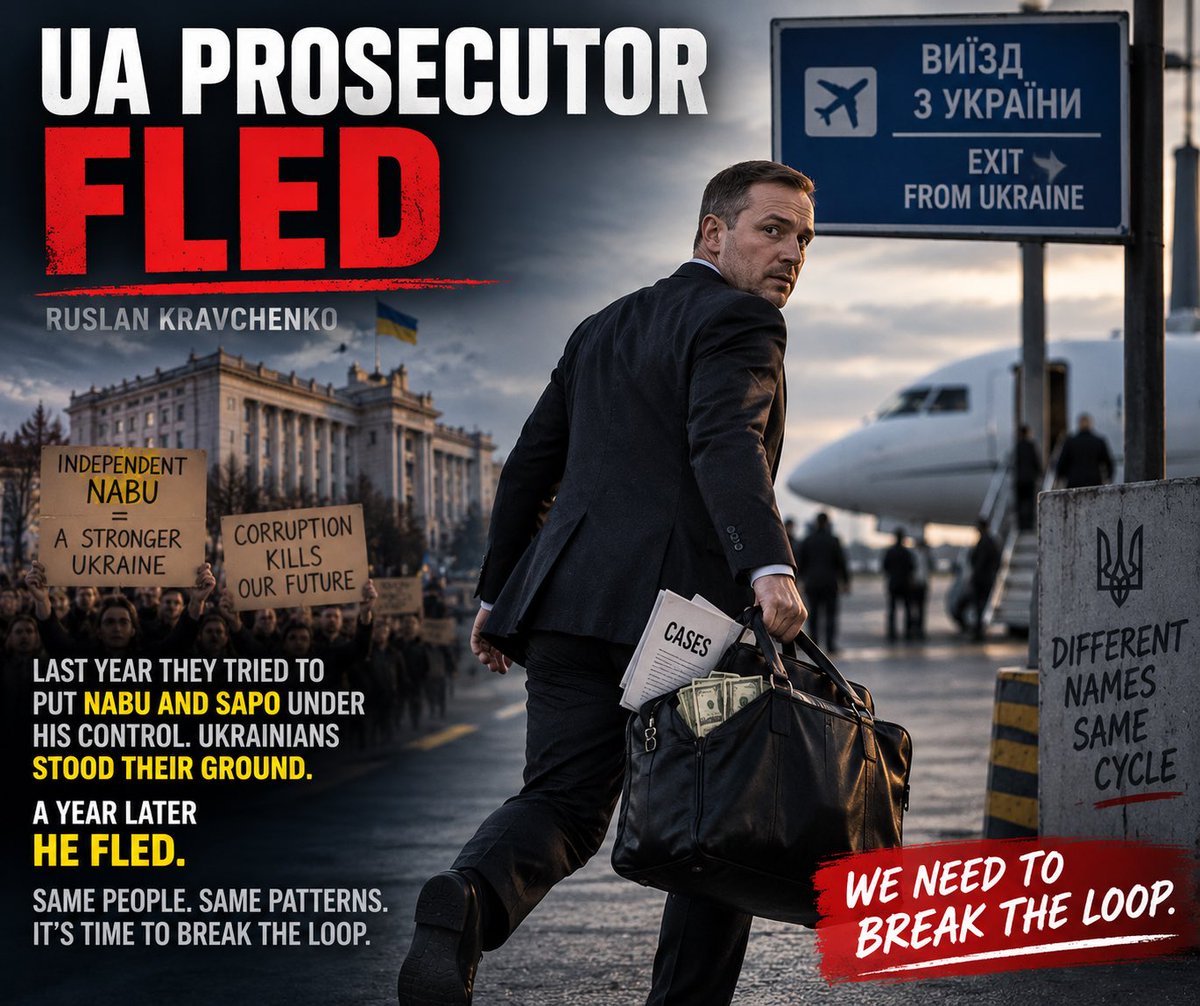
Last year, Ukraine’s parliament tried to put NABU and SAPO under the Prosecutor General’s control.
Ukrainians took to the streets and stood their ground. The law was reversed. NABU and SAPO kept their independence.
A year later, the Prosecutor General himself has fled the country amid a corruption scandal.
And following Ukraine’s national tradition, the Tsar will appoint another “close friend” as Prosecutor General, and the cycle will begin again.
Friend gets appointed. Friend gets power. Scandal erupts. Friend disappears. Another friend takes his place.
Ukraine cannot keep running in this endless loop.
NABU and SAPO survived because Ukrainians refused to surrender their independence. Now the country needs to go further - break the cycle in which institutions depend on who is personally loyal to whom.
Ukraine needs institutions stronger than presidents, prosecutors, friends and clans.
#Ukraine #NABU #SAPO #AntiCorruption #RuleOfLaw
Finally, thanks to NABU and the Ukrainian people who took to the streets to defend its independence, the world is getting a glimpse of what Ukraine’s structures of power actually look like.
The New York Times obtained secret Ukrainian government audits of military procurement.
A contractor delivered ZERO of 600 drones. It was then awarded another contract for 1,950. Only 50 arrived on time.
Another supplier delivered 233,000 unusable mortar rounds. It still received more military contracts.
Seven of Ukraine’s 10 largest military contractors received new business despite previous defaults, fraud investigations or executives facing corruption cases.
The audits found $1.2 BILLION lost to fraud, waste and mismanagement in 2024 alone.
Pure mobster behavior operating on a national scale, even while the country is fighting for its very existence.
NYT investigation:
https://t.co/5clmY0QJLe
Corruption in Ukraine is systemic - top to bottom.
Another case, another branch of power. NABU says a senior Prosecutor General’s Office official led a criminal organization that protected scam call centers, took systematic bribes and laundered millions.
Parliament. Government. Courts. Prosecutors. Law enforcement. Again and again, the same pattern.
At what point do we stop pretending these are isolated cases?
NABU/SAPO say the alleged organization was created in 2025 and included serving prosecutors; the investigation is ongoing.
https://t.co/NS6h34imih
Ukraine has already demonstrated that it contains forces capable of resisting political capture. NABU and SAPO continued investigating. Journalists continued publishing. Civil society continued organizing. When the government moved against the anti-corruption institutions in July 2025, Ukrainians went into the streets and international partners pushed back hard enough to force a reversal.
That may ultimately be the most important lesson of the entire story.
The problem is not that one man arrived in 2019 and suddenly corrupted a previously clean Ukrainian state.
He didn't.
The problem is that Ukrainians elected someone who promised to finally break a system they already knew was corrupt - and his administration became extraordinarily successful at convincing the country and the world that it had done so.
For years, the facade worked.
Now, case by case, investigation by investigation and scandal by scandal, we are beginning to see what remained behind it.
Ukraine's political system did not suddenly become closed or corrupt under Zelenskyy. It had been deeply corrupt for decades. Informal networks, political patronage, oligarchic influence, selective law enforcement, backroom deals and the use of state institutions for private and political interests were features of the system long before 2019.
What made this administration different was not that it invented the system. It was how successfully it convinced Ukrainians - and, for a long time, much of the outside world - that it represented a clean break from it.
Zelenskyy came to power precisely because millions of Ukrainians were exhausted by that state. He was the outsider. The anti-establishment candidate. The man without decades in government and, supposedly, without obligations to the old political clans.
"New faces" were not just campaign branding. They were the central promise.
And for a remarkably long time, it worked.
The administration managed to present itself at home and especially abroad as something fundamentally different from the governments that preceded it - younger, cleaner, digital, Western-oriented and determined to dismantle the old corrupt networks.
Seven years later, that distinction is becoming increasingly difficult to maintain.
Ukrainian investigative journalists and civic activists have documented pieces of this story for years. More recently, however, the picture has increasingly been supplemented by material emerging from official institutions themselves - NABU and SAPO investigations, HACC proceedings, searches, notices of suspicion, criminal cases and bail amounts measured in tens or hundreds of millions of hryvnias.
Taken together, these cases do not describe the creation of an entirely new system. They suggest something much more familiar: the old Ukrainian system survived, adapted and consolidated itself behind a new political brand.
The mechanics themselves are painfully familiar.
Independence of institutions has always been inconvenient to political power in Ukraine. The difference was supposed to be that the new administration would finally respect it. Instead, according to its critics, personnel once again became the principal guarantee of political control.
For seven years, Bankova has methodically installed people whose personal loyalty has been tested in key positions - prosecutors general, heads of the SBU, State Bureau of Investigation, Ministry of Internal Affairs, National Police, Accounting Chamber and other institutions responsible for controlling public money and assistance from Ukraine's partners.
The danger is obvious: when the people being monitored and the people doing the monitoring belong to the same political ecosystem, formal independence begins to mean very little. Everyone may formally be responsible for a different institution, but the institutions themselves cease functioning as genuine checks on one another.
And the security apparatus was only half of the construction.
The other half was Parliament.
An "obedient parliament" is not merely a figure of speech. For years, Bankova has sent down lists of government officials, candidates for appointments and required legislation, while the governing majority has been expected to deliver the votes.
Formally, Zelenskyy's Servant of the People party won 254 seats after the 2019 election. But by 2026, according to the account presented here, its dependable core - MPs whose votes Bankova could reliably count on - had shrunk to approximately 110-130 people.
The allegations about how discipline was maintained are considerably more serious.
At the end of December 2025, NABU and SAPO uncovered what investigators described as a hierarchical group within the parliamentary faction that systematically paid colleagues for desired votes - allegedly between $2,000 and $20,000 depending on their "voting efficiency."
…more in the comments…
Formally, Umerov is expected to coordinate security cooperation and negotiations. Critics allege that his informal role is considerably broader and includes influence over financial flows surrounding defense procurement and foreign weapons sales.
There is an irony running through this entire story.
Almost everyone entered the Zelenskyy era under the banner of destroying Ukraine's old political system.
Yet seven years later we are again talking about the things Ukrainians have been talking about for decades: envelopes for MPs, politically loyal prosecutors, businessmen close to power, enormous state contracts, selective criminal investigations, compromised regulators, pressure on independent investigators and insiders becoming expendable when they cease to be useful.
The names are new.
The technology is newer.
The presentation is infinitely better.
The system is painfully familiar.
That is why describing the last seven years simply as Zelenskyy "turning Ukraine into a mafia state" misses the more important point.
Ukraine already had a deeply corrupt political system.
Zelenskyy did not create it.
He was elected to break it.
And that is what makes the story of his administration so consequential. It managed, for years, to persuade millions of Ukrainians and many of Ukraine's Western partners that the old system was finally being dismantled while many of its familiar mechanisms - personal loyalty, political protection, informal networks, control over institutions and privileged access to state resources - appear to have survived behind a dramatically improved facade.
The list of people who once stood at the center of that facade grows shorter.
Bohdan was pushed out. Kolomoiskyi ended up behind bars. Shefir lost his influence. Bakanov was dismissed. Mindich and Tsukerman left the country. Halushchenko, Chernyshov and Yermak became subjects of major investigations. Fedorov was expelled from the inner circle.
Meanwhile, figures such as Tatarov, Umerov, Budanov and Pishchanska remain.
But the fate of individual players is ultimately secondary.
The central question is what happens to the system itself.
That episode matters because it strips away much of the rhetoric surrounding the system.
When institutions remained abstract symbols of reform, supporting their independence was politically convenient. When those institutions began investigating increasingly powerful people, independence suddenly became a problem.
More recently, according to reporting cited by https://t.co/dNslrQ4P6P and the Anti-Corruption Action Center, SBU investigators have sought access, through a criminal case, to HACC's document-management system.
Such access could potentially expose information about individuals whom NABU detectives are preparing to search.
If investigators controlled by another part of the state could see that information in advance, targets could potentially be warned before searches took place. Investigations on the scale of "Midas" would become vastly more difficult.
And finally there are the people responsible for the most important resource of wartime Ukraine: defense money.
Mykhailo Fedorov is often presented today as someone who came into conflict with the system. But that description ignores most of his political career.
Fedorov was part of Zelenskyy's project from the beginning.
He first headed the Ministry of Digital Transformation, where critics repeatedly raised questions concerning government software procurement. Later came controversies surrounding drone procurement by officials at the State Special Communications Service.
For years, none of this pushed Fedorov outside the administration's trusted circle.
The relationship allegedly changed only after he became defense minister and began interfering with financial interests that critics claim were connected to much more powerful figures - including attempts to limit Fire Point's share of state orders for long-range drones.
There was another problem.
Fedorov's personal political ratings were rising, prompting increasingly uncomfortable speculation about whether he might eventually become a presidential candidate himself.
In July 2026, he was dismissed, formally because of a conflict with then-Commander-in-Chief Oleksandr Syrskyi.
His dismissal triggered enormous public anger and major street protests. Syrskyi subsequently lost his own position and was replaced by Mykhailo Drapatyi, but Fedorov was not restored to office.
That makes his transformation into an opposition figure complicated.
For seven years he had been part of the same political project. He did not become an outsider because he rejected the system at its beginning. He became an outsider only after the system turned against him.
Rustem Umerov's trajectory went in the opposite direction.
He moved from the State Property Fund to the Defense Ministry, then to the National Security and Defense Council, and finally became head of the Foreign Intelligence Service on August 3, 2026.
Questions had already surrounded his period in defense procurement, including controversies involving Fire Point, and his name reportedly appeared in connection with the so-called Mindich recordings.
Nevertheless, he continued to rise.
Zelenskyy ultimately entrusted him with Ukraine's foreign intelligence service.
Svitlana Pishchanska is an administrator of the Italian company San Tommaso S.R.L., through which the Zelenskyy family's villa in Forte dei Marmi has reportedly been registered. She has also been described as a significant Servant of the People donor and appeared in journalistic investigations concerning French companies allegedly connected to Strasbourg's Association of Russian Culture.
The Antimonopoly Committee was not the only watchdog accused of becoming politically dependent.
Similar concerns have surrounded ARMA, the agency responsible for managing seized assets, and the Economic Security Bureau, or BEB. Critics have repeatedly accused the latter of being transformed into an instrument of pressure on businesses, while NABU investigations have implicated individual bureau employees in alleged bribery.
All of this becomes much easier when political power maintains influence over law enforcement and the judicial system.
That brings us to Oleh Tatarov.
Tatarov has been described by critics as the shadow supervisor of the security agencies and judicial hierarchy. Unlike many other people who have moved through Zelenskyy's inner circle, he has survived repeated scandals and political purges and remained in office for years.
His own criminal case became one of the earliest illustrations of why critics considered his position so extraordinary.
In December 2020, NABU suspected Tatarov of involvement in bribery connected to the alleged falsification of an expert examination in a National Guard embezzlement investigation.
The case was subsequently transferred away from NABU - first to the State Bureau of Investigation and then, following action by then-Prosecutor General Iryna Venediktova, to the SBU - where it effectively disappeared from public view.
Those who worked alongside Tatarov proved considerably less durable.
Andriy Smyrnov handled judicial matters within the Presidential Office, relying on an architecture that critics associated with the earlier influence of Andriy Portnov. Smyrnov subsequently came under investigation after leaving office, including allegations concerning bribery in exchange for favorable Antimonopoly Committee decisions.
Ivan Bakanov, Zelenskyy's longtime friend who became head of the SBU despite having little relevant professional experience, was eventually removed after the security service suffered a series of catastrophic failures.
Iryna Mudra was subsequently accused by investigators, according to the account presented here, of using her position in the Presidential Office in connection with the laundering of cash intended to help secure the release of favored individuals from detention.
Investigative actions involving her on August 19 were then described as one of the triggers for another confrontation between the SBU and Ukraine's anti-corruption institutions.
And this confrontation is crucial, because it exposes the difference between the image of the administration and the way political power behaves when genuinely independent institutions threaten people close to it.
The attack was not unprecedented.
On July 22-23, 2025, Parliament adopted Law No. 12414, dramatically undermining the independence of NABU and SAPO. Zelenskyy signed it the same evening, and it entered into force the following day.
The reaction was immediate. Ukrainians protested. Civil society mobilized. Western partners applied intense pressure.
The administration reversed course and legislation restoring the agencies' independence followed.
Halushchenko was initially suspended from his newly acquired position as justice minister. On February 15, 2026, he was detained while allegedly attempting to cross the border.
SAPO requested a record UAH 425 million bail. Halushchenko reportedly called the request a "sentence." The court initially set bail at UAH 200 million and subsequently reduced it to UAH 150 million.
By late June, the entire amount had reportedly been posted by four companies displaying characteristics that raised questions about whether they were genuine operating businesses.
Then, on August 19, NABU and SAPO launched another operation, dubbed "Forrest Gump," concerning the alleged laundering of the same UAH 150 million used to post Halushchenko's bail.
The circle had almost literally closed.
Zelenskyy's close associate Oleksiy Chernyshov - allegedly referred to as "Che Guevara" on the Mindich recordings - was served a notice of suspicion on November 11, 2025.
His UAH 51.6 million bail was reportedly paid by two people: a lawyer linked to someone in Mindich's circle and a woman whom journalists initially struggled to identify because of how common her name was.
In May 2026, Chernyshov reportedly received another notice of suspicion concerning alleged money laundering through construction of an elite cottage development. His electronic monitoring bracelet was removed in July.
Above both men, according to investigators as characterized in reporting about the case, stood Tymur Mindich and Oleksandr Tsukerman - personal friends of the president and alleged organizers of the broader "Midas" scheme.
On November 13, 2025, Zelenskyy imposed sanctions on them, but both had already left Ukraine.
On December 1, Mindich was ordered into custody in absentia.
On December 26, Ukrainska Pravda journalists reportedly located both men in Israel.
Then there was Andriy Yermak.
For more than five years, Yermak accumulated extraordinary influence inside the Presidential Office and became one of the central figures in Zelenskyy's system of government. Critics accused him of increasingly isolating the president and concentrating decision-making inside a tiny circle around Bankova.
Yermak resigned on November 28, 2025 - the same day NABU searched premises connected to him.
According to the allegations that followed, on May 11, 2026, he was served a notice of suspicion concerning the laundering of more than UAH 460 million through construction of the elite "Dynasty" cottage development in Kozyn.
On May 14, HACC reportedly set bail at UAH 140 million.
The money was raised within four days. UAH 30 million was reportedly contributed by former Ukrainian national football team coach Serhiy Rebrov; UAH 8 million by Babyn Yar reserve director Roza Tapanova, who previously worked at Yermak's law firm; and UAH 666 by actor Hryhoriy Hryshkan - apparently as a joke.
While some people allegedly generated the financial flows, others occupied institutions that were supposed to make sure such flows were properly scrutinized.
The Pishchanska sisters illustrate the problem particularly well.
Olha Pishchanska headed the Antimonopoly Committee from 2020 to 2023 and became head of the Accounting Chamber in January 2024, making her responsible for state auditing, including audits of wartime expenditures. Her appointment proceeded despite concerns reportedly expressed by G7 ambassadors.
According to the investigation, coordination took place through a WhatsApp chat, while one participant received at least $145,000 during November and December alone for subsequent distribution. Five Servant of the People MPs were served notices of suspicion, with bail reportedly set between UAH 16.6 million and UAH 40 million each.
Investigators alleged that the scheme had operated since at least 2022, although insiders had been talking about informal payments inside the governing majority since much earlier.
Again, none of this means that buying political loyalty was invented in 2019. Quite the opposite. Ukraine had a long history of parliamentary horse-trading, oligarchic factions, informal payments, political bargaining and MPs changing allegiance.
The significance of these allegations is precisely that the administration elected to destroy those practices appears to have reproduced them.
The packaging changed. The mechanism did not.
After the scandal and criminal suspicions, securing enough votes became considerably more difficult, so the mechanism allegedly had to be redesigned.
In April 2026, the Svyrydenko government reportedly proposed what critics described as a "more legal" substitute for direct payments: UAH 5 million in subsidies for an MP's constituency in exchange for supporting required legislation.
At the same time, the government was accused of promising to "regulate NABU pressure" - meaning that existing cases against MPs would supposedly proceed to court without additional summonses for questioning. How such an arrangement could actually have been implemented is unclear, but reports suggested that a number of MPs took the promise seriously.
Throughout these years, Bankova's principal vote-counter has remained Davyd Arakhamia, head of the Servant of the People parliamentary faction.
He has acquired a reputation as one of Parliament's most effective negotiators. His critics would describe the same quality rather differently - as an extraordinary willingness to negotiate without being constrained by principles, ideology or political loyalty.
But Parliament is ultimately an instrument. To understand the system, it is more revealing to look at the people who built and operated it - and at what eventually happened to them.
Andriy Bohdan laid the foundations of the government's famous 2019 "turbo mode." He later fell out of favor and spent years publicly criticizing the president.
On May 2, 2026, Zelenskyy imposed ten-year sanctions on him - formally on national-security grounds. Bohdan himself and people described as insiders reportedly argued that the real reason was suspicion that he had been involved in leaking fragments of the so-called "Mindich tapes" to journalists.
Ihor Kolomoiskyi and Serhiy Shefir represent an even earlier stage of the story.
Kolomoiskyi provided important media support during Zelenskyy's rise, but ultimately ended up in pretrial detention. Meanwhile, the relationship between his former business empire and people associated with the new political establishment deteriorated dramatically.
Shefir spent years as an intermediary between the administration and influential business interests, but eventually lost his influence and was pushed out of the center of power.
They were followed by figures responsible for some of the largest financial flows in the state - Herman Halushchenko and Oleksiy Chernyshov.
Halushchenko oversaw the energy sector, and NABU and SAPO subsequently built their "Midas" operation around alleged corruption there.
On November 10, 2025, more than 70 searches reportedly took place amid allegations of systematic kickbacks from Energoatom contractors amounting to 10-15% of contract values.
Coming out!
Ukraine’s security services disguise themselves to the world as mob clans fighting for territory.
A HUR-linked commander is allegedly held by SBU for 9 days without charges. It goes public - suddenly he’s back home. Then SBU and HUR start shooting.
A jailed insider may be ready to talk.
Then millions start moving. Powerful people scramble. Institutions meant to stop dirty money enter the story, but not on the side you would expect.
And NABU is watching it all.
Operation Midas was only the beginning.
Full story below