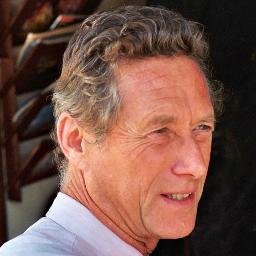
SEÚL RADIO #79: IVÁN WERNING 🎙️
@IvanWerning es uno de los economistas argentinos más importantes de su generación. Doctorado por la Universidad de Chicago y profesor del MIT desde hace más de dos décadas, construyó una reputación global por su forma original y rigurosa de hacerse nuevas preguntas sobre cómo mejorar el funcionamiento de la economía. De paso por Buenos Aires para hacer una presentación en las jornadas del Banco Central, vino a nuestro estudio a hablar de si hay un buen impuesto a la herencia, del aprendizaje de los banqueros centrales, el éxito inicial del gobierno de Milei y el legado de uno de sus mentores, Gary Becker, entre muchos otros temas.
Causation is a certain correlation that occurs when "all else" is held constant (observed+unobserved conditions). This specific "correlation" is not the raw one except hard to spot exceptions, but if you know you s*** you use judgement to combine data & theory (exclusions) and discuss these ideas openly with others to convince.
Actually correlation does imply causation and that's basically how anybody make sense of the world. It just doesn't prove it and you need to know you shit to spot the exceptions.
This is quite inaccurate, even if one wants to convey relative frustration with macro… (or specifically macro prediction)
Today, there is no conceptual difference between micro and macro, it’s just economics. The only a difference in scope of the questions.
As is true if the physics of the inclined plane vs cosmology.
@DrewFudenberg@ben_golub Fair, but honestly for the RH I'm sure there would be interest in sifting though the prompts that lead to the proof.
As for your idea, did you try asking Claude to create a summery of prompts that were most critical along the path and in determining that path vs others.
It gets interesting. Hard to tell at this point. But I wonder, might the "Claude proof" have harvested this human author or its referees? Which side of this race are you on?
An independent, 100% human, claimed proof of RH (only 940 pages long). (Seems like this was finished months ago, but has been privately being reviewed.)
https://t.co/xz4sFkNesk
@alexolegimas@arindube@ben_golub And anyway I agree. but that's precisely the spirit of the discussion I am raising, to talk about how important they are and understand there is a tradeoff.
Sure, but to report percentages and for that to be useful, we very much need to understand what the cutoffs are. Any interpretation without it seems premature.
I'm sure many mistakes are worth fixing. When I see a mistake, however small, I want to fix it! But it's also costly and getting to the right equilibrium here is important and requires that discussion.
@alexolegimas@arindube Yeah for what it's worth, since I have no idea how that judgement is made. In my experience and judgement, it hasn't been very good on its own judging that.
Interesting, but how can you judge which are serious issues versus gaps to be filled? Suppose you ran this on Wiles' June 1993 (Isaac Newton Institute in Cambridge) draft of his proof for Fermat's Last Theorem? I suppose you could try that (although the models may have the latter completions)