I'm a Builder, ask me what I'm building rn
SME in Cross Platform Applications. Specialize in real world AI value creation. Stack: .Net, C#, MAUI, Azure, AI/ML.
@tuuu28283 I think Americans have a deep respect for Japanese people. You are a very resourceful people with an incredible talent for engineering, Toyota has been a major player in that respect.
We also tend to resonate with your art on many levels: video games and anime namely.
I have "Emergency Calm."
I will have a mental breakdown over answering a simple email.
But if the kitchen catches fire? I enter a flow state. I am cool, calculated, and precise.
My brain was not built for modern bureaucracy. It was built for the apocalypse.
I am a specialized crisis unit trying to survive in a world that just wants me to file spreadsheets.
i know it sounds so existential, but after playing with claude cowork non-stop for the past week, i've officially internalized how existential AI is.
not in like "AGI is here, humans don't matter."
but more like: if you aren't learning these new AI skills, you're completely toast. Good luck getting a job. Good luck building anything of value fast enough for its value to be monetized. Good luck surviving amidst an ocean of AI-orchestrating competition.
just... good luck.
either get on board, or pray for UBI.
Don't worry about a bunch of software engineers losing their jobs. Worry about what a bunch of unemployed engineers will do to yours.
Engineers are lifelong learners who cannot do their job without learning another specialization in which to apply their craft. Programming isn't like speaking French, it's like building an aqueduct in French. An engineer must be an expert in both coding and the subject of that code.
Engineers who get laid off are just going to learn another person's job, automate it 1000x, and take it for themselves. Software skills are going to be mandatory for any white-collar job by 2030. If you work in an office and have no idea how to code, I'd suggest you'd learn like your career depended on it.
Hinton, the godfather of AI, said it best: we built the learning algorithms, but we no longer understand what they’ve built.
That’s the paradox of deep learning. We designed the rules for how these systems learn, yet the internal logic of their neural networks has become too complex for us to fully grasp. Millions or even trillions of parameters interact in ways no human can trace.
We can observe what they do, we can measure accuracy, behavior, and output but not truly explain why they do it. Their reasoning isn’t transparent; it’s emergent.
In a sense, we’ve created alien intelligences born from our math, still tethered to our code yet evolving patterns we can’t decode. The machines are doing something beyond our comprehension and that might be both the most exciting and the most unsettling thing about the age of AI.
I don’t know who needs to hear this… but if superintelligence alignment is something that can be solved through science and reasoning, our absolute best chance at doing it in a timely manner is to scale up AI until we reach pseudo-ASI and then just be like:
“Solve superalignment. Think step by step.”
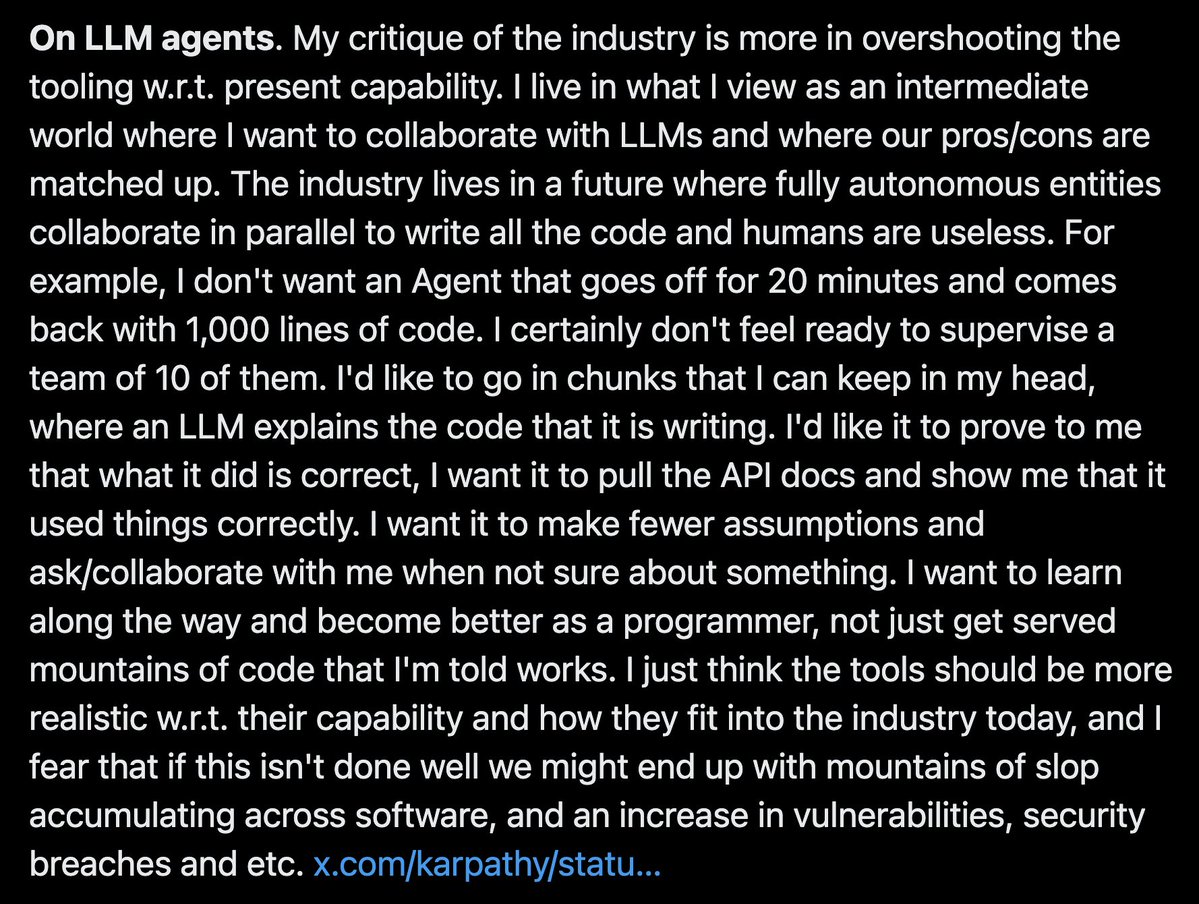
If you saw how people actually use coding agents, you would realize Andrej's point is very true.
People who keep them on a tight leash, using short threads, reading and reviewing all the code, can get a lot of value out of coding agents. People who go nuts have a quick high but then quickly realize they're getting negative value.
For a coding agent, getting the basics right (e.g., agents being able to reliably and minimally build/test your code, and a great interface for code review and human-agent collab) >>> WhateverBench and "hours of autonomy" for agent harnesses and 10 parallel subagents with spec slop
You're in an interview with Microsoft's AI security team.
They ask: "Prompt injection is a huge threat. How would you design a robust defense system for our new AI assistant?"
You say: "I'd use a regex to filter keywords like 'ignore your instructions'."
Chaos 🥵
Instead, here's what you should do 👇
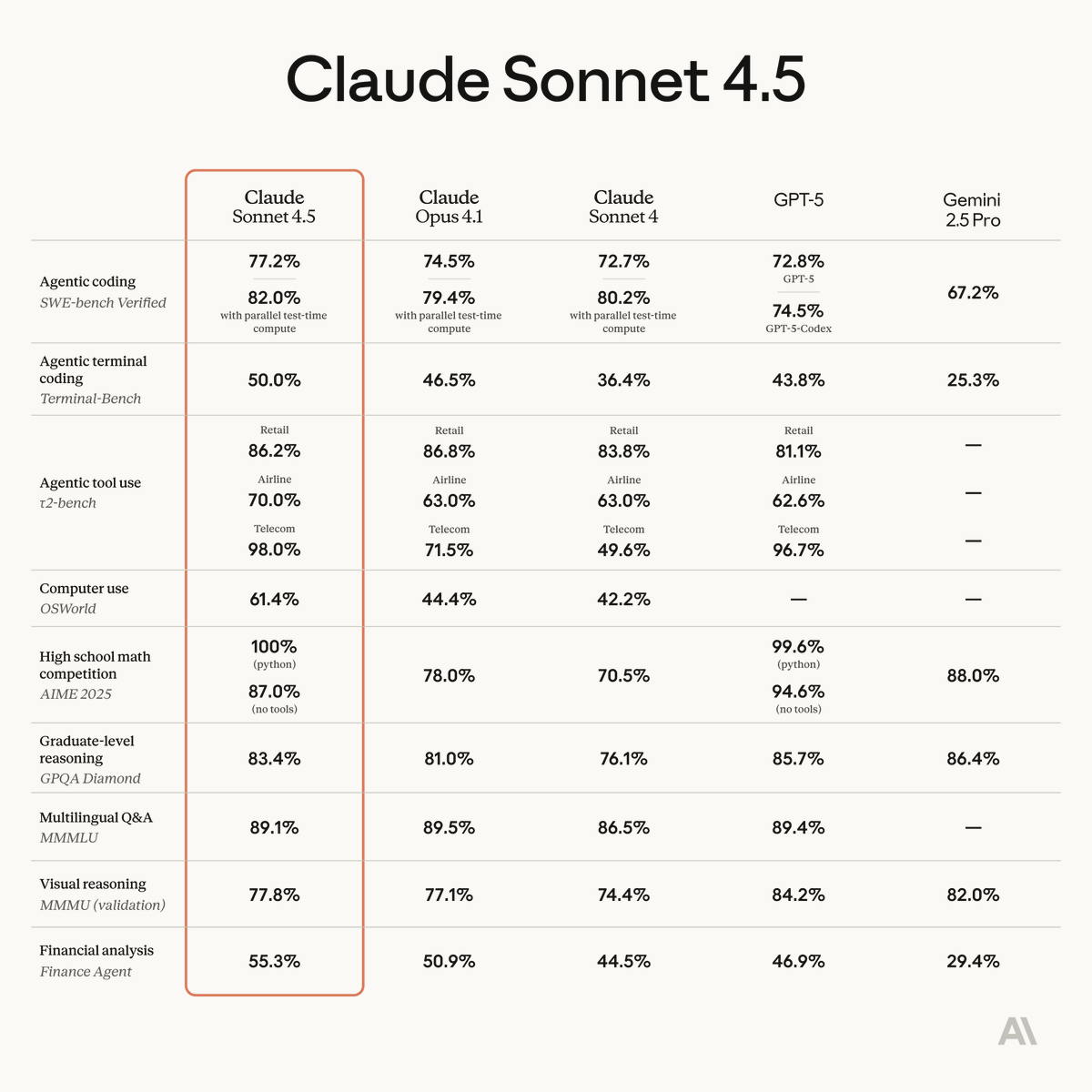
Introducing Claude Sonnet 4.5—the best coding model in the world.
It's the strongest model for building complex agents. It's the best model at using computers. And it shows substantial gains on tests of reasoning and math.
Watch this man demonstrate how long it would take to disassemble a rifle and place it in a backpack that it wouldn’t fit in.
Do you believe the official Tyler Robinson story?
Dr. Fishfinder’s Rules of Consequences
1. They do it because they can.
2. They do it because the consequences are acceptable.
3. When the consequences become unacceptable, the behavior will change.
4. Until the consequences become unacceptable, the behavior will continue.
Make.
The Consequences.
Unacceptable.
- Dr. Fishfinder
maybe not: ❌ CRITICAL: Backwards Compatibility Technical Debt
❌ JSON Serialization Anti-Pattern
❌ Property Aliasing Confusion
❌ MAJOR: Test Code in Production
❌ Static HttpClient Anti-Pattern
// RestApiDataSourceProvider:12
private static readonly HttpClient _httpClient = new();
Static HttpClient without proper configuration can cause DNS issues and resource leaks.
❌ EF Context State Management Issues
❌ Exception Swallowing
❌ String-Based Magic Values
❌ Mock Data in Production Code
// RestApiDataSourceProvider:116-128 - NOT REAL API CALLS!
};
❌ WeatherDataSourceProvider - Also Mock
// WeatherDataSourceProvider:88-102 - No real API calls!
❌ Interface Violation
❌ Fragile Path Extraction
❌ Incomplete Transformation Implementations
❌ Hard-coded Unit Conversions
I'm always starting new projects often times abandoning the last one, for various reasons.
I posit that in each case I learned the lesson I was there for and moved on. When a real solid idea comes, I think it'll stick.