🔥¡SORTEO TCGP!🔥
Premio: Hoopa Ex ⭐️⭐️ (ESP)
Para participar:
🥇Seguir a @TheMakyokyo
🥈Repostear este tweet
🥉Aceptar Disclaimers
Ganadores: Se anunciarán el Viernes 20/11
¡Suerte entrenadores! 😈
#PokemonTCGPocket
In NARUTO CARD GAME, there are 5 types of cards that you'll take to battle with you.
Master the use of Leaders, Characters, EX Character, Chakra, and Summon cards, hone your strategy, and strike when the time is right!
NARUTO CARD GAME Arriving in June 2027!
#NARUTO#NARUTOTCG
Chavales, empiezan HOY los clasificatorios. Primer torneo oficial de @origins_tcg. 10K$ prizepool con entrada GRATUITA.
El juego está GRATIS en steam, si venís de Snap o HS lo vais a entender todo enseguida y tenéis TODAS las cartas GRATIS.
Lo estoy stremeando todos los días.
We will showcase Origins during Steam Next Fest the coming week with:
• Ranked mode
• Exlusive rewards
• Our biggest tournament ever
What games are you looking forward to the most?
Over 1300 people have signed up to the Crimson Cup so far
Our biggest tournament yet is starting in one week together with Steam Next Fest and you can still register while we have leftover spots
Go here: https://t.co/Hrh6UIpTSK
In physical trading card games, the first print run of a set tends to separate from everything that follows. The difference is supply, and that’s been lost in digital TCGs.
How it typically goes:
1. New game launches
2. The publisher prints conservatively, because nobody knows whether the game will find an audience
3. Most of that first run gets opened, played with, damaged, or thrown away, because at the time it is simply a product rather than a collectible
4. If the game succeeds, later print runs are larger and are bought by people who already know the game matters
5. The first run was consumed. The later runs were preserved
The result is that first editions become scarce because they existed before anyone was paying attention.
Some examples: A 1999 Pokémon Base Set 1st Edition booster box retailed for somewhere around $100 to $120. Sealed examples have since sold in ranges reported from roughly $10,000 to over $250,000 depending on condition and auction.
A 1993 Magic Alpha booster box cost around $88 at retail. Sealed Alpha packs now reportedly trade in the $8,000 to $12,000 range.
Those outcomes took decades and depended on both games becoming enormous. They are not a formula.
What is portable from them is the structure. First print runs are consumed before the audience arrives and everything after that is produced for one that already exists.
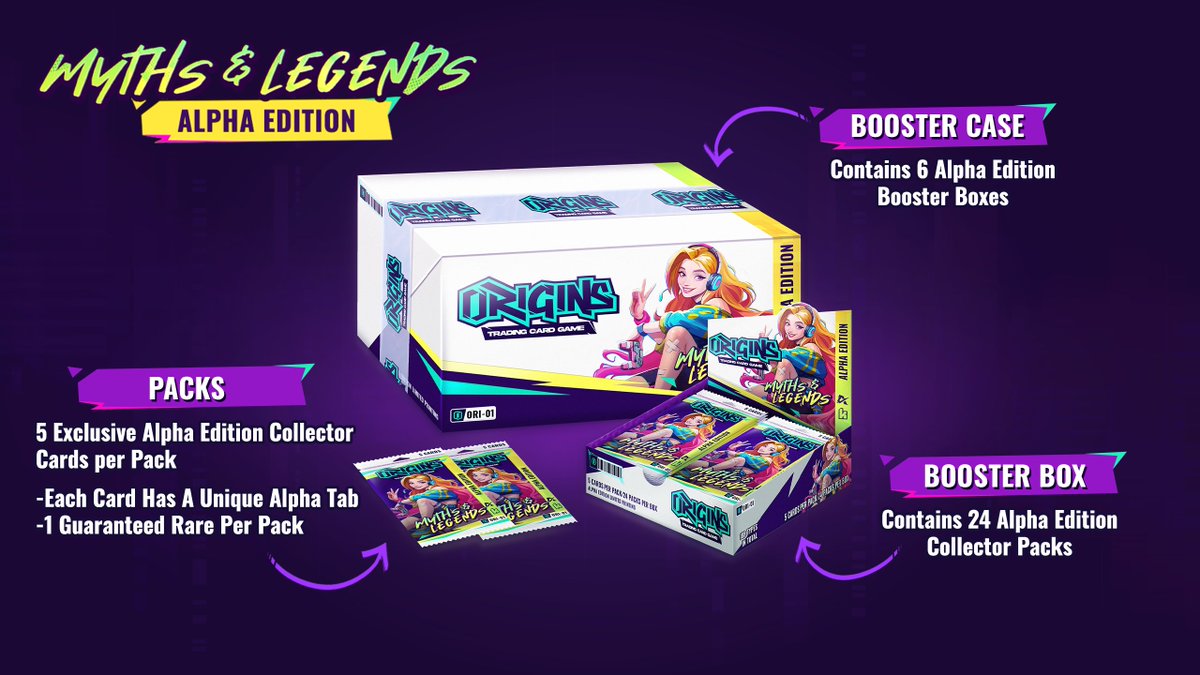
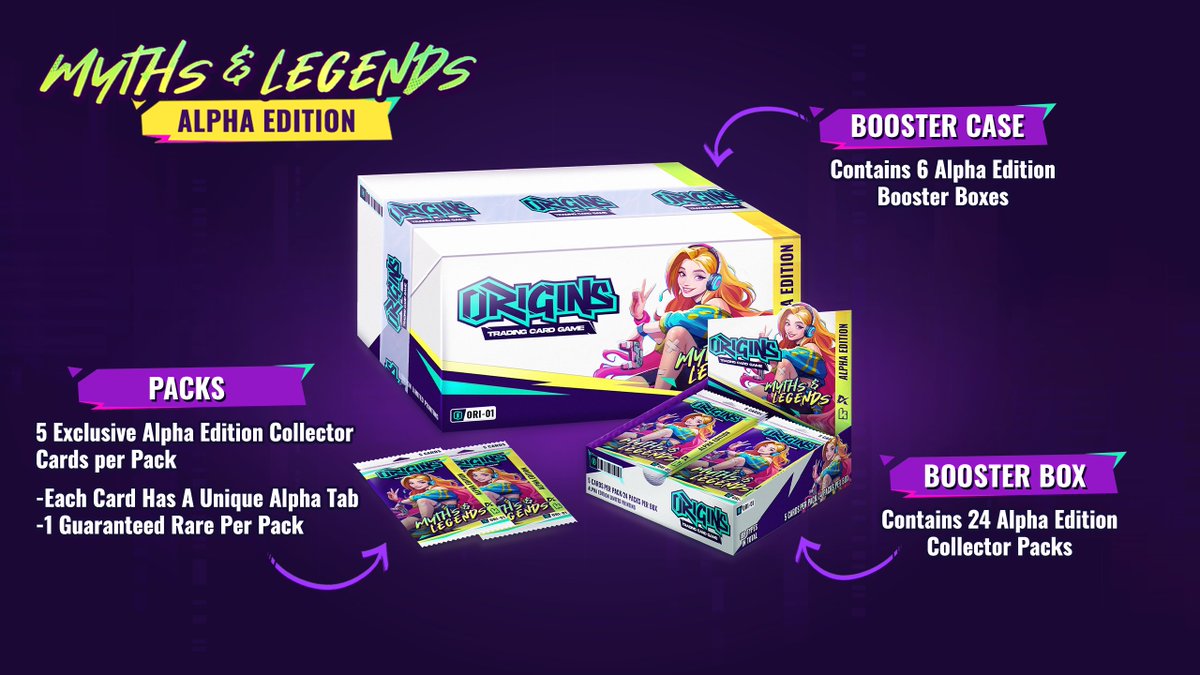
Origins Alpha Edition is built to be distinguishable on purpose. Every Alpha card will carry an Alpha tag on the card face. Alpha booster boxes and cases will only be available through the Kickstarter, and once that window closes, Origins will not produce more.
All of it will be tradable via Steam day 1.
That creates a defined supply.
What collectors do with a limited edition is determined by collectors, not by the company that printed it.
And that’s how it should be.
Origins is a digital trading card game, but its community should go far beyond that.
Local game stores play a huge role in building communities for traditional TCGs. They teach new players, organize regular and give collectors a place to meet people who care about the same game.
And local tournaments are often the place to win the coolest loot.
That's why we're building a program that supports local game shops for Origins:
Participating stores will be able to accept preorders for Origins collectible products and receive a share of the revenue. Because the cards, packs, boxes, and cases will exist as Steam inventory items, stores will not need to purchase stock, hold physical inventory, allocate shelf space, or handle fulfillment.
This means it costs literally $0 to be a part of the program, but you share the up-side just as much, if not more, than you would with a physical TCG.
In return, participating stores will host organized-play events. Origins will direct players toward those locations and support stores as local hubs for the game.
Some collectible rewards will only enter the ecosystem through these events.
Unique promo cards, along with special packs, will be earned by attending and competing at participating stores. Origins will not sell those tournament cards or place them in standard packs.
This program allows us to grow together with our community:
• Stores get to benefit from Origins set releases
• Players gain a recurring place to meet, learn, compete & win unique promos
• Origins develops an organized-play network that can grow from quarterly local events toward more frequent competition, regional events, and eventually a world championship structure
Origins is digital by design. Its community still deserves real places to gather.
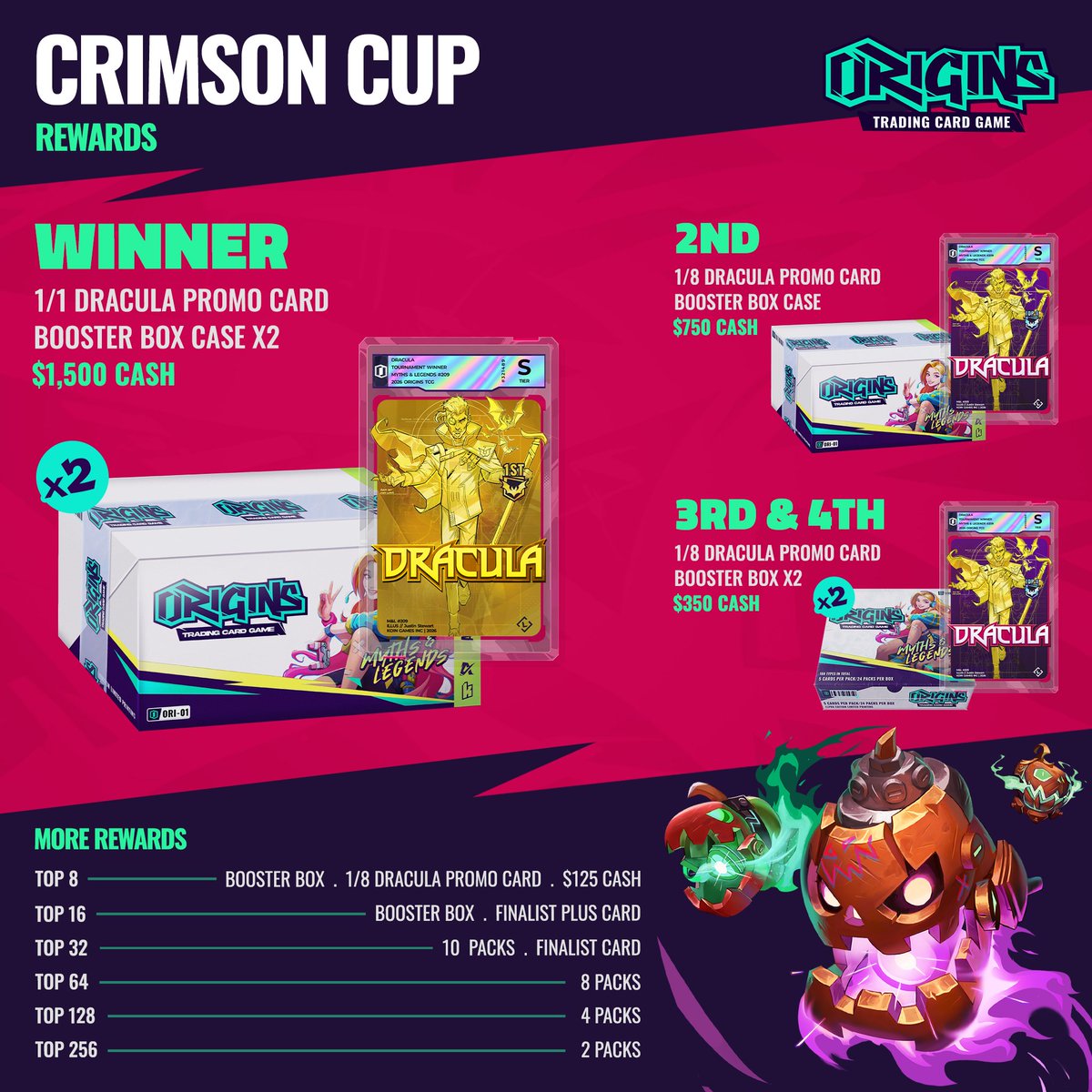
Announcing our biggest tournament ever: The Origins Crimson Cup with a $10k prize-pool
Win exclusive promo cards, booster boxes and cash prizes!
Sign up & more details below 👇👇
Announcing the official prizepool breakdown for the Origins TCG Crimson Cup
The pool consists of a split between prize money, collectibles and exclusive promo cards
The tournament starts with Steam Next Fest in two weeks!
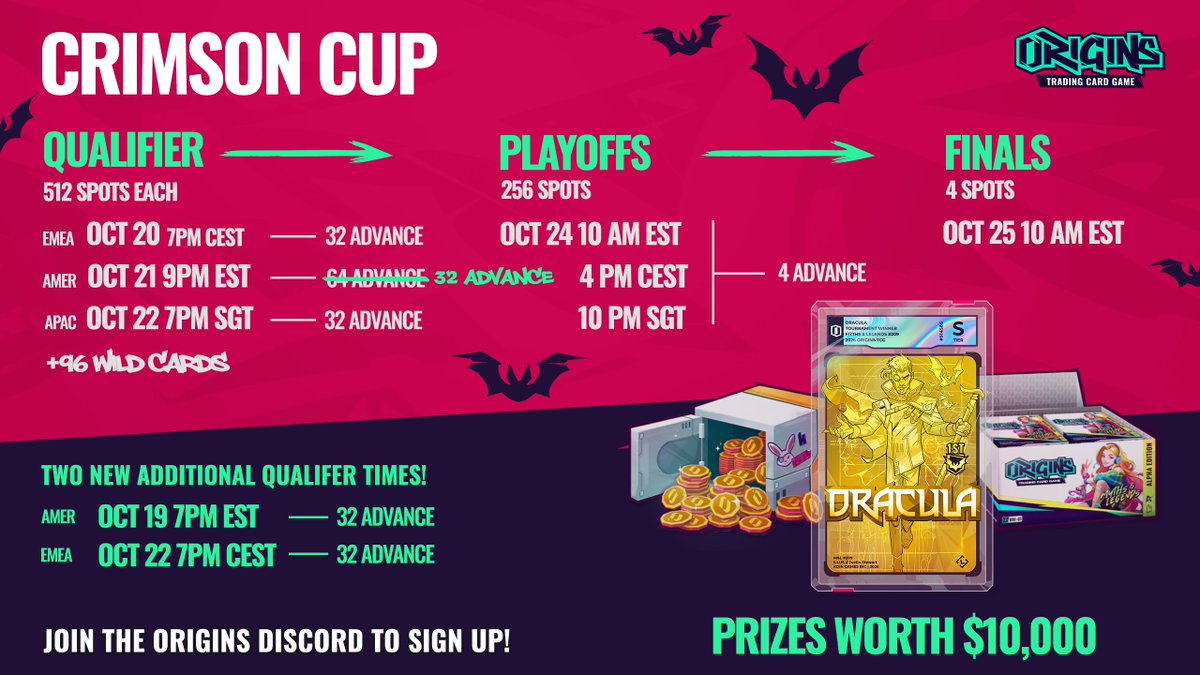
Important Crimson Cup announcement:
Due to popular demand we decided to add two more qualifiers and just announced the location pool for the tournament
Find all details and sign-up to the tournaments here: https://t.co/Hrh6UIpm3c
How do Origins TCG sets work?
As you know we're taking a lot of inspiration from other games for our economy. For set releases it's first and foremost physical TCGs.
- Sealed product
- Limited print runs
- Defined release periods
- LGS
Here's the details:
1. The Alpha Edition
The first Origins set is Myths and Legends, containing 218 characters. Its first-edition collectible release is Alpha Edition.
Alpha Edition will only be available through the Kickstarter. Every Alpha card will carry an Alpha tag on the card face so the edition remains identifiable forever. A character may appear again in a later set, but the Alpha Edition version and its Alpha tag will not.
Once the Alpha window closes, Origins will not issue additional Alpha cards, packs, booster boxes, or cases.
2. The collectible set cycle
Origins plans to release a new set every 3 to 4 months. Standard sets will have a 3-month sale window during which collectible cards and sealed products will be distributed through Origins, participating local game stores, and approved online partners.
Afterward, the only available copies will be the cards, packs, booster boxes, and cases already owned by collectors. Those items can be traded through the Steam Community Market.
3. Sealed supply
Packs, booster boxes, and cases will exist as individual Steam inventory items. Collectors can open them, trade them, or leave them sealed. Booster boxes and cases will only be available through preorder.
This allows sealed product to remain part of the collection instead of becoming a temporary purchase screen that disappears after opening.
4. What limited supply does and does not mean
Limited supply creates verifiable scarcity. It does not guarantee demand, market value, or price appreciation. All of these will be determined by collectors on the secondary market.
The limited supply also applies only to collectible versions. Every base gameplay card will remain free to every player, so an edition closing will never remove a card from the game.
5. How rarity is created
A collectible card can differ across several layers:
- Edition
- Rarity
- Grade
- Digital condition
- Promo status
These layers give our cards a lot of depth and allows us to make a particular collectible more specific without changing what the card does in a match.
6. How grading works
The contents of a sealed pack are determined before the pack is opened. When a collectible card is revealed, the system rolls its grade.
Grading is automatic, instant, and free. The card is evaluated across centering, corners, edges, and surface, with visible digital defects explaining the result. Grades range from 1 to 10, including half grades.
Because grade and card rarity are separate, two copies of the same card and art treatment can still be meaningfully different collectibles.
This is our approach to set releases. If you want to learn more join our community and make sure to try our demo on Steam!
Que una futura abogada haga esto es de terror. Como perdiste 7-1 y no tienes cómo rebatir con la Constitución en la mano, te dedicas a perfilar magistrados como si fueras policía política. El único que aplaudes es el que defendió tus intereses. Eso no es debate, es una intromisión inaceptable a la rama judicial; hacerle listas y señalamientos a los jueces que no fallan a tu favor debería costarte la tarjeta profesional antes de que te la den. Argumente en derecho, deje el chisme.
🚨 Las EPS repiten en bloque que la plata de la UPC no alcanza. Pero, ¿por qué recibiendo exactamente lo mismo, unas cumplen y otras no?
En "Finanzas de las EPS" desnudamos los balances reales y explicamos por qué el déficit es de gestión y no de tarifa.
1/3
El efecto tsunami: por qué cada intervención parece un fracaso
Hay un patrón que se repite consistentemente en las grandes intervenciones del sector salud colombiano desde Saludcoop hasta hoy, pasando por Cafesalud, Medimás, Caprecom y, más recientemente, Nueva EPS, Sanitas, Coosalud y Famisanar.
Antes de la intervención, los reportes muestran entidades con dificultades manejables. Después de la intervención, los hallazgos cuantifican deterioro masivo: pasivos que crecen exponencialmente, patrimonio que se desploma, indicadores que se hunden. La lectura mediática inmediata es siempre la misma: “la intervención destruyó a la EPS”. La conclusión política se vende sola: “la solución es menos Estado, no más Estado”.
Pero esa lectura presupone algo que la contabilidad no soporta: que el deterioro empieza con la intervención. La realidad es exactamente la contraria.
La intervención no genera el deterioro; lo revela. El deterioro ya existía, oculto, acumulándose por años, sostenido por reportes contables que no se cruzaban con la realidad económica subyacente.
Una EPS no intervenida tiene incentivos estructurales para reportar lo mejor posible. Subestima IBNR porque su cálculo es estadístico y discrecional. Mantiene activos a valor en libros aunque su valor recuperable sea inferior. No reconoce deudas hasta que el proveedor las exige formalmente. Glosa facturas en el extremo del rigor jurídicamente sostenible. Difiere reconocimiento de litigios. Estructura operaciones con vinculados que mejoran ratios sin generar valor económico real. Todo eso ocurre dentro de los márgenes que la flexibilidad contable permite. No es necesariamente fraude; es gestión agresiva del reporte.
Cuando llega el interventor, ese margen desaparece. El interventor tiene la obligación legal y reputacional opuesta: tiene que constituir provisiones por todo lo razonablemente probable, valorar activos al menor entre costo y valor recuperable, reconocer deudas pendientes incluso si están en disputa, recalcular IBNR con criterios actuariales conservadores, registrar contingencias jurídicas. La revelación contable se invierte 180 grados: pasa de optimizar imagen a expresar realidad económica. El efecto numérico es exactamente el que el público observa y malinterpreta: pasivos que crecen, patrimonio que cae, indicadores que se hunden. Pero no es destrucción de valor; es contabilización de una destrucción de valor que ya había ocurrido.
Un tsunami no se forma cuando golpea la costa. Se forma kilómetros mar adentro, durante minutos u horas en que la energía se acumula sin manifestarse en superficie. Cuando finalmente llega la ola, lo que aterra a quienes la ven no es la energía nueva: es la energía acumulada que de pronto se hace visible. La superficie del mar se veía tranquila cinco minutos antes.
La metáfora es exacta. Años de deterioro encubierto se reconocen contablemente en meses. La velocidad aparente del colapso es una ilusión óptica producida por el cambio del régimen de reporte. El colapso real es lento; el reconocimiento es rápido. Y la trampa argumentativa que esto habilita es perversa: cada intervención produce el mismo patrón contable, cada patrón se usa para deslegitimar la siguiente intervención, y la siguiente intervención llega más tarde, cuando el daño acumulado es aún mayor, lo que produce un colapso aparente todavía más espectacular, lo que refuerza el argumento original. El círculo se cierra solo.
Mientras menos se intervienen las EPS, más se acumula daño oculto. Cuando finalmente se interviene, el daño aparece de golpe. Y ese aparecer de golpe se usa para argumentar que no había que intervenir. Es una trampa diseñada estructuralmente para impedir cualquier corrección.
🇨🇴 GOLAZO Y LOCURA TOTAL. Luis Díaz marcó el 3-3 de #BayernMunich ante #RealMadrid, al 89’
👀 Es la sexta anotación del extremo en la temporada de Champions League