En el año 2000, unos obreros que retiraban una torre eléctrica cerca de Roma dieron con unos escalones que bajaban a una tumba romana sellada. Dentro, en el dedo de una mujer, un anillo de oro guardaba el rostro en 3D de un joven muerto hacía 1.900 años. Tira del hilo 🧵👇🏽👇🏽👇🏽
Nathalie Denolf, de Alemania, es una cetrera profesional y conservacionista que cuenta con aves rapaces, buitres y búhos muy poco comunes.
Aquí muestra cómo Oropherion, un macho de águila marcial, se muestra protector con ella. Esta enorme águila permanece inseparable de ella, ya que ambos cazan y pasan tiempo juntos.
Se trata de un águila de trabajo, entrenada para participar en competiciones de caza en Europa y los Emiratos Árabes Unidos.
Ambos son magníficos 🦅😍
En las islas Farasán, en Arabia Saudí, existe un fuerte romano. Quizá el más lejano del Imperio. Hace poco se excavó y las arqueólogas se llevaron una sorpresa: las ollas que se usaban para preparar el rancho de los legionarios venían de Eritrea.->
Me despido hasta el mediodia.
Benji estaba desconectado, no percibía nada, totalmente ciego y sordo, hasta que llegó el aroma de su humano favorito, quién fue a su rescate.
MiniEspín.
Khalsi, au nord-ouest de l’Inde. Dans ce petit village niché au pied de l’Himalaya, l’archéologue britannique Alexander Cunningham découvre en 1850 un rocher gravé où l’empereur Ashoka diffuse sa vision du Dharma en nommant tous les rois grecs de son temps. À dérouler 🧶
On 11 May, 330, the sun, rising behind the Asian hills across the Bosporos, shone for the last time on the ancient city of Byzantion.
On that day, the Emperor Constantine rededicated the city to himself and to the Fortune of Rome. Henceforth, Byzantion became Costantinople and, as New Rome, it would change the course of history.
Costantinople was created between 320 and 324 through a series of arcane Roman rites.
There was a " limitatio ", when Constantine delineated the walls in the ground with a spear; the " inauguratio ", when the omens were taken and an horoscope cast; and finally the " consecratio" and " dedicatio " of 11 May 330, when the City was endowed with its new identity. Experts in the traditional cult ensured that the rites were performed properly and the emperor made a bloodless sacrifice, one appropriate for a Christian, that bound the City to its new names. The focal point of its new destiny was the emperor's column and statue, but the City also featured traditional centers of Roman religion: a Capitolium and temples to Kybele and the Tyche ( or Fortune ) of New Rome. If Christian thinkers struggled to discern the emperor's Christian beliefs in all this, or averted their gaze from the naked paganism, ordinary Christians did what Romans had always done before the imperial images: " they propitiated with sacrifices the image of Constantine standing on the porphyry column, honored him with lamps and incense, and prayed to it as a god.
Costantinople began as a Roman Imperial foundation, not a Christian capital, a concept did not yet exist.
After the forum rites of 11 May, the imperial procession moved along the Mese ( City's main boulevard) toward the Augustaion, the open square before the palace named for emperor's mother, the Augusta Helena, whose statue stood there. To the left was the Golden Milestone, or Milion, a massive tetrapylon ( four piers joined by arches supporting a domed roof.) Like its equivalent column in Rome, the Milion served a symbolic zero point for measuring distances from Costantinople, the new center of the eastern empire.
Behind it, to the north, the Basilica ( " Royal ") Stoa, a colonnaded countryard that hosted twin shrines for the godess Rome and the Tyche of Costantinople, who was depicted on coins as a enthroned matron with a crown of walls. Panning clockwise around the square, the procession saw the foundation of the church of Hagia Sophia, whose construction had just begun; the entrance to the palace and a second Senate House; the Zeuxippos baths, a complex that would hold a collection of over eighty statues, many of heroes and scenes from the Trojan War; and finally, to their right, the hippodrome. This was the monumental core of New Rome, the nexus of imperial , spiritual, and popular power.
The day's events concluded with chariot races in the hippodrome, where the emperor appeared before the people wearing his new diadem set with precious stones. This was an innovation in imperial regalia, but otherwise the procession before the games, or " pompa circensis " was a venerable part of Roman traditional. Chariot races featuring the Blue, Green, Red, and White teams were centuries-old at Rome and would continue for another nine hundred years at New Rome, until 1204, making them the longest-lived sporting events in world history ( the hippodrome would be the stage on which regimes would have been made and unmade.)
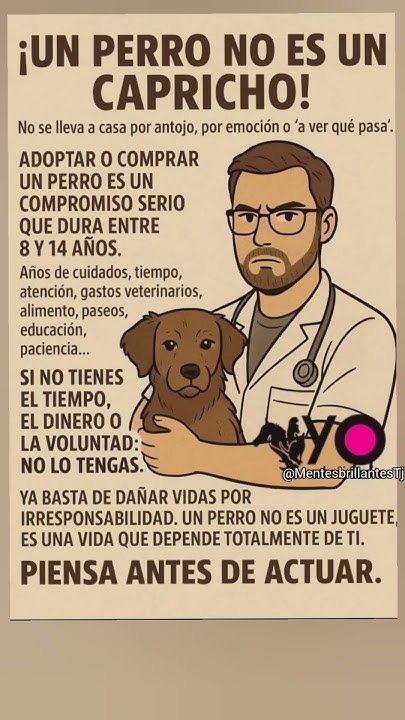
La responsabilidad del Amor
No adoptes por llenar un vacío que no sabes cuidar.
Un perro no es una pausa en tu soledad,
es un capítulo completo que exige amor, constancia y verdad.
No es un accesorio para tus días felices
ni un entretenimiento para tus tardes vacías.
Es un ser que aprenderá a esperarte,
a leerte con los ojos,
a sentir tu tristeza antes de que hables.
Cada vez que su plato esté vacío,
esperará que seas tú quien lo llene.
Cada vez que tiemble por miedo,
esperará que seas tú quien lo abrace.
Y cuando su cuerpo envejezca,
esperará que seas tú quien no lo abandone.
Si no puedes prometerle todo eso,
no le robes el derecho de encontrar a quien sí pueda.
Porque un perro no pide lujo,
solo pide que seas su hogar hasta el último latido.
Prometerle la vida es cumplirla entera.
"Pipo":
Porque un hombre se volvió viral por festejarle el cumpleaños número 14 a su perro Pipo: “Catorce años donde lloramos, reímos, nos abrazamos, charlamos, ganamos pero muchas veces perdimos, nunca nos abandonamos…”
La mayoría del tiempo, los perritos mueren antes de los humanos, pero antes de hacerlo, viven…
Viven vidas valientes y hermosas. Protegen a sus familias con una lealtad inquebrantable. Nos aman con una ferocidad que no conoce límites. Llenan nuestros días de alegría, nuestros hogares de calidez y nuestros corazones de luz.
Los perritos no pierden tiempo preocupándose por el mañana. Viven plenamente en el momento, persiguiendo pelotas, durmiendo en rayos de sol y moviendo la cola al simple sonido de nuestras voces. Nos enseñan a amar sin condiciones y a encontrar la felicidad en las pequeñas cosas.
Así que sí, los perros mueren. Pero antes de hacerlo, nos dan todo lo que tienen. Y por eso su amor permanece con nosotros mucho después de que se han ido.
Brindemos por los perros que viven valientemente, aman profundamente y dejan huellas de patas en nuestros corazones para siempre. 🐾💖