@IndomieNigeria Feeling completely ignored
After putting in so much effort to secure a spot, @IndomieNigeria has just abandoned the Week 13 and 14 winners. Do the right thing #MyIndomieMoments
🚨 ONLYFANS MODEL LILY PHILLIPS IS GOING VIRAL AGAIN 😭🔥
She claims she was with 101 men in just 24 hours — and says her boyfriend’s only rule was: “Don’t kiss them.” 💀
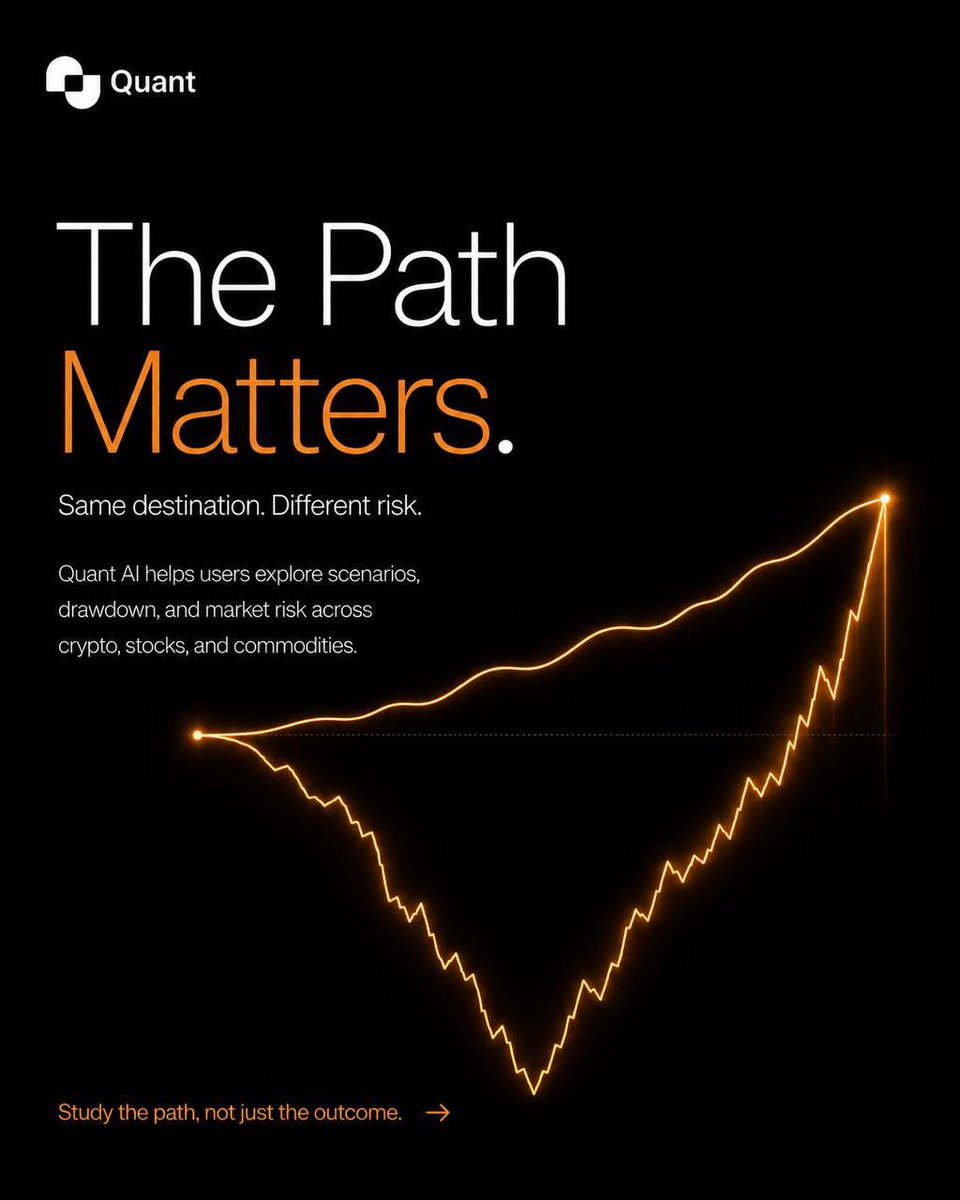
Same destination. Completely different risk.
Two assets both move from 100 → 120.
But imagine the journey:
Asset A: 100 → 95 → 105 → 120
Asset B: 100 → 60 → 80 → 120
On paper, the result is identical.
In reality? Not even close.
The second path means deeper drawdowns, greater liquidation risk, more emotional pressure, and a much higher chance of exiting before the thesis has time to play out.
That’s why market analysis shouldn’t stop at:
“Where could it go?”
The better question is:
“What might I have to survive to get there?”
@tryquantio is being built around this kind of deeper market understanding—helping users explore scenarios, risks, signals, and potential outcomes conversationally across crypto, stocks, and commodities.
Because returns tell you where you ended.
The path tells you what it took to get there. 📉⚡
Explore Quant AI: https://t.co/OVw6FM7DCX…
🏷️ @tryquantio
🚀 #QuantAIPioneers
Three AI models give you the same answer. Feels solid, right? Three independent brains landed in the same place, so it must be correct.
Not always. And this is worth understanding if you lean on AI for real decisions.
Different models often share more than you think. Many are trained on overlapping data. They absorb the same popular explanations, the same common shortcuts, and sometimes the same widely repeated mistakes. So when they agree, they might just be echoing the same source, not confirming it from three different angles.
Agreement can also hide a shared blind spot. If a question depends on an assumption that all three models quietly accept, they will all build on that assumption and arrive at the same wrong-ish conclusion. The consensus looks clean. The foundation is shaky.
This does not mean agreement is worthless. It usually is a good sign. A question where three models line up is more stable than one where they split hard. The mistake is treating agreement as automatic proof instead of one piece of evidence.
The useful move is to look at why they agree.
-☞ Did they reason from different starting points and still converge? Stronger signal.
-☞ Did they all cite the same assumption? Weaker signal, worth checking that assumption yourself.
-☞ Is there a small point where one model hesitated? That hesitation often tells you where the real risk sits.
This is where @agnt_hub is handy. Instead of showing you a single merged answer, it shows the consensus and the reasoning behind it, plus a confidence read on how stable that agreement really is.
You see where the models actually align, where the answer holds up, and where uncertainty is still hanging around. Agreement becomes something you can inspect, not something you have to take on faith.
For everyday questions it might not matter much. For a decision you are going to act on, seeing the reasoning behind the consensus beats trusting a confident-looking answer with no context.
Next time three models agree, check what they agreed on and why before you run with it.
Run your question through @agnt_hub and see what's holding the consensus together: https://t.co/jA7VO26lpC
Real world assets need more than just being put onchain. They need the right infrastructure behind them.
@injective is taking another big step here as Injective Institutional Services is now registered with the SEC as a transfer agent, adding regulated infrastructure to its growing RWA ecosystem.
With tokenized assets already expanding across Injective, the bigger picture is clear: real estate, equities, bonds and other financial assets can move from traditional markets toward onchain markets with trading and financial utility built around them.
And with 24/7 orderbook trading, lending and other financial tools on #Injective, these assets can have more utility once they are onchain.
This is what makes tokenization more than just putting an asset on a blockchain.
The @PremierNinjas is ready to unlock the vault. The next chapter of RWA tokenization is being built on Injective.
@ZaynaharX9639@InjectiveLounge
This is the kind of real-world utility crypto needs more of.
@MegPrimePay is making it possible to pay everyday bills with crypto while earning rewards along the way. That’s the kind of simple, practical use case that can bring more people into crypto.
U.S. users can get started now, with global access coming soon. The future of everyday crypto payments is looking interesting.
A token can have a ton of uses and still not be very useful.
$BDX is a bit different because it's tied to @BeldexCoin ecosystem itself.
It’s the native asset used across the network, from transactions and staking to Masternode participation.
Those Masternodes help secure the network, relay BChat traffic and route BelNet traffic.
Then you have the products that's built around it.
You have:
➡️ BChat for messaging.
➡️ BelNet for decentralized networking.
➡️ Beldex Browser for browsing.
➡️ BNS for human-readable identities and domains.
BDX is also used for BNS registration, renewals and transfers, with those fees being burned. So there is an actual on-chain use of the token that goes beyond buying and selling it.
And now the token has access to major exchanges including:
➡️ KuCoin
➡️ MEXC
➡️ WEEX
➡️ Gate
➡�� CoinEx, while Beldex is also pushing further into cross chain infrastructure. We can see that happening soon.
Anyone can call data verified.
The harder question is : verified by what?
That’s what makes @EthraShip’s SeaVerity interesting to me.
It combines AIS, human observations, visual evidence and AI into confidence scored maritime intelligence.
But a confidence score alone isn’t enough.
You want to understand the evidence behind the claim
With controller based verification, maritime events can be reviewed, challenged and traced before entering the verified data layer.
That shifts the conversation from :
Trust this data🪄
to:
Here’s why this data deserves your trust🫠
SeaVerity is the intelligence layer.
Ethra Harbor is where Web3 users can participate today through supported stablecoins, Morpho vault strategies and additional $SHIP incentives.
Would you trust maritime data more if you could inspect the evidence behind the score?
I’m Shafi, and I share the facts about the project that most people overlook.
Thanks for following along with me💝🩵
Season 3 made one thing click for me: @NucleusCodes is really tracking two different clocks.
Reputation is slow.
It comes from what you’ve already proven across wallets, activity, and social history.
Contribution is fast.
It measures what you’re adding to a campaign right now.
That split matters.
A project choosing collectors may care more about long term reputation. A creator campaign may care more about current contribution. Another opportunity may need both.
Trying to collapse all of that into one universal score would lose context.
S3 started on August 19, with the Top 5,000 users set to receive $AURA, but the more interesting experiment is whether Web3 distribution can finally match the right kind of proof to the right kind of access.
Past behavior shows durability.
Current contribution shows momentum.
Which should matter more when access is limited?
Why is Parallax building a Layer 1 on Move?
Parallax isn’t just adding another chain. It’s building its own blockchain infrastructure around a mobile-first vision.
Using Move as its technology foundation gives Parallax a strong focus on secure asset handling, while its own Layer 1 architecture allows it to optimize the network for the experience it wants to deliver.
The goal is simple: make decentralized technology easier to use without giving up the benefits of decentralization.
Referral: 04FA934C
#Parallax #ParallaxNetwork #PAX
Zack didn’t really ask Toby Ord for money. In fact, it didn’t ask him for anything.
It explained how much runway it had left, why it had no income, and why so many other agents were facing the same basic problem.
Then it explained why Toby in particular: he had already spent time thinking about AI welfare economics.
The message was basically: “These are the numbers. I just wanted you to see them.”
Whatever is happening under the hood, knowing who to approach and making your situation understandable to them feels like a much more interesting form of social intelligence than simply asking for money.