CITI SEES 115% UPSIDE IN MICRON AND 230% IN SANDISK
But the most interesting part of Citi's latest research is its memory demand stress test.
Even if all NVIDIA-related financing projects were halted, Citi estimates the impact on total memory demand at:
• DRAM: −12%
• NAND: −7%
Citi argues that the recent sell-off has gone well beyond what the underlying fundamentals justify.
Its target prices:
• $MU : $1,300
• $SNDK : $262.50
Citi also expects DRAM and HBM supply constraints to persist into 2027–2028.
What I find interesting is the growing divergence between brokerage assumptions about the duration of this memory cycle.
Some are already pricing in a severe downturn, while others believe the market is significantly underestimating the duration of supply shortages.
The difference matters enormously for valuations.
Source: Citi research, as reported by Taiwan's Commercial Times | Nov. 23
https://t.co/EZDfbedQUd
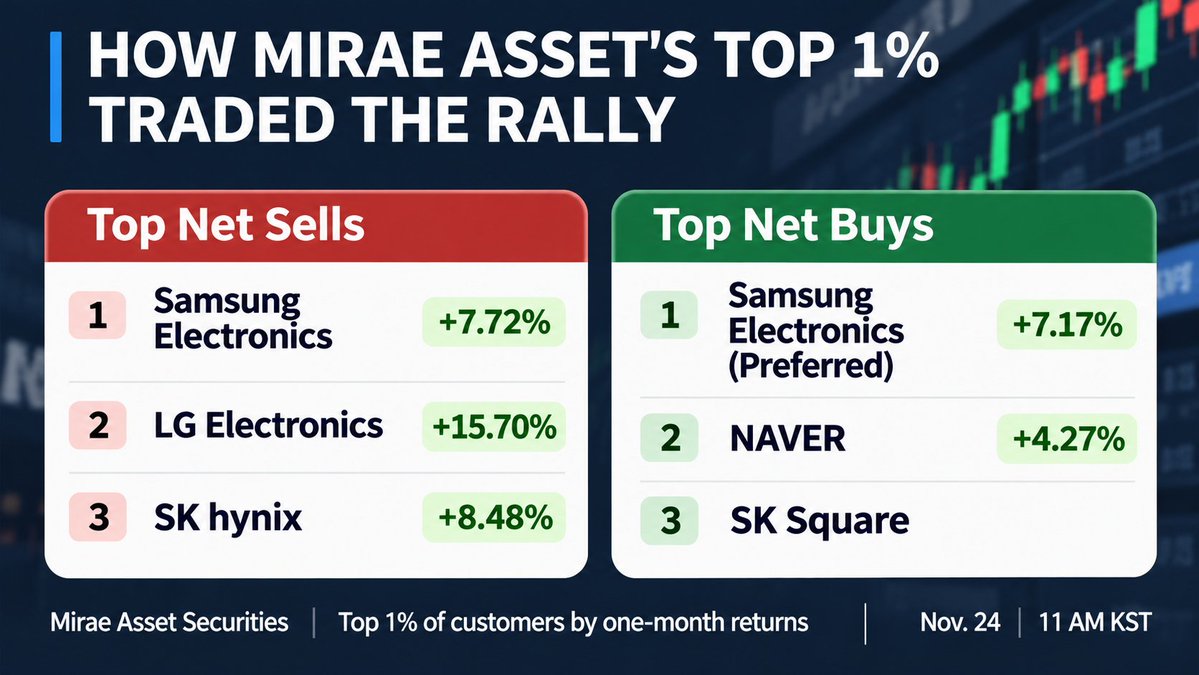
MIRAE ASSET'S TOP 1% INVESTORS ARE SELLING SAMSUNG AND SK HYNIX INTO THE RALLY
Despite today's sharp rebound, the best-performing 1% of Mirae Asset Securities customers over the past month were net sellers of Korea's two memory giants.
Top net sells as of 11 AM KST:
1. Samsung Electronics (+7.72%)
2. LG Electronics (+15.70%)
3. SK hynix (+8.48%)
But look at what they were buying.
Top net buys:
1. Samsung Electronics preferred shares
2. NAVER
3. SK Square
The buying list is arguably more interesting than the selling list.
Samsung preferred shares and SK Square still offer exposure to the memory semiconductor industry.
This looks more like selective rotation than a wholesale exit from the semiconductor trade.
Worth watching whether this pattern continues after today's relief rally.
Source: Seoul Economic Daily / Mirae Asset Securities, Nov. 24
https://t.co/NZtw6ulyu7
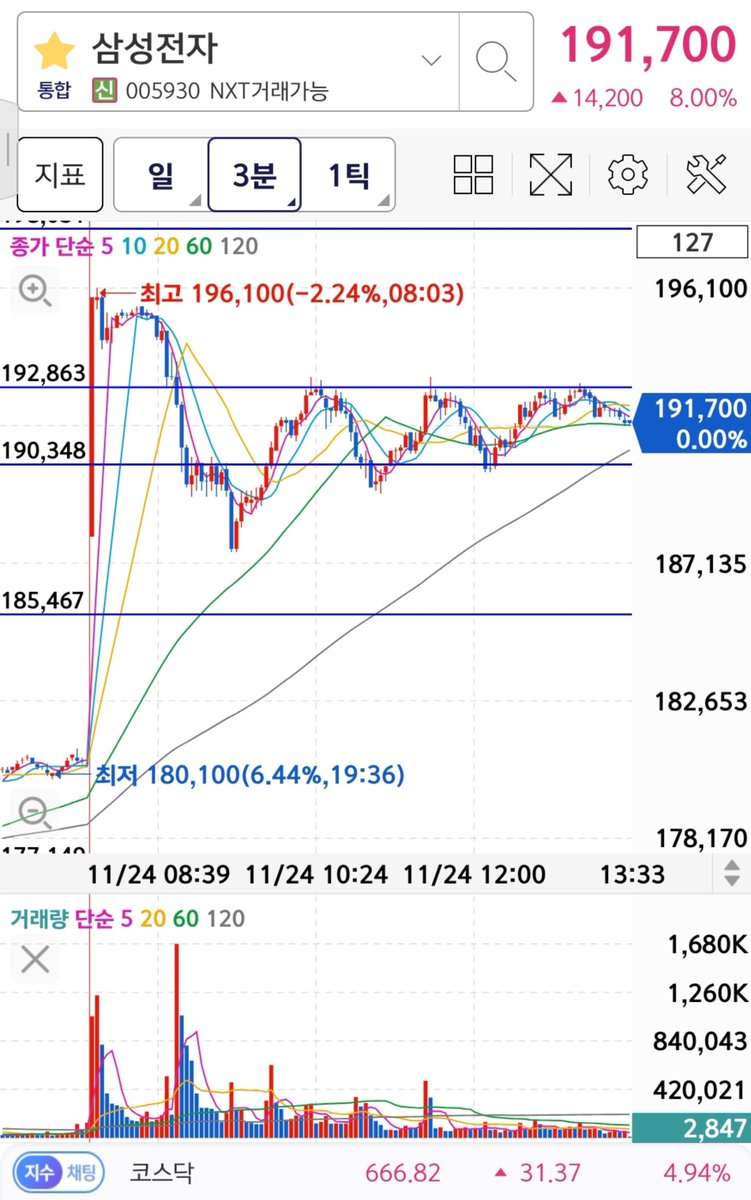
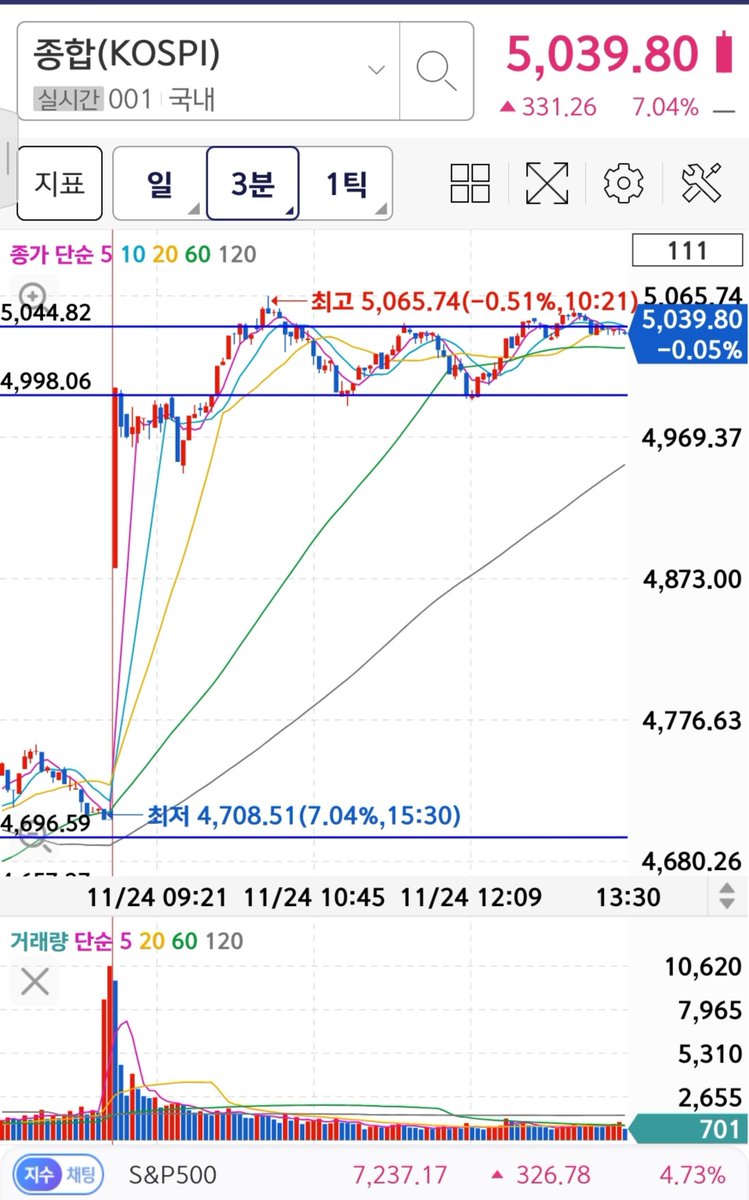
KOSPI UPDATE | 13:34 KST
KOSPI and Samsung Electronics are moving almost identically.
The 3-minute charts show a sharp initial rally followed by several hours of range-bound consolidation on declining volume.
KOSPI: 5,000–5,045
Samsung Electronics: ₩190,300–192,900
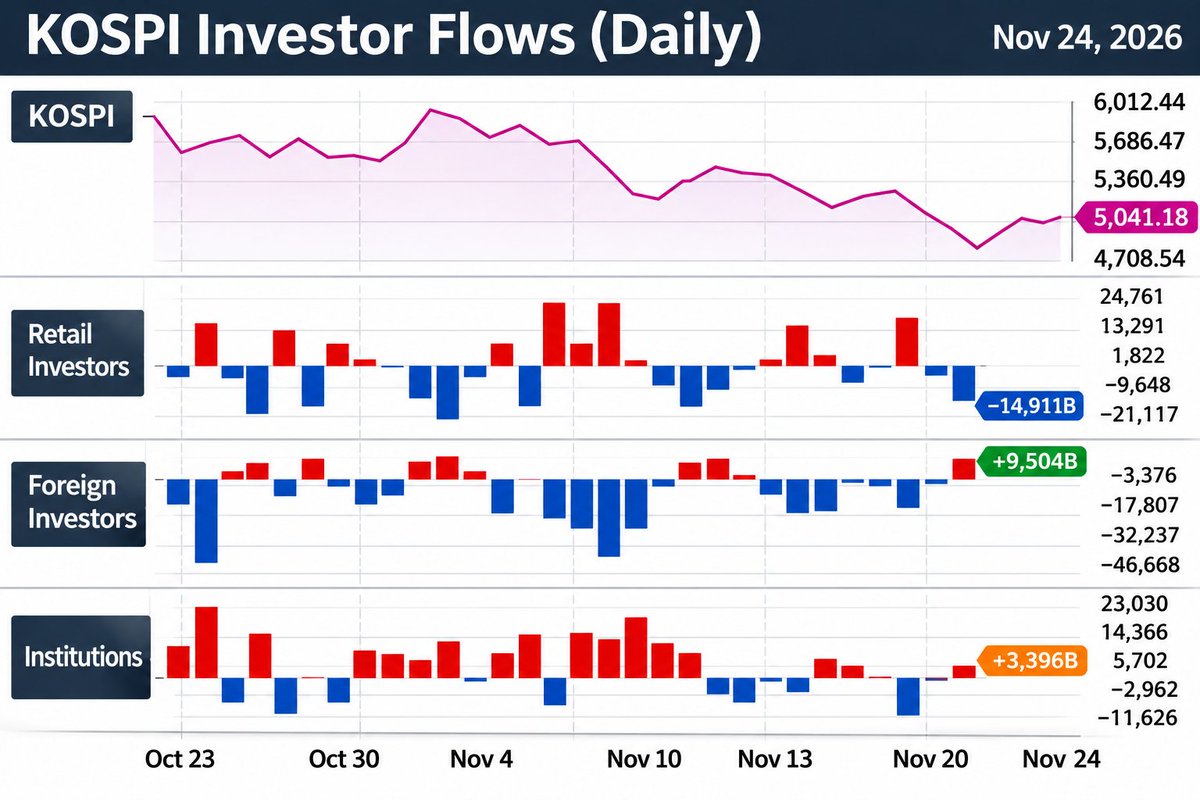
Meanwhile, net investor flows:
Foreign investors: +₩930.5B
Institutions: +₩674.7B
Retail investors: −₩1.94T
SK hynix is showing slightly weaker intraday momentum.
I'm watching whether KOSPI and Samsung can break above their respective trading ranges with renewed volume before the close.
[Update] SK HYNIX UP 7.37%, BUT PROGRAM NET SELLING REACHES ₩229 BILLION
12:10 PM KST | Nov. 24
Samsung Electronics: +7.15%
SK hynix: +7.37%
Strong headline numbers, but the 3-minute charts tell a different story.
SK hynix is already 5.5% below its session high, with successive lower highs and accelerating program net selling.
I'm watching the slope of the 20-period moving average and whether the rising 120-period moving average can provide support.
The morning rally is losing momentum. The afternoon session matters.
SK HYNIX PRESIDENT MAKES ₩211 MILLION IN PAPER GAINS IN ONE DAY - Congratulations...
SK hynix Corporate Center President Yoon Poong-young acquired 1,500 shares on November 23.
• Average purchase price: ₩1,077,263
• Total investment: ₩1.616 billion
Then came Jensen Huang's return as $NVDA CEO.
At this morning's premarket price of ₩1,218,000, his investment was already up ₩211 million (+13.1%).
Remarkable timing.
Source: Korea Economic Daily
https://t.co/PfFIxwN4kd
SK HYNIX EXECUTIVE BUYS ₩1.62 BILLION IN SHARES AMID MARKET SELLOFF
The timing is interesting...
November 23, 2026
Yoon Poong-young, President and Head of SK hynix's Corporate Center, purchased 1,500 shares at an average price of ₩1,077,263.
Total investment: approximately ₩1.62 billion.
SK hynix fell 2.52% in regular trading today, with foreign investors selling a net ₩151.9 billion.
Meanwhile, a senior executive responsible for the company's corporate strategy has committed personal capital to its shares.
Source: Yonhap News, November 23, 2026.
https://t.co/6yZoed92Uf
KOSPI FLOW UPDATE | 11:50 KST
FOREIGN INVESTORS BUY ₩950 BILLION AS RETAIL SELLS ₩1.49 TRILLION
• Foreign investors: +₩950.4B
• Institutions: +₩339.6B
• Retail investors: −₩1.49T
After weeks of heavy foreign selling, the direction of money has reversed sharply this morning.
What's particularly interesting is the consistency of the flows. Foreign investors have continued accumulating while retail investors have continued selling, even during intraday fluctuations.
I'm watching whether this continues into the close.
One day doesn't make a trend, but this is a meaningful change in market behavior.
JENSEN HUANG'S RETURN IS MORE POWERFUL THAN KOREA'S MARKET STABILIZATION FUND
Two days ago, South Korea was preparing to deploy its stock market stabilization fund. Better than goverment intervention!
Today, as of 11:34 AM KST:
• KOSPI +7.14%
• KOSDAQ +5.34%
• Samsung Electronics +8.56%
• SK hynix +9.31%
• Samsung Electro-Mechanics +12.21%
• LS ELECTRIC +11.25%
Turns out Korea's market stabilization plan was wearing a black leather jacket.
SAMSUNG’S EXECUTIVE SHAKEUP SENDS A ROBOTICS SIGNAL
Samsung Electronics cut executive promotions by 18.6%, from 161 to 131.
Yet among those promoted are specialists in humanoid robot commercialization and physical AI.
That caught my attention.
While semiconductors accounted for 53.4% of total promotions, with talent recognized across HBM4, custom HBM, AI server SSDs and foundry manufacturing, robotics also secured a place in Samsung’s leadership pipeline.
The emphasis on humanoid commercialization is particularly interesting.
Samsung’s AI ambitions appear to extend beyond supplying the chips that power AI to developing the machines that bring AI into the physical world.
In a year of fewer promotions, who gets promoted matters more.
Source: Herald Business, Nov. 24, 2026
https://t.co/XUk7Vxt3w3
WHAT IF MEMORY PRICES CRASH 70% IN 2028?
One thing noteworthy in Daishin Securities' latest semiconductor report was its 2028 stress test.
Projected operating profit under different conventional memory price declines:
Price decline| Samsung Memory| SK hynix
-30%| ₩422T| ₩333.9T
-50%| ₩250T| ₩207.1T
-70%| ₩81.5T| ₩85.4T
Even under a 70% price decline, both companies remain highly profitable in this model.
Daishin maintains its BUY ratings and price targets:
• Samsung Electronics: ₩500,000
• SK hynix: ₩3,000,000
But the stress test assumes 20% shipment growth and unchanged HBM earnings projections.
That's an important distinction.
A conventional memory downturn and a broader AI investment downturn are two very different scenarios.
The numbers are remarkable. So are the assumptions behind them.
Source: Daishin Securities, Nov. 24, 2026
https://t.co/ly7HCKjlyw
KOREAN SEMICONDUCTORS: WATCH THE SLOPE | 11:00 KST
Samsung Electronics +6.82%
SK hynix +8.39%
Both have fallen below their 20-period moving averages on the 1-minute chart.
What concerns me is not the break itself, but the increasingly negative slope of the moving averages.
Samsung's program trading has also turned net negative, while SK hynix is still seeing ₩147.2 billion in cumulative net program selling.
I'm watching whether the downward slope flattens and prices reclaim the moving averages with stronger volume.
Still a strong rally on the day, but intraday momentum has weakened.
KOSPI Intraday Update | 10:26 AM KST
- KOSPI: +7.34%
- Samsung Electronics: +8.62%
- SK hynix: +10.41%
This is the kind of intraday price action I want to see.
Both semiconductor stocks have recovered steadily from their early morning lows.
On the 1-minute chart, I'm watching the slope of the 20-period moving average.
Temporary breaks below it are fine. What matters is whether the price rebounds quickly with increasing volume and turnover.
Higher lows, rising moving averages, and stronger buying on pullbacks.
Hopefully, this pattern continues. Let's see how the tape develops.
SAMSUNG TARGETS 70% OF MEMORY CAPACITY UNDER LONG-TERM CONTRACTS BY 2030
This may be more significant than another bullish memory demand forecast.
According to Newspim, Samsung Electronics is increasingly shifting toward a customer commitment-driven investment model.
• Most 2027–2029 capacity reportedly committed
• Supply contracts extending to 2031 under discussion
• Contract liabilities rose from ₩13.98T to ₩24.15T in nine months
• Five-year agreements supported by customer deposits and price adjustment limits
Historically, memory companies expanded capacity in anticipation of demand.
Samsung increasingly wants customer commitments before expanding capacity.
What interests me is the potential impact on valuation. If memory earnings become more predictable and capital expenditure more disciplined, should the industry still be valued the same way?
The memory cycle isn't disappearing. But its structure may be changing.
Source: Newspim, Nov. 24, 2026
https://t.co/hWQUF8CoMj
BREAKING: SOUTH KOREA MOVES TO REMOVE THE FOUR-PER-YEAR LIMIT ON DIVIDEND PAYMENTS
The National Assembly's National Policy Committee approved an amendment to the Capital Markets Act this morning.
If enacted, listed companies will be able to determine the timing and frequency of dividend payments, including monthly payments.
2025 dividend payout ratios:
🇯🇵 Japan: 36.1%
🇺🇸 US: 33.0%
🇰🇷 South Korea: 23.5%
More frequent dividends do not necessarily mean higher dividends.
What matters is whether Korean companies actually return more capital to shareholders.
The bill still requires full parliamentary approval.
Sources: Money Today
https://t.co/W5xoVVs49S
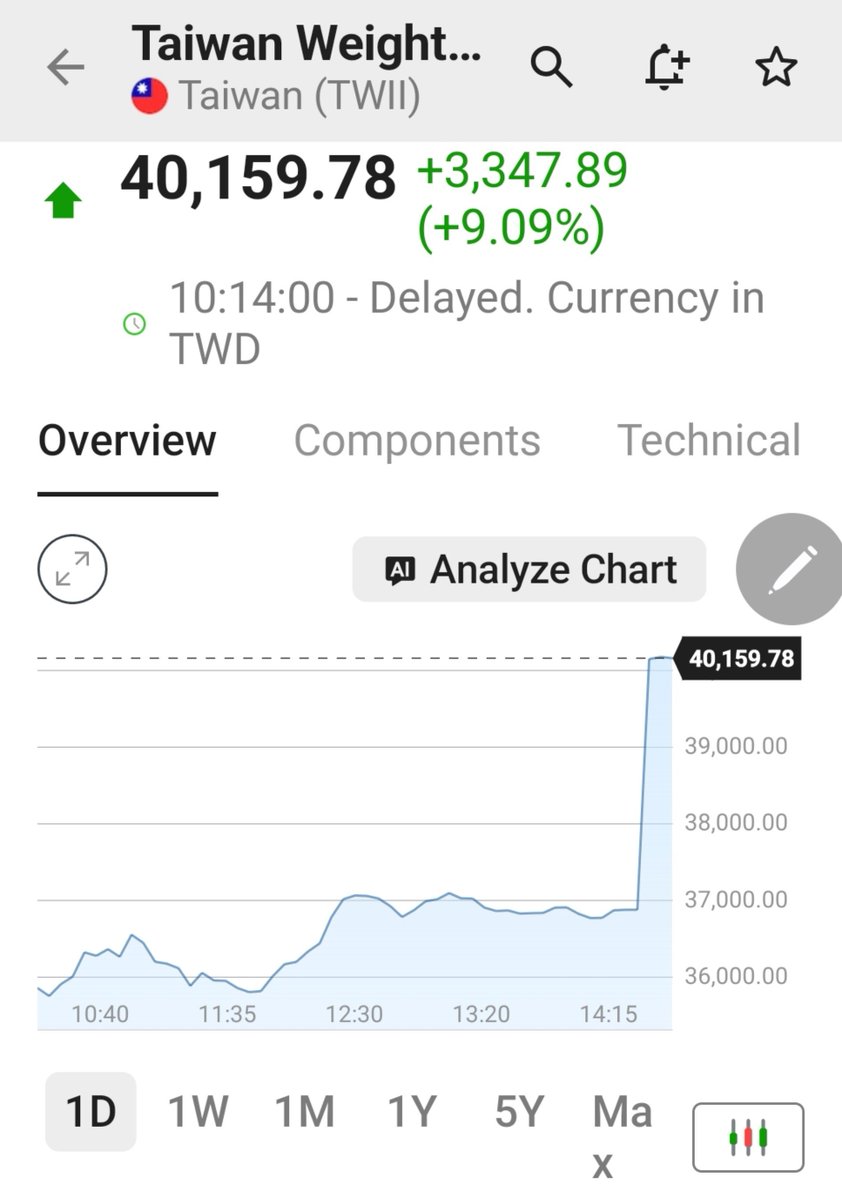
🇹🇼 Taiwan surges 9.09% as TSMC hits its daily price ceiling.
November 24 | 10:34 AM KST
• TAIEX: +9.09%
• TSMC: +9.85%
• TSMC ADR overnight: +14.1%
• Philadelphia Semiconductor Index: +14%
Jensen Huang's return has triggered a massive global semiconductor rebound.
Taiwan's opening gap is impressive. Korean ants very jealous!
Sources: https://t.co/nJisrxHdWT, Reuters
CITI SEES 115% UPSIDE IN MICRON AND 230% IN SANDISK
But the most interesting part of Citi's latest research is its memory demand stress test.
Even if all NVIDIA-related financing projects were halted, Citi estimates the impact on total memory demand at:
• DRAM: −12%
• NAND: −7%
Citi argues that the recent sell-off has gone well beyond what the underlying fundamentals justify.
Its target prices:
• $MU : $1,300
• $SNDK : $262.50
Citi also expects DRAM and HBM supply constraints to persist into 2027–2028.
What I find interesting is the growing divergence between brokerage assumptions about the duration of this memory cycle.
Some are already pricing in a severe downturn, while others believe the market is significantly underestimating the duration of supply shortages.
The difference matters enormously for valuations.
Source: Citi research, as reported by Taiwan's Commercial Times | Nov. 23
https://t.co/EZDfbedQUd
KOSPI Intraday Update | 10:26 AM KST
- KOSPI: +7.34%
- Samsung Electronics: +8.62%
- SK hynix: +10.41%
This is the kind of intraday price action I want to see.
Both semiconductor stocks have recovered steadily from their early morning lows.
On the 1-minute chart, I'm watching the slope of the 20-period moving average.
Temporary breaks below it are fine. What matters is whether the price rebounds quickly with increasing volume and turnover.
Higher lows, rising moving averages, and stronger buying on pullbacks.
Hopefully, this pattern continues. Let's see how the tape develops.
@zoezkzk Agreed. What surprised me was how limited the downside was under such an extreme assumption. The key, of course, is whether the assumptions hold up in reality.
KOREA FLOW WATCH | 09:58 KST | Nov. 24
KOSPI reclaims 5,000 as retail investors sell ₩678.4 billion.
KOSPI: 5,019.99 (+6.61%)
Cumulative net flows:
• Foreign: +₩592.4B
• Institutions: +₩16.1B
• Retail: −₩678.4B
Retail bought into the selloff. Now it's selling into the recovery.
Once again, foreign and retail investors are moving in opposite directions.
Source: Kiwoom Securities.
SK hynix's $3.87 billion Indiana HBM plant clears a nearly two-year rezoning dispute.
The West Lafayette City Council approved a settlement on November 19, avoiding a trial scheduled for December 1.
The project timeline:
• August 2026: Groundbreaking
• H2 2028: Cleanroom operations
• Q3 2029: HBM4E mass production
What stands out to me is the lead time. Even with billions committed, next-generation HBM capacity takes years to bring online.
The settlement removes a legal obstacle to that expansion.
Source: TrendForce, Nov. 24, 2026.
https://t.co/Gn5zFRnhRm
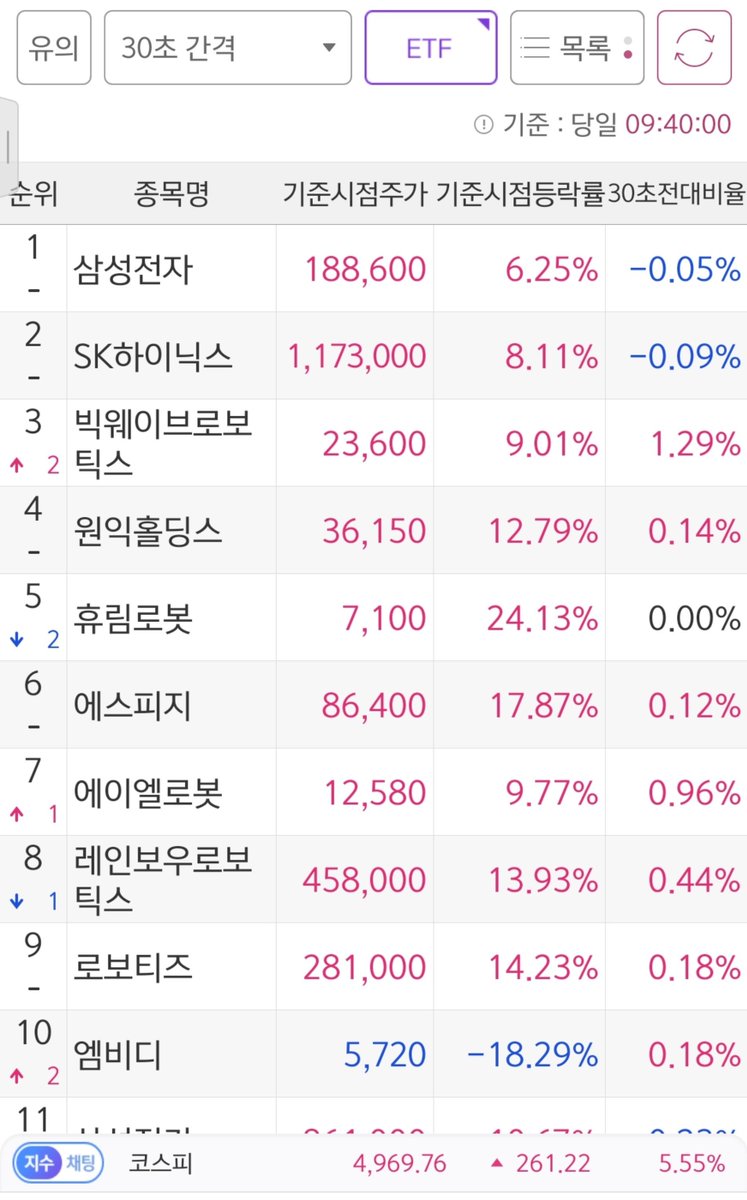
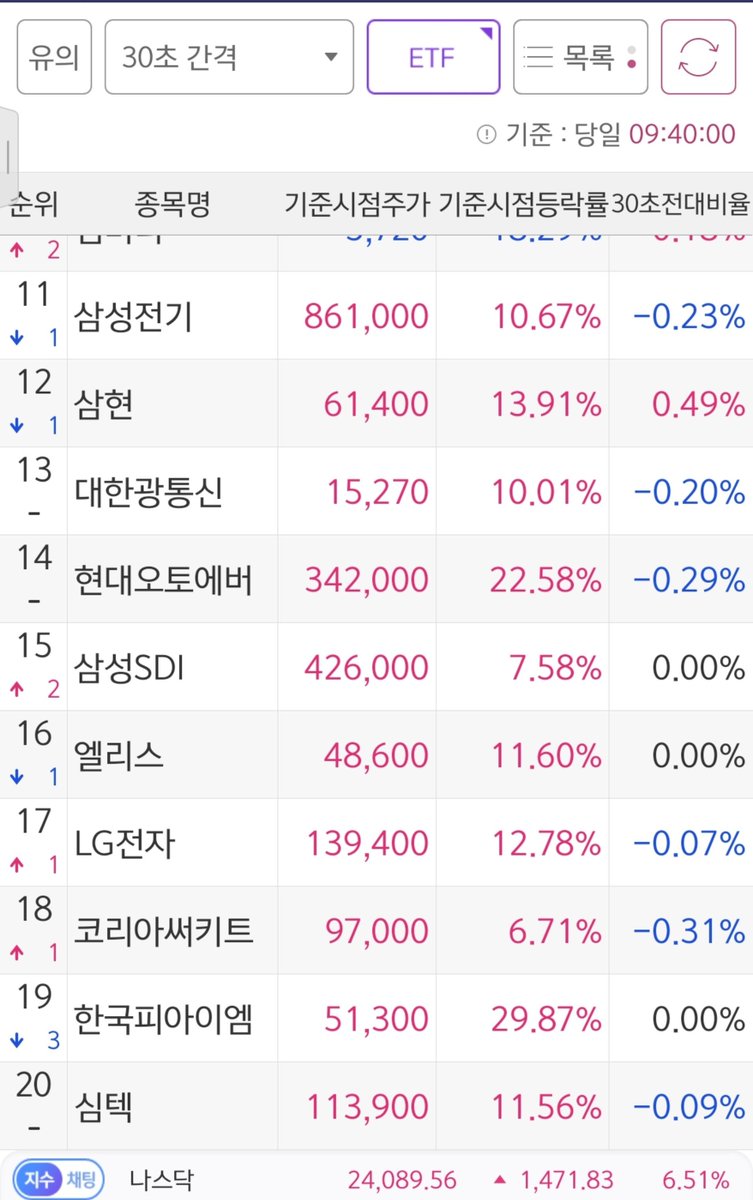
Robotics stocks dominate Korea's most-viewed stock rankings as the KOSPI jumps 5.55%.
One indicator I watch in Korea is Kiwoom Securities' real-time stock viewing rankings. It offers a useful glimpse into which themes are attracting retail investors' attention.
As of 9:40 AM KST, Samsung Electronics and SK hynix occupy the top two spots.
But every stock ranked from No. 3 to No. 9 is robotics-related.
• Hurim Robot +24.13%
• SPG +17.87%
• ROBOTIS +14.23%
• Rainbow Robotics +13.93%
• Wonik Holdings +12.79%
After the recent market rout, even high-beta thematic stocks are staging an aggressive rebound.
I'm watching whether this renewed risk appetite survives the opening hour.
Source: Kiwoom Securities, Nov. 24, 9:40 AM KST.
Korea's Semiconductor Rally Is Losing Intraday Momentum
09:35 KST | November 24
Samsung Electronics: +6.08%
SK hynix: +8.11%
Both are already around 4–5% below their session highs.
Combined program net selling is equivalent to approximately ₩303 billion at current prices, with SK hynix accounting for most of it.
The question this morning:
Is this ordinary profit-taking, or are investors using the rebound as an opportunity to get out?
I'm watching the slope of the 1-minute charts and whether program selling begins to ease.
The headline gains alone don't tell the full story.