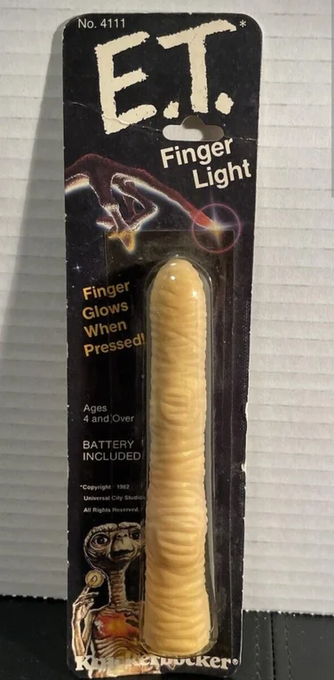
In the 80's Knickerbocker released an ET themed light up finger toy, the product was quickly removed from stores and discontinued just a few months later.
Moon Close-Ups That Will Blow Your Mind NASA’s Lunar Reconnaissance Orbiter (LRO) keeps delivering some of the most jaw-dropping, high-resolution views of our Moon — and the latest releases are next-level.Check out the dramatic Posidonius Y crater: a fresh impact scar where an asteroid or comet slammed into the lunar surface at hypervelocity. The result? A rugged, blocky rim packed with massive boulders — some the size of buildings — blasted out from deep underground with insane force.And that’s not all. LRO is also serving up stunning images of craters caught right along the terminator — that razor-sharp line between lunar day and night — where long shadows dramatically highlight every ridge, cliff, and crater wall.These images aren’t just beautiful — they’re scientific gold, revealing the Moon’s violent impact history in incredible detail.
God almighty. This looks and sounds like a straight up Reno 911 skit.
Houston.... what are ya'll doing in these streets playing with dirty underwear 🤨😂
Doctors are warning about a dangerous online trend called “ballmaxxing” where men inject saline or surgical lubricants into their testicles to temporarily enlarge them
Experts say the practice can cause infections, nerve damage and even permanent testicular damage
Did you know Earth doesn't just spin — it wobbles like a cosmic top?What you're witnessing in diagrams of this phenomenon is one of the most mesmerizing yet subtle dances of our planet: axial precession — a slow, majestic gyration of Earth's rotational axis that completes a full circle roughly every 26,000 years (precisely around 25,772 years according to modern astronomical measurements). At first glance, Earth feels rock-steady: spinning once a day, orbiting the Sun once a year. But zoom out over millennia, and its 23.5° axial tilt traces out a vast, invisible cone in space — exactly like a spinning top that's starting to slow and wobble before it topples (though Earth won't topple; this is a stable, ongoing process driven by gravity).
Let's unpack the magic step by step:23.5° Axial Tilt (Obliquity) → This fixed angle (varying only slightly over longer cycles) gifts us our seasons. Without it, every latitude would experience monotonous, unchanging weather year-round — no dramatic summers or winters!
The ~26,000-Year Precession Cycle → Earth's bulging equator feels gentle gravitational tugs from the Sun and Moon, causing the axis to slowly pivot. Today, the North Celestial Pole points almost directly at Polaris (the current North Star in Ursa Minor). But rewind ~5,000 years to ancient Egypt, and Thuban in Draco reigned as pole star. Fast-forward ~12,000 years from now, and the dazzling Vega in Lyra will shine near the pole — far brighter than Polaris ever does!
Celestial Poles on the Move → Earth's geographic poles (the physical North and South Poles on the surface) stay put relative to the planet. But the celestial poles — where the axis pierces the imaginary celestial sphere — drift in slow circles against the backdrop of stars. This shifts which star claims the title of "North Star" over deep time.
Ecliptic, Equator, and Tropics → The plane of Earth's orbit (the ecliptic) intersects the celestial equator at shifting points, defining the Tropic of Cancer and Tropic of Capricorn — the northernmost and southernmost latitudes where the Sun can appear directly overhead at solstice.
Why does this epic slow-motion wobble actually matter?It plays a starring role in Milankovitch cycles, the trio of orbital variations (eccentricity, obliquity, and precession) that pace Earth's long-term climate rhythms. Precession tweaks which hemisphere gets peak summer sunlight when Earth is closest to (or farthest from) the Sun, subtly amplifying or dampening seasonal extremes over tens of thousands of years — helping trigger ice ages and interglacial warm https://t.co/sT5jtVkoWD also reshapes ancient skywatching: civilizations aligned monuments and calendars to shifting stars. And for modern astronomers and navigators, it demands constant updates to star charts and celestial https://t.co/jAImLVhBsj short, Earth isn't a static ball — it's a dynamic, ever-evolving world in a grand gravitational ballet. Next time you gaze at Polaris twinkling overhead, smile: it's only our North Star for now. In the grand cosmic timeline, the night sky itself is slowly rewriting its own story.
Javier Bardem tried to reject the role in No Country for Old Men (2007), Bardem told the Coens, "I don't drive, I speak bad English and I hate violence". The Coen brothers hired him saying, that those were the exact reasons he was perfect.
J.K. Simmons actually slapped Miles Teller during the "Not my tempo" scene in Whiplash (2014). After several takes of miming it, the two agreed to do a real slap to get the visceral, shocked reaction seen in the final 2014 cut.