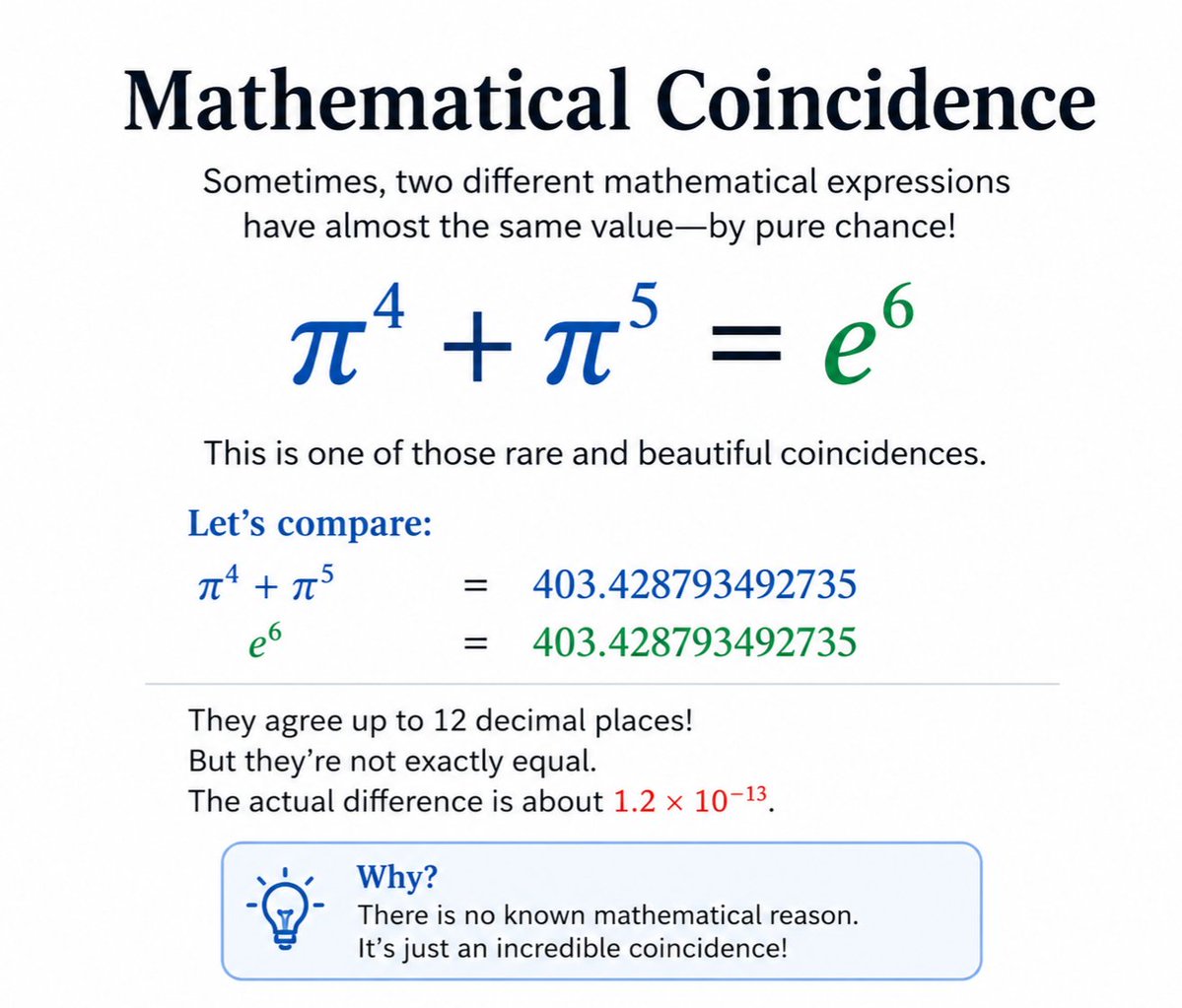
A mathematical coincidence occurs when two mathematical expressions are nearly equal, despite having no known theoretical explanation for their close agreement.
On this day June 19, 1623 – Blaise Pascal is born in Clermont-Ferrand, France.
A child prodigy, Pascal invented the Pascaline, one of the earliest mechanical calculators. He designed it to assist his father with tax calculations.
He made major contributions to projective geometry, probability theory; including work related to Pascal’s triangle and expected value; and hydrostatics with Pascal’s law on pressure in fluids.
Pascal also helped develop early ideas in calculus and combinatorics.
In later years he focused on philosophy and religion, authoring Pensées and formulating Pascal’s Wager.
Unlock the language of algebra with these core symbols.
From equal by definition and function composition to discriminants, inner products, and matrix inverses; everything you need for equations, proofs, and higher math in one clear layout.
These symbols are used daily by engineers designing circuits, data scientists building machine learning models, and physicists describing motion and forces.
Fibonacci numbers appear in circle diagrams that demonstrate their additive structure.
Each entry pairs the number with overlapping circle chains on the left, built from single and double clusters that sum to the value, and concentric circle layers on the right equaling the same count.
The chains develop recursively by combining elements from earlier entries, consistent with the sequence's core relation.
It is used to demonstrate recursive addition and pattern recognition in math education through geometric visualization.
Toroidal geometry places origin O at its center with major radius R to the tube axis and minor radius r setting the tube size.
Upper view marks these radii, angle α, and unit normal vector n_k hat. Central panel shows the gridded torus surface with red and blue winding curves near M1 and M2. Lower view projects the curves onto coordinates with x directed left, z up, y down.
It models closed field lines in toroidal magnetic confinement devices for fusion research.
Vector calculus operators link scalar and vector fields through precise transformations.
> Gradient of scalar φ yields ∇φ = (∂φ/∂x)i + (∂φ/∂y)j + (∂φ/∂z)k.
> Divergence of vector A computes ∇ · A = ∂A1/∂x + ∂A2/∂y + ∂A3/∂z.
> Curl of A gives ∇ × A = (∂A3/∂y − ∂A2/∂z)i + (∂A1/∂z − ∂A3/∂x)j + (∂A2/∂x − ∂A1/∂y)k, with the diagram showing scalar-to-vector mappings.
These operators are used to calculate magnetic fields generated by electric currents in motor design.
Drop the word for "mathematics" in your language below!
Proof that European languages love unity... except for Dutch, which chose absolute chaos with wiskunde.
A precise algebraic equation defines a heart-shaped surface in three-dimensional space.
The surface consists of all points satisfying the implicit equation:
(x² + (9/4)y² + z² - 1)³ - x²z³ - (9/80)y²z³ = 0
for coordinates in the range -3 ≤ x, y, z ≤ 3.
The wireframe plot shows the resulting closed surface with paired upper lobes joined above a tapered base.
It is used to demonstrate implicit function graphing in calculus teaching tools and to produce custom organic forms in 3D graphics and modeling software.
Can a mechanical linkage turn linear constraints into a flawless, continuous orbit?
This mechanism is a variation of the Trammel of Archimedes (ellipsograph), featuring an extended multi-track base to smoothly guide two perpendicular slider pins.
As the shuttles travel back and forth along their fixed linear tracks, the end of the rigid arm maps out a mathematically perfect ellipse.
The parametric formula tracing this path is x = a cos(θ) and y = b sin(θ), where a and b represent the distances from the pen to each slider pin.
It is used to rout oval tables, cut custom picture frames, and guide mechanical cutting tools smoothly.
So Erdős & Straus were basically asking:
“Does this ancient Egyptian-style splitting trick work perfectly for the number 4 divided by any n?”They guessed yes.But proving it? That turned out to be brutally hard.
Why is it so difficult?
We have clever tricks that solve it for most numbers (using math patterns and modular arithmetic).
But there are always a few “stubborn” types of numbers left that don’t fit the easy patterns.
No one has found a single trick that covers every single case.